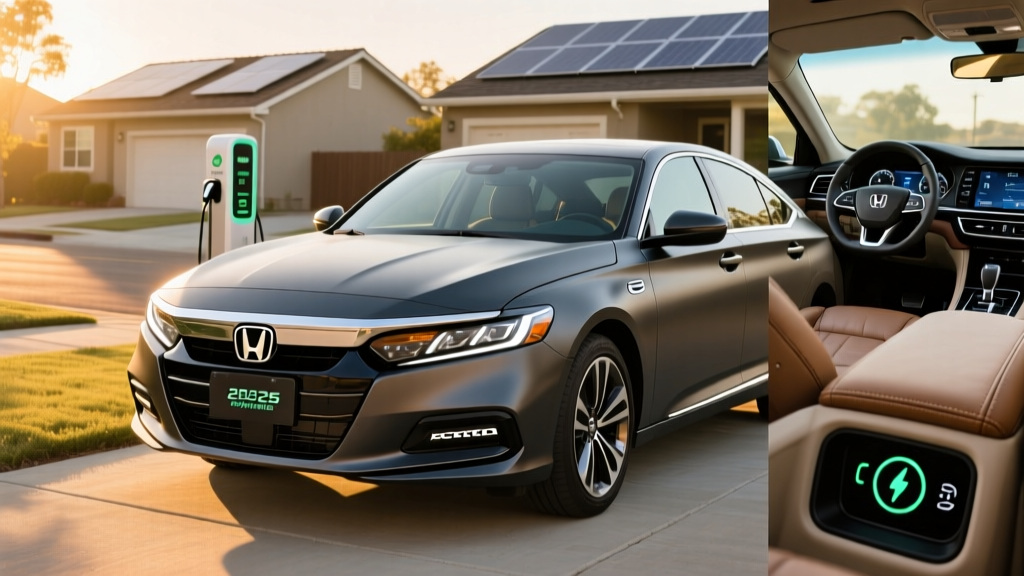
The Honda Accord Hybrid Touring sits at the top of one of the best-selling hybrid sedan lineups in America. For 2026, it carries forward the two-motor hybrid system that made the 11th-generation Accord Hybrid a benchmark for midsize sedan efficiency — but buyers shopping the Touring trim specifically need to know exactly what they're getting for the premium price, how real-world fuel economy stacks up against the EPA sticker, and whether this conventional hybrid (HEV) is the right electrified choice versus a plug-in hybrid or full battery-electric vehicle.
This guide breaks down every number that matters: EPA and real-world MPG, powertrain output, battery warranty and replacement cost, federal tax credit eligibility, and a clear decision framework for who should buy the Accord Hybrid Touring — and who should look elsewhere.
HEV vs PHEV: What the Accord Hybrid Actually Is
Before examining specs, it's essential to clarify a common point of confusion. The Honda Accord Hybrid is a conventional hybrid electric vehicle (HEV), not a plug-in hybrid (PHEV). This distinction affects how you fuel it, what tax credits apply, and what kind of driving it optimizes for.
| Feature | Conventional Hybrid (HEV) | Plug-In Hybrid (PHEV) |
|---|---|---|
| Plugs in to charge? | No — charges via regenerative braking and engine | Yes — has a charge port and larger battery |
| Electric-only driving | Very short distances at low speed (~1 mile) | Typically 20–50 miles on battery alone |
| Battery size | ~1.0–1.5 kWh (small buffer) | ~10–25 kWh usable |
| Federal tax credit (§30D) | Not eligible | Up to $7,500 if sourcing/income/MSRP rules met |
| Best for | Drivers who can't charge at home; want MPG gains with zero behavior change | Drivers with home/work charging who want electric commuting + gas road trips |
| Example | Honda Accord Hybrid, Toyota Camry Hybrid | Toyota RAV4 Prime, Chrysler Pacifica Hybrid |
The Accord Hybrid has no charge port. You fuel it exclusively with gasoline. Its hybrid system recovers energy during braking and deceleration to charge a small lithium-ion battery, which then assists the gasoline engine during acceleration and enables brief electric-only propulsion at very low speeds. You will never need to find a charger or alter your refueling habits.
Powertrain Specs: Two-Motor Hybrid System
The 2026 Accord Hybrid Touring uses Honda's fourth-generation two-motor hybrid system, which pairs a 2.0-liter Atkinson-cycle four-cylinder engine with two electric motors integrated into the e-CVT transaxle. Unlike a traditional CVT with belts or pulleys, this e-CVT uses the generator motor and drive motor to create a continuously variable ratio electrically — resulting in smooth, responsive acceleration without the rubber-band feel of older CVT designs.
| Specification | 2026 Accord Hybrid Touring |
|---|---|
| Engine | 2.0L Atkinson-cycle inline-4 |
| Engine power | 146 HP @ 6,100 rpm |
| Drive motor power | 181 HP / 247 lb-ft torque |
| Combined system output | 204 HP / 247 lb-ft torque |
| Transmission | e-CVT (two-motor hybrid system) |
| Drivetrain | Front-wheel drive |
| 0–60 mph (est.) | ~7.2 seconds |
| Hybrid battery | Lithium-ion, ~1.06 kWh (gross) |
| Charge port | None (self-charging HEV) |
| Fuel tank | 12.8 gallons |
| Curb weight | ~3,564 lbs |
The 204 combined horsepower figure represents the system's peak output, which occurs when both the engine and drive motor contribute simultaneously. In practice, the 247 lb-ft of torque from the drive motor is available from near zero RPM, giving the Accord Hybrid Touring strong initial acceleration that feels more responsive than the horsepower number alone suggests. In EV mode, the car can operate on electric power alone at speeds up to approximately 40 mph for very short distances — typically under a mile — before the engine engages.
Fuel Economy: EPA Ratings and Real-World MPG
Fuel economy is the Accord Hybrid Touring's headline feature. The EPA rates it identically across all Hybrid trims (Sport, Sport-L, EX-L, and Touring), since they share the same powertrain:
| Driving Cycle | EPA Rating | Real-World Expectation |
|---|---|---|
| City | 51 MPG | 50–55 MPG (hybrids often exceed EPA in city driving) |
| Highway | 44 MPG | 38–43 MPG (sustained 70–80 mph cruising reduces advantage) |
| Combined | 48 MPG | 44–50 MPG depending on driving mix |
Why real-world city MPG often beats the EPA sticker: Conventional hybrids like the Accord Hybrid shine in stop-and-go traffic. Every time you brake, the drive motor acts as a generator, recovering kinetic energy that would otherwise be wasted as heat and storing it in the battery. That stored energy then powers electric-only acceleration from stops, reducing the engine's workload. The more you stop, the more energy you recover. On fueleconomy.gov, several Accord Hybrid owners have reported lifetime averages above 50 MPG in predominantly urban driving.
Why highway MPG falls short: At sustained highway speeds, there's minimal braking to recover energy, and the gasoline engine does most of the work directly. Aerodynamic drag increases with the square of speed, so driving at 80 mph versus 65 mph noticeably reduces efficiency. Expect highway-only road trips to yield closer to 38–43 MPG, particularly in cold weather or with a full load of passengers and cargo.
Total range: With a 12.8-gallon fuel tank and 48 MPG combined, the theoretical maximum range is approximately 614 miles. In mixed real-world driving, expect 520–580 miles between fill-ups. That's a significant advantage over most BEVs and PHEVs for long road trips, with no charging stops required.
Real-World MPG Summary: EPA combined 48 MPG. Expect 50–55 MPG in city-heavy commuting, 38–43 MPG on sustained highway trips, and 44–50 MPG in mixed driving. Cold weather (below 32°F) can reduce MPG by 5–10% due to increased engine warm-up time and cabin heating load.
Touring Trim: What You Get for the Price
The Touring is the top-tier Accord Hybrid trim, and in 2026 it carries an MSRP of approximately $40,245 (including destination charge). That premium over the Sport Hybrid ($39,795) and EX-L Hybrid ($38,490) buys a substantial equipment upgrade:
- 12-speaker Bose premium audio system
- Wireless Apple CarPlay and Android Auto with 12.3-inch touchscreen
- Google built-in (Google Assistant, Google Maps, Play Store apps)
- Head-up display (HUD)
- Heated and ventilated front seats; heated rear outboard seats
- Wireless phone charging pad
- Low-speed braking control and front/rear parking sensors
- 19-inch alloy wheels with 235/40R19 tires
- Leather-trimmed interior
- Honda Sensing suite (adaptive cruise control, lane keeping assist, collision mitigation, traffic sign recognition, traffic jam assist)
The Touring is positioned as a near-luxury hybrid sedan at a mainstream price. For comparison, a similarly equipped Toyota Camry XSE Hybrid AWD starts around $38,000 but doesn't offer the same level of standard technology. A Hyundai Sonata Hybrid Limited comes in around $39,000 but delivers slightly lower combined MPG.
Federal and State Tax Credits: What Applies to the Accord Hybrid
This is where many buyers get confused, so let's be precise:
Federal §30D Clean Vehicle Credit: The Accord Hybrid does NOT qualify. The IRS §30D tax credit applies only to plug-in electric vehicles — battery-electric vehicles (BEVs) and plug-in hybrids (PHEVs) with a battery capacity of at least 7 kWh. Because the Accord Hybrid is a conventional HEV with a ~1 kWh battery and no charge port, it is ineligible for the federal EV tax credit of up to $7,500.
There is no current federal tax credit specifically for conventional hybrids. The previous hybrid credit expired in 2010.
State and local incentives: Some states offer rebates or HOV lane access for hybrids, but these vary widely and change frequently. California's Clean Fuel Rebate, for example, has historically excluded conventional hybrids in favor of PHEVs and BEVs. Check your state's energy or environmental agency website for current programs.
Used hybrid credit (§25E): If you purchase a qualifying used Accord Hybrid from a dealer for $25,000 or less, you may be eligible for the §25E previously owned clean vehicle credit — up to $4,000 or 30% of the sale price (whichever is less). However, this credit also requires the vehicle to be a plug-in EV or fuel cell vehicle, so a used Accord Hybrid would likely not qualify. Always verify with a tax professional before relying on incentive eligibility.
Battery Warranty, Lifespan, and Replacement Cost
Hybrid battery longevity is consistently one of the top concerns for HEV buyers. Here's what the data shows for the Accord Hybrid:
| Item | Details |
|---|---|
| Hybrid battery warranty | 8 years / 100,000 miles (10 years / 150,000 miles in CARB states: CA, CT, ME, MA, NJ, NY, OR, RI, VT, WA, and others adopting California emissions standards) |
| Warranty capacity threshold | Honda covers the battery if capacity drops below a specified level (typically ~60–70% of original capacity, though Honda does not publish an exact percentage — check your warranty booklet) |
| Powertrain warranty | 5 years / 60,000 miles |
| Real-world battery lifespan | Honda's lithium-ion hybrid batteries have demonstrated strong longevity; many Accord and Civic Hybrids from 2005+ are still running on original batteries past 150,000 miles |
| Battery replacement cost (out of warranty) | Approximately $2,000–$4,000 for the hybrid battery pack, plus $300–$600 labor. Significantly less expensive than a BEV battery replacement. |
Why hybrid batteries tend to last: The Accord Hybrid's ~1 kWh battery is small, but Honda's battery management system (BMS) is conservative. It never allows the battery to fully charge or fully deplete — operating in a narrow state-of-charge window (roughly 40–80%) that dramatically reduces stress on the lithium-ion cells. This shallow-cycling strategy is the same principle used in BEV battery longevity best practices, but applied automatically by the vehicle. The result is that hybrid batteries often outlast their warranty periods by a wide margin.
For context, a full BEV battery replacement can cost $8,000–$20,000+ depending on the vehicle. The Accord Hybrid's small battery means replacement is a fraction of that cost — and it's far less likely to be needed within typical ownership periods.
Reliability and Safety Ratings
The 11th-generation Accord (2023–present) has earned strong reliability and safety marks:
- IIHS: The Accord has been an IIHS Top Safety Pick+ recipient, earning Good ratings across all crashworthiness tests and acceptable or good ratings for headlight performance and crash avoidance.
- NHTSA: The Accord has received a 5-star overall safety rating from NHTSA.
- Honda Sensing: Standard on all trims including the Touring, this Level 0–1 ADAS suite includes collision mitigation braking, road departure mitigation, adaptive cruise control with low-speed follow, lane keeping assist, and traffic jam assist. The driver must remain fully engaged at all times — this is not an autonomous or hands-free system.
Consumer Reports and J.D. Power have generally rated the Accord Hybrid's reliability as above average for the midsize sedan segment. The hybrid system adds complexity versus a gas-only powertrain, but Honda's two-motor design has fewer wear components than traditional transmissions (no torque converter, no clutch packs, no conventional gearsets in the e-CVT).
Who Should Buy the Accord Hybrid Touring — and Who Shouldn't
Choose the Accord Hybrid Touring if:
- You want 48+ MPG combined without plugging in or changing any habits
- You drive 15,000+ miles per year and want to minimize fuel costs
- You take frequent long road trips and don't want to plan around charging stations
- You don't have access to home or workplace charging (apartment, street parking)
- You want a near-luxury sedan experience at a mainstream price point
- You prioritize proven reliability and low battery replacement risk
Consider a PHEV instead if:
- You have home charging and a commute under 30 miles — a PHEV like the Toyota Prius Prime (44 miles electric-only) lets you commute on electricity and still take gas-powered road trips
- You want to qualify for the federal §30D tax credit (up to $7,500 for eligible PHEVs)
- You want to reduce gasoline consumption to near zero on most daily driving
Consider a full BEV instead if:
- You have reliable home Level 2 charging
- Your daily driving is under 250 miles and you're comfortable with DC fast charging for road trips
- You want zero tailpipe emissions and the lowest per-mile energy cost
- You want access to the full $7,500 federal tax credit (subject to MSRP, income, and sourcing rules)
Pros and Cons at a Glance
Pros
- 48 MPG combined EPA; real-world city MPG often exceeds 50
- No charging required — zero behavior change from a gas car
- 614-mile theoretical range; 520+ miles real-world between fill-ups
- 204 HP with strong low-end torque from electric drive motor
- Touring trim loaded with premium features (Bose audio, HUD, ventilated seats, Google built-in)
- IIHS Top Safety Pick+ and 5-star NHTSA ratings
- Conservative battery management yields strong long-term reliability
- Low battery replacement cost (~$2,000–$4,000) vs. BEVs
Cons
- No federal tax credit eligibility (HEV, not PHEV/BEV)
- Highway MPG drops to ~38–43 at sustained 70–80 mph speeds
- Touring trim at ~$40,245 is a premium for a midsize sedan
- FWD only — no AWD option (unlike Toyota Camry Hybrid AWD)
- 19-inch wheels on Touring can produce a firmer ride than lower trims
- Electric-only mode limited to ~1 mile at low speeds
- No DC fast charging capability (not applicable to HEVs, but a limitation vs. PHEVs/BEVs)
Frequently Asked Questions
How many MPG does the 2026 Honda Accord Hybrid Touring get?
The EPA rates the Accord Hybrid at 51 MPG city, 44 MPG highway, and 48 MPG combined. In real-world city-heavy driving, many owners report 50–55 MPG. Highway-only driving at sustained speeds typically yields 38–43 MPG. Cold weather can reduce these figures by 5–10%.
Does the Accord Hybrid need to be plugged in?
No. The Accord Hybrid is a conventional hybrid (HEV), not a plug-in hybrid (PHEV). It has no charge port. The hybrid battery is charged entirely through regenerative braking and the gasoline engine. You fuel it exactly like a conventional gas car.
How far can the Accord Hybrid drive on electric power alone?
Approximately 1 mile at speeds under 40 mph in ideal conditions. This is a conventional hybrid — the electric motor's role is to assist the engine and improve fuel economy, not to serve as a primary propulsion source. If you want meaningful electric-only range (20–50 miles), you need a PHEV.
Does the Accord Hybrid qualify for any tax credit?
The Accord Hybrid does not qualify for the federal §30D Clean Vehicle Credit, which is limited to plug-in electric vehicles (BEVs and PHEVs). There is no current federal tax credit for conventional hybrids. State incentives vary — check your state's energy agency for current programs.
How long does the Accord Hybrid battery last, and what does replacement cost?
Honda warranties the hybrid battery for 8 years / 100,000 miles (10 years / 150,000 miles in CARB states). Real-world data suggests these batteries frequently last 150,000+ miles. Out-of-warranty replacement costs approximately $2,000–$4,000 for the battery pack plus $300–$600 in labor — far less than a BEV battery replacement.
Is the Accord Hybrid reliable?
The 11th-generation Accord Hybrid has earned above-average reliability ratings from Consumer Reports and strong safety scores from IIHS (Top Safety Pick+) and NHTSA (5-star overall). Honda's two-motor hybrid system has been in production since 2014 and has a proven track record. The e-CVT design has fewer wear components than a conventional automatic transmission.
How does the Accord Hybrid compare to the Toyota Camry Hybrid?
The Camry Hybrid (51 combined MPG, available AWD) is the closest competitor. The Accord Hybrid Touring offers a more premium interior, larger trunk (16.7 cu ft vs. 15.1), and more standard technology on the top trim. The Camry Hybrid offers AWD and a slightly lower starting price. Both achieve nearly identical EPA fuel economy ratings. The choice comes down to AWD preference (Camry) versus interior refinement and tech (Accord Touring).
Hybrid vs PHEV vs EV — which is right for me?
HEV (Accord Hybrid): Best if you can't charge at home, drive long distances frequently, or want maximum simplicity with no behavior change. 48 MPG, no plug, ~$40K.
PHEV (e.g., Prius Prime): Best if you have home charging and a short commute. Drive 30–44 miles on electricity daily, use gas for road trips. May qualify for $7,500 federal credit.
BEV (e.g., Tesla Model 3, Hyundai Ioniq 6): Best if you have reliable home charging, drive under 250 miles daily, and want the lowest per-mile cost and zero tailpipe emissions. Qualifies for up to $7,500 federal credit (eligibility varies).