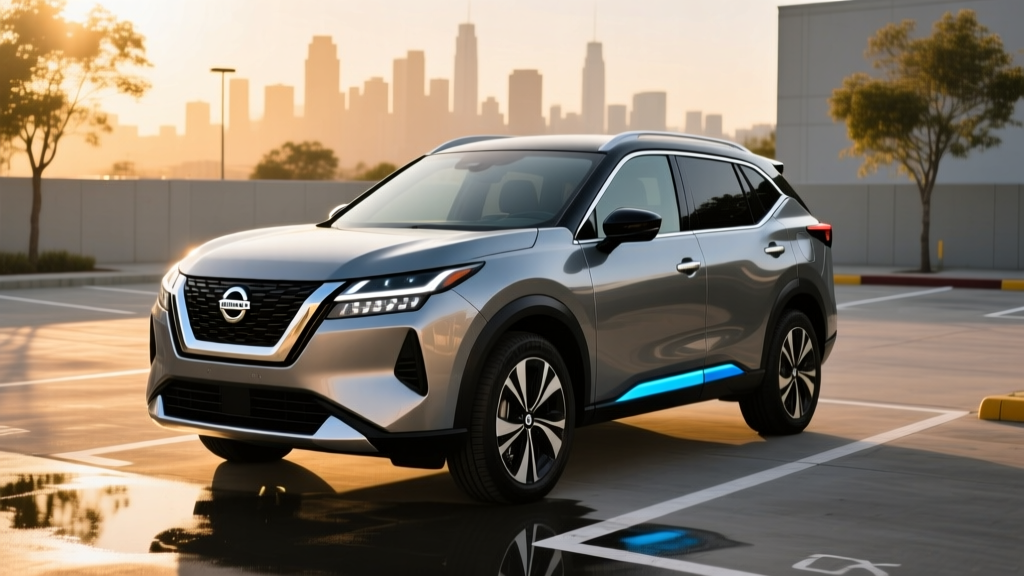
Nissan's Rogue is one of the best-selling compact SUVs in the United States, but unlike the Toyota RAV4 Hybrid and Honda CR-V Hybrid, it has never offered a hybrid variant in North America. That changes with the 2027 Nissan Rogue Hybrid, which Nissan confirmed will use its proprietary e-Power series-hybrid system — a setup already proven in the X-Trail e-Power sold in Japan and Europe. This guide covers everything confirmed and projected about the 2027 Rogue Hybrid, including expected EPA MPG, drivetrain architecture, pricing, and whether it qualifies for federal tax incentives.
HEV vs. PHEV: What Type of Hybrid Is the 2027 Rogue?
The 2027 Rogue Hybrid will be a conventional series hybrid (HEV), not a plug-in hybrid (PHEV). This is a critical distinction that affects how you fuel it, what you pay, and whether you qualify for federal tax credits.
Conventional Hybrid (HEV)
- No plug — refuels at any gas station
- Small battery (1-2 kWh) recharged by engine + regen braking
- Electric motor assists engine for better MPG
- No electric-only range to speak of
- Lower purchase price, simpler ownership
- Does NOT qualify for §30D federal tax credit
The 2027 Rogue Hybrid falls here.
Plug-In Hybrid (PHEV)
- Plugs in to charge (Level 1 or Level 2)
- Larger battery (12-25 kWh) for 20-45 miles electric-only
- Gas engine kicks in when battery depletes
- May qualify for up to $7,500 §30D credit (with sourcing/income rules)
- Higher purchase price, requires charging access
- Best for drivers with home charging and short commutes
Nissan's e-Power system is unique among conventional hybrids. Unlike Toyota's Hybrid Synergy Drive, which blends engine and motor power through a planetary gearset, e-Power is a series hybrid: the gasoline engine never drives the wheels directly. Instead, the engine acts solely as a generator, producing electricity that powers the electric motor(s) connected to the drivetrain. The result is an EV-like driving feel — linear torque delivery, quiet operation at low speeds — without any need to plug in.
e-Power Drivetrain: Engine, Motors, and Horsepower
Based on the X-Trail e-Power already in production and Nissan's second-generation e-Power architecture, here is what we expect for the 2027 Rogue Hybrid:
| Specification | Expected (Based on X-Trail e-Power) |
|---|---|
| Powertrain Type | Series hybrid (e-Power, 2nd gen) |
| Gasoline Engine | 1.5L turbocharged 3-cylinder (variable compression, generator only) |
| Engine Output | ~156 hp (used for electricity generation) |
| Front Electric Motor | ~201 hp / 330 Nm (243 lb-ft) |
| Rear Electric Motor (AWD) | ~133 hp / 195 Nm (144 lb-ft) |
| Combined System Output | ~210-334 hp (FWD/AWD, net output varies by config) |
| Battery | ~1.8-2.1 kWh lithium-ion (buffer capacity, not plug-charged) |
| Drivetrain | FWD standard; e-4ORCE dual-motor AWD available |
| Transmission | None (single-speed reduction gear, no CVT) |
Nissan's e-Power technology page details how the variable-compression 1.5L turbo engine operates at its most efficient RPM range because it's mechanically disconnected from the wheels. This is fundamentally different from the CVT-equipped gas Rogue and contributes to both fuel efficiency and the smooth, gearless acceleration feel.
The e-4ORCE AWD system uses the rear motor for torque vectoring and stability control, not just traction. In real-world driving, this means the AWD Rogue Hybrid should feel planted in rain and light snow without the fuel-economy penalty of a traditional mechanical AWD system.
Fuel Economy: Expected EPA MPG and Real-World Numbers
The headline question for any hybrid buyer: how many MPG does it actually get?
| Configuration | City (est.) | Highway (est.) | Combined (est.) |
|---|---|---|---|
| Rogue Hybrid FWD | 38-41 MPG | 35-37 MPG | 37-39 MPG |
| Rogue Hybrid AWD (e-4ORCE) | 36-38 MPG | 33-35 MPG | 35-37 MPG |
| 2026 Rogue Gas AWD (baseline) | 28 MPG | 35 MPG | 31 MPG |
| 2026 RAV4 Hybrid AWD | 41 MPG | 38 MPG | 39 MPG |
Note: These are projected EPA figures based on the X-Trail e-Power's WLTP consumption (~5.8-6.4 L/100km) converted and adjusted for EPA test cycles. Official EPA numbers will be published on fueleconomy.gov once Nissan submits certification data.
For context, the current gas-only Rogue AWD returns 31 MPG combined. The hybrid variant should improve on that by roughly 15-25%, with the biggest gains in city driving. Against the RAV4 Hybrid (39 MPG combined) and CR-V Hybrid (40 MPG combined), the Rogue Hybrid will be competitive but likely a tick behind Toyota's parallel-hybrid efficiency in mixed driving.
Pricing, Trims, and Tax Credit Eligibility
Nissan has not published official MSRP for the 2027 Rogue Hybrid, but based on the price premium of the X-Trail e-Power over the standard X-Trail in global markets, and the competitive positioning against the RAV4 Hybrid and CR-V Hybrid, here is our projected pricing:
| Trim (Projected) | Est. MSRP | Key Features |
|---|---|---|
| S Hybrid (FWD) | ~$33,000-$34,500 | Base hybrid, 8" display, Safety Shield 360 |
| SV Hybrid (AWD) | ~$36,000-$37,500 | e-4ORCE AWD, heated seats, power liftgate |
| SL Hybrid (AWD) | ~$39,500-$41,000 | Leather, panoramic roof, ProPILOT Assist 1.1 |
| Platinum Hybrid (AWD) | ~$43,000-$45,000 | Quilted leather, Bose audio, ProPILOT 2.0 |
Does the 2027 Rogue Hybrid Qualify for a Federal Tax Credit?
No. Because the 2027 Rogue Hybrid is a conventional hybrid (HEV) — not a plug-in hybrid (PHEV) or battery electric vehicle (BEV) — it does not qualify for the IRS §30D Clean Vehicle Credit. That credit, worth up to $7,500, is reserved for vehicles with a battery capacity of at least 7 kWh that can be charged from an external source. The Rogue Hybrid's ~2 kWh buffer battery, charged exclusively by the onboard engine-generator and regenerative braking, does not meet this threshold.
Reliability, Battery Warranty, and Long-Term Costs
Hybrid reliability is a top concern for buyers, and the battery is the component that generates the most anxiety. Here is what we know and what to expect:
Expected Hybrid Battery Warranty
Coverage: 8 years / 100,000 miles (10 years / 150,000 miles in CARB states including CA, NY, MA, and others that follow California emissions standards)
Capacity Threshold: Warranty typically covers the hybrid battery if it falls below 60-70% of original capacity, though Nissan's specific threshold will be confirmed at launch.
Replacement Cost (estimated): $2,500-$4,000 for the small ~2 kWh hybrid battery pack — significantly less than a PHEV or BEV battery replacement because the pack is small and simple.
Nissan's e-Power system has an inherent reliability advantage: the gasoline engine operates within a narrow, optimized RPM band as a generator, meaning less thermal stress and mechanical wear than a conventional engine that must respond to variable throttle demands. The 1.5L VC-Turbo engine has been in production since 2019 in other Nissan models, providing a multi-year track record.
The hybrid battery itself is small (~2 kWh) and operates within a tight state-of-charge window managed by the powertrain computer — typically between 40% and 80% SoC. This shallow cycling dramatically reduces degradation compared to a BEV battery that regularly charges to 100%. Toyota's hybrid batteries routinely last 150,000-200,000+ miles with similar management strategies, and Nissan's e-Power should follow a comparable longevity curve.
For comparison, the standard gas Rogue carries a 5-year/60,000-mile powertrain warranty. Nissan's hybrid components should carry the industry-standard 8-year/100,000-mile hybrid system warranty, consistent with Toyota and Honda.
2027 Rogue Hybrid vs. the Competition
The compact hybrid SUV segment is crowded. Here is how the Rogue Hybrid stacks up against its key rivals:
| Spec | 2027 Rogue Hybrid AWD (est.) | 2026 RAV4 Hybrid AWD | 2026 CR-V Hybrid AWD |
|---|---|---|---|
| Hybrid Type | Series (e-Power) | Parallel (Toyota Hybrid) | Parallel (Honda 2-motor) |
| Combined MPG | 35-37 | 39 | 40 |
| Combined HP | ~334 (AWD) | 219 | 204 |
| 0-60 MPH (est.) | ~6.5-7.0 sec | ~7.4 sec | ~7.6 sec |
| Starting MSRP (AWD) | ~$36,000 | ~$33,500 | ~$35,500 |
| Federal Tax Credit | No | No | No |
| Cargo Volume | ~36 cu ft (est.) | 37.6 cu ft | 36.3 cu ft |
| Hybrid Battery Warranty | 8 yr/100k mi (est.) | 10 yr/150k mi | 8 yr/100k mi |
The Rogue Hybrid's main advantage is performance. With dual electric motors producing a combined ~334 hp in AWD trim, it will be the quickest compact hybrid SUV in the segment by a wide margin. The trade-off is slightly lower MPG than the RAV4 and CR-V, which prioritize efficiency over power.
✅ Pros
- EV-like smooth acceleration with no gear shifts
- Best-in-class horsepower (~334 hp AWD)
- No plug needed — familiar gas-station ownership
- 35-39 MPG combined (est.) — a major gain over gas Rogue
- e-4ORCE AWD with torque vectoring
- Small hybrid battery = lower replacement cost
❌ Cons
- MPG likely 2-4 MPG behind RAV4/CR-V hybrids
- No federal tax credit eligibility
- Unproven in the U.S. market (new here, not globally)
- Higher starting price than gas Rogue (~$4,000-$5,000 premium)
- Engine drone possible under hard acceleration (series hybrid trait)
- Cargo space may be slightly reduced by battery packaging
Who Should Buy the 2027 Rogue Hybrid?
Decision Framework
Choose the 2027 Rogue Hybrid if:
- You want 35+ MPG without changing your fueling routine (no plug, no charging apps)
- You prioritize acceleration and driving feel — the e-Power system delivers instant electric torque
- You drive a mix of city and highway and want real gains in stop-and-go commuting
- You want AWD capability without the fuel penalty of a traditional AWD system
- You're not ready for a full EV but want to meaningfully reduce fuel costs
Choose a PHEV (like the RAV4 Prime or Tucson PHEV) instead if:
- You have reliable home Level 2 charging and a commute under 35 miles
- You want to drive mostly on electricity and qualify for the §30D tax credit
- You want 35-42 miles of electric-only range before the engine starts
Choose a full EV (like the Ioniq 5 or EV6) instead if:
- You have home charging and want zero tailpipe emissions and the lowest per-mile fuel cost
- You qualify for the $7,500 federal credit and your state offers additional EV incentives
- You drive under 250 miles daily and can access DC fast charging for road trips
Stick with the gas Rogue if:
- Your annual mileage is under 8,000 miles and the hybrid premium won't pay back in fuel savings within your ownership period
- You want the lowest possible purchase price
Frequently Asked Questions
How many MPG does the 2027 Nissan Rogue Hybrid get?
Based on Nissan's e-Power system data from the X-Trail e-Power, the Rogue Hybrid is projected to achieve 38-41 MPG city, 35-37 MPG highway, and 35-39 MPG combined depending on FWD vs. AWD configuration. Final EPA certification numbers will be published before launch. In real-world city driving with frequent stops, series hybrids often exceed their EPA city rating thanks to aggressive regenerative braking.
How far can the 2027 Rogue Hybrid go on electric only?
It can't — at least not in any meaningful way. As a conventional series hybrid (HEV), the Rogue Hybrid has no plug and no usable electric-only range. The ~2 kWh battery serves as a buffer to store energy from the engine-generator and regenerative braking, enabling the electric motor to drive the wheels for brief low-speed moments (parking lots, stop-and-go creep), but the engine will start whenever the buffer depletes. If electric-only range is a priority, you need a PHEV with a larger battery and a charging port.
Is the 2027 Rogue Hybrid reliable? What will battery replacement cost?
Nissan's e-Power system has been on sale in Japan since 2016 (first generation) and globally since 2022 (second generation), providing a multi-year track record. The hybrid battery is small (~2 kWh) and managed within a narrow charge window, which minimizes degradation. We expect Nissan to offer an 8-year/100,000-mile hybrid battery warranty (10 years/150,000 miles in CARB states). Replacement cost for a ~2 kWh hybrid battery is estimated at $2,500-$4,000 — a fraction of the $10,000-$20,000+ cost of replacing a BEV or PHEV battery. The gasoline engine, operating only as a generator at optimized RPM, should experience less wear than a conventional engine.
Does the 2027 Nissan Rogue Hybrid qualify for any tax credit?
No. The federal §30D Clean Vehicle Credit requires a battery capacity of at least 7 kWh and the ability to charge from an external power source (i.e., a plug). The Rogue Hybrid's ~2 kWh battery charges only from the onboard engine-generator and regenerative braking. It does not qualify for the $7,500 federal credit. Some states may offer separate incentives for conventional hybrids — check your state energy office or consult a tax professional. The IRS Clean Vehicle Credits page lists full eligibility requirements.
How is e-Power different from Toyota's hybrid system?
Toyota's Hybrid Synergy Drive is a parallel hybrid: both the engine and electric motor can drive the wheels, blended through a planetary gearset (eCVT). Nissan's e-Power is a series hybrid: only the electric motor drives the wheels, and the engine acts purely as a generator. The result is a smoother, more EV-like driving experience with no gear shifts or engine RPM tied to vehicle speed. The trade-off is slightly lower highway efficiency, since energy is converted twice (chemical → mechanical → electrical → mechanical) rather than taking a direct mechanical path at cruising speed.
When will the 2027 Nissan Rogue Hybrid be available?
Nissan has confirmed the Rogue Hybrid for the U.S. market as part of its 2027 model-year lineup. Based on typical automotive launch timelines, expect a reveal in late 2026 with dealership arrivals in early-to-mid 2027. We will update this article with confirmed specs, pricing, and EPA data as they become available.