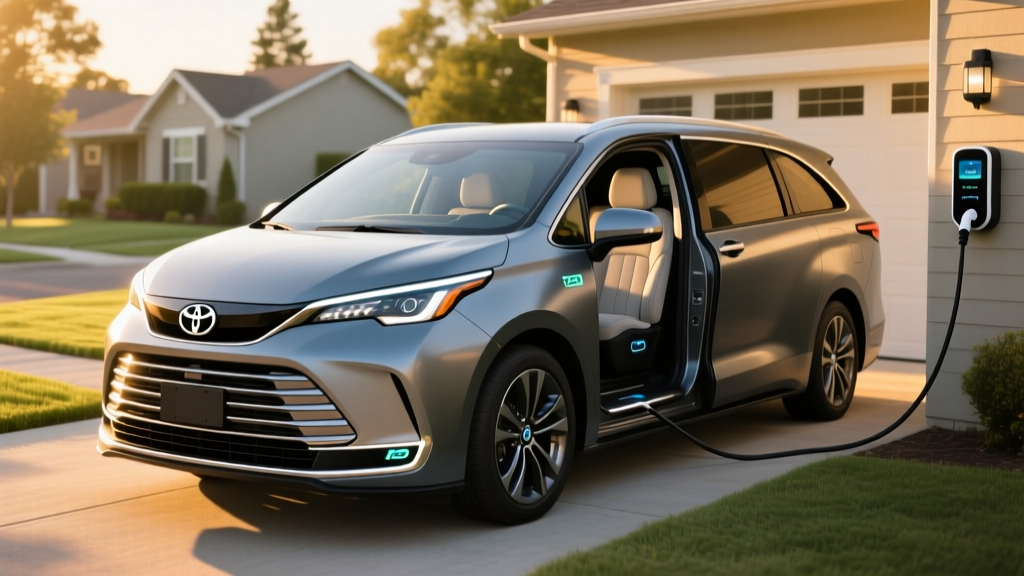
If you've searched for a 2026 Toyota Sienna hybrid for sale, you've likely noticed something unusual: every single Sienna Toyota builds is a hybrid. There's no gas-only version and, as of the 2026 model year, no plug-in hybrid (PHEV) variant either. The Sienna is a conventional hybrid electric vehicle (HEV) — meaning it charges its own battery through regenerative braking and the gasoline engine, never requiring you to plug it in.
That distinction matters more than most buyers realize. It shapes the Sienna's real-world fuel economy, its eligibility for federal tax credits, and whether it's the right electrified minivan for your household. Below, we break down the 2026 Sienna's powertrain, MPG, pricing, battery longevity, and how it compares to full EVs and PHEVs so you can buy with confidence.
HEV vs PHEV: What the 2026 Sienna Actually Is
Before looking at dealer lots, it's worth clarifying the two hybrid categories, because shoppers frequently conflate them:
Conventional Hybrid (HEV) — 2026 Sienna
- No plug required — the battery recharges via the engine and regen braking
- Small traction battery (~1.6 kWh usable)
- Cannot drive on electric-only power for meaningful distances
- No federal EV tax credit eligibility
- Behavior: starts in EV mode at low speeds, seamlessly blends gas and electric
Plug-In Hybrid (PHEV) — Not Available on Sienna
- Requires plug-in charging (Level 1 or Level 2)
- Larger battery (typically 12–20 kWh) for 25–45 miles of electric-only driving
- May qualify for up to $7,500 federal tax credit under IRS §30D (if MSRP/income/sourcing rules met)
- Operates as a short-range EV for daily commutes, then switches to hybrid mode
The 2026 Sienna is firmly in the HEV camp. If you need plug-in electric-only range for school runs or short commutes, you'll need to look at competitors like the Chrysler Pacifica PHEV — or consider a full battery-electric vehicle (BEV).
Fuel Economy: EPA MPG and Real-World Numbers
The 2026 Toyota Sienna's hybrid powertrain is carried over from the fourth-generation platform introduced in 2021, and its EPA ratings remain among the best in the minivan segment. According to fueleconomy.gov, the front-wheel-drive (FWD) Sienna achieves the following:
| Drivetrain | City MPG | Highway MPG | Combined MPG |
|---|---|---|---|
| FWD | 36 | 36 | 36 |
| AWD (Electronic On-Demand) | 35 | 36 | 35 |
Real-world MPG vs. EPA: Toyota's hybrid synergy drive excels in stop-and-go city driving, where regenerative braking recaptures energy that a gas-only minivan would waste as heat. Many Sienna owners report exceeding the 36 MPG city figure in suburban and urban conditions, sometimes hitting 38–40 MPG on flat terrain in mild weather. Highway driving at sustained 75+ MPH, however, tends to drop to 30–33 MPG because the aerodynamic drag of a minivan body overwhelms the hybrid system's efficiency advantage at high speed.
Cold weather also impacts fuel economy. In sub-freezing temperatures, expect a 5–10% reduction (roughly 32–34 MPG combined) as the engine runs more frequently to provide cabin heat and warm the catalytic converter. This is normal hybrid behavior, not a defect.
Powertrain Specs: What Moves the Sienna
| Specification | 2026 Toyota Sienna |
|---|---|
| Engine | 2.5L 4-cylinder Dynamic Force (A25A-FXS) |
| Engine Output | 189 hp / 176 lb-ft torque |
| Electric Motors | 2 (FWD) or 3 (AWD) permanent-magnet synchronous |
| Combined System Horsepower | 245 hp |
| Transmission | eCVT (electronically controlled continuously variable) |
| Hybrid Battery | ~1.6 kWh nickel-metal hydride (NiMH), sealed |
| Drivetrain Options | FWD or Electronic On-Demand AWD |
| Towing Capacity | 3,500 lbs (all trims) |
| 0–60 MPH | ~7.1 seconds (FWD, manufacturer estimate) |
| Fuel Tank | 14.5 gallons |
| Total Driving Range | ~522 miles (combined EPA) |
The Sienna's eCVT is not a traditional belt-and-pulley CVT like those found in some Nissan or Subaru models. Toyota uses a planetary gearset that splits power between the engine and electric motors with no belts, chains, or friction clutches to wear out. This design is a key reason the Sienna's hybrid drivetrain has earned a reputation for exceptional longevity.
The AWD system adds a separate rear electric motor (no mechanical driveshaft) that engages automatically when the front wheels slip. It's not designed for off-roading but provides confident traction in rain and light snow.
2026 Sienna Trim Pricing and Availability
As of the 2026 model year, Toyota offers the Sienna across a wide trim range. MSRP figures below include destination charges and reflect manufacturer-published pricing:
| Trim | Drivetrain | MSRP (approx.) |
|---|---|---|
| LE | FWD | $39,485 |
| LE | AWD | $40,285 |
| XLE | FWD | $43,995 |
| XSE | FWD | $46,495 |
| Limited | FWD | $49,745 |
| Platinum | AWD | $54,460 |
| Woodland Edition | AWD | $47,865 |
Dealer markups and availability: The Sienna has been one of Toyota's most allocation-constrained models since its 2021 redesign. Depending on your market, expect dealer markups of $2,000–$5,000 above MSRP on popular trims (XLE, Limited, Woodland), though this has moderated from the peak shortages of 2022–2023. Ordering through a dealer and waiting 2–4 months often yields MSRP pricing.
Does the 2026 Sienna Qualify for a Federal Tax Credit?
No. The 2026 Toyota Sienna is a conventional hybrid (HEV), not a plug-in hybrid or battery-electric vehicle. Under current IRS §30D rules, the federal Clean Vehicle Credit of up to $7,500 is available only for plug-in electric vehicles (BEVs and PHEVs) that meet battery capacity, critical-mineral sourcing, MSRP cap, and buyer income requirements.
The Sienna does not qualify for any federal tax credit. It also does not qualify for most state EV rebates, which similarly target plug-in vehicles. However, some states and utilities offer smaller incentives (typically $250–$500) for any high-efficiency vehicle — check your state energy office or utility provider for specifics.
§30D Federal Credit — Why the Sienna Doesn't Qualify:
- Requires plug-in capability (minimum 7 kWh battery capacity for vehicles with 4+ wheels) — Sienna has ~1.6 kWh, no plug
- MSRP cap: $80,000 for vans/SUVs, $55,000 for sedans — Sienna is within cap, but fails the plug-in requirement
- Buyer income cap: $300K joint / $225K head of household / $150K single
- Critical mineral and battery component sourcing requirements apply to qualifying PHEVs/BEVs
Battery Warranty, Reliability, and Replacement Cost
Hybrid battery longevity is the single most common concern among first-time hybrid buyers. Here's what the data shows for the Sienna:
2026 Sienna Hybrid Battery Warranty
- Hybrid Battery: 10 years / 150,000 miles (whichever comes first) — covers capacity loss below a defined threshold and defects
- Hybrid System Components: 8 years / 100,000 miles (inverter, transaxle, control modules)
- Basic Powertrain: 5 years / 60,000 miles
- Emissions Warranty: 8 years / 80,000 miles (federal); up to 15 years / 150,000 miles in CARB states (CA, NY, MA, and others)
Real-world reliability: Toyota's hybrid system — shared across the Camry, RAV4 Hybrid, Highlander Hybrid, and Sienna — has accumulated billions of real-world miles since the Prius launched in 1997. The Sienna's NiMH battery pack is intentionally oversized relative to its daily cycling needs, meaning it rarely charges above 80% or discharges below 40% state of charge. This shallow cycling dramatically extends cell life. Independent fleet data and owner surveys from sources like Consumer Reports consistently rank Toyota hybrids among the most reliable vehicles in any category.
Battery replacement cost: If the hybrid battery fails outside warranty, a new OEM replacement currently costs approximately $3,000–$4,500 installed at a Toyota dealer (parts + labor). Refurbished or aftermarket NiMH packs are available for $1,500–$2,500. However, failures before 200,000 miles are uncommon, and many first-generation Sienna hybrids (2021–2023) are still running on their original packs with minimal degradation.
Toyota's hybrid battery ECU also performs cell-level balancing, and a failing battery often shows warning signs (reduced MPG, dashboard hybrid-system warning) well before total failure, giving owners time to plan a repair rather than facing a sudden breakdown.
Who Should Buy the 2026 Sienna Hybrid vs. an EV or PHEV?
The Sienna occupies a specific niche in the electrified-vehicle landscape. Here's a practical decision framework:
Choose the 2026 Sienna Hybrid If:
- You need a 7–8 passenger minivan with class-leading fuel economy
- You lack access to home or workplace charging (apartment, street parking, no garage outlet)
- You take frequent road trips exceeding 300+ miles and don't want to plan around DC fast-charging stops
- You want electrified efficiency without changing your refueling habits at all
- You tow up to 3,500 lbs (small boat, camper trailer, utility trailer)
- You prioritize long-term reliability and low cost of ownership over cutting-edge EV tech
Choose a Plug-In Hybrid (e.g., Chrysler Pacifica PHEV) If:
- You can install a Level 2 home charger and want 32+ miles of electric-only driving for school runs and errands
- Your daily driving is under 35 miles round-trip, and you want to drive mostly on electricity
- You want partial federal tax credit eligibility (up to $7,500, subject to §30D rules)
Choose a Full EV (e.g., Kia EV9, Tesla Model X) If:
- You have reliable home Level 2 charging and want zero tailpipe emissions
- You want the lowest per-mile "fuel" cost (electricity at $0.12–0.18/kWh vs. gas at $3.20–$4.00/gallon)
- You qualify for the full $7,500 federal tax credit and can absorb higher upfront pricing
- You don't need more than 6–7 seats or 3,500-lb towing
Pros and Cons at a Glance
Pros
- 36 MPG combined — best-in-class for minivans by a wide margin
- No plug-in required; zero behavior change from a gas minivan
- Standard Toyota Safety Sense 3.0 (AEB, lane-keeping, adaptive cruise, road-sign assist)
- Available AWD via rear electric motor — no mechanical complexity
- Proven hybrid drivetrain with 10-year/150K-mile battery warranty
- 3,500-lb towing standard across all trims
- Spacious interior with available 8-passenger seating and large cargo area
Cons
- No plug-in hybrid option — cannot drive on electric-only power for meaningful distances
- No federal tax credit eligibility (HEV, not PHEV/BEV)
- 245 hp is adequate but not brisk when fully loaded with passengers and cargo
- Dealer markups persist in many markets; long wait times for specific trims
- Infotainment system (12.3-inch touchscreen on higher trims) lags behind competitors in responsiveness
- No DC fast charging (not applicable — HEV, but worth noting for shoppers comparing to PHEVs)
Frequently Asked Questions
How many MPG does the 2026 Toyota Sienna hybrid get?
The EPA rates the FWD Sienna at 36 city / 36 highway / 36 combined MPG. The AWD version drops slightly to 35/36/35. In real-world suburban driving, many owners report 37–40 MPG, while sustained highway driving at 75+ MPH typically yields 30–33 MPG.
Does the Sienna have an electric-only driving mode?
Yes, but only at very low speeds (under ~25 MPH) for short distances (a mile or less). The hybrid battery is too small (~1.6 kWh) to provide meaningful electric-only range. This is standard HEV behavior — the electric motor assists the gas engine rather than replacing it.
How far can the 2026 Sienna go on a full tank?
With its 14.5-gallon fuel tank and 36 MPG combined rating, the Sienna can travel approximately 522 miles between fill-ups. Real-world range varies from roughly 435 miles (all highway, loaded) to 580+ miles (city-heavy driving in mild weather).
Is the Sienna hybrid reliable? What does battery replacement cost?
Toyota's hybrid system is among the most reliable powertrains in the industry, with the NiMH battery covered for 10 years/150,000 miles. Out-of-warranty replacement costs approximately $3,000–$4,500 at a dealer, but premature failures before 200,000 miles are rare based on fleet and owner data.
Does the 2026 Sienna qualify for any tax credit?
No. The Sienna is a conventional hybrid (HEV), not a plug-in vehicle. The federal §30D Clean Vehicle Credit of up to $7,500 applies only to qualifying BEVs and PHEVs that meet battery sourcing, MSRP, and income requirements. Some state or utility programs may offer small incentives for high-efficiency vehicles — check your local programs.
Hybrid vs. PHEV vs. full EV — which minivan should I buy?
If you can't charge at home, the Sienna HEV is the clear winner — no plug needed, 36 MPG, and 500+ mile range. If you have home charging and want electric-only daily driving, consider the Chrysler Pacifica PHEV (32 miles electric, then 30 MPG hybrid). If you want the lowest running cost and qualify for the tax credit, look at the Kia EV9 (300-mile range, 3-row BEV) — but you'll need to plan road-trip charging.
Does the Sienna hybrid battery need maintenance?
No. The hybrid battery is sealed and requires no routine maintenance. Toyota's hybrid system manages charging, temperature, and cell balancing automatically. There is no hybrid-battery fluid to check or replace.
What is the difference between the Sienna's eCVT and a regular CVT?
Toyota's eCVT uses a planetary gearset to blend power from the engine and electric motors. Unlike a belt-driven CVT (found in some Subaru and Nissan models), there are no belts, pulleys, or friction clutches. This makes it more durable and responsive, and it's a key reason Toyota hybrids have strong long-term reliability records.
Sources: EPA fuel economy data via fueleconomy.gov; 2026 Toyota Sienna specifications from Toyota Motor North America; IRS Clean Vehicle Credit rules via irs.gov. Pricing and incentive rules are subject to change; verify current figures with your dealer and tax professional.