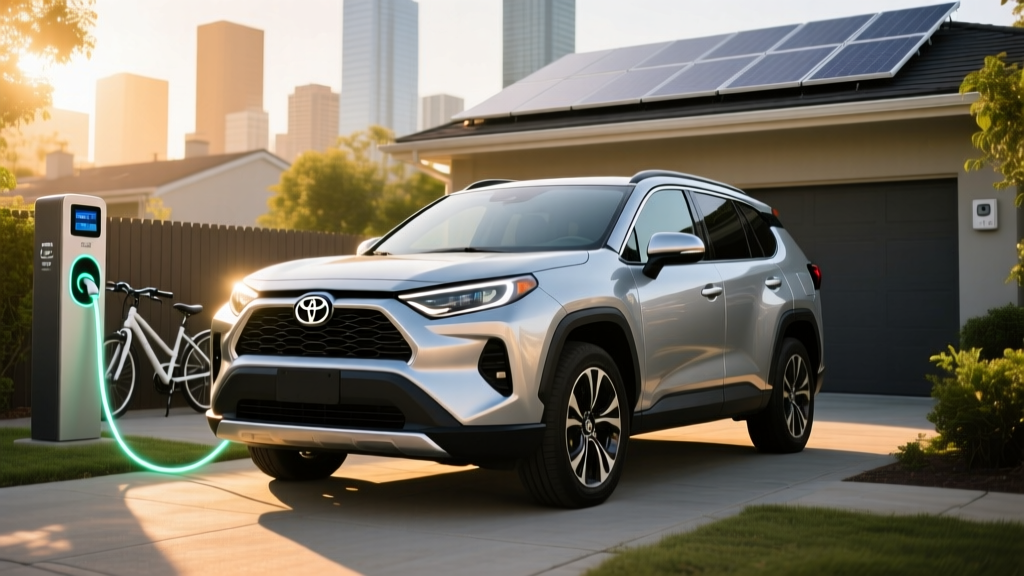
The 2026 Toyota RAV4 Prime plug-in hybrid remains one of the most compelling bridge vehicles for drivers who want meaningful electric-only commuting without committing fully to a battery-electric vehicle. With an EPA-estimated 42 miles of electric-only range, 302 combined horsepower, and the cargo practicality of a compact SUV, the RAV4 Prime occupies a narrow but high-demand lane: plug-in hybrids that actually deliver on their electric promise for daily driving.
But the RAV4 Prime also carries a premium over the standard RAV4 Hybrid, faces constrained dealer inventory in many regions, and does not qualify for the full federal EV tax credit under current IRS §30D rules. This guide breaks down every number that matters — from real-world MPG to battery warranty — so you can decide whether the Prime's plug-in premium pays off for your driving pattern.
HEV vs. PHEV: What Separates the RAV4 Prime from the RAV4 Hybrid
Toyota sells two electrified RAV4 variants, and confusing them is the most common buyer mistake. Here's the fundamental difference:
RAV4 Hybrid (HEV)
- No plug required — the 1.6 kWh battery charges via regenerative braking and the gas engine
- No electric-only highway driving — the electric motor assists the engine but cannot power the car alone at speed
- EPA combined: 39–41 MPG depending on trim
- Lower MSRP by roughly $7,000–$9,000 vs. the Prime
RAV4 Prime (PHEV)
- Plug-in capable — the 18.1 kWh battery charges from a wall outlet or Level 2 charger
- 42 miles electric-only — covers most commutes without burning a drop of gas
- EPA combined (charge-sustaining): 38 MPG after battery depletion; 94 MPGe when using electric range
- 302 hp combined — significantly more powerful than the HEV's 219 hp
The critical takeaway: the HEV is a fuel-efficiency play. The PHEV is an electric-first commuter that happens to have a gas backup. If your daily round-trip commute is under 40 miles and you can charge at home, the Prime effectively operates as an EV on weekdays and a hybrid on road-trip weekends.
Powertrain Specs: 302 Horsepower with AWD Standard
| Specification | Value |
|---|---|
| Engine | 2.5L inline-4 Atkinson cycle |
| Engine output | 176 hp / 163 lb-ft torque |
| Front electric motor | 134 kW (180 hp) |
| Rear electric motor | 40 kW (54 hp) |
| Combined system output | 302 hp |
| Drivetrain | Electronic AWD (eAWD) — standard all trims |
| Battery (usable) | 18.1 kWh lithium-ion (NMC chemistry) |
| EV-only range (EPA) | 42 miles |
| Total range (EV + gas) | ~600 miles |
| 0–60 mph | 5.7 seconds |
| Towing capacity | 1,500 lbs (SE); 1,750 lbs (XSE w/ tow prep) |
The RAV4 Prime's powertrain pairs Toyota's proven 2.5-liter Dynamic Force engine with two electric motors — one driving each axle. Unlike mechanical AWD systems, there is no driveshaft connecting front and rear; the rear motor engages electronically when slip is detected or under hard acceleration. The result is a 0–60 mph time of 5.7 seconds, making the Prime the quickest RAV4 Toyota sells and one of the faster compact PHEV crossovers available.
Fuel Economy and Electric Efficiency: EPA Numbers vs. Real World
| Mode | City | Highway | Combined |
|---|---|---|---|
| EV-only (MPGe) | 108 MPGe | 84 MPGe | 94 MPGe |
| Hybrid (charge-sustaining, MPG) | 40 MPG | 36 MPG | 38 MPG |
Understanding these two rows is essential. When the battery is charged, the Prime runs primarily on electricity and achieves the 94 MPGe combined figure. Once the 42-mile EV range is depleted, the vehicle operates as a conventional hybrid at 38 MPG combined — still excellent for a 302-hp AWD SUV, but slightly lower than the lighter RAV4 Hybrid's 41 MPG combined.
Real-World Range & MPG Expectations
EPA EV range: 42 miles. Real-world expectation: 35–40 miles in mixed driving; 30–34 miles at sustained 70+ mph highway speeds; as low as 25–28 miles in sub-freezing winter conditions when cabin heating draws from the battery.
Real-world hybrid MPG (battery depleted): Expect 36–40 MPG in city-heavy driving (hybrids often exceed EPA in stop-and-go thanks to regen braking), and 33–36 MPG on long highway trips.
The RAV4 Prime's efficiency in EV mode translates to roughly 28–30 kWh/100 miles — typical for a PHEV of this weight (~4,400 lbs curb weight).
Owners who charge nightly and commute under 35 miles round-trip report going months between fill-ups, effectively achieving 80–100+ MPGe over a tank. Those who rarely charge will see 38 MPG — good, but not meaningfully better than the standard hybrid, making the Prime's price premium harder to justify without plug-in utilization.
Charging the RAV4 Prime: Level 1, Level 2, and the No-DC-Fast-Charge Limitation
The RAV4 Prime uses a standard J1772 connector for AC charging. Here is the critical limitation every buyer must understand: the RAV4 Prime does not support DC fast charging. There is no CCS or CHAdeMO port. All charging is AC only.
| Charging Level | Power (kW) | Voltage | 0–Full Time | Miles of EV Range per Hour |
|---|---|---|---|---|
| Level 1 (included cord) | 1.4 kW | 120V household | ~12 hours | ~4 miles/hr |
| Level 2 (SE trim, 3.3 kW onboard) | 3.3 kW | 240V | ~5.5 hours | ~12 miles/hr |
| Level 2 (XSE trim, 6.6 kW onboard) | 6.6 kW | 240V | ~2.5 hours | ~25 miles/hr |
The onboard charger wattage varies by trim. The SE trim includes a 3.3 kW onboard charger, meaning even a 48-amp Level 2 home station will only deliver 3.3 kW to the battery. The XSE trim upgrades to a 6.6 kW onboard charger, cutting charge time roughly in half. For most owners charging overnight at home, either speed is sufficient — a full recharge happens while you sleep. But if you plan to opportunity-charge at public Level 2 stations during the day, the 6.6 kW charger on the XSE is a meaningful advantage.
The included Level 1 charging cord plugs into any standard 120V outlet. At ~4 miles of range per hour, a full overnight charge (10 hours) yields roughly 40 miles — enough for many commutes, though a dedicated 240V Level 2 circuit is strongly recommended for consistent daily full charges.
Pricing, Trims, and Tax Credit Eligibility
The 2026 RAV4 Prime is offered in two trims. Pricing reflects the MSRP before destination charges:
- SE: Starting at approximately $44,500 MSRP (+ ~$1,390 destination)
- XSE: Starting at approximately $48,000 MSRP (+ ~$1,390 destination)
Popular packages (Premium Package on XSE, Technology Package) can push the XSE above $52,000 out the door before incentives.
Federal Tax Credit Status (§30D)
The 2026 RAV4 Prime does not qualify for the full $7,500 federal EV tax credit under current IRS §30D rules. The reason: Toyota's battery cell sourcing and critical-minerals supply chain do not meet the thresholds mandated by the Inflation Reduction Act for vehicles assembled in North America with Japan-sourced battery components.
- ✔ MSRP under $80,000 SUV cap — passes
- ✔ North American final assembly (Georgetown, KY) — passes
- ✘ Battery component sourcing requirement — does not meet current-year threshold
- ✘ Critical minerals sourcing requirement — does not meet current-year threshold
Some buyers may still qualify for a partial credit or state-level incentives. Check IRS §30D guidance for the latest rules and consult a tax professional. Several states (California, Colorado, New York, Massachusetts) offer additional rebates for PHEVs that may apply regardless of federal eligibility.
The lack of a federal tax credit is the single biggest financial headwind for the Prime. A buyer paying ~$46,000 for an SE without a $7,500 credit faces a significantly longer payback period vs. the standard RAV4 Hybrid (starting ~$35,000). The math works if your commute is reliably under 40 miles, you charge at home on cheap electricity, and you keep the vehicle 5+ years.
Battery Warranty, Reliability, and Long-Term Costs
Toyota Hybrid Battery Warranty
Coverage: 10 years / 150,000 miles (whichever comes first) for the high-voltage traction battery.
Capacity retention threshold: Toyota warrants the battery against defects and abnormal capacity loss. The warranty covers repair or replacement if the battery falls below a functional threshold that impairs vehicle operation — though Toyota does not publish a specific percentage (unlike some EV makers that guarantee 70% retention).
Hybrid system warranty: All hybrid-specific components (inverter, electric motors, control modules) are covered under the same 10-year/150,000-mile term.
Toyota's hybrid reliability record is among the strongest in the industry. The RAV4 Prime's powertrain is a derivative of the system used in millions of Toyota hybrids globally, including the Prius and Camry Hybrid. The 18.1 kWh battery is modestly sized by EV standards, which reduces thermal stress and degradation risk.
Battery replacement cost: If the high-voltage battery requires replacement out of warranty, expect a cost in the range of $4,000–$6,000 for the battery pack plus labor, based on current Toyota hybrid battery pricing. However, real-world data from Toyota's hybrid fleet suggests that PHEV and HEV batteries routinely last well beyond the warranty period. The smaller battery in the RAV4 Prime is cycled more deeply than a conventional HEV battery, but Toyota's thermal management and conservative buffer strategy (the car never uses 100% of the 18.1 kWh) mitigate degradation.
For comparison, the standard 12V auxiliary battery (a separate, conventional battery that powers electronics) will need replacement every 4–6 years at typical cost of $200–$350 — standard for any modern vehicle.
RAV4 Prime vs. Full EV vs. Gas SUV: Which Fits Your Life?
Choose the RAV4 Prime (PHEV) if:
- Your daily commute is 20–40 miles round-trip and you can charge at home (garage or driveway with outlet access)
- You take 3+ road trips per year exceeding 200 miles and don't want to plan around DC fast chargers
- You want AWD and a compact SUV footprint without going full EV
- You value the 302-hp performance bump over the standard hybrid
Choose the RAV4 Hybrid (HEV) if:
- You cannot charge at home (apartment, street parking, no garage circuit)
- Your commute is short but unpredictable — you want efficiency without plugging in
- You want to minimize upfront cost (saves $7,000–$9,000 vs. Prime)
- You prioritize fuel economy over performance (41 MPG combined vs. 38 MPG)
Choose a Full EV (e.g., Tesla Model Y, Hyundai Ioniq 5) if:
- You have reliable home Level 2 charging and your daily driving is under 250 miles
- You want to eliminate gasoline entirely and reduce maintenance (no oil changes, fewer brake replacements)
- You qualify for the $7,500 federal tax credit on a qualifying BEV, narrowing the price gap
- You want the lowest cost-per-mile for daily driving (electricity at $0.13/kWh ≈ $0.04/mile vs. gas at $3.50/gal ≈ $0.14/mile for a 25 MPG SUV)
The RAV4 Prime's ideal buyer has a specific profile: home charging access, a commute within the 42-mile EV envelope, and regular longer trips where a pure EV would require route planning. If you can't charge at home, the Prime's advantages collapse — you'll be driving a heavier, more expensive RAV4 Hybrid at 38 MPG instead of 41 MPG, paying thousands extra for electric range you never use.
Pros, Cons, and the Bottom Line
Pros
- 42-mile EV range covers most daily commutes gas-free
- 302 hp makes it the quickest RAV4 — genuinely fun to drive
- Standard eAWD with no mechanical complexity
- 10-year/150,000-mile hybrid battery warranty
- ~600-mile total range eliminates road-trip range anxiety
- Proven Toyota hybrid reliability with extensive dealer network
- No DC charging dependency — works with any household outlet
Cons
- Does not qualify for $7,500 federal tax credit under current §30D rules
- $7,000–$9,000 premium over the standard RAV4 Hybrid
- No DC fast charging — long road trips run on gas only
- Dealer markups common due to high demand and limited supply
- SE trim limited to 3.3 kW Level 2 charging (slow for public stations)
- Cargo space slightly reduced vs. non-hybrid RAV4 due to battery placement
- EV range drops significantly in cold weather (25–28 mi in freezing temps)
The 2026 RAV4 Prime is not the cheapest path to electrified driving, and the absence of a federal tax credit stings. But for the buyer who can charge at home, commutes within the EV envelope, and needs the flexibility of a gas engine for longer hauls, it remains the best-executed plug-in hybrid compact SUV on the market. The powertrain is proven, the warranty is strong, and the real-world efficiency delivers on the sticker promise — provided you actually plug it in.
Frequently Asked Questions
How many MPG does the 2026 RAV4 Prime get?
In hybrid mode (after the battery is depleted), the RAV4 Prime achieves an EPA-estimated 40 city / 36 highway / 38 combined MPG. When operating on its charged battery, it achieves 94 MPGe combined. According to fueleconomy.gov, real-world city MPG in hybrid mode often meets or slightly exceeds the EPA estimate thanks to regenerative braking, while highway MPG at sustained 75+ mph tends to run 2–4 MPG below the sticker.
How far can the RAV4 Prime go on electric only?
The EPA rates the RAV4 Prime at 42 miles of electric-only range. In real-world conditions, expect 35–40 miles in mild weather with mixed driving, 30–34 miles at highway speeds, and 25–28 miles in freezing temperatures when the cabin heater draws from the battery. The total combined range (EV + 14.5-gallon fuel tank) is approximately 600 miles.
Does the RAV4 Prime qualify for a federal tax credit?
Under current IRS §30D rules, the 2026 RAV4 Prime does not qualify for the full $7,500 federal EV tax credit due to battery component and critical-minerals sourcing requirements that Toyota's supply chain does not currently meet. State-level incentives may still apply. Always verify current eligibility on irs.gov and consult a tax professional before relying on credit assumptions in your purchase decision.
Is the RAV4 Prime reliable? What does a battery replacement cost?
Toyota's hybrid systems have a two-decade track record of exceptional reliability across millions of vehicles. The RAV4 Prime's high-voltage battery is covered by a 10-year/150,000-mile warranty. Out-of-warranty replacement costs are estimated at $4,000–$6,000 based on Toyota hybrid battery pricing, though real-world data suggests these batteries routinely outlast the warranty period. The conventional hybrid components (inverter, motors) share the same warranty coverage.
Can the RAV4 Prime DC fast charge?
No. The RAV4 Prime supports only AC charging via a J1772 connector — Level 1 (120V, 1.4 kW) and Level 2 (240V, up to 6.6 kW on XSE trim). There is no DC fast-charging capability. On road trips, once the 42-mile EV range is depleted, the vehicle operates as a conventional hybrid fueled by gasoline. This is a deliberate trade-off: the smaller 18.1 kWh battery keeps weight and cost down but eliminates the need for expensive DC charging hardware.
Should I get the RAV4 Prime or a full EV like the Tesla Model Y?
If you can charge at home, your daily driving is under 40 miles, and you take several long road trips per year, the RAV4 Prime gives you electric commuting without route-planning anxiety. If your daily driving is predictable, you have reliable home charging, and you want to eliminate gasoline entirely — plus potentially claim the $7,500 federal credit — a full EV like the Model Y or Ioniq 5 may offer lower long-term operating costs. The Prime is the pragmatic bridge; a BEV is the full commitment.
What's the difference between the SE and XSE trims?
Both trims share the 302-hp powertrain, 42-mile EV range, and eAWD. The XSE adds a 6.6 kW onboard charger (vs. 3.3 kW on SE), a 9-inch touchscreen (vs. 8-inch), SofTex synthetic leather seats, ambient interior lighting, and available Premium and Technology packages with features like a panoramic sunroof, head-up display, and JBL audio. The faster 6.6 kW charger on the XSE is the most functionally significant upgrade for daily plug-in use.