Quick Verdict: The PHEV That Refuses to Compromise
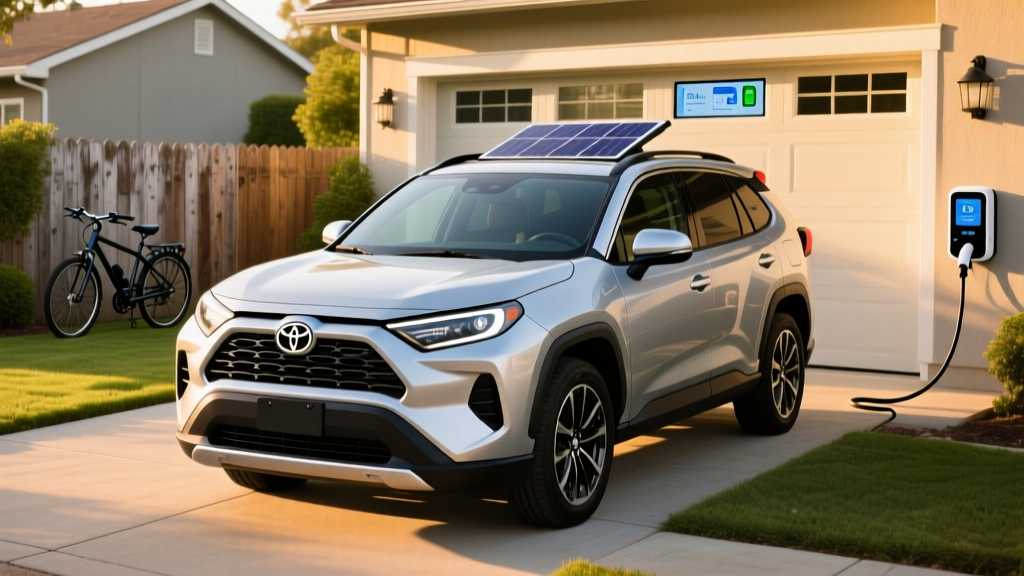
The 2026 Toyota RAV4 PHEV — badged as the RAV4 Prime — remains one of the most compelling bridge vehicles for buyers who want electric daily driving without committing to a full battery-electric vehicle. With an EPA-rated 42 miles of electric-only range, 302 combined horsepower, and a combined 38 MPG once the battery depletes, it covers the majority of American commutes on electrons alone while eliminating range anxiety on road trips. For 2026, Toyota has refined the infotainment and added Toyota Safety Sense 3.0, but the core powertrain formula — a 2.5-liter four-cylinder paired with front and rear electric motors and an 18.1 kWh lithium-ion battery — carries forward from the generation introduced in 2021.
| Spec | Value |
|---|---|
| EPA Electric-Only Range | 42 miles |
| EPA Combined MPG (hybrid mode) | 38 MPG (94 MPGe combined) |
| Total Combined Range | ~470 miles (EV + gas) |
| Battery Capacity | 18.1 kWh (lithium-ion, NMC chemistry) |
| Combined Horsepower | 302 hp |
| 0–60 mph | 5.7 seconds |
| Drivetrain | AWD (electronic rear motor) |
| Level 2 Charge Time (240V, 6.6 kW) | ~2.5 hours (0–100%) |
| DC Fast Charging | Not available |
| Base MSRP (SE trim) | $44,960 |
| Battery Warranty | 10 years / 150,000 miles |
HEV vs PHEV: Which RAV4 Powertrain Fits Your Life?
Toyota offers the RAV4 in three powertrain flavors for 2026: the conventional gas model, the RAV4 Hybrid (HEV), and the RAV4 Prime (PHEV). Understanding the difference is essential before you visit a dealer.
| Attribute | RAV4 Hybrid (HEV) | RAV4 Prime (PHEV) |
|---|---|---|
| Needs to plug in? | No — self-charging via regen & engine | Yes — plug in for EV range |
| Electric-only range | ~1 mile at low speed | 42 miles EPA |
| EPA Combined MPG | 41 MPG | 38 MPG (hybrid mode after depletion) |
| Combined Horsepower | 219 hp | 302 hp |
| 0–60 mph | 7.4 sec | 5.7 sec |
| Battery Size | 1.6 kWh (small buffer) | 18.1 kWh |
| Base MSRP | ~$33,575 | $44,960 |
| Federal Tax Credit (§30D) | Not eligible | Up to $7,500 (see eligibility below) |
The conventional hybrid (HEV) never plugs in. It uses a small battery recharged by regenerative braking and the gasoline engine to assist acceleration and enable brief low-speed electric movement. The plug-in hybrid (PHEV) carries a much larger battery that you charge from a wall outlet or Level 2 station, giving you genuine electric-only highway capability before the gasoline engine takes over as a regular hybrid.
Electric Range, MPG, and Real-World Efficiency
| Mode | City | Highway | Combined |
|---|---|---|---|
| Charge-Depleting (EV) | 94 MPGe combined (electricity + gas assist) | ||
| Charge-Sustaining (Hybrid) | 40 MPG | 36 MPG | 38 MPG |
The EPA rates the RAV4 Prime at 42 miles of EV range. In real-world testing during mild weather (60–75°F), many owners report 44–48 miles on a full charge by keeping speeds under 65 mph and using the EV mode's regenerative braking aggressively. However, expect the following reductions:
- Highway driving at 75+ mph: EV range drops to roughly 32–36 miles due to aerodynamic drag.
- Cold weather (below 32°F): Expect 25–30 miles of EV range. The RAV4 Prime lacks a dedicated heat pump for cabin heating, so the engine may activate sooner in freezing conditions to provide warmth.
- Hilly terrain: Range fluctuates significantly; downhill regen recovers some energy but sustained climbs drain the battery faster.
Once the battery depletes, the RAV4 Prime operates as a conventional hybrid at 38 MPG combined. In city-heavy driving, real-world owners frequently see 40–43 MPG because regenerative braking recovers more energy at low speeds — a common hybrid trait where real-world city efficiency exceeds the EPA sticker. Highway-only trips in hybrid mode typically yield 34–36 MPG.
Charging the RAV4 Prime: What You Need to Know
The 2026 RAV4 Prime charges via a standard J1772 connector (Level 2 AC). Here are the practical charging scenarios:
| Charging Level | Power | 0–100% Time | Where |
|---|---|---|---|
| Level 1 (120V household) | ~1.4 kW | ~12 hours | Standard outlet |
| Level 2 (240V, 32A) | 6.6 kW (onboard max) | ~2.5 hours | Home wallbox, public AC stations |
| DC Fast Charge | N/A | N/A | Not supported |
A critical limitation: the RAV4 Prime does not support DC fast charging. The 18.1 kWh battery is small enough that Toyota designed it for overnight Level 2 replenishment. If you charge at home every night, this is a non-issue — 2.5 hours on a 240V Level 2 station means you'll wake up with a full battery every morning. But on road trips, you cannot top up the battery at Electrify America or Tesla Supercharger stations. The gasoline engine handles highway driving, and you simply refuel at any gas station.
Home charging setup cost: If you already have a 240V outlet (like a dryer outlet) near your parking spot, a quality J1772 Level 2 EVSE costs $300–$600. A dedicated 240V/40A circuit installation by a licensed electrician typically runs $500–$1,500 depending on panel proximity. No panel upgrade is usually needed for the RAV4 Prime's modest 6.6 kW draw.
Powertrain: 302 Horsepower With Hybrid Efficiency
The RAV4 Prime's powertrain pairs a 2.5-liter Atkinson-cycle four-cylinder engine (177 hp, 165 lb-ft) with two electric motors:
- Front motor: 134 kW (180 hp)
- Rear motor: 40 kW (54 hp) — provides electronic AWD
- Combined system output: 302 hp
The result is a 0–60 mph time of 5.7 seconds, making the RAV4 Prime one of the quickest compact SUVs in its class — faster than many turbocharged gas competitors. The electronic AWD system engages the rear motor on demand for traction without a mechanical driveshaft, reducing parasitic loss. In EV mode, both motors draw from the 18.1 kWh battery, providing smooth, quiet acceleration up to about 84 mph before the engine engages.
Pricing, Trims, and Federal Tax Credit Eligibility
The 2026 RAV4 Prime is offered in two trims:
- SE: $44,960 MSRP (includes destination)
- XSE: $49,075 MSRP (adds premium audio, panoramic roof, heated rear seats)
Federal §30D Tax Credit — Eligibility Checklist
The RAV4 Prime may qualify for up to $7,500 under the IRS §30D Clean Vehicle Credit, but eligibility depends on several factors that change annually. As of 2026, the key requirements include:
- MSRP cap: SUVs must be under $80,000 — both RAV4 Prime trims qualify.
- Buyer income cap: AGI must not exceed $150,000 (single), $225,000 (head of household), or $300,000 (joint filers).
- Battery sourcing: A percentage of critical minerals and battery components must be sourced from the U.S. or free-trade-agreement partners. Toyota has adjusted supply chains, but verify current-year compliance on the IRS eligible vehicles list before purchasing.
- Point-of-sale transfer: You can transfer the credit to the dealer at purchase to reduce your out-of-pocket cost immediately, rather than waiting to claim it on your tax return.
Always confirm eligibility with your tax professional and check fueleconomy.gov for the latest credit status. State incentives (e.g., California, Colorado, New York) may stack on top — check your state's energy office for current programs.
After the maximum $7,500 federal credit, the effective price of the SE trim drops to approximately $37,460 — narrowing the gap with the RAV4 Hybrid to about $4,000. At that delta, the PHEV's 42-mile EV range, 302 hp, and potential fuel savings make the math compelling for anyone with home charging.
Reliability and Battery Longevity
Toyota Hybrid Battery Warranty: 10 years or 150,000 miles (whichever comes first), covering defects and capacity loss below a specified threshold. This applies to both the HEV and PHEV traction batteries.
Toyota's hybrid Synergy Drive system has an exceptional reliability track record spanning two decades, from the original Prius to the current RAV4 lineup. The RAV4 Prime's 18.1 kWh lithium-ion (NMC chemistry) battery is conservatively tuned — Toyota limits the usable state-of-charge window (top and bottom buffers) to reduce degradation. Real-world data from 2021–2025 model-year RAV4 Primes shows minimal capacity loss: most owners report less than 5% degradation after 60,000 miles.
Battery replacement cost: If the battery fails outside warranty, a replacement currently costs between $4,000 and $6,500 including labor at a Toyota dealer. However, out-of-warranty failures are rare — Toyota's hybrid battery failure rate remains among the lowest in the industry. Independent shops and refurbished battery options can reduce replacement cost to $2,500–$4,000.
The conventional powertrain components (engine, eCVT transmission, electric motors) are equally durable. The eCVT has no traditional gears or belts — it uses a planetary gearset that is virtually wear-free. Many Toyota hybrids exceed 200,000 miles with only routine maintenance.
Who Should Choose the RAV4 Prime vs a Full EV or Gas Car?
Choose the RAV4 Prime (PHEV) if:
- Your daily commute is under 40 miles round-trip and you can charge at home.
- You take road trips of 200+ miles several times a year and don't want to plan around charging stops.
- You live in a cold climate where EV range loss is a real concern.
- You want one vehicle that does everything — daily EV commuting and gas-powered long-distance travel.
- You qualify for the §30D tax credit, making the price gap vs. the HEV manageable.
Choose the RAV4 Hybrid (HEV) if:
- You cannot install home charging (apartment, street parking, no garage).
- Your budget is tighter and you don't qualify for the federal tax credit.
- Your daily driving is already efficient and you just want better MPG without plugging in.
Choose a full BEV (e.g., Tesla Model Y, Hyundai Ioniq 5) if:
- You have reliable home charging and your daily driving is under 250 miles.
- You want zero tailpipe emissions and minimal maintenance (no oil changes, no engine).
- You're ready to use DC fast charging for road trips and accept 20–30 minute stops.
Pros
- 42-mile EV range covers most daily commutes gas-free
- 302 hp / 5.7-sec 0–60 — genuinely quick for a compact SUV
- Standard AWD with no fuel-economy penalty
- 38 MPG hybrid mode — efficient even when battery is depleted
- 10-year/150,000-mile hybrid battery warranty
- Eligible for up to $7,500 federal tax credit (verify sourcing)
- Proven Toyota reliability and strong resale value
Cons
- No DC fast charging — road-trip battery top-ups not possible
- $44,960 starting price is a significant premium over the RAV4 Hybrid
- Only ~42 miles EV range — shorter than some PHEV competitors
- No heat pump — cold-weather EV range drops noticeably
- Cargo space slightly reduced vs. gas RAV4 (battery packaging)
- Dealer markups remain common due to high demand and limited supply
Frequently Asked Questions
How many MPG does the 2026 RAV4 Prime get?
The EPA rates the RAV4 Prime at 38 MPG combined (40 city / 36 highway) in hybrid mode after the battery depletes. In EV mode, it achieves 94 MPGe combined. Real-world city driving in hybrid mode often exceeds the EPA estimate, with 40–43 MPG common in stop-and-go traffic thanks to aggressive regenerative braking.
How far can the RAV4 Prime go on electric only?
The EPA rates it at 42 miles of electric-only range. In mild weather with moderate speeds, expect 44–48 miles. In cold weather or at highway speeds, plan for 25–36 miles. The gasoline engine seamlessly takes over when the battery depletes — you never strand yourself.
Does the RAV4 Prime qualify for a tax credit?
It may qualify for up to $7,500 under the federal §30D Clean Vehicle Credit, subject to buyer income limits, MSRP caps (both trims qualify), and battery-sourcing requirements. Verify current eligibility on the IRS eligible vehicles page before purchasing. Some states offer additional rebates or tax credits that stack with the federal credit.
Is the RAV4 Prime reliable, and what does battery replacement cost?
Toyota's hybrid system has a two-decade reliability track record. The RAV4 Prime's battery is warranted for 10 years / 150,000 miles. Out-of-warranty replacement costs $4,000–$6,500 at a dealer, though failures are rare. The eCVT transmission and electric motors are essentially maintenance-free.
Do I need to charge the RAV4 Prime every night?
For maximum EV range and fuel savings, yes — plug it in nightly on a Level 2 (240V) charger and it will fully replenish in about 2.5 hours. On a standard 120V outlet, a full charge takes roughly 12 hours (still feasible overnight). If you skip charging, the vehicle simply operates as a highly efficient hybrid at 38 MPG — no harm done.
Can the RAV4 Prime DC fast charge?
No. The RAV4 Prime only supports AC Level 1 (120V) and Level 2 (240V) charging via a J1772 connector. There is no CCS or NACS DC fast-charging port. This is typical for PHEVs with smaller batteries — the 18.1 kWh pack is designed for overnight home replenishment, not highway quick-charging.
Hybrid vs PHEV vs EV — which should I choose?
If you can charge at home and commute under 40 miles daily but take occasional long road trips, the PHEV offers the best of both worlds. If you can't charge at home, the HEV gives you great MPG with zero lifestyle change. If you have home charging, drive under 250 miles daily, and want zero emissions and minimal maintenance, a full BEV is the most forward-looking choice. The RAV4 Prime occupies the sweet spot for households not yet ready to go fully electric.