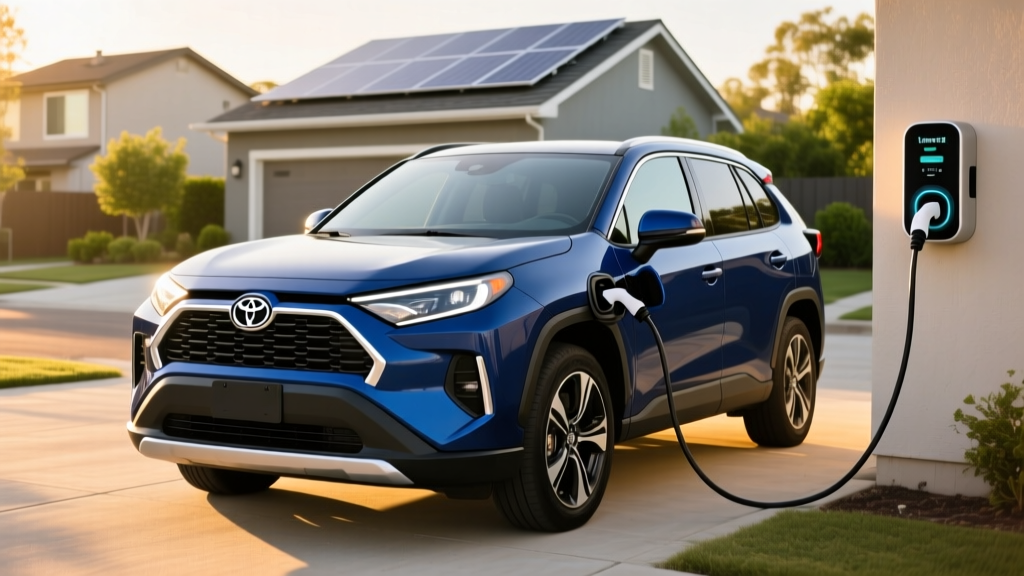
If you have been searching for a 2026 Toyota RAV4 plug-in hybrid for sale, you are likely weighing one of the most practical electrified SUVs on the market. Toyota sells this vehicle under the RAV4 Prime badge, and it pairs a 2.5-liter four-cylinder engine with a robust electric motor system and an 18.1 kWh lithium-ion battery. The result: 42 miles of electric-only driving, 302 combined horsepower, and a combined 94 MPGe when the battery is charged. For buyers who want EV-like commuting without range anxiety on road trips, the RAV4 Prime occupies a compelling middle ground.
This guide covers everything you need to evaluate before buying — from real-world range expectations and charging logistics to tax-credit eligibility and long-term battery reliability. All figures reflect the 2026 model year and current federal incentive rules.
HEV vs. PHEV: What the RAV4 Prime Actually Is
Toyota offers the RAV4 in two electrified forms, and confusing them is a common mistake among first-time hybrid shoppers:
| Feature | RAV4 Hybrid (HEV) | RAV4 Prime (PHEV) |
|---|---|---|
| Plugs in? | No — self-charging via engine & regen | Yes — plug in to charge battery |
| Battery size | 1.6 kWh (buffer-limited) | 18.1 kWh usable |
| Electric-only range | ~1 mile at very low speed | 42 miles (EPA) |
| Combined horsepower | 219 hp | 302 hp |
| EPA combined (gas) | 39 MPG | 35 MPG (after battery depletes) |
| EPA MPGe (electric+gas) | N/A | 94 MPGe |
| 0-60 mph | ~7.4 sec | ~5.7 sec |
| Base MSRP (2026 est.) | ~$33,500 | ~$44,990 |
The RAV4 Prime is a plug-in hybrid (PHEV). You plug it into a Level 1 (120V) or Level 2 (240V) charger to fill the battery, then drive on electricity alone for your daily commute. Once the battery depletes, it operates as a conventional hybrid — no plugging required to keep driving. The standard RAV4 Hybrid, by contrast, never plugs in; it recovers energy through regenerative braking and the engine to maintain a small buffer battery.
Fuel Economy: EPA MPG, MPGe, and Real-World Numbers
The RAV4 Prime operates in two modes, and each has its own efficiency rating from the EPA:
| Mode | City | Highway | Combined |
|---|---|---|---|
| Charge-depleted (hybrid/gas) | 40 MPG | 36 MPG | 38 MPG |
| Charge-sustaining + electric (MPGe) | — | — | 94 MPGe |
Real-world expectations: In city driving with a charged battery, many owners report routinely achieving the full 42-mile electric range and using little to no gasoline for weeks. On the highway at 70+ mph with a depleted battery, expect closer to 33-35 MPG — the heavier battery pack and less favorable aerodynamics reduce highway efficiency compared to the lighter HEV variant. In cold weather (below freezing), electric-only range can drop 15-25% due to battery chemistry limitations and cabin heating demand, so plan for roughly 32-36 electric miles in winter.
The combined 42-mile electric range plus an 14.5-gallon fuel tank gives a total range exceeding 500 miles — a key advantage over pure EVs for road-trip-heavy households.
Powertrain, Battery, and Charging Specifications
| Specification | Detail |
|---|---|
| Engine | 2.5L inline-4 Atkinson-cycle |
| Combined system output | 302 hp |
| Battery chemistry | Lithium-ion (NMC) |
| Battery capacity | 18.1 kWh (usable) |
| Electric-only range (EPA) | 42 miles |
| Level 1 charging (120V / 12A) | ~12 hours (0-100%) |
| Level 2 charging (240V / 32A) | ~2.5 hours (0-100%) |
| DC fast charging | Not supported |
| 0-60 mph | ~5.7 seconds |
| Drivetrain | Electronic AWD (eAWD) |
| Towing capacity | 2,500 lbs |
Charging reality check: The RAV4 Prime does not support DC fast charging. This is typical for PHEVs with smaller batteries — the 18.1 kWh pack is designed for overnight Level 2 home charging, not highway quick-charging. If you need a vehicle that can add 150+ miles of range in 20 minutes on a road trip, a full BEV (battery electric vehicle) is the better choice.
For home charging, a 240V Level 2 outlet (NEMA 14-50 or hardwired wall connector) is strongly recommended. The onboard charger accepts up to 6.6 kW, meaning a full charge takes roughly 2.5 hours — easily done during a workday or overnight. A standard 120V household outlet works but takes approximately 12 hours, which may not fully replenish the battery if you drive the full 42 miles daily.
2026 RAV4 Prime Pricing, Trims, and Tax Credit Eligibility
The 2026 RAV4 Prime is offered in two trims:
- SE: ~$44,990 MSRP (est.) — sport-tuned suspension, SofTex seats, 18-inch alloy wheels, 9-inch infotainment
- XSE: ~$48,500 MSRP (est.) — premium audio, panoramic sunroof option, heated/ventilated front seats, 19-inch wheels
Federal tax credit (§30D): Under current IRS rules, the RAV4 Prime may qualify for up to $7,500 in federal tax credits, but eligibility is constrained by several requirements that change frequently:
- MSRP cap: SUVs must be priced at or below $80,000 — the RAV4 Prime clears this easily.
- Buyer income cap: Modified adjusted gross income must not exceed $150,000 (single), $225,000 (head of household), or $300,000 (joint).
- Battery sourcing: A percentage of critical minerals and battery components must be sourced from the U.S. or free-trade-agreement countries. This requirement tightens annually, and eligibility can shift model year to model year.
- Point-of-sale transfer: As of 2024, qualifying buyers can transfer the credit to the dealer for an immediate price reduction at purchase rather than waiting to claim it on their tax return.
Because battery-sourcing rules are updated regularly, always verify current eligibility on the fueleconomy.gov tax credit lookup tool before finalizing a purchase. Do not assume the full $7,500 applies — partial credits ($3,750) are common when only one of the two sourcing thresholds is met.
Reliability, Battery Warranty, and Replacement Cost
Toyota's hybrid systems are among the most proven in the industry, with decades of real-world data from the Prius lineage. The RAV4 Prime's hybrid battery carries the following coverage:
- Hybrid battery warranty: 10 years / 150,000 miles (whichever comes first)
- Hybrid system components: 8 years / 100,000 miles
- Basic vehicle warranty: 3 years / 36,000 miles
- Powertrain warranty: 5 years / 60,000 miles
Real-world longevity: Toyota's hybrid batteries in the RAV4 line have demonstrated strong durability. Many first-generation RAV4 Hybrid owners (2016+) report minimal battery degradation at 100,000+ miles. The PHEV's larger battery experiences more charge cycles but benefits from Toyota's conservative buffer management — the vehicle never fully depletes or fully charges the pack, which reduces stress on the cells.
Replacement cost: If the hybrid battery fails outside of warranty, expect a replacement cost in the range of $4,000 to $7,000 including parts and labor at a Toyota dealership. Third-party refurbishment options may reduce this to $2,500-$4,000. However, given the 10-year/150,000-mile warranty and Toyota's track record, out-of-pocket battery replacement is statistically uncommon during typical ownership.
Who Should Buy the RAV4 Prime vs. a Full EV or Gas Car?
Pros
- 42-mile EV range covers most daily commutes gasoline-free
- 302 hp makes it the quickest RAV4 in the lineup
- 500+ mile total range eliminates road-trip range anxiety
- Standard eAWD for all-weather confidence
- No DC fast-charging dependency — Level 2 at home is sufficient
- Strong resale value and proven hybrid reliability
Cons
- $44,990+ starting price is a significant premium over the HEV
- No DC fast charging — unsuitable for apartment dwellers without home charging
- 35 MPG highway (gas mode) is lower than the HEV's highway figure
- Cargo space slightly reduced vs. non-hybrid RAV4 due to battery placement
- Tax-credit eligibility is not guaranteed and subject to sourcing-rule changes
Choose the RAV4 Prime (PHEV) if: You can charge at home (Level 2), your daily driving is under 40 miles, you take regular road trips where charging infrastructure is unreliable, and you want EV-like daily driving without committing to a full BEV.
Choose the RAV4 Hybrid (HEV) if: You cannot plug in at home, you want hybrid efficiency (39 MPG combined) with zero charging logistics, and the $11,000+ price premium of the Prime doesn't pencil out for your mileage.
Choose a full BEV (e.g., Tesla Model Y, Hyundai Ioniq 5) if: You want zero gasoline expenses, have reliable home and/or workplace charging, your road trips are planned around DC fast-charging networks, and you want to maximize federal tax-credit value.
Frequently Asked Questions
How many MPG does the 2026 RAV4 Prime get?
When operating as a hybrid after the battery is depleted, the RAV4 Prime returns an EPA-estimated 40 city / 36 highway / 38 combined MPG. When factoring in electric-only driving, its combined rating is 94 MPGe. Real-world city driving with regular charging can mean using almost no gasoline for weeks.
How far can the RAV4 Prime go on electric only?
The EPA rates the RAV4 Prime at 42 miles of electric-only range. In warm weather at moderate speeds, some drivers report 44-46 miles. In cold weather or at sustained highway speeds, expect 32-38 miles. Once the battery depletes, the gasoline engine engages seamlessly.
Does the 2026 RAV4 Prime qualify for a federal tax credit?
It may qualify for up to $7,500 under IRS §30D, but eligibility depends on your income, the vehicle's battery-sourcing compliance (which changes annually), and MSRP caps. Always check fueleconomy.gov and consult a tax professional before relying on the credit.
Is the RAV4 Prime reliable, and what does battery replacement cost?
Toyota's hybrid systems are among the most reliable in the industry. The hybrid battery is warranted for 10 years / 150,000 miles. Out-of-warranty replacement typically costs $4,000-$7,000 at a dealership, but premature failure is rare based on historical Toyota hybrid data.
Can the RAV4 Prime DC fast charge?
No. The RAV4 Prime supports Level 1 (120V) and Level 2 (240V) AC charging only, with a maximum onboard charger rate of 6.6 kW. A full Level 2 charge takes approximately 2.5 hours. This is standard for PHEVs, whose smaller batteries are designed for home or workplace charging rather than highway fast-charging stops.
How does the RAV4 Prime compare to a full EV like the Tesla Model Y?
The Model Y offers 300+ miles of all-electric range and DC fast charging but requires reliable access to charging infrastructure and a higher upfront cost. The RAV4 Prime sacrifices all-electric range (42 miles) for the flexibility of a gasoline engine on longer trips — ideal for one-car households in areas with inconsistent public charging.
When you find a 2026 Toyota RAV4 plug-in hybrid for sale, verify the trim level, confirm current tax-credit eligibility for your specific VIN, and ensure you have a plan for Level 2 home charging to unlock the vehicle's full value. The RAV4 Prime rewards owners who can charge daily with near-EV commuting costs and the freedom to drive cross-country without a second thought.