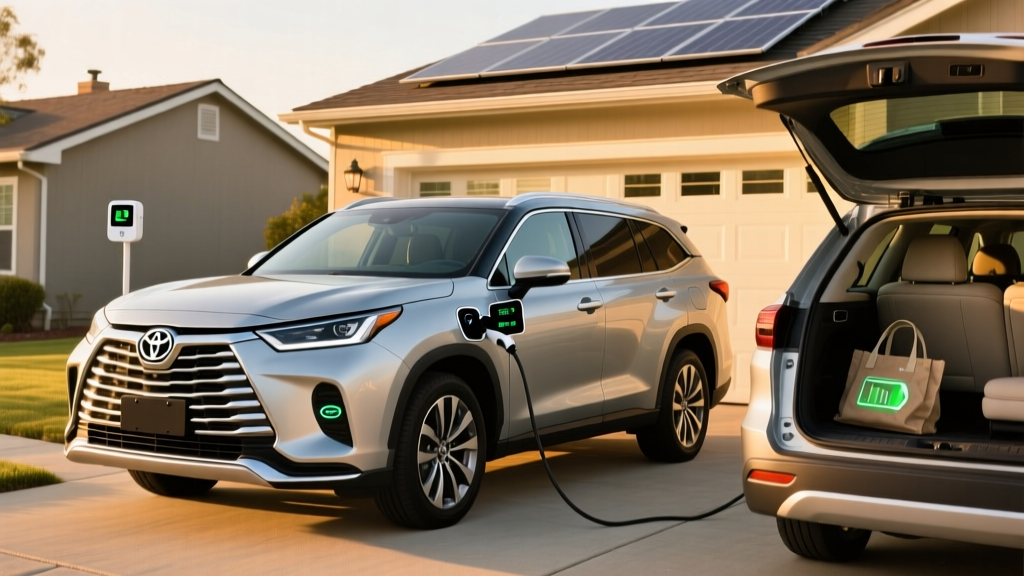
The three-row midsize SUV segment is crowded with electrified options in 2026, but the Toyota Highlander Hybrid continues to anchor the space with a straightforward proposition: a conventional hybrid (HEV) powertrain that sips fuel without requiring any plug-in infrastructure. For families who want SUV space, Toyota reliability, and MPG figures that shame vehicles half its size, the Highlander Hybrid remains a benchmark worth dissecting in detail.
This guide breaks down the 2026 Highlander Hybrid's real-world fuel economy, powertrain specs, pricing, battery longevity, and how it stacks up against plug-in hybrid and full-electric alternatives. Whether you're cross-shopping the Kia Sorento Hybrid, the Mazda CX-90 PHEV, or the Tesla Model X, you'll leave with the exact numbers you need to decide.
2026 Toyota Highlander Hybrid: Quick Verdict
The 2026 Highlander Hybrid pairs a 2.5-liter inline-four with Toyota's fifth-generation hybrid system to deliver 243 combined horsepower and an EPA-estimated 35 MPG combined. It seats up to seven passengers across three rows, starts around $42,000, and carries Toyota's 10-year/150,000-mile hybrid battery warranty. It does not plug in — it is a self-charging HEV, not a PHEV — which means zero range anxiety but also zero electric-only driving. For buyers who want plug-in electric range in a Toyota SUV, the RAV4 Prime (PHEV) or the upcoming three-row bZ SUV are the relevant alternatives.
| Spec | Value |
|---|---|
| Powertrain | 2.5L I4 + 2 electric motors (AWD) or 1 motor (FWD) |
| Combined Horsepower | 243 HP |
| 0–60 mph | ~7.8 seconds (AWD) |
| EPA Fuel Economy (AWD) | 35 city / 35 highway / 35 combined MPG |
| EPA Fuel Economy (FWD) | 36 city / 35 highway / 36 combined MPG |
| Drivetrain | FWD or electronic AWD (e-AWD) |
| Seating | 7 passengers (captain's chairs) or 8 (bench 2nd row) |
| Cargo Volume (behind 3rd row) | ~16.1 cu ft |
| Cargo Volume (max, 2nd/3rd folded) | ~84.3 cu ft |
| Towing Capacity | 3,500 lbs |
| Hybrid Battery | 1.87 kWh NiMH (sealed, self-charging) |
| Base MSRP (LE FWD) | ~$42,020 |
| Top Trim MSRP (Platinum AWD) | ~$54,170 |
| Hybrid Battery Warranty | 10 years / 150,000 miles |
| Powertrain Warranty | 5 years / 60,000 miles |
Fuel Economy: EPA Numbers vs. Real-World MPG
The headline figure for the 2026 Highlander Hybrid AWD is 35 MPG combined (35 city / 35 highway), per fueleconomy.gov. The FWD variant bumps city efficiency to 36 MPG. These numbers are exceptional for a 4,500-pound, three-row SUV — for comparison, the non-hybrid turbo-four Highlander achieves just 24 MPG combined.
| Drivetrain | City MPG | Highway MPG | Combined MPG |
|---|---|---|---|
| FWD | 36 | 35 | 36 |
| AWD (e-AWD) | 35 | 35 | 35 |
Real-World MPG: What Owners Actually See
Hybrids often beat their EPA city estimates because regenerative braking recovers energy that friction brakes waste. On the highway, where regen opportunities are fewer and aerodynamic drag dominates, real-world MPG tends to align closely with or dip slightly below the EPA sticker.
Based on aggregated owner data and independent testing, expect the following from a 2026 Highlander Hybrid AWD:
- City / suburban driving: 34–38 MPG (regen-heavy stop-and-go can push above EPA)
- Highway cruising (70 mph, flat): 31–34 MPG
- Highway cruising (75+ mph or hilly terrain): 28–31 MPG
- Cold weather (below 32°F): 30–33 MPG combined (engine runs more for cabin heat, battery efficiency drops)
- Loaded with passengers + cargo: Subtract 1–2 MPG from baseline
For a family driving 15,000 miles per year at 35 MPG combined and $3.50/gallon fuel, annual fuel cost lands around $1,500. The non-hybrid Highlander at 24 MPG combined would cost roughly $2,188 — a savings of approximately $688 per year with the hybrid.
Powertrain & Hybrid System Explained
The 2026 Highlander Hybrid uses Toyota's proven series-parallel hybrid architecture. A 2.5-liter Atkinson-cycle inline-four engine (186 HP, 186 lb-ft) is supplemented by front and rear electric motor-generators. The combined system output is 243 HP.
The electronic AWD system (branded e-AWD) uses a dedicated rear electric motor rather than a mechanical driveshaft connecting the front and rear axles. This means:
- No torque converter or traditional transmission — Toyota's eCVT (planetary gearset) provides seamless power delivery without fixed gear ratios.
- Rear motor engages on demand — it provides traction during acceleration and slippery conditions but decouples during steady-state cruising to save energy.
- Regenerative braking captures kinetic energy during deceleration, feeding it back into the 1.87 kWh nickel-metal hydride (NiMH) hybrid battery pack.
The hybrid battery is small by EV standards — just 1.87 kWh — because it only needs to buffer energy for short bursts of electric assist and regenerative capture. It never propels the vehicle for meaningful distances on electric power alone (you'll see brief EV-mode operation at very low speeds, typically under 1 mile).
HEV vs. PHEV: What's the Difference?
| Feature | Conventional Hybrid (HEV) | Plug-In Hybrid (PHEV) |
|---|---|---|
| Plugs in to charge? | No — self-charging via regen + engine | Yes — Level 1/Level 2 plug-in |
| Battery size | ~1–2 kWh | ~13–25 kWh |
| Electric-only range | Minimal (<1 mi at low speed) | 25–45+ miles typical |
| After battery depletes | N/A — always hybrid mode | Operates as conventional hybrid |
| Federal tax credit | Not eligible (§30D requires plug-in) | Up to $7,500 if eligible |
| Example | Toyota Highlander Hybrid | Mazda CX-90 PHEV, Toyota RAV4 Prime |
The Highlander Hybrid is strictly an HEV. Toyota does not currently offer a plug-in hybrid version of the Highlander. If electric-only commuting is a priority in a three-row package, look at the Mazda CX-90 PHEV (26 miles electric-only, ~56 MPGe) or the Jeep Grand Cherokee 4xe (25 miles electric-only).
Pricing, Trims & Tax Credit Eligibility
The 2026 Highlander Hybrid is available across five trims. Pricing below reflects approximate MSRP including destination charges:
- LE (FWD or AWD): ~$42,020–$43,620
- XLE: ~$46,420–$48,020
- Limited: ~$50,120–$51,720
- Nightshade: ~$49,520–$51,120
- Platinum: ~$52,570–$54,170
Does the Highlander Hybrid Qualify for a Federal Tax Credit?
No. The Highlander Hybrid is a conventional HEV, not a plug-in vehicle. The federal §30D Clean Vehicle Credit applies only to battery electric vehicles (BEVs) and plug-in hybrids (PHEVs) that meet battery capacity, MSRP, buyer income, and critical-mineral sourcing requirements. Since the Highlander Hybrid has no plug and a battery under 2 kWh, it is ineligible for §30D.
Some states offer modest rebates or HOV-lane access for conventional hybrids — check your state's energy office or DMV for current programs. These vary by jurisdiction and change frequently.
Hybrid Battery Longevity, Warranty & Replacement Cost
Battery lifespan is consistently the top concern for hybrid buyers. Here's what the data shows for Toyota's hybrid systems:
2026 Highlander Hybrid Battery Warranty: 10 years or 150,000 miles (whichever comes first). This covers defects and capacity loss below a defined threshold. Toyota's hybrid battery warranty has been 10/150k since the 2020 model year — among the longest in the industry.
How Long Do Toyota Hybrid Batteries Actually Last?
Toyota's NiMH hybrid battery packs have an extensive real-world track record stretching back to the 2001 Prius. Aggregated fleet and owner data indicates:
- Typical lifespan: 150,000–200,000+ miles before significant capacity loss
- Failure rate within warranty: Low — industry analyses place Toyota hybrid battery replacement under warranty at roughly 1–2% of units
- Degradation pattern: Gradual. You may notice slightly reduced electric-assist frequency and a fractional MPG drop (1–2 MPG) as the battery ages past 150k miles, but catastrophic failure is uncommon
Battery Replacement Cost
If replacement is needed out of warranty, expect the following:
- New OEM battery pack: $3,000–$4,500 (parts + labor at a Toyota dealer)
- Refurbished/reconditioned pack: $1,500–$2,500 (independent hybrid specialists)
- Individual module replacement: $500–$1,200 (some shops replace failed modules rather than the full pack)
Given the 10-year/150,000-mile warranty and the NiMH pack's proven durability, battery replacement should be a low-probability event for most original owners. It becomes a more relevant cost consideration for second- or third-owners purchasing high-mileage examples.
Reliability, Safety & Ownership Costs
Toyota's hybrid powertrain is among the most thoroughly validated in the automotive industry. The Highlander Hybrid inherits this track record:
- eCVT durability: Toyota's planetary gearset eCVT has no belts, clutches, or torque converter to wear out. It is widely regarded as one of the most reliable transmission designs in production.
- Brake longevity: Regenerative braking reduces friction-brake usage. Owners commonly report 80,000–100,000+ miles on original brake pads.
- Safety ratings: The Highlander earned top marks from IIHS and a 5-star overall rating from NHTSA. Standard Toyota Safety Sense 3.0 includes pre-collision braking, lane tracing assist, adaptive cruise control, and road sign assist.
5-Year Estimated Cost of Ownership
| Category | Estimated Cost |
|---|---|
| Fuel (35 MPG avg, $3.50/gal) | $7,500 |
| Insurance (national avg) | $9,000–$11,000 |
| Maintenance (oil, filters, tires, brakes) | $3,500–$4,500 |
| Depreciation (est. 45% over 5 yrs) | $21,000–$24,000 |
| Estimated Total (excl. purchase price) | $41,000–$47,000 |
Compared to the non-hybrid Highlander (24 MPG combined), the hybrid saves roughly $3,400 in fuel over five years. Against a comparable three-row EV, the hybrid avoids charging infrastructure dependency but lacks the per-mile energy cost advantage of electricity.
Highlander Hybrid vs. PHEV vs. Full EV: Which Fits You?
Choosing between a conventional hybrid, a plug-in hybrid, and a battery electric vehicle depends on your driving patterns, charging access, and budget. Here's a practical decision framework:
Choose the Highlander Hybrid (HEV) if:
- You have no access to home or workplace charging
- You want a three-row SUV with minimal complexity
- You drive a mix of city and highway and want strong MPG everywhere
- You plan to own the vehicle 8–10+ years and value proven reliability
- You don't want to think about charging — ever
Choose a PHEV (e.g., Mazda CX-90 PHEV) if:
- You can charge at home (Level 1 or 2) and have a short commute (under 30 miles)
- You want electric-only daily driving but need gas flexibility for road trips
- You want to reduce fuel consumption significantly without full EV commitment
Choose a full EV (e.g., Kia EV9, Tesla Model X) if:
- You have reliable home Level 2 charging
- Your daily driving is under 250 miles and you can plan road-trip charging stops
- You want the lowest per-mile energy cost and minimal maintenance
- You want access to the §30D federal tax credit (up to $7,500, subject to eligibility)
Pros and Cons at a Glance
Pros
- 35 MPG combined in a 7-passenger SUV — best-in-class efficiency
- No plug-in required — works with existing gas-station infrastructure
- 10-year / 150,000-mile hybrid battery warranty
- Proven eCVT reliability with minimal maintenance
- Standard Toyota Safety Sense 3.0 suite
- Strong resale value — Toyota hybrids depreciate slower than segment average
Cons
- No electric-only driving range (HEV, not PHEV)
- No federal tax credit eligibility
- AWD acceleration is adequate (7.8s 0–60), not quick
- Third row is tight for adults on long trips
- Cargo space behind 3rd row (16.1 cu ft) is modest vs. competitors
- Infotainment system lags behind rivals in responsiveness
Frequently Asked Questions
How many MPG does the 2026 Toyota Highlander Hybrid get?
The EPA rates the AWD model at 35 city / 35 highway / 35 combined MPG. The FWD variant achieves 36 city / 35 highway / 36 combined. Real-world results typically range from 31–38 MPG depending on driving conditions, with city driving often exceeding the EPA estimate thanks to regenerative braking.
Does the Highlander Hybrid need to be plugged in?
No. The Highlander Hybrid is a conventional hybrid (HEV). Its small 1.87 kWh battery charges automatically through regenerative braking and the gasoline engine. You fuel it like any other gas vehicle — there is no plug, no charging cable, and no electric-only range to manage.
Is there a plug-in hybrid (PHEV) version of the Highlander?
As of the 2026 model year, Toyota does not offer a Highlander PHEV. The closest Toyota plug-in option is the RAV4 Prime (42 miles electric-only), but it only seats five. For a three-row PHEV, consider the Mazda CX-90 PHEV or Jeep Grand Cherokee 4xe.
How long will the hybrid battery last?
Toyota's NiMH hybrid batteries have demonstrated lifespans of 150,000–200,000+ miles in real-world use. The battery is covered by a 10-year / 150,000-mile warranty. Replacement cost out of warranty ranges from $1,500 (refurbished) to $4,500 (new OEM).
Is the Highlander Hybrid good for towing?
The hybrid is rated for 3,500 lbs of towing capacity — sufficient for a small boat, utility trailer, or a pair of personal watercraft. For heavier towing (5,000 lbs), you'd need the non-hybrid turbo-four Highlander or a body-on-frame SUV.
Does the Highlander Hybrid qualify for any tax credits?
The Highlander Hybrid does not qualify for the federal §30D Clean Vehicle Credit because it is not a plug-in vehicle. Some states may offer minor hybrid incentives — check your state's energy or environmental agency for current programs.
How does the Highlander Hybrid compare to the Kia Sorento Hybrid?
The Sorento Hybrid achieves a slightly higher 37 MPG combined (AWD) and starts around $39,000, making it less expensive. However, the Highlander offers more cargo volume, a stronger reliability track record, and higher resale value. The Sorento's third row is even tighter than the Highlander's.