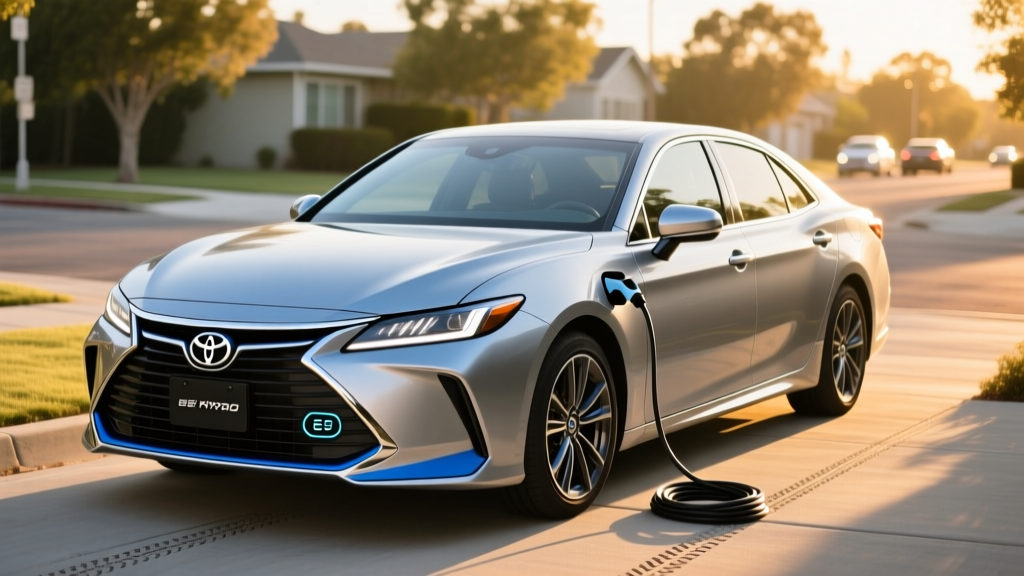
The 2026 Toyota Crown Signia occupies a narrow but compelling lane: a midsize wagon-style crossover that delivers genuine hybrid efficiency without asking buyers to plug in, change their habits, or pay a luxury badge premium. With an EPA-estimated 38 MPG combined, standard electronic all-wheel drive, and a starting price around $42,500, it targets buyers who want electrified efficiency today without the charging infrastructure dependencies of a full BEV or the range limitations of a PHEV.
But the Crown Signia is a conventional hybrid (HEV), not a plug-in hybrid (PHEV). That distinction matters enormously for tax credit eligibility, daily driving routine, and total cost of ownership. This guide breaks down the exact specs, real-world fuel economy expectations, and ownership economics you need before signing a purchase order.
HEV vs PHEV: Where the Crown Signia Fits
Before examining the numbers, it's essential to understand what the Crown Signia is not. It is a self-charging hybrid electric vehicle (HEV). Its small battery recharges exclusively through regenerative braking and the gasoline engine. You never plug it in. You cannot drive it on electric-only power for meaningful distances.
| Feature | HEV (Crown Signia) | PHEV (e.g., RAV4 Prime) | Full BEV |
|---|---|---|---|
| Plug-in required | No | Yes | Yes |
| Electric-only range | ~1 mi (low speed) | 30–42 mi typical | 200–400+ mi |
| Battery capacity | ~1.6 kWh (small buffer) | 14–18 kWh usable | 60–100+ kWh |
| Federal tax credit (§30D) | Not eligible | Up to $7,500 (if sourcing/income rules met) | Up to $7,500 (if sourcing/income rules met) |
| Home charging install | Not needed | Level 2 recommended ($500–$2,000) | Level 2 required ($500–$2,000+) |
| Tailpipe emissions | Reduced vs gas | Zero (electric mode) | Zero |
The Crown Signia's hybrid system is best understood as an efficiency multiplier for a gasoline powertrain, not a bridge to electric-only driving. If you need 30+ miles of zero-emission commuting, look at a PHEV like the Toyota RAV4 Prime or a full BEV. If you want set-it-and-forget-it fuel savings with zero lifestyle change, the HEV architecture is exactly right.
Fuel Economy: EPA Ratings and Real-World MPG
The 2026 Crown Signia carries over the fourth-generation Toyota Hybrid System (THS) paired with a 2.5-liter inline-four engine. All trims come with electronic on-demand AWD, which adds a rear-axle motor but does not materially hurt fuel economy thanks to the system's efficiency.
| Driving Cycle | EPA Estimate | Real-World Expectation |
|---|---|---|
| City | 39 MPG | 40–44 MPG (hybrids excel in stop-and-go) |
| Highway | 37 MPG | 34–37 MPG (aero drag and sustained speed reduce regen benefit) |
| Combined | 38 MPG | 36–41 MPG depending on driving mix |
Real-world context: Toyota hybrids historically overperform their EPA city estimates because regenerative braking recovers energy that a conventional car wastes as heat. On a 12-mile urban commute with frequent stops, owners routinely report 42+ MPG. Conversely, sustained 75 MPH highway driving in cold weather (below 35°F) can drop observed economy to 32–34 MPG as the engine runs more frequently for cabin heat and the battery's charge-acceptance rate decreases.
Compared to a similarly sized gasoline-only midsize crossover averaging 24 MPG combined, the Crown Signia saves roughly 140 gallons of fuel per year at 12,000 miles driven — approximately $460 annually at $3.30/gallon regular unleaded (the Crown Signia does not require premium).
Powertrain and Performance Specs
| Specification | 2026 Toyota Crown Signia |
|---|---|
| Engine | 2.5L inline-4 Atkinson cycle |
| Hybrid system | Toyota Hybrid System (THS) — 4th gen |
| Combined net horsepower | 240 hp |
| Front motor | Permanent magnet synchronous, ~134 hp |
| Rear motor (AWD) | 40 kW (~54 hp), on-demand |
| 0–60 mph | 7.1 seconds (manufacturer est.) |
| Drivetrain | Electronic on-demand AWD (standard all trims) |
| Transmission | eCVT (planetary gearset, not a belt CVT) |
| Towing capacity | 2,700 lbs (with factory tow prep) |
| Cargo volume (rear seats up) | 25.8 cu ft |
| Cargo volume (rear seats folded) | ~68 cu ft |
The 240 hp combined output puts the Crown Signia in a performance tier above most competing hybrids in the midsize crossover segment. The eCVT is Toyota's proven planetary-gear power-split device — it is not the rubber-band-feeling belt-driven CVT found in some competitors. Acceleration is linear and confident for merging, though the engine note under hard acceleration remains characteristically droning as the system holds the engine at its optimal RPM.
The rear AWD motor engages automatically when front-wheel slip is detected or during hard cornering. It does not provide a torque-vectoring performance feel, but it handles rain, light snow, and gravel roads capably. Ground clearance is approximately 6.3 inches — adequate for winter roads but not for off-road use.
Pricing, Trims, and Tax Credit Reality
The 2026 Crown Signia is offered in XLE and Limited trims. Pricing is estimated based on the outgoing model year with modest adjustments:
| Trim | Est. MSRP | Federal Tax Credit | Effective Price |
|---|---|---|---|
| XLE | $42,500 | $0 | $42,500 |
| Limited | $47,500 | $0 | $47,500 |
This is the single biggest financial consideration for cross-shopping buyers. A similarly equipped PHEV like the Toyota RAV4 Prime (if you can find one at MSRP) may qualify for up to $7,500 in federal credits depending on battery sourcing, your income, and the vehicle's MSRP cap compliance — effectively narrowing or eliminating the Crown Signia's price advantage despite the RAV4 Prime's higher sticker. Consult the IRS §30D guidelines and a tax professional for your specific eligibility.
Some states offer hybrid-specific incentives or reduced registration fees for high-efficiency vehicles. These vary by jurisdiction and change frequently — check your state's department of revenue or energy office for current programs.
Battery Longevity, Warranty, and Replacement Cost
Hybrid battery anxiety is the most common concern among first-time hybrid buyers. The data, however, is strongly reassuring for Toyota's THS system.
| Coverage Item | Term |
|---|---|
| Hybrid battery warranty | 10 years / 150,000 miles (whichever comes first) |
| Hybrid system components (inverter, motors, ECU) | 8 years / 100,000 miles |
| Powertrain warranty (engine, transaxle) | 5 years / 60,000 miles |
| Battery capacity retention threshold | Typically 60–70% of original capacity before warranty claim |
Toyota's hybrid battery warranty is among the strongest in the industry and reflects the company's confidence in nickel-metal hydride (NiMH) and lithium-ion hybrid pack longevity. Real-world data from millions of Prius, Camry Hybrid, and RAV4 Hybrid vehicles on the road shows hybrid batteries routinely lasting 150,000–200,000+ miles before needing replacement. Many original Prius batteries from the 2004–2009 era are still in service at 200,000+ miles.
Should replacement be needed out of warranty, a remanufactured Toyota hybrid battery pack currently costs $2,000–$3,500 installed at a dealership, or $1,200–$2,000 from independent hybrid specialists using reconditioned modules. Full new OEM packs run $4,000–$5,500 installed. These costs have declined significantly as the hybrid fleet has aged and the aftermarket has matured.
The Crown Signia's hybrid battery is small (~1.6 kWh) compared to a PHEV or BEV pack, which means replacement is proportionally cheaper. The battery also operates within a narrow state-of-charge window (roughly 40–80%), managed by the vehicle's computer to minimize degradation. Unlike a BEV battery that cycles from 10–90% daily, the Crown Signia's pack experiences shallow cycles that extend its calendar life considerably.
Who Should Buy the Crown Signia Hybrid — and Who Shouldn't
Choose the Crown Signia HEV if:
- You lack access to home or workplace charging (apartment, street parking, no garage outlet)
- You want zero change to your fueling routine — gas station stops only
- Your annual mileage is moderate (10,000–15,000 miles) and fuel savings, while welcome, aren't the sole purchase driver
- You need AWD for snow/rain but don't want a truck-based SUV
- You value Toyota's long-term reliability track record and plan to own the vehicle 8–12 years
- You want wagon-like cargo versatility (68 cu ft with seats folded) without minivan or SUV bulk
Look elsewhere if:
- You want electric-only commuting — consider a PHEV (RAV4 Prime, Tucson PHEV) or a BEV (Ioniq 5, Model Y)
- You're counting on the $7,500 federal tax credit to make the math work — HEVs don't qualify
- You need three rows of seating — the Crown Signia is strictly a 5-passenger vehicle
- You drive 25,000+ miles annually and want maximum fuel cost savings — a BEV's per-mile energy cost (~$0.04–$0.06/mi) beats even 38 MPG hybrid (~$0.09/mi)
- You want the latest Level 2+ hands-free driver assist — Toyota Safety Sense 3.0 is capable but conservative compared to GM Super Cruise or Ford BlueCruise
How the Crown Signia Compares to Alternatives
The Crown Signia's closest competitors straddle different segments:
- Toyota RAV4 Hybrid ($33,000–$40,000): More affordable, slightly less refined ride, similar MPG (39–41 combined), less cargo length but more headroom. The RAV4 Hybrid is the volume seller; the Crown Signia is the premium alternative.
- Toyota RAV4 Prime PHEV ($44,500+): 42 miles electric-only, 302 hp, qualifies for federal credit. More expensive at MSRP but potentially cheaper after incentives. Requires home charging to realize its efficiency advantage.
- Hyundai Santa Fe Hybrid ($39,000–$45,000): Three-row seating, slightly lower MPG (33–35 combined), more interior space. A viable alternative if you need occasional third-row use.
- Subaru Outback (gas, $32,000–$42,000): No hybrid option currently, 28–29 MPG combined, standard AWD, strong off-road capability. The Outback is the Crown Signia's closest body-style rival but can't match its fuel economy.
Ownership Costs Over Five Years
| Cost Category | Crown Signia HEV | Gas Midsize Crossover (24 MPG) |
|---|---|---|
| Purchase price (base) | $42,500 | $36,000 |
| Fuel (60,000 mi, $3.30/gal) | $5,210 | $8,250 |
| Maintenance (5 yr est.) | $2,800 | $3,400 |
| Insurance (5 yr est.) | $7,500 | $6,800 |
| Depreciation (5 yr est.) | $18,000 | $16,500 |
| 5-Year Total | $76,010 | $70,950 |
The Crown Signia's fuel savings of ~$3,040 over five years partially offset its higher purchase price, but do not fully close the gap with a cheaper gas-only alternative. The value proposition improves significantly if you plan to own the vehicle beyond five years (when the gas vehicle's maintenance costs accelerate) or if you drive more than 12,000 miles annually. Toyota hybrids also tend to hold resale value well — Kelley Blue Book consistently ranks Toyota among the top brands for long-term value retention.
Frequently Asked Questions
How many MPG does the 2026 Toyota Crown Signia get?
The EPA rates the Crown Signia at 39 MPG city, 37 MPG highway, and 38 MPG combined. In real-world driving, expect 40–44 MPG in city and suburban conditions, and 34–37 MPG on sustained highway trips. Cold weather and aggressive driving will reduce these figures.
Does the Crown Signia plug in or charge from a wall outlet?
No. The Crown Signia is a conventional hybrid (HEV). Its battery charges exclusively through regenerative braking and the gasoline engine. There is no charge port, no plug, and no electric-only driving mode beyond trivial low-speed maneuvers.
Does the Crown Signia qualify for the $7,500 federal EV tax credit?
No. Under IRS §30D, only plug-in electric vehicles (PHEVs and BEVs) with at least 7 kWh of battery capacity qualify. The Crown Signia's hybrid battery is approximately 1.6 kWh and is not externally chargeable. It is ineligible for the federal clean vehicle credit and most state EV incentive programs.
How long will the Crown Signia's hybrid battery last?
Toyota warranties the hybrid battery for 10 years or 150,000 miles. Historical data from Toyota's hybrid fleet shows most batteries lasting 150,000–200,000+ miles before significant degradation. The battery operates in a shallow charge-discharge window that maximizes longevity. Out-of-warranty replacement costs $2,000–$5,500 depending on new vs. remanufactured.
Hybrid vs PHEV vs EV — which should I choose?
Choose an HEV (like the Crown Signia) if you have no home charging access and want zero lifestyle change. Choose a PHEV if you can charge at home and want 30–42 miles of electric commuting with a gas backup for road trips. Choose a BEV if you have reliable charging access, want zero tailpipe emissions, and want the lowest per-mile energy cost. The right answer depends entirely on your charging access, daily mileage, and willingness to adapt your fueling routine.
Is the Crown Signia reliable?
Toyota's hybrid powertrain is among the most proven in the automotive industry, with over 25 years of production history and millions of units on the road. The THS system has fewer wear components than a conventional automatic transmission (no torque converter, no traditional gear shifts). Consumer Reports consistently rates Toyota among the top brands for predicted reliability, and the hybrid system specifically has a strong track record for longevity.
What is the Crown Signia's real cargo capacity?
Toyota rates the Crown Signia at 25.8 cubic feet behind the rear seats and approximately 68 cubic feet with the rear seats folded. The wagon-style roofline provides more usable cargo length than a typical SUV, making it practical for long items like skis, furniture, or bicycle wheels with the front wheel removed.