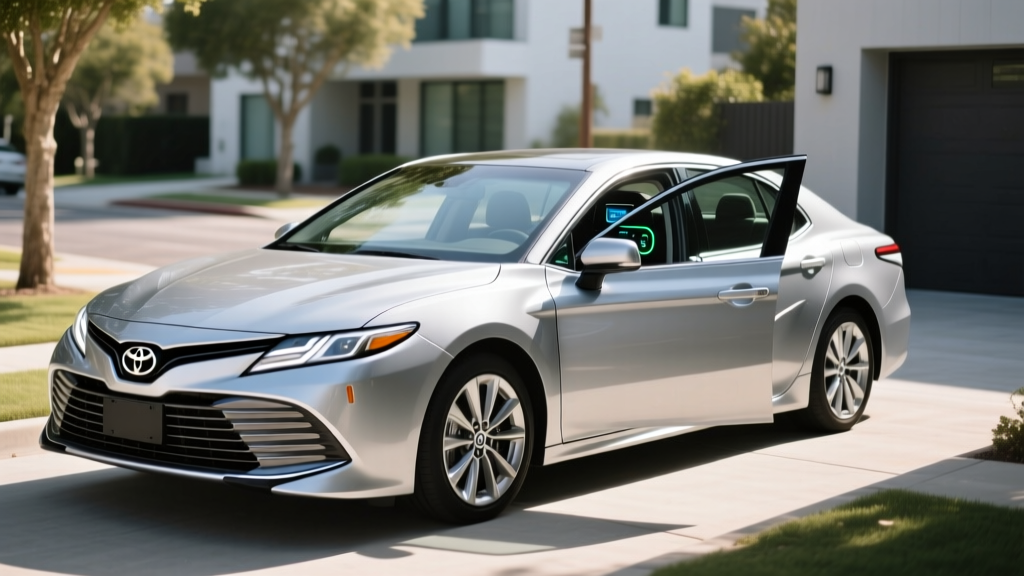
The 2026 Toyota Camry XLE Hybrid occupies a specific niche in the midsize sedan market: it's a conventional hybrid (HEV) that requires no plug, no range planning, and no charging infrastructure — yet returns fuel economy that embarrasses many compact cars. For buyers weighing an electrified purchase but hesitant about EV charging logistics or PHEV complexity, the Camry XLE Hybrid remains one of the most practical entry points into hybrid ownership.
This guide covers everything a research-driven buyer needs: exact EPA MPG figures, the fifth-generation Toyota Hybrid System powertrain, real-world fuel economy expectations, battery longevity data, pricing across trims, and where this car fits against plug-in hybrids and full battery-electric vehicles.
2026 Toyota Camry XLE Hybrid at a Glance: Key Specs
| Specification | 2026 Camry XLE Hybrid (FWD) | 2026 Camry XLE Hybrid (AWD) |
|---|---|---|
| Powertrain | 2.5L 4-cyl + electric motor (HEV) | 2.5L 4-cyl + dual electric motors (HEV) |
| Combined Horsepower | 225 hp | 232 hp |
| EPA MPG (City / Hwy / Combined) | 51 / 49 / 51 | 49 / 47 / 48 |
| Fuel Tank Capacity | 13.2 gallons | 13.2 gallons |
| Estimated Total Range | ~673 miles | ~634 miles |
| Hybrid Battery Type | Lithium-ion | Lithium-ion |
| Drivetrain | Front-wheel drive | Electronic AWD |
| 0–60 mph (est.) | ~7.2 seconds | ~6.9 seconds |
| Starting MSRP (XLE Hybrid) | ~$34,495 | ~$35,995 |
| Hybrid Battery Warranty | 10 years / 150,000 miles | |
Note: MSRP figures are approximate based on Toyota's current pricing structure and may vary by dealer. Destination charges apply.
How Many MPG Does the 2026 Camry XLE Hybrid Actually Get?
The EPA rates the front-wheel-drive 2026 Camry XLE Hybrid at 51 MPG city, 49 MPG highway, and 51 MPG combined. The AWD variant drops slightly to 49/47/48. These numbers are published on fueleconomy.gov, the official EPA source.
| Driving Scenario | FWD EPA | FWD Real-World Expectation | AWD EPA | AWD Real-World Expectation |
|---|---|---|---|---|
| City | 51 MPG | 48–54 MPG | 49 MPG | 46–52 MPG |
| Highway | 49 MPG | 44–48 MPG | 47 MPG | 42–46 MPG |
| Combined | 51 MPG | 46–52 MPG | 48 MPG | 44–50 MPG |
Why Real-World MPG Can Exceed EPA in City Driving
Unlike EVs (which lose range on the highway) or gas cars (which are least efficient in stop-and-go traffic), conventional hybrids like the Camry XLE often beat their EPA city rating in real-world urban driving. Here's why:
- Regenerative braking: Every stop converts kinetic energy back into battery charge, which the electric motor then uses for the next acceleration. More stops = more regen = better city efficiency.
- EV-mode creeping: At low speeds and in parking lots, the Camry can run on its electric motor alone for short distances, burning zero fuel.
- Engine-off coasting: The hybrid system shuts off the gas engine when coasting or idling, eliminating waste.
On the highway, expect efficiency to dip closer to the low-to-mid 40s. Sustained high speeds demand continuous engine output with less regenerative opportunity. Cold weather also reduces MPG — expect a 5–10% drop in winter as the engine runs more frequently to provide cabin heat and maintain battery temperature.
HEV vs. PHEV vs. EV: Which Powertrain Fits Your Life?
The 2026 Camry is offered exclusively as a conventional hybrid (HEV) — it has no plug, no electric-only range to manage, and refuels at any gas station in under five minutes. This is a deliberate distinction from plug-in hybrids and battery-electric vehicles.
| Factor | HEV (Camry Hybrid) | PHEV (e.g., Prius Prime) | BEV (e.g., Tesla Model 3) |
|---|---|---|---|
| Plug Required? | No | Yes (for electric range) | Yes (always) |
| Electric-Only Range | ~1 mile at low speed | 25–45 miles typical | 250–360+ miles |
| Home Charging Needed? | No | Recommended (Level 2) | Essential (Level 2) |
| City MPG / MPGe | 51 MPG | ~50 MPG + ~120 MPGe electric | ~130+ MPGe |
| Total Range | ~600+ miles | ~400–600 miles combined | 250–360 miles |
| Fuel/Charging Cost per Mile | ~$0.07–0.09 | ~$0.04–0.08 (varies) | ~$0.03–0.05 |
| Federal Tax Credit | None | Up to $7,500 (§30D) | Up to $7,500 (§30D) |
| Maintenance Complexity | Low (standard hybrid) | Moderate (two systems) | Low (no engine) |
- You lack access to home or workplace charging
- You want EV-like city efficiency without any plug-in routine
- You take frequent road trips and don't want to plan charging stops
- You want proven long-term reliability with minimal new-technology risk
- You can install a Level 2 home charger
- Your daily commute is under 40 miles round-trip (you'd rarely use gas)
- You want to qualify for the federal tax credit
- You have reliable home Level 2 charging
- You want the lowest per-mile fuel cost and near-zero routine maintenance
- Your daily driving is under 250 miles and you road-trip infrequently (or are willing to DC fast-charge)
Powertrain Deep Dive: The Fifth-Generation Toyota Hybrid System
The 2026 Camry XLE Hybrid uses Toyota's fifth-generation hybrid architecture, pairing a 2.5-liter Dynamic Force four-cylinder engine with one or two electric motor-generators and a lithium-ion hybrid battery pack.
How the System Works
Unlike a traditional car where the engine does everything, the Camry Hybrid uses an electronically controlled continuously variable transmission (eCVT) to blend power from three sources:
- Gas engine (2.5L I4): Produces approximately 184 hp and 163 lb-ft of torque. It operates primarily in its most efficient RPM range, with the electric motor filling in torque gaps.
- Front electric motor (MG2): Provides immediate torque from zero RPM, assists during acceleration, and acts as a generator during regenerative braking.
- Rear electric motor (AWD only): On AWD models, a second, independent rear motor provides electronic all-wheel drive without a mechanical driveshaft — engaging only when traction demands it.
The combined system output is 225 hp for FWD and 232 hp for AWD. This is sufficient for confident highway merging and passing, though the Camry Hybrid is tuned for efficiency rather than sportiness. The eCVT delivers smooth, linear acceleration without traditional shift points.
Hybrid Battery: Small, Purposeful, and Durable
The Camry's hybrid battery is a lithium-ion pack with approximately 1.0–1.6 kWh of usable capacity (Toyota does not publish exact kWh for HEV packs, as they're not designed for plug-in use). This battery isn't meant to drive the car long distances on electric power — it's a buffer that stores regenerative energy and delivers quick bursts of electric assist.
Because the battery cycles through shallow charge/discharge events (typically staying between 40–80% state of charge), degradation is minimal compared to a full EV battery. The system's thermal management and conservative charge window are engineered for a 15+ year service life under normal conditions.
Pricing, Trims, and Tax Credit Eligibility
The 2026 Camry is offered exclusively in hybrid form across four main trim levels. The XLE Hybrid sits near the top of the lineup as the premium comfort trim.
| Trim | FWD MSRP (approx.) | AWD MSRP (approx.) | Key Features |
|---|---|---|---|
| LE Hybrid | $29,995 | $31,495 | Base hybrid, 8" touchscreen, TSS 3.0 |
| SE Hybrid | $31,495 | $32,995 | Sport-tuned suspension, 18" wheels |
| XLE Hybrid | $34,495 | $35,995 | Leather-trimmed seats, 12.3" display, ambient lighting |
| XSE Hybrid | $35,495 | $36,995 | Sport styling + premium features |
All prices are approximate MSRP and exclude destination charges (~$1,095). Dealer pricing may vary.
Does the 2026 Camry Hybrid Qualify for a Federal Tax Credit?
No. The conventional Camry Hybrid (HEV) does not qualify for the federal §30D clean vehicle tax credit. Under current IRS rules, the §30D credit applies only to plug-in electric vehicles — battery-electric vehicles (BEVs) and plug-in hybrids (PHEVs) with a minimum battery capacity of 7 kWh.
Because the Camry HEV's hybrid battery is approximately 1.0–1.6 kWh and cannot be plugged in, it falls outside the credit's eligibility requirements entirely. This is true regardless of buyer income or MSRP.
- Federal §30D credit: Not eligible (HEV — no plug, battery below 7 kWh threshold)
- State hybrid incentives: A handful of states offer modest rebates or HOV-lane access for hybrids, but most have shifted incentives toward PHEVs and BEVs. Check your state's energy office for current programs.
- Employer or utility rebates: Some utilities and employers offer small incentives for purchasing any electrified vehicle — worth checking locally.
Reliability, Maintenance, and Battery Replacement Costs
The Toyota Camry Hybrid's reputation for reliability is one of its strongest selling points. Toyota's hybrid system has been in continuous production since 1997 (Prius), and the Camry Hybrid has been in the lineup since 2007. The fifth-generation system in the 2026 model benefits from two decades of iterative refinement.
What Makes It Reliable
- eCVT simplicity: The planetary gearset eCVT has no belts, no clutch packs, and no traditional shifting components. It's one of the most durable transmission designs in the industry.
- Conservative battery management: The hybrid battery never fully charges or fully depletes, dramatically reducing cell stress and extending lifespan.
- Reduced brake wear: Regenerative braking handles much of the deceleration, meaning conventional brake pads and rotors last significantly longer than on gas-only vehicles — often 80,000–100,000+ miles before replacement.
- Engine longevity: The 2.5L Dynamic Force engine runs at optimized RPM ranges with less thermal stress than a conventional engine that must handle all driving demands alone.
Battery Replacement Cost: What If It Fails?
While hybrid battery failure within the warranty period is covered by Toyota, out-of-warranty replacement is a legitimate concern for long-term owners.
- New OEM replacement battery: $2,000–$4,000 (parts and labor at a Toyota dealer)
- Refurbished/remanufactured battery: $1,000–$2,500 from aftermarket suppliers
- Individual cell/module replacement: Some independent hybrid specialists can replace only the failed modules for $500–$1,500
Based on historical data from previous-generation Camry Hybrids, most hybrid batteries last 150,000–200,000+ miles before significant degradation or failure. Given the 10-year/150,000-mile warranty, most owners will never face an out-of-pocket battery replacement.
Routine Maintenance Savings
Compared to a gas-only midsize sedan, the Camry Hybrid eliminates or reduces several maintenance items:
- No traditional starter motor to replace (the hybrid motor starts the engine)
- Extended brake pad life (regenerative braking)
- No alternator (the hybrid system handles electrical generation)
- Standard oil changes still required (~every 10,000 miles with synthetic)
Who Should Buy the 2026 Camry XLE Hybrid?
Pros
- 51 MPG combined (FWD) — among the best of any midsize sedan
- No plug-in charging required; works with your existing routine
- 600+ miles of total range per tank
- 10-year / 150,000-mile hybrid battery warranty
- Proven fifth-generation hybrid system with deep reliability history
- XLE trim offers premium comfort: leather, 12.3" display, quiet cabin
- Standard Toyota Safety Sense 3.0 (adaptive cruise, lane-keeping, auto emergency braking)
- AWD available for $1,500 premium with minimal MPG penalty
Cons
- No federal tax credit eligibility (HEV)
- No electric-only driving beyond very low-speed maneuvers
- eCVT can produce a droning engine note under hard acceleration
- 225–232 hp is adequate, not quick — not a performance sedan
- Higher base price than the gas-only Camry of previous generations (though the gas model is now discontinued)
- Per-mile fuel cost still higher than a BEV charging at home
Frequently Asked Questions
How many MPG does the 2026 Toyota Camry XLE Hybrid get?
The FWD Camry XLE Hybrid is EPA-rated at 51 city / 49 highway / 51 combined. The AWD version rates 49/47/48. In real-world city driving, many owners report matching or slightly exceeding the EPA city figure thanks to regenerative braking. Highway driving typically returns mid-to-low 40s.
Does the Camry Hybrid need to be plugged in?
No. The Camry Hybrid is a conventional hybrid (HEV), not a plug-in hybrid (PHEV). It charges its own battery through regenerative braking and the gas engine. You simply fill it with gasoline at any station.
How far can the Camry Hybrid drive on electric power alone?
The Camry HEV can creep on electric power alone for roughly 0.5–1 mile at very low speeds (under 25 mph) in parking lots or heavy traffic. This is not designed for meaningful electric-only commuting — it's an efficiency assist. If you want 25–40 miles of electric-only range, you need a PHEV like the Toyota Prius Prime or RAV4 Prime.
Is the Camry Hybrid reliable? What about battery replacement?
Toyota's hybrid system is among the most proven in the industry, with nearly 30 years of production history. The 2026 Camry Hybrid battery is covered for 10 years / 150,000 miles. Out-of-warranty battery replacement typically costs $2,000–$4,000 for a new OEM unit, but most batteries last 150,000–200,000+ miles based on historical data.
Does the 2026 Camry Hybrid qualify for any tax credits?
The Camry Hybrid (HEV) does not qualify for the federal §30D clean vehicle tax credit because it is not a plug-in vehicle and its battery capacity is below the 7 kWh minimum. Some states or utilities may offer small incentives for hybrid purchases — check your local programs. For the full $7,500 federal credit, you would need to consider a PHEV or BEV that meets current IRS sourcing, MSRP, and income requirements.
How does the Camry Hybrid compare to a full EV for daily commuting?
If you have home charging and a commute under 250 miles, a BEV will cost less per mile to "fuel" (~$0.04/mile vs. ~$0.08/mile for the Camry Hybrid) and requires less maintenance. However, the Camry Hybrid wins on convenience — no charging infrastructure needed, 600+ mile range, and five-minute refueling. For apartment dwellers, frequent road-trippers, or those in areas with sparse charging networks, the hybrid's flexibility is a significant advantage.
Is AWD worth it on the Camry Hybrid?
The electronic AWD system adds $1,500 and costs only 2–3 MPG combined. It engages a rear electric motor only when needed (slippery conditions, hard acceleration from a stop), so it doesn't constantly drain efficiency. If you live in a region with snow, ice, or frequent rain, the AWD system provides meaningful traction benefits with a minimal fuel-economy trade-off. For dry-climate drivers, FWD is the more efficient choice.
Sources: EPA fuel economy data via fueleconomy.gov; IRS clean vehicle credit rules via irs.gov; Toyota manufacturer specifications.