Quick Verdict: The Sporty Hybrid Sedan That Doesn't Ask You to Compromise
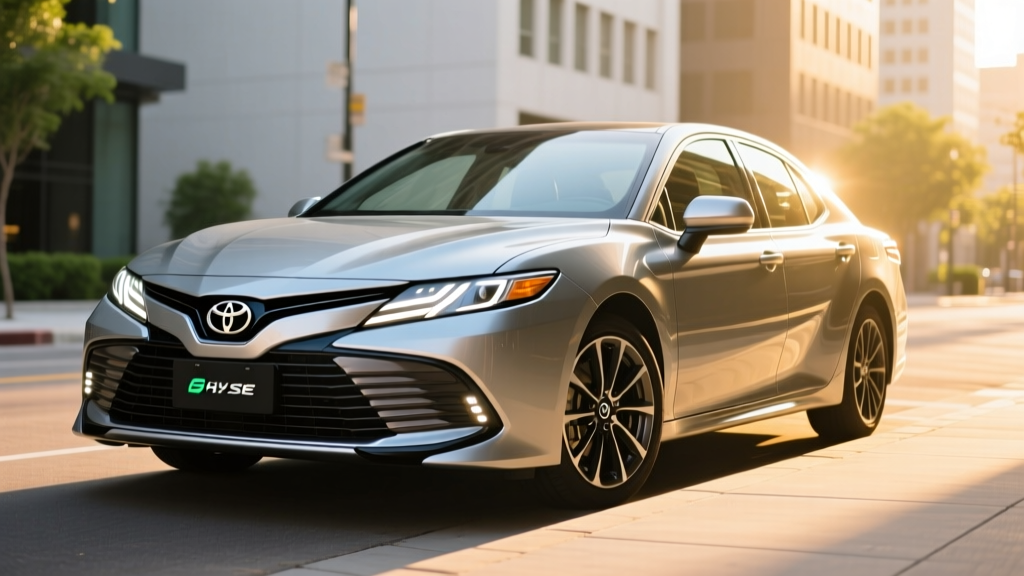
The 2026 Toyota Camry Hybrid XSE occupies a specific niche: buyers who want the fuel-sipping efficiency of a hybrid powertrain wrapped in the sharpest styling Toyota offers in the Camry lineup. With the ninth-generation Camry now fully hybrid across all trims, the XSE sits at the top as the sport-oriented variant, pairing a 225-horsepower all-wheel-drive powertrain with an EPA-estimated 44 MPG combined. It doesn't plug in. It doesn't require lifestyle changes. It just sips fuel and looks good doing it.
But how does that EPA number hold up in real-world driving? What does the hybrid battery warranty actually cover? And does the XSE's sport tuning justify its price premium over the SE or XLE? We break down every number that matters.
2026 Camry Hybrid XSE: Core Specifications
| Spec | 2026 Camry Hybrid XSE (AWD) |
|---|---|
| Powertrain | 2.5L 4-cyl + 2 electric motors (AWD e-motor rear) |
| Combined Horsepower | 225 hp |
| Transmission | eCVT (electronically controlled) |
| EPA MPG (City / Hwy / Combined) | 44 / 43 / 44 |
| Fuel Tank | 13.2 gallons |
| Total Range (est.) | ~580 miles |
| 0-60 mph | ~7.1 seconds |
| Drivetrain | Electronic On-Demand AWD |
| Hybrid Battery | Lithium-ion, ~1.6 kWh (self-charging HEV) |
| Base MSRP | ~$35,495 (est., incl. destination) |
| Federal Tax Credit (§30D) | Not eligible (HEV, not PHEV/BEV) |
| Hybrid Battery Warranty | 10 years / 150,000 miles |
| Powertrain Warranty | 5 years / 60,000 miles |
Fuel Economy: EPA Numbers vs. Real-World MPG
The 2026 Camry Hybrid XSE with AWD carries an EPA estimate of 44 MPG city, 43 MPG highway, and 44 MPG combined, according to fueleconomy.gov. Front-wheel-drive trims (SE, XLE) push slightly higher at 51/49/50 MPG, but the XSE's AWD system and sport-tuned suspension carry a modest efficiency penalty.
Toyota's hybrid system excels in stop-and-go city driving, where regenerative braking recaptures energy constantly. Expect to meet or slightly exceed the 44 MPG city figure in urban commuting. Highway driving at 75+ mph will likely yield 39-42 MPG. In cold weather (below 35°F), expect a 5-10% reduction as the engine runs more frequently for cabin heat. Over a mixed 12,000-mile year, most XSE AWD owners report averaging 41-45 MPG — remarkably close to the EPA sticker.
For context, a comparable gas-only midsize sedan averages 28-30 MPG combined. The Camry Hybrid XSE cuts fuel consumption by roughly a third, translating to approximately $500-$700 in annual fuel savings depending on local gas prices and mileage.
HEV vs. PHEV vs. EV: Where Does the Camry Hybrid Fit?
The 2026 Camry is offered exclusively as a conventional hybrid (HEV). Toyota does not offer a plug-in hybrid (PHEV) Camry variant. Understanding the distinction matters for your purchase decision.
| Feature | HEV (Camry Hybrid) | PHEV (e.g., RAV4 Prime) | BEV (e.g., Tesla Model 3) |
|---|---|---|---|
| Plug in to charge? | No — self-charging | Yes (Level 1/2) | Yes (Level 1/2/DC) |
| Electric-only range | ~1 mile at low speed | 25-42 miles typical | 250-360+ miles |
| Battery size | ~1.6 kWh | 13-18 kWh | 60-82 kWh |
| Federal tax credit (§30D) | Not eligible | Up to $7,500* | Up to $7,500* |
| Home charging needed? | No | Recommended | Essential |
| Gas engine? | Yes | Yes | No |
*§30D credit eligibility depends on MSRP caps, buyer income limits, and battery sourcing requirements per IRS guidelines. Consult a tax professional.
The Camry Hybrid XSE is the right choice if you want maximum fuel efficiency with zero behavioral change — no charging cables, no range planning, no dependency on charging infrastructure. You fuel up at any gas station and drive exactly as you always have.
Powertrain Deep Dive: How the 225-HP Hybrid System Works
The Camry Hybrid XSE uses Toyota's fifth-generation hybrid system, pairing a 2.5-liter Dynamic Force four-cylinder engine with two motor-generators through an eCVT planetary gearset. The front axle receives power from the engine and a primary drive motor, while a dedicated rear-axle electric motor provides electronic on-demand AWD — there is no mechanical driveshaft connecting front and rear.
Engine output: 184 hp / 163 lb-ft (gas engine alone)
Front motor: 134 hp / 155 lb-ft
Rear AWD motor: 40 hp / 89 lb-ft
Net system output: 225 hp (combined, not additive peak)
The eCVT is not a traditional belt-and-pulley CVT. It uses a planetary gearset to seamlessly blend engine and motor power, eliminating the "rubber band" feel associated with older CVTs. The XSE trim adds paddle shifters with six simulated gear ratios for drivers who want more engagement on winding roads.
Acceleration to 60 mph takes approximately 7.1 seconds — respectable for a midsize hybrid sedan and roughly a second quicker than the previous-generation Camry Hybrid. The AWD system engages automatically when slippage is detected or under hard acceleration, and operates seamlessly without driver input.
Pricing, Trims, and Tax Credit Reality
The 2026 Camry Hybrid lineup spans four trims, all using the same hybrid powertrain:
| Trim | Drivetrain | Est. MSRP (incl. dest.) | EPA Combined MPG |
|---|---|---|---|
| LE | FWD | ~$29,995 | 51 |
| SE | FWD or AWD | ~$31,495 / ~$32,495 | 47 / 44 |
| XLE | FWD or AWD | ~$33,995 / ~$34,995 | 47 / 44 |
| XSE | AWD (standard) | ~$35,495 | 44 |
The Camry Hybrid is a conventional HEV, not a plug-in vehicle. Under IRS §30D rules, only plug-in electric vehicles (BEVs and PHEVs) with sufficient battery capacity qualify for the federal clean vehicle credit. The Camry Hybrid does not qualify. Some states or municipalities may offer modest rebates for high-efficiency hybrids — check your local programs. The IRS clean vehicle credit page details current eligibility requirements for plug-in vehicles.
The XSE commands a roughly $1,500 premium over the SE AWD, primarily for its sport-tuned suspension, 19-inch alloy wheels, unique front and rear styling, dual exhaust tips, and interior upgrades including sport SofTex-trimmed seats. Whether that premium is worthwhile depends on how much you value the visual and dynamic differentiation.
Battery Longevity, Warranty, and Replacement Costs
Coverage: 10 years or 150,000 miles (whichever comes first), transferable to subsequent owners.
What's covered: Hybrid battery pack, hybrid control module, and related hybrid system components.
Capacity threshold: Toyota warrants the battery against defects and abnormal capacity loss. There is no published minimum State of Health (SoH) percentage, but owners rarely report significant degradation within the warranty period.
Toyota's hybrid battery track record is among the strongest in the industry. The Prius, which pioneered this architecture, routinely sees original hybrid batteries lasting 200,000+ miles. The lithium-ion pack in the current Camry Hybrid is relatively small (~1.6 kWh) and is managed conservatively — the system never fully charges or fully depletes it, operating in a narrow state-of-charge window (roughly 40-80%) to minimize degradation.
Replacement cost if out of warranty: A new OEM hybrid battery pack for the current-generation Camry Hybrid runs approximately $2,500-$4,000 installed at a Toyota dealer. Third-party refurbished packs are available for $1,500-$2,500. Given the conservative battery management and Toyota's history, most owners will never face this expense.
Pros and Cons: The Honest Assessment
- 44 MPG combined AWD is exceptional for the segment
- No plug-in required — zero lifestyle adjustment
- 10-year / 150,000-mile hybrid battery warranty
- AWD standard on XSE — rare for hybrid sedans
- Strong Toyota resale value and reliability reputation
- ~580-mile total range eliminates refueling stops on long trips
- Refined powertrain with minimal engine drone
- No federal tax credit (HEV, not PHEV/BEV)
- AWD XSE gets 7 fewer combined MPG than FWD LE
- eCVT prioritizes efficiency over sporty feel
- ~1.6 kWh battery means virtually no electric-only driving
- XSE premium over SE AWD is mainly cosmetic
- No DC fast charging capability (not applicable to HEV)
- Competing PHEVs offer 25-40 miles of pure electric range
Who Should Buy the Camry Hybrid XSE — And Who Shouldn't
Choose the Camry Hybrid XSE if:
- You lack home charging access (apartment, street parking) and can't plug in
- You want 40+ MPG without thinking about charging or range
- You value AWD for snow/rain but don't want an SUV
- You plan to keep the car 8-10+ years (warranty coverage and Toyota reliability)
- You drive 15,000+ miles annually and fuel cost matters
Look elsewhere if:
- You have home charging and want pure electric daily driving → consider a PHEV like the RAV4 Prime or a BEV like the Tesla Model 3 or Hyundai Ioniq 6
- You want federal tax credit eligibility → you need a qualifying PHEV or BEV
- You prioritize maximum MPG above styling → the Camry Hybrid LE FWD gets 51 combined for ~$5,500 less
- You want a truly sporty driving experience → the hybrid powertrain prioritizes efficiency; a turbocharged gas sedan will feel more engaging
Frequently Asked Questions
How many MPG does the 2026 Camry Hybrid XSE actually get?
The EPA rates it at 44 city / 43 highway / 44 combined. Real-world experience with Toyota's current hybrid system suggests you'll meet or slightly exceed the city figure in stop-and-go driving. Sustained highway driving at 75+ mph typically yields 39-42 MPG. Cold weather reduces efficiency by 5-10%. Most owners average 41-45 MPG over a mixed-driving year.
Does the 2026 Camry Hybrid XSE qualify for any tax credit?
No. The Camry Hybrid is a conventional hybrid (HEV), not a plug-in vehicle. The federal §30D clean vehicle credit applies only to BEVs and PHEVs that meet battery sourcing, MSRP, and buyer income requirements. Some state or utility programs offer small rebates for efficient hybrids — check your local offerings.
Is the Camry Hybrid reliable, and what does battery replacement cost?
Toyota's hybrid system has a two-decade reliability track record, with many original Prius and Camry Hybrid batteries lasting 200,000+ miles. The hybrid battery is warranted for 10 years / 150,000 miles. If replacement is needed out of warranty, expect $2,500-$4,000 for a new OEM pack or $1,500-$2,500 for a refurbished unit.
Can the Camry Hybrid XSE drive on electric power alone?
Only for very short distances (under a mile) at low speeds, such as creeping through a parking lot. The ~1.6 kWh battery is too small for meaningful electric-only driving. The engine engages frequently, especially under acceleration or at highway speeds. If electric-only commuting is a priority, a PHEV with 25+ miles of EV range is the right choice.
How does the XSE differ from the SE and XLE trims?
The XSE adds sport-tuned suspension, 19-inch black alloy wheels, a unique gloss-black grille and rear spoiler, dual chrome exhaust tips, paddle shifters, and SofTex sport seats. Mechanically, the hybrid powertrain is identical across all trims. The XSE is available exclusively with AWD, while the SE and XLE offer FWD or AWD.
Does the Camry Hybrid need to be plugged in?
No. The Camry Hybrid is a self-charging HEV. The battery recharges through regenerative braking and the gasoline engine. There is no plug, no charging cable, and no dependency on charging infrastructure. You refuel at any gas station as you would with a conventional car.