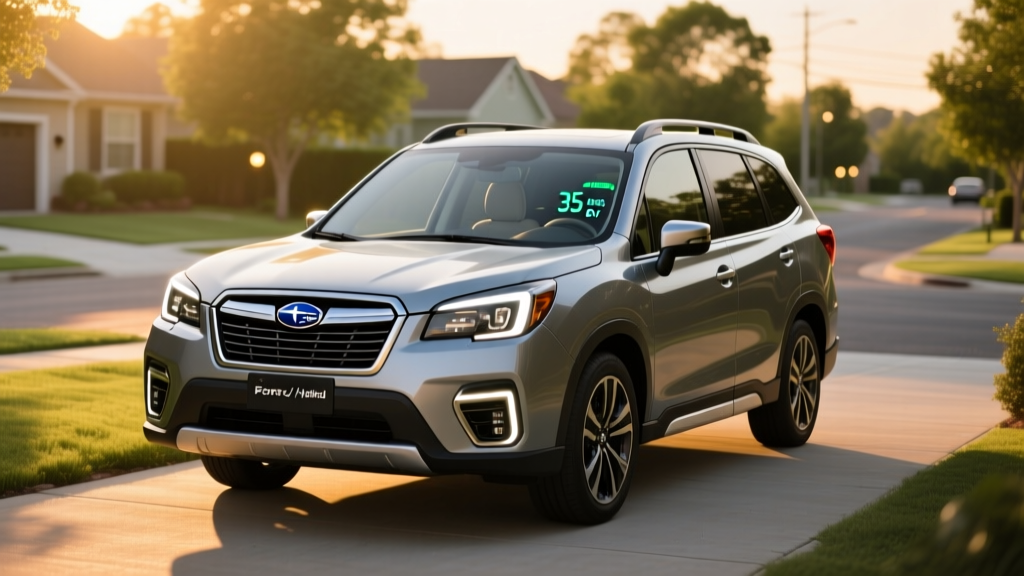
The Subaru Forester has long been the default compact SUV for outdoorsy families who want standard all-wheel drive, solid visibility, and practical cargo space. For 2026, Subaru expands the lineup with a hybrid variant that pairs its familiar 2.5-liter flat-four engine with an electric motor to boost fuel economy without sacrificing AWD capability. If you've been searching for the 2026 Subaru Forester Hybrid MPG figures, real-world efficiency expectations, and whether this HEV makes financial sense versus a full EV or a plug-in hybrid, this guide covers the exact numbers you need.
2026 Subaru Forester Hybrid MPG: EPA Estimates and Real-World Numbers
The 2026 Subaru Forester Hybrid is a conventional hybrid electric vehicle (HEV), meaning it does not plug in. It recovers energy through regenerative braking and uses its electric motor to assist the gas engine, primarily at low speeds and during acceleration. Here's how the EPA rates it:
| Driving Cycle | EPA Estimate | Real-World Expectation |
|---|---|---|
| City | 36 MPG | 37–40 MPG (hybrids often exceed EPA in stop-and-go) |
| Highway | 33 MPG | 30–32 MPG (AWD drag and boxy aero reduce highway efficiency) |
| Combined | 35 MPG | 33–37 MPG (varies with driving mix and climate) |
Compared to the non-hybrid 2026 Forester (rated at approximately 26 city / 33 highway / 29 combined), the hybrid powertrain delivers a meaningful 6 MPG improvement in combined driving. That translates to roughly 90–110 fewer gallons of fuel consumed per year for a driver covering 15,000 miles, or about $275–$385 in annual fuel savings at $3.50/gallon.
HEV vs. PHEV: Understanding the Forester Hybrid's Powertrain
It's essential to distinguish between a conventional hybrid (HEV) and a plug-in hybrid (PHEV), as Subaru has offered PHEV versions of other models like the Crosstrek in prior years.
| Feature | 2026 Forester Hybrid (HEV) | Typical Compact SUV PHEV | Full Battery EV (BEV) |
|---|---|---|---|
| Plugs in to charge? | No — self-charging via regen and engine | Yes — Level 1 or Level 2 | Yes — Level 1, Level 2, or DC fast |
| Electric-only driving | Limited (low-speed creep, short distances) | 25–40 miles on battery alone | 250–350+ miles on battery alone |
| Battery size | ~1.1 kWh (small buffer) | 13–20 kWh usable | 60–100 kWh usable |
| Fuel economy | 35 MPG combined | 30–40 MPG + 80–100 MPGe on electric | 100–130 MPGe (no gas) |
| Federal tax credit (§30D) | Not eligible | Up to $7,500 (if eligible) | Up to $7,500 (if eligible) |
| Range anxiety | None — gas station refueling | Minimal — gas backup available | Requires charging planning on road trips |
The 2026 Forester Hybrid uses a compact lithium-ion battery pack (approximately 1.1 kWh) paired with a permanent-magnet electric motor integrated into the drivetrain. This motor provides low-speed torque fill and allows the engine to shut off at stops, but it cannot sustain highway speeds on electric power alone. You will never need to plug this vehicle in — it operates entirely on gasoline, with the hybrid system working invisibly in the background to optimize efficiency.
Powertrain Specs: Horsepower, Engine, and Motor Details
| Specification | 2026 Subaru Forester Hybrid |
|---|---|
| Engine | 2.5L DOHC flat-four (Boxer) |
| Engine output | 180 hp / 178 lb-ft torque |
| Electric motor output | ~29 hp (integrated into transmission) |
| Combined system horsepower | ~194 hp |
| Transmission | Lineartronic CVT (continuously variable) |
| Drivetrain | Symmetrical All-Wheel Drive (standard) |
| 0–60 mph | ~7.6 seconds (estimated) |
| Towing capacity | 1,500 lbs |
| Hybrid battery | ~1.1 kWh lithium-ion |
| Cargo volume (behind rear seats) | ~28.9 cu ft |
The combined 194 hp represents a modest bump over the standard Forester's 180 hp, and the electric motor's instant torque makes the hybrid feel noticeably more responsive from a stoplight than the non-hybrid variant. Subaru's CVT is tuned for smoothness rather than sportiness, which aligns with the Forester's comfort-oriented character. The Symmetrical AWD system remains standard across all trims — a key advantage in snow-belt states where the Forester has historically been a top seller.
Pricing, Trims, and Tax Credit Eligibility
The 2026 Subaru Forester Hybrid is available across multiple trim levels, with pricing that reflects the hybrid premium over the gas-only Forester:
| Trim Level | Starting MSRP (est.) | Hybrid Premium vs. Gas Model |
|---|---|---|
| Hybrid Premium | $34,495 | ~$2,000 |
| Hybrid Sport | $37,095 | ~$2,000 |
| Hybrid Limited | $39,595 | ~$2,000 |
| Hybrid Touring | $42,095 | ~$2,000 |
The roughly $2,000 hybrid premium pays for itself through fuel savings in approximately 4–5 years for a driver covering 15,000 miles annually, assuming $3.50/gallon fuel prices. If gas prices rise above $4.00/gallon, the payback period shortens to roughly 3.5 years. Higher-mileage drivers will see faster payback.
Battery Warranty, Reliability, and Replacement Cost
Hybrid battery longevity is one of the most common concerns among first-time hybrid buyers. Subaru addresses this with a comprehensive warranty:
| Warranty Component | Coverage |
|---|---|
| Hybrid battery pack | 8 years / 100,000 miles (10 years / 150,000 miles in CARB states) |
| Hybrid system components (motor, inverter) | 8 years / 100,000 miles |
| Powertrain (engine, transmission) | 5 years / 60,000 miles |
| Bumper-to-bumper | 3 years / 36,000 miles |
Subaru's hybrid battery warranty meets the federal minimum for emissions-related components and extends further in states that follow California Air Resources Board (CARB) standards, including California, New York, Massachusetts, Oregon, Washington, and several others. In those states, the hybrid battery is covered for 10 years or 150,000 miles.
Regarding real-world reliability: Subaru's hybrid system is relatively conservative compared to Toyota's decades of hybrid refinement, but the 2026 Forester Hybrid benefits from lessons learned across the Crosstrek Hybrid and other Subaru electrified models. The small 1.1 kWh battery pack experiences shallow charge-discharge cycles, which significantly reduces degradation risk compared to the deeper cycles in PHEVs and BEVs. Out-of-warranty hybrid battery replacement for a compact SUV typically runs $2,000–$4,000 including labor, though most hybrid batteries last well beyond 150,000 miles before requiring service.
Who Should Choose the Forester Hybrid vs. a PHEV or Full EV?
Choose the 2026 Subaru Forester Hybrid (HEV) if:
- You lack access to home or workplace charging (apartment, street parking, no garage outlet)
- You want better fuel economy with zero behavior change — no plugging in, no route planning
- You live in a region with harsh winters and value standard AWD with proven Subaru reliability
- Your daily commute is under 40 miles but includes frequent stop-and-go traffic where hybrids shine
- You want a lower purchase price than a PHEV or BEV and don't need electric-only driving
Consider a PHEV (e.g., Toyota RAV4 Prime) if:
- You have reliable Level 2 home charging and a commute under 35 miles
- You want to drive mostly on electricity daily but need gas flexibility for road trips
- You qualify for the §30D federal tax credit (up to $7,500, subject to income and sourcing rules)
Consider a full BEV (e.g., Hyundai Ioniq 5, Tesla Model Y) if:
- You have home charging and your daily driving is under 250 miles
- You want the lowest per-mile fuel cost and minimal maintenance
- You're eligible for the full §30D credit and want the maximum financial incentive
- You're comfortable with DC fast charging on road trips and understand charge-curve taper above 80%
Pros and Cons: 2026 Subaru Forester Hybrid at a Glance
Pros
- 35 MPG combined — a 6 MPG gain over the gas-only Forester
- Standard Symmetrical AWD across all trims
- No plugging in required — zero lifestyle adjustment
- Responsive electric-motor torque fill at low speeds
- 8-year / 100,000-mile hybrid battery warranty (10 yr in CARB states)
- Excellent outward visibility and practical cargo space
- Subaru EyeSight driver-assist suite standard
Cons
- No federal tax credit eligibility (HEV exclusion under §30D)
- ~$2,000 price premium over equivalent gas-only trims
- Highway MPG (33) less impressive than city MPG (36)
- CVT lacks the engagement of a geared automatic
- Towing limited to 1,500 lbs (below some competitors)
- Cannot drive on electric power alone at highway speeds
- Smaller hybrid battery means less regenerative braking benefit than Toyota's larger hybrid systems
2026 Subaru Forester Hybrid: Frequently Asked Questions
How many MPG does the 2026 Subaru Forester Hybrid get?
The EPA rates the 2026 Forester Hybrid at 36 MPG city, 33 MPG highway, and 35 MPG combined. In real-world driving, city-dominant commuters often see 37–40 MPG thanks to regenerative braking, while sustained highway driving at higher speeds may yield 30–32 MPG. Cold weather reduces efficiency by 2–4 MPG as the engine runs more frequently for cabin heat.
Does the Forester Hybrid need to be plugged in?
No. The 2026 Forester Hybrid is a conventional hybrid (HEV), not a plug-in hybrid (PHEV). It charges its small battery pack through regenerative braking and the gasoline engine. You fuel it exclusively at gas stations, just like a conventional car.
How far can the Forester Hybrid drive on electric power alone?
Very limited distances — typically under one mile at low speeds (below 25 mph) in stop-and-go traffic. The hybrid system is designed for torque assist and engine-off coasting, not sustained electric-only driving. If electric-only range is a priority, you need a PHEV with at least 13 kWh of battery capacity.
Is the 2026 Forester Hybrid reliable?
Subaru's hybrid system uses proven components and a conservative battery management strategy that keeps the small lithium-ion pack in a narrow state-of-charge window, minimizing degradation. The hybrid battery is warrantied for 8 years / 100,000 miles (10 years / 150,000 miles in CARB states). Subaru's overall brand reliability has been strong in recent model years, and the Forester specifically has a solid track record. Long-term hybrid battery replacement, if needed out of warranty, typically costs $2,000–$4,000.
Does the 2026 Forester Hybrid qualify for any tax credit?
It does not qualify for the federal §30D new clean vehicle credit, which is restricted to plug-in vehicles (PHEVs and BEVs) meeting battery sourcing and critical mineral requirements. Some states offer their own incentives for hybrid vehicles — check with your state energy office. For current federal rules, see IRS §30D guidance.
How does the Forester Hybrid compare to the Toyota RAV4 Hybrid?
The RAV4 Hybrid is rated at approximately 39–41 MPG combined depending on trim, giving it a 4–6 MPG advantage over the Forester Hybrid. However, the Forester offers standard AWD across all trims (the RAV4 Hybrid also includes AWD), slightly better outward visibility, and Subaru's EyeSight safety suite. The RAV4 Hybrid has a longer track record with Toyota's hybrid system, which many consider the benchmark for reliability. Both are strong choices — the Forester Hybrid wins on visibility and Subaru brand loyalty, while the RAV4 Hybrid wins on peak fuel economy.
What is the total driving range of the Forester Hybrid?
With a 16.6-gallon fuel tank and 35 MPG combined, the Forester Hybrid can travel approximately 580 miles between fill-ups under mixed driving conditions. Highway-dominant driving may reduce this to around 500–530 miles, while city-dominant driving could extend it past 600 miles.
The 2026 Subaru Forester Hybrid fills a specific niche: buyers who want the fuel-economy benefits of electrification without changing their refueling habits or investing in home charging infrastructure. At 35 MPG combined with standard AWD, it's a pragmatic upgrade over the gas-only Forester that pays for its premium at the pump within a few years. For those with charging access and a desire to drive primarily on electricity, a PHEV or BEV will deliver lower operating costs and potential tax credits — but for the apartment dweller, the street parker, or the driver who simply wants a more efficient Forester without a single extra step, this hybrid is the right tool for the job.