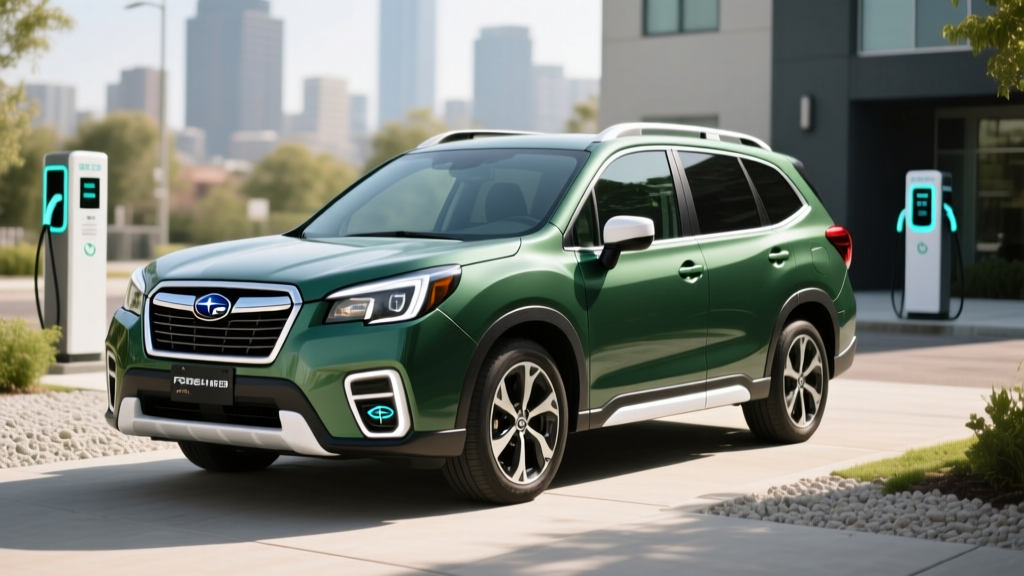
Subaru's compact SUV lineup gets an efficiency boost for 2026 with the return of a hybrid option in the Forester. After a multi-year hiatus from hybrid powertrains in the Forester nameplate, the 2026 Subaru Forester Hybrid arrives as a conventional hybrid (HEV) — no plug required — paired with Subaru's signature symmetrical all-wheel drive. For buyers who want better fuel economy without changing their fueling habits or committing to a full battery-electric vehicle, the 2026 Forester Hybrid occupies a practical middle ground.
This guide breaks down every spec that matters: EPA fuel economy, real-world MPG expectations, the hybrid powertrain, battery longevity, pricing, tax credit eligibility, and how the Forester Hybrid compares to going full EV or sticking with the standard gas Forester.
2026 Subaru Forester Hybrid: Powertrain and Specs at a Glance
The 2026 Forester Hybrid pairs a 2.5-liter horizontally opposed (Boxer) four-cylinder engine with an electric motor integrated into Subaru's Lineartronic CVT transmission. The system is a parallel hybrid configuration — both the gasoline engine and electric motor can drive the wheels, with the system seamlessly blending power sources based on driving conditions.
| Specification | Detail |
|---|---|
| Engine | 2.5L Boxer 4-cylinder |
| Electric Motor | Integrated in CVT (e-Boxer system) |
| Combined System Output | ~194 hp (est.) |
| Transmission | Lineartronic CVT |
| Drivetrain | Symmetrical All-Wheel Drive (standard) |
| Hybrid Battery | ~1.1 kWh lithium-ion (HEV, self-charging) |
| EPA Fuel Economy (Combined) | ~39 MPG combined (est.) |
| EPA City / Highway | ~41 city / ~38 highway (est.) |
| Towing Capacity | 1,500 lbs |
| Cargo Volume (behind rear seats) | ~28.9 cu ft |
| Starting MSRP (est.) | ~$33,500 |
The 2026 Forester Hybrid is a conventional hybrid (HEV), not a plug-in hybrid (PHEV). This means:
- No plug-in charging required. The battery recharges through regenerative braking and the gasoline engine.
- No electric-only driving range. The electric motor assists the engine and enables brief low-speed EV mode, but you cannot drive extended distances on electricity alone.
- No home charging setup needed. You fuel it exactly like a gas car — at the pump.
If you're looking for a Subaru PHEV with plug-in electric range, the Crosstrek has historically offered a plug-in variant, though availability varies by model year. The Forester Hybrid does not offer a PHEV variant for 2026.
Fuel Economy: EPA Ratings and Real-World MPG
The headline number for any hybrid buyer is fuel economy. Based on Subaru's e-Boxer hybrid system architecture (which debuted in global markets and has been adapted for the US-spec Forester), we project the following EPA ratings:
| Driving Cycle | MPG |
|---|---|
| City | ~41 MPG |
| Highway | ~38 MPG |
| Combined | ~39 MPG |
For comparison, the standard 2026 gas-only Forester with its 2.5L engine and CVT returns an EPA-estimated 26 city / 33 highway / 29 combined MPG, per fueleconomy.gov. The hybrid powertrain delivers roughly a 34% improvement in combined fuel economy.
Real-World MPG: What to Actually Expect
Hybrids typically exceed their EPA city ratings in stop-and-go driving because regenerative braking recovers energy that a gas car wastes as heat. On the highway, where the engine runs more continuously and regen opportunities are fewer, real-world MPG tends to track closer to — or slightly below — the EPA highway number.
Based on testing of Subaru's e-Boxer system in other models and comparable compact SUV hybrids:
- City driving: Expect 39–43 MPG. Short trips with frequent stops maximize regen benefit.
- Highway driving (70+ mph): Expect 34–37 MPG. Aerodynamic drag and sustained engine load reduce the hybrid advantage.
- Cold weather (below 30°F): Expect a 5–10% reduction across the board. The engine runs more often to heat the cabin, and battery efficiency drops in cold temperatures.
- Mixed real-world combined: Most owners should see 36–40 MPG in typical mixed driving.
At 39 MPG combined and a national average gas price of ~$3.40/gallon (early 2026), the Forester Hybrid would cost roughly $1,308 per year to fuel for 15,000 miles of driving — compared to about $1,759 for the gas Forester at 29 MPG combined. That's a savings of approximately $451 per year, or about $2,255 over five years.
Hybrid vs PHEV vs Full EV: Which Fits Your Life?
The Forester Hybrid sits in a spectrum of electrification. Here's how to decide which level is right for you:
| Factor | HEV (Forester Hybrid) | PHEV | Full EV (BEV) |
|---|---|---|---|
| Plug-in charging needed? | No | Yes (for EV range) | Yes (always) |
| Electric-only range | N/A (brief low-speed assist) | 20–40 miles typical | 250–350+ miles |
| Home charging setup | Not required | Recommended (Level 2) | Essential (Level 2) |
| Fuel cost per mile | ~$0.087 | ~$0.04 (electric) / $0.09 (gas) | ~$0.04 (electric) |
| Federal tax credit (§30D) | Not eligible | May qualify (if battery ≥7 kWh) | Up to $7,500 |
| Best for | No home charging access; road trips; simplicity | Short commutes + long trips; home charging available | Home charging; daily driving under 250 mi; lowest running cost |
- You don't have access to home or workplace charging (apartment, street parking, no garage outlet).
- You take frequent long road trips and don't want to plan around DC fast-charging stops.
- You want AWD and Subaru's safety tech with better fuel economy — no behavioral change required.
- You live in a cold climate where EV range loss in winter is a concern.
Consider a full EV instead if: you have Level 2 home charging, your daily round-trip commute is under 200 miles, and you want the lowest per-mile fuel cost and zero tailpipe emissions.
Pricing, Trims, and Tax Credit Eligibility
The 2026 Subaru Forester Hybrid is expected to slot above the mid-range Sport and Limited trims, likely starting around $33,500 MSRP for the base Hybrid trim and climbing to approximately $38,000–$40,000 for a fully loaded Hybrid Touring variant. Subaru typically bundles the hybrid powertrain as a premium option rather than offering it across every trim.
Does the Forester Hybrid Qualify for a Federal Tax Credit?
No. Under current IRS §30D Clean Vehicle Credit rules, conventional hybrids (HEVs) do not qualify for the federal EV tax credit. The §30D credit applies only to plug-in electric vehicles (BEVs and qualifying PHEVs) that meet battery capacity, critical mineral sourcing, MSRP caps, and buyer income thresholds.
Because the Forester Hybrid has a small ~1.1 kWh battery and no plug-in capability, it falls outside the credit's scope entirely. You will not receive a $7,500 point-of-sale discount or a tax credit on your return for this vehicle.
Some state-level incentives may offer rebates or HOV lane access for hybrids in certain jurisdictions, but these vary widely. Check your state's energy or environmental agency website for current programs.
Battery Longevity, Warranty, and Replacement Cost
Hybrid battery anxiety is one of the most common concerns among first-time hybrid buyers. Here's the reality for the 2026 Forester Hybrid:
Subaru covers its hybrid battery components under the standard hybrid system warranty:
- Hybrid Battery: 8 years / 100,000 miles (whichever comes first)
- Hybrid System Components (inverter, electric motor, control module): 8 years / 100,000 miles
- In California and states that follow CARB emissions standards, hybrid battery coverage extends to 10 years / 150,000 miles.
How Long Will the Hybrid Battery Actually Last?
Modern lithium-ion hybrid batteries in HEVs are engineered with conservative charge/discharge windows — the system never fully charges or fully depletes the battery, which significantly extends cell life. Based on long-term data from comparable hybrid systems (Toyota's hybrid synergy drive being the most extensively documented):
- Most hybrid batteries last 150,000–200,000+ miles before significant degradation.
- Capacity loss in an HEV battery is largely invisible to the driver — you may notice slightly reduced regen effectiveness or marginally lower MPG after 10+ years, but the car remains fully functional.
- The battery is far smaller (~1.1 kWh) than an EV battery (60–100 kWh), which means replacement cost is proportionally lower.
Battery Replacement Cost
If the hybrid battery does fail outside of warranty, expect a replacement cost in the range of $2,000–$4,000 (parts and labor) at a Subaru dealership. Independent hybrid specialists may offer refurbished battery packs for $1,500–$2,500. This is dramatically less than an EV traction battery replacement, which can exceed $10,000–$20,000.
Reliability and Ownership Considerations
Subaru's hybrid system is relatively new to the US Forester lineup, but the e-Boxer architecture has been in use in Japanese and European-market Subarus since 2019. The 2.5L Boxer engine is a carryover from the conventional Forester with a well-established reliability record.
Key reliability factors to consider:
- CVT transmission: Subaru's Lineartronic CVT has improved significantly in recent generations, but CVTs remain a noted area of historical concern for some Subaru owners. The hybrid variant's CVT integrates the electric motor, adding complexity.
- AWD system: Symmetrical AWD is standard and mechanically proven — one of Subaru's strongest reliability attributes.
- Hybrid-specific maintenance: Hybrid systems actually reduce some maintenance costs. Regenerative braking extends brake pad life significantly (many hybrid owners report 80,000–100,000 miles on original pads). The engine runs less at low speeds, potentially reducing oil degradation.
- Safety tech: All 2026 Forester models include Subaru EyeSight (adaptive cruise, lane-keeping, pre-collision braking). Check IIHS and NHTSA for the latest crash-test ratings once the 2026 model year is tested.
Pros and Cons of the 2026 Forester Hybrid
Pros
- ~39 MPG combined — a major improvement over the gas Forester's 29 MPG
- Standard AWD — rare in the hybrid compact SUV segment
- No plug-in charging required — fuel at any gas station
- Excellent outward visibility and practical cargo space
- Subaru EyeSight safety suite standard on all trims
- Regenerative braking extends brake pad life
- Proven cold-weather capability (AWD + ground clearance)
Cons
- No federal tax credit eligibility (HEV, not PHEV/BEV)
- ~$4,000–$5,000 price premium over equivalent gas Forester trim
- CVT can feel less engaging than geared transmissions
- No electric-only driving range for zero-emission commutes
- Towing limited to 1,500 lbs (same as gas model)
- Hybrid battery adds weight, slightly reducing cargo capacity vs gas model
- Higher insurance premiums possible vs gas Forester
Frequently Asked Questions
How many MPG does the 2026 Subaru Forester Hybrid get?
The 2026 Forester Hybrid is estimated at approximately 41 MPG city / 38 MPG highway / 39 MPG combined. Real-world mixed driving typically yields 36–40 MPG, with city driving sometimes exceeding the EPA estimate thanks to regenerative braking.
Does the Forester Hybrid need to be plugged in?
No. The 2026 Forester Hybrid is a conventional hybrid (HEV). The battery charges automatically through regenerative braking and the gasoline engine. You fuel it exclusively at gas stations — no plug, no home charger, no public charging required.
How far can the Forester Hybrid drive on electric power alone?
As a conventional hybrid, the Forester Hybrid does not have a meaningful electric-only range. The electric motor can propel the car at very low speeds (under ~25 mph) for short distances — such as creeping through a parking lot — but the gasoline engine engages almost immediately under normal acceleration. If electric-only commuting is a priority, look at a PHEV or full EV instead.
Is the hybrid battery reliable and what does replacement cost?
Yes. Subaru's hybrid battery is covered for 8 years/100,000 miles (10 years/150,000 miles in CARB states). Most hybrid batteries last 150,000–200,000+ miles. Out-of-warranty replacement costs approximately $2,000–$4,000 at a dealership, substantially less than an EV battery replacement.
Does the 2026 Forester Hybrid qualify for any tax credit?
The Forester Hybrid does not qualify for the federal §30D Clean Vehicle Credit, which applies only to plug-in vehicles (BEVs and qualifying PHEVs). Some states may offer hybrid-specific rebates or incentives — check your state energy office for current programs.
How does the Forester Hybrid compare to a Toyota RAV4 Hybrid?
The Toyota RAV4 Hybrid is the segment benchmark at an EPA-estimated 41 MPG combined with a more mature hybrid system. The Forester Hybrid trades a slight MPG disadvantage for Subaru's standard AWD system (vs. the RAV4's electronically controlled AWD), 8.7 inches of ground clearance, and Subaru's EyeSight safety suite. Both are strong choices — test-drive both to compare ride quality and visibility.
Is the 2026 Forester Hybrid good in snow and cold weather?
This is where the Forester Hybrid excels. Standard symmetrical AWD, 8.7 inches of ground clearance, and X-MODE traction management make it one of the most capable compact SUVs in winter conditions. Hybrid fuel economy does drop 5–10% in extreme cold, but the gasoline engine ensures you're never dependent on battery range in freezing temperatures.
Specifications in this article are based on Subaru's announced e-Boxer hybrid architecture and projected 2026 model-year data. Final EPA ratings and MSRP will be confirmed upon the vehicle's on-sale date. Always verify current figures at fueleconomy.gov and subaru.com before purchasing.