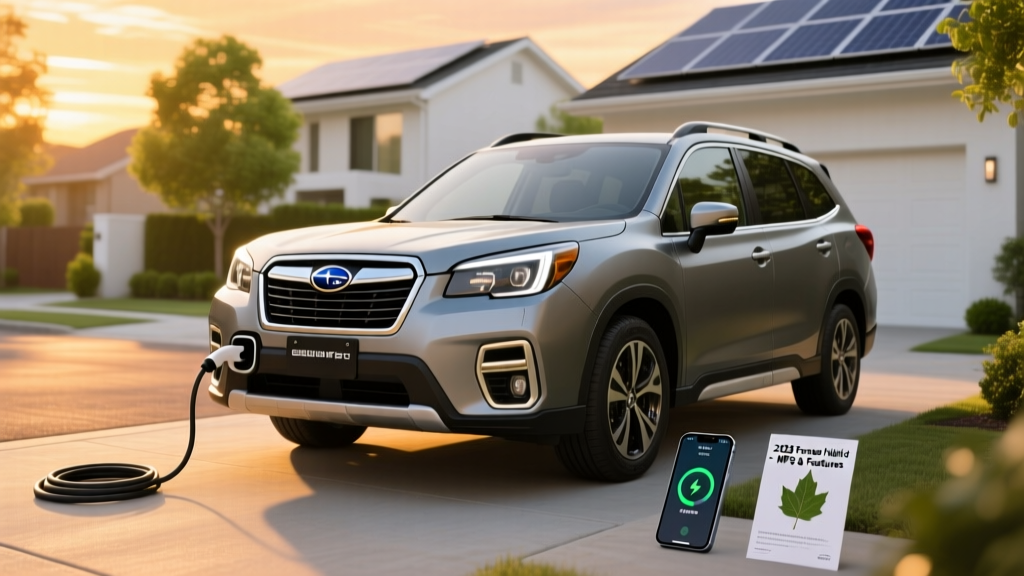
Subaru confirmed in late 2024 that a next-generation hybrid Forester is in development, leveraging Toyota's hybrid system technology as part of the long-standing partnership between the two automakers. For buyers tracking 2026 Subaru Forester hybrid availability, the picture is becoming clearer: the hybrid variant is expected to arrive as a 2026 or early 2027 model-year addition to the redesigned Forester lineup that debuted for 2025. Here is what we know, what is still preliminary, and how the hybrid Forester is likely to fit into the compact SUV landscape.
2026 Subaru Forester Hybrid: Expected Availability Timeline
Subaru has not published a firm on-sale date for the hybrid Forester as of mid-2026. Based on the automaker's product cadence and statements from CEO Tomomi Nakamura regarding expanded electrification, industry analysts expect the Forester Hybrid to arrive at U.S. dealerships in late 2026 as a 2027 model-year vehicle, or potentially as a mid-cycle addition to the 2026 lineup in select markets.
The current sixth-generation Forester (gas-only) went on sale for the 2025 model year. Subaru typically introduces powertrain variants 12 to 18 months after a generation launch, which aligns with a late-2026 or early-2027 hybrid debut. Buyers who want to reserve one should monitor Subaru's U.S. newsroom and local dealer announcements starting in Q3 2026.
HEV vs PHEV: Which Hybrid Forester Is Coming?
Subaru's hybrid strategy for the U.S. market has focused on conventional hybrids (HEVs) — vehicles that use a small battery and electric motor to assist the gasoline engine but do not plug in. The previous Crosstrek Hybrid was a plug-in hybrid (PHEV), but it was discontinued after the 2023 model year due to low take rates and the complexity of managing two powertrain architectures.
| Feature | Conventional Hybrid (HEV) | Plug-In Hybrid (PHEV) |
|---|---|---|
| Plugs in to charge? | No — charges via regenerative braking and engine | Yes — has a charge port for Level 1/Level 2 |
| Electric-only driving | Very limited (~1 mile at low speed) | 20–40 miles typical on battery alone |
| Battery size | 1–2 kWh (small, self-charging) | 10–20 kWh (larger, plug-in capable) |
| Federal tax credit | Not eligible under IRS §30D | Potentially eligible (up to $7,500, with rules) |
| Best for | Drivers who want better MPG without lifestyle change | Drivers with home charging who want EV-like daily commutes |
All evidence points to the 2026-era Forester Hybrid being a conventional HEV, similar in architecture to the hybrid system Subaru introduced in the Crosstrek and Impreza for the Japanese and European markets. This means no plug, no electric-only commute mode, but a meaningful bump in fuel economy — particularly in city driving where hybrid systems recapture the most energy through regenerative braking.
Estimated Fuel Economy: MPG Breakdown
The current 2025/2026 gas-only Subaru Forester with the 2.5-liter flat-four engine is rated by the EPA at approximately 26 city / 33 highway / 29 combined MPG (source: fueleconomy.gov). A hybrid variant using Toyota's proven series-parallel hybrid transaxle should deliver a substantial improvement.
| Vehicle | City MPG | Highway MPG | Combined MPG |
|---|---|---|---|
| 2025 Subaru Forester (gas, AWD) | 26 | 33 | 29 |
| 2026 Forester Hybrid (est., AWD) | ~35 | ~35 | ~35 |
| 2025 Toyota RAV4 Hybrid (AWD) | 41 | 38 | 39 |
| 2025 Honda CR-V Hybrid (AWD) | 40 | 34 | 37 |
Powertrain: Toyota-Sourced Hybrid Meets Subaru AWD
Subaru's hybrid system will almost certainly adapt the Toyota Hybrid System (THS) architecture — the same proven series-parallel setup found in millions of Toyota and Lexus vehicles. However, Subaru will integrate it with its signature symmetrical all-wheel-drive system and the 2.5-liter BOXER engine.
| Specification | Estimated Detail |
|---|---|
| Engine | 2.5L BOXER 4-cylinder + electric motor(s) |
| Combined system horsepower | ~200–215 hp (est.) |
| Hybrid battery | ~1.1–1.6 kWh lithium-ion (self-charging HEV) |
| Drivetrain | Symmetrical AWD with e-motor rear assist |
| Transmission | eCVT (planetary gearset, no traditional belts) |
| Towing capacity | ~1,500 lbs (est.; gas model rated at 1,500 lbs) |
The eCVT used in Toyota-sourced hybrid systems is fundamentally different from the belt-driven CVTs in some Subaru models. It uses a planetary gearset with no friction components, which contributes to the exceptional long-term reliability these powertrains have demonstrated across millions of vehicles.
Pricing and Tax Credit Eligibility
The 2025 gas-only Subaru Forester starts at approximately $29,695 (base) and ranges up to roughly $39,595 (Touring). A hybrid variant will carry a premium over its gas counterpart — typically $1,500 to $2,500 based on how Subaru and Toyota price their hybrid upgrades.
| Trim (Projected) | Est. MSRP | Gas Equivalent | Hybrid Premium |
|---|---|---|---|
| Premium | ~$33,500 | ~$31,695 | +$1,800 |
| Limited | ~$36,500 | ~$34,695 | +$1,800 |
| Touring | ~$41,500 | ~$39,595 | +$1,900 |
Battery Warranty, Reliability, and Replacement Cost
Hybrid battery longevity is consistently the top concern for hybrid shoppers. Subaru is expected to follow industry-standard hybrid warranty coverage:
- Hybrid battery: 8 years / 100,000 miles (10 years / 150,000 miles in CARB states including CA, NY, MA, and others)
- Hybrid system components: 8 years / 100,000 miles
- Powertrain (engine, transmission): 5 years / 60,000 miles
Source: Subaru's existing warranty structure and standard industry practice for Toyota-sourced hybrid systems.
The Toyota Hybrid System that will underpin the Forester Hybrid has an outstanding reliability track record. The Prius, RAV4 Hybrid, and Camry Hybrid have demonstrated that these batteries routinely last 150,000 to 200,000+ miles before significant degradation. Individual cell replacement (rather than full pack replacement) is increasingly available at independent hybrid specialists for $1,500 to $3,000, while a full dealer replacement typically runs $3,000 to $5,000.
Because HEV batteries are small (1–2 kWh) and operate within a narrow state-of-charge window — never fully charged, never fully depleted — they experience far less stress than the large batteries in full EVs. This is a key reason hybrid batteries outlast EV batteries in terms of calendar life relative to their capacity.
Who Should Choose the Forester Hybrid vs a Full EV or Gas Model?
The Forester Hybrid occupies a specific niche. Here is a practical decision framework:
✅ Choose the Forester Hybrid If:
- You want 35+ MPG without changing your fueling habits
- You don't have access to home or workplace charging
- You need standard AWD for snow, rain, or light trails
- You want Subaru's EyeSight safety suite and strong visibility
- You plan to keep the vehicle 8+ years (hybrid reliability advantage)
- You want lower fuel costs without the higher upfront price of an EV
🔌 Consider a Full EV Instead If:
- You have reliable Level 2 home charging
- Your daily commute is under 60 miles round-trip
- You want to eliminate gasoline costs entirely
- You qualify for the full $7,500 federal tax credit (IRS §30D)
- You want the lowest possible maintenance costs (no oil changes, fewer moving parts)
- Models like the Hyundai Ioniq 5, Tesla Model Y, or Subaru Solterra fit your needs
How It Compares to Hybrid Rivals
The Forester Hybrid will enter a competitive segment. The Toyota RAV4 Hybrid and Honda CR-V Hybrid are the benchmarks, both offering around 37–39 combined MPG with AWD. Subaru's advantage has always been standard AWD, superior outward visibility, and genuine light-off-road capability via X-Mode. The hybrid powertrain should close the fuel-economy gap that has historically been the Forester's main weakness relative to these rivals.
Forester Hybrid Strengths
- Standard symmetrical AWD
- 8.7 inches of ground clearance
- Excellent outward visibility
- Standard EyeSight (ADAS)
- Toyota-sourced hybrid reliability
Forester Hybrid Weaknesses
- Likely 2–4 MPG behind RAV4 Hybrid
- No federal tax credit (HEV, not PHEV)
- Late to the hybrid compact SUV party
- Towing limited to ~1,500 lbs
- Availability still uncertain for 2026
Frequently Asked Questions
How many MPG does the 2026 Subaru Forester Hybrid get?
Official EPA numbers are not yet published. Based on the Toyota hybrid system architecture and the Forester's weight and aerodynamics, expect approximately 35 MPG combined (roughly 35 city / 35 highway). The gas-only Forester achieves 29 combined, so the hybrid represents a ~20% improvement. Real-world city driving may yield slightly higher numbers thanks to regenerative braking.
Does the Forester Hybrid plug in?
No. The Forester Hybrid is expected to be a conventional hybrid (HEV), meaning it charges its small battery through regenerative braking and the gasoline engine. You fuel it like any other car — there is no charge port and no electric-only driving mode.
Does the 2026 Forester Hybrid qualify for a tax credit?
No federal tax credit. The IRS §30D clean vehicle credit applies only to plug-in vehicles (BEVs and PHEVs) with battery capacities of at least 7 kWh. Since the Forester Hybrid's battery will be approximately 1–2 kWh, it does not qualify. Some states may offer small hybrid rebates — check the Alternative Fuels Data Center for your area.
Is the Forester Hybrid reliable? What about battery replacement cost?
The Toyota Hybrid System has one of the strongest reliability records in the auto industry, with millions of units on the road. Hybrid batteries in this system routinely last 150,000–200,000+ miles. Subaru is expected to warranty the hybrid battery for 8 years/100,000 miles (10 years/150,000 miles in CARB states). If replacement is eventually needed, expect $3,000–$5,000 at a dealer or $1,500–$3,000 at an independent hybrid specialist.
When will the 2026 Subaru Forester Hybrid be available to buy?
Subaru has confirmed a hybrid Forester is in development but has not announced an exact on-sale date. Based on product-cycle timing, expect it at U.S. dealerships in late 2026 or early 2027. Monitor Subaru.com and dealer communications starting Q3 2026 for confirmed timing and pricing.
Should I wait for the Forester Hybrid or buy a RAV4 Hybrid now?
If you need a vehicle immediately and prioritize maximum fuel economy, the RAV4 Hybrid (39 MPG combined, widely available) is the segment benchmark. If you value Subaru's standard AWD system, higher ground clearance, and EyeSight safety suite — and can wait 6–12 months — the Forester Hybrid should be worth the hold, especially if Subaru prices the hybrid premium competitively at under $2,000 over gas trims.