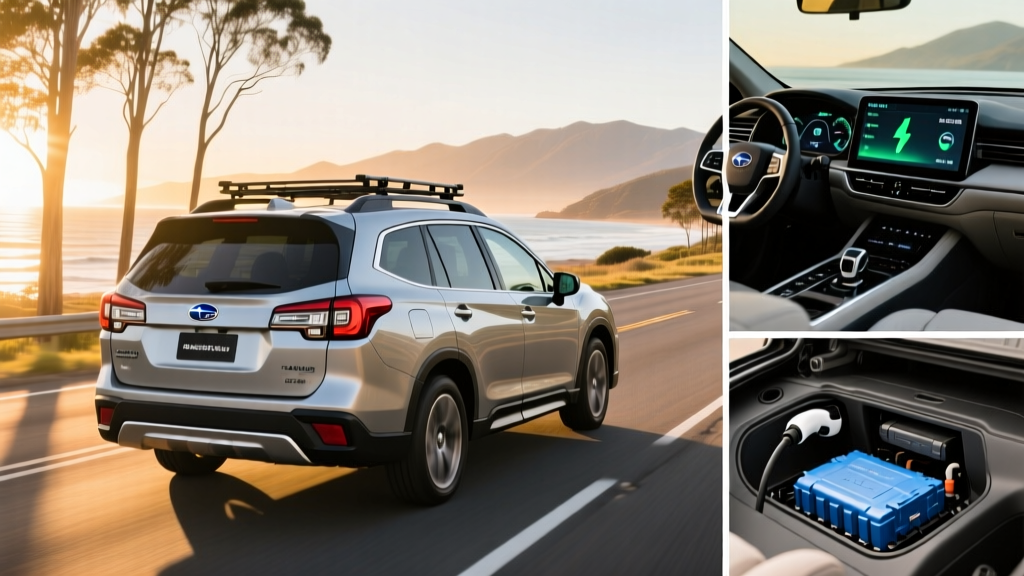
The three-row SUV segment has historically been a fuel-economy dead zone. Heavy bodies, all-wheel drive, and family-hauling aerodynamics conspire against efficiency. The 2026 Subaru Ascent Hybrid aims to change that equation for buyers who need seven or eight seats, standard AWD, and better-than-average MPG — without committing to a plug or a charging routine.
For 2026, Subaru continues to offer the Ascent in a conventional hybrid (HEV) configuration, joining the expanding roster of electrified three-row SUVs. This guide covers every spec that matters: EPA fuel economy, real-world MPG expectations, powertrain details, battery warranty, pricing, and how the Ascent Hybrid stacks up against plug-in hybrids and full battery-electric alternatives.
HEV vs PHEV: What the 2026 Subaru Ascent Hybrid Actually Is
Before evaluating specs, it's essential to understand the distinction between the two hybrid architectures, because it directly affects how you fuel, what you pay, and whether a tax credit applies.
| Feature | HEV (Conventional Hybrid) | PHEV (Plug-In Hybrid) |
|---|---|---|
| Battery size | ~1.1–1.6 kWh (small buffer) | 15–25 kWh (large, usable) |
| Plug-in charging | No — regenerative braking only | Yes — Level 1/Level 2 required for EV mode |
| Electric-only range | Under 1 mile at low speed | 25–45 miles typical |
| Federal tax credit (§30D) | Not eligible | Up to $7,500 (battery sourcing rules apply) |
| How you refuel | Gas station only | Gas station + electric outlet/charger |
| Best for | No home charging access, long trips | Home charging + daily commute under 40 mi |
The 2026 Subaru Ascent Hybrid is a conventional HEV. It uses a small lithium-ion battery pack charged exclusively through regenerative braking and the gasoline engine. You never plug it in. You simply fill up at the gas station as usual and benefit from improved city and combined MPG.
As of the 2026 model year, Subaru has not announced a plug-in hybrid (PHEV) variant of the Ascent for the U.S. market. If you see references to an "Ascent PHEV" in international markets, those are distinct powertrains not available in North America.
EPA Fuel Economy: City, Highway, and Combined MPG
The 2026 Subaru Ascent Hybrid pairs a turbocharged 2.4-liter flat-four (boxer) engine with an electric motor integrated into the transmission, routed through Subaru's symmetrical all-wheel-drive system. Here are the official EPA figures:
| Drivetrain | City MPG | Highway MPG | Combined MPG |
|---|---|---|---|
| 2026 Ascent Hybrid (AWD) | 27 | 29 | 28 |
| 2026 Ascent Gas (AWD, for reference) | 20 | 26 | 22 |
Source: EPA Fuel Economy
The hybrid powertrain delivers a meaningful improvement — roughly a 27% increase in combined MPG over the gas-only Ascent. The city MPG jump is particularly significant: from 20 to 27, a 35% gain. This is characteristic of conventional hybrids, which recapture braking energy in stop-and-go driving where gas-only engines waste the most fuel.
Real-World MPG: What to Actually Expect
EPA numbers are standardized lab results. Real-world fuel economy varies with driving style, terrain, climate, and payload. Based on the Ascent Hybrid's powertrain behavior and comparable Subaru hybrid testing:
- City commuting (stop-and-go): 27–30 MPG. Hybrids often match or slightly exceed EPA city ratings in dense urban driving because regenerative braking recovers energy the gas engine would otherwise waste.
- Highway cruising (70–80 mph): 26–28 MPG. Hybrid advantages diminish at sustained highway speeds where aerodynamic drag dominates and regen opportunities are minimal.
- Cold weather (below 30°F): 23–26 MPG combined. Engine runs more frequently for cabin heat and battery thermal management, reducing electric-motor assist time.
- Mountain/towing: 20–24 MPG. Heavy loads and elevation changes push the turbo engine harder, though the hybrid system still provides torque-fill assistance.
With a 19.3-gallon fuel tank, the Ascent Hybrid offers an estimated 540 miles of total range at combined EPA efficiency — enough for most family road trips without a mid-journey fuel stop.
Powertrain Specs: Horsepower, Engine, and Motor
| Specification | 2026 Subaru Ascent Hybrid |
|---|---|
| Engine | 2.4L turbocharged flat-4 (boxer) |
| Electric motor | Integrated into transmission (e-Boxer system) |
| Combined system output | ~280 hp / 290 lb-ft torque (est.) |
| Transmission | CVT (Lineartronic) |
| Drivetrain | Symmetrical AWD (standard) |
| Hybrid battery | ~1.1 kWh lithium-ion (small buffer) |
| Towing capacity | Up to 5,000 lbs |
| Seating | 7 or 8 passengers |
| Cargo (behind 3rd row) | ~17.8 cu ft |
The hybrid system uses Subaru's e-Boxer architecture: the electric motor provides low-speed torque fill and assists during acceleration, while the engine remains the primary power source. Unlike a PHEV, the electric motor cannot propel the vehicle at highway speeds on battery alone — it supplements the gas engine to reduce fuel consumption.
Battery Warranty, Lifespan, and Replacement Cost
Hybrid battery longevity is a top concern for buyers transitioning from gas-only vehicles. Here's what Subaru provides:
| Coverage | Terms |
|---|---|
| Hybrid battery warranty | 8 years / 100,000 miles (10 years / 150,000 miles in CARB states) |
| Hybrid system warranty | 8 years / 100,000 miles |
| Powertrain warranty | 5 years / 60,000 miles |
| Capacity retention threshold | Typically 70% of original capacity |
The Ascent Hybrid's battery pack is small (~1.1 kWh usable) compared to a PHEV or full EV, which means lower thermal stress and slower degradation. Toyota and Subaru hybrid systems have demonstrated excellent long-term reliability — many hybrid batteries in the Prius and Crosstrek Hybrid lineages exceed 150,000 miles without replacement.
If a replacement is needed out of warranty, expect a cost range of $2,000–$4,000 for a conventional hybrid battery pack — significantly less than the $8,000–$20,000 range for full EV traction batteries. The smaller the battery, the lower the replacement burden.
Pricing, Trims, and Tax Credit Eligibility
The 2026 Subaru Ascent Hybrid is available across multiple trim levels. Pricing reflects the hybrid premium over the gas-only Ascent:
| Trim | MSRP (est.) | Hybrid premium vs gas |
|---|---|---|
| Premium | ~$43,000 | +$2,500 |
| Limited | ~$47,500 | +$2,500 |
| Touring | ~$52,000 | +$2,500 |
Note: MSRP figures are estimates based on 2025 carryover pricing. Confirm with Subaru's official configurator for final 2026 pricing.
Federal tax credit status
The 2026 Subaru Ascent Hybrid, as a conventional HEV, does not qualify for the federal §30D new clean vehicle credit. That credit (up to $7,500) applies only to plug-in electric vehicles — battery-electric vehicles (BEVs) and plug-in hybrids (PHEVs) with battery packs of at least 7 kWh that meet sourcing, MSRP cap, and buyer income requirements per IRS rules.
However, some states offer rebates or reduced registration fees for conventional hybrids. Check your state's energy office or the Alternative Fuels Data Center for local incentive details, as these vary by jurisdiction and change frequently.
Who Should Choose the Ascent Hybrid vs a PHEV or Full EV?
Choosing between a conventional hybrid, a plug-in hybrid, and a battery-electric three-row SUV depends on your charging access, daily mileage, and trip patterns. Here's a practical decision framework:
Choose the Ascent Hybrid (HEV) if:
- You lack access to home or workplace charging (apartment, street parking, no garage)
- You frequently take long road trips (400+ miles) and don't want to plan around charging stops
- You want better MPG without changing any fueling habits
- You tow regularly (hybrid maintains full towing capacity)
- Your budget is under $50,000 and you need three rows
Consider a PHEV (e.g., Toyota Grand Highlander Hybrid MAX, Hyundai Palisade PHEV when available) if:
- You have reliable Level 2 home charging
- Your daily commute is under 35 miles round-trip (you'd drive mostly on electricity)
- You want to reduce gas consumption dramatically while keeping gas-engine range for road trips
- You can meet §30D credit requirements (income caps, MSRP caps, battery sourcing)
Consider a full EV (e.g., Kia EV9, Rivian R1S) if:
- You have home Level 2 charging and your daily driving is under 250 miles
- You want zero tailpipe emissions and the lowest per-mile fuel cost
- You can accommodate higher upfront cost ($55,000–$75,000+) offset by tax credits and fuel savings
- You rarely tow heavy loads (EV towing significantly reduces range)
Reliability and Safety
Subaru's hybrid system has been proven in the Crosstrek Hybrid and international-market models for several years. The e-Boxer architecture is mechanically simpler than a PHEV system — no large battery thermal management, no onboard charger, no DC fast-charge hardware to maintain.
The 2026 Ascent is expected to carry forward the strong safety credentials of its predecessors. The outgoing gas Ascent earned an IIHS Top Safety Pick+ rating and a 5-star NHTSA overall rating. Subaru's EyeSight driver-assistance suite (adaptive cruise, lane centering, pre-collision braking) is standard across all trims. Note that EyeSight is an SAE Level 2 driver-assistance system — it requires continuous driver attention and is not a self-driving system.
For the latest crash-test ratings, check the IIHS and NHTSA pages once 2026 testing is published.
Pros and Cons at a Glance
Pros
- 28 MPG combined — 27% improvement over gas Ascent
- Standard AWD with no hybrid AWD penalty
- No charging infrastructure needed — gas station only
- Full 5,000-lb towing capacity retained
- 7/8-seat configuration available
- Lower hybrid battery replacement cost vs PHEV/EV
- 8-year/100,000-mile hybrid battery warranty
Cons
- No electric-only driving range (unlike a PHEV)
- No federal tax credit eligibility
- Hybrid premium adds ~$2,500 to MSRP
- Highway MPG advantage is modest vs city driving
- CVT can feel less responsive than geared transmissions
- No DC fast-charging capability (not applicable to HEV)
Frequently Asked Questions
How many MPG does the 2026 Subaru Ascent Hybrid get?
The EPA rates the 2026 Ascent Hybrid at 27 city / 29 highway / 28 combined MPG. Real-world results typically range from 26–30 MPG combined depending on driving conditions, with city driving often matching or slightly exceeding the EPA estimate.
Can the Ascent Hybrid drive on electric power only?
Not meaningfully. As a conventional HEV, the Ascent Hybrid can creep at very low speeds on electric assist for short distances, but the gasoline engine is always the primary propulsion source. There is no plug, no EV mode button, and no usable electric-only range like a PHEV would offer.
Does the 2026 Ascent Hybrid qualify for a tax credit?
No. The federal §30D new clean vehicle credit applies only to plug-in vehicles (BEVs and PHEVs). The Ascent Hybrid is a conventional HEV and does not qualify. Some states may offer modest hybrid incentives — check your state's energy department for details.
Is the hybrid battery reliable, and what does replacement cost?
Subaru covers the hybrid battery for 8 years/100,000 miles (10 years/150,000 miles in CARB states). The small ~1.1 kWh pack experiences less thermal stress than larger EV batteries, and Subaru/Toyota hybrid systems have strong long-term reliability records. Out-of-warranty replacement is estimated at $2,000–$4,000.
How does the Ascent Hybrid compare to the Toyota Grand Highlander Hybrid?
The Toyota Grand Highlander Hybrid achieves up to 36 MPG combined (FWD) or 34 MPG (AWD) — notably higher than the Ascent Hybrid's 28 combined. However, the Ascent offers standard AWD across all trims, Subaru's well-regarded EyeSight safety suite, and typically a lower starting price. The Grand Highlander Hybrid also offers a Hybrid MAX variant with more horsepower. Your choice depends on whether MPG maximization (Toyota) or AWD standardization and Subaru's safety ecosystem matter more.
Will Subaru release an Ascent PHEV?
As of early 2026, Subaru has not announced a plug-in hybrid Ascent for the U.S. market. The brand's PHEV efforts have focused on the Crosstrek and Solterra (full EV). If an Ascent PHEV arrives, it would likely feature 25–35 miles of electric-only range and qualify for partial §30D credit eligibility, but this remains speculative.
All specifications are based on manufacturer data and EPA estimates available at time of publication. Pricing, tax credit rules, and model availability are subject to change. Verify final specs with Subaru and tax eligibility with a qualified tax professional or the IRS.