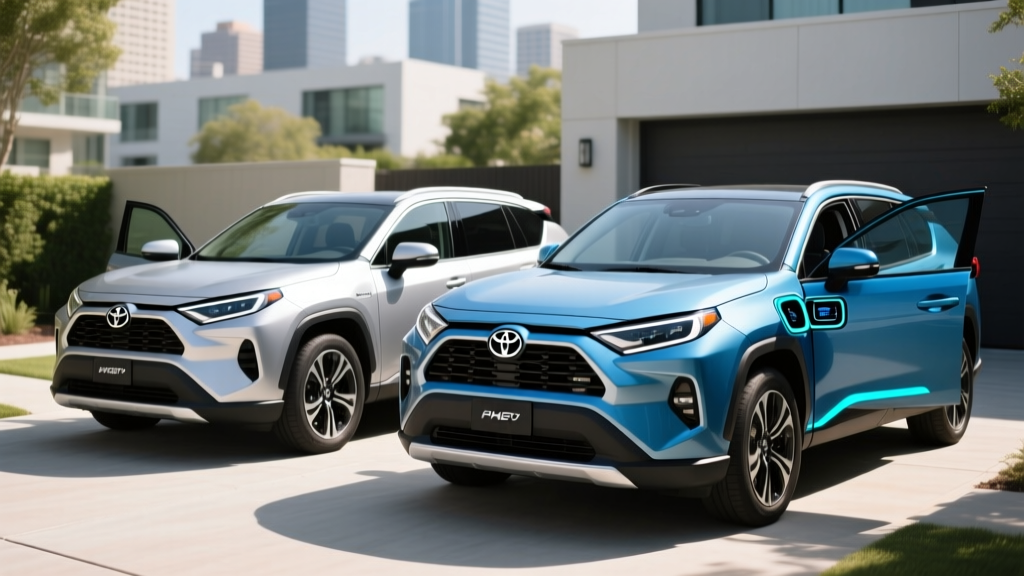
If you've searched for a thorough hybrid car description of America's best-selling electrified SUV, you've found it. The 2026 Toyota RAV4 family splits into two distinct powertrains: the conventional RAV4 Hybrid (HEV) and the plug-in RAV4 Prime (PHEV). They share a body but solve entirely different problems. One never plugs in and sips fuel; the other drives 42 miles on electricity before the engine wakes up. This guide breaks down both with the exact numbers buyers need.
RAV4 Hybrid (HEV) vs RAV4 Prime (PHEV): The Core Difference
Conventional Hybrid (RAV4 Hybrid): A 1.6 kWh nickel-metal-hydride (NiMH) traction battery recharges itself through regenerative braking and the gasoline engine. You never plug it in. The electric motor assists the 2.5L four-cylinder to cut fuel use, especially in stop-and-go city driving where the engine shuts off frequently.
Plug-in Hybrid (RAV4 Prime): An 18.1 kWh lithium-ion battery can be charged from a wall outlet or public charger, delivering up to 42 miles of pure electric driving before the hybrid system takes over. Think of it as a short-range EV bolted to a long-range hybrid.
Neither configuration requires you to change driving habits. The powertrain management computer decides when to use the motor, the engine, or both. The HEV optimizes for fuel economy at all times; the PHEV prioritizes electric miles first, then operates as a conventional hybrid once the battery is depleted.
Fuel Economy: EPA MPG and Real-World Numbers
| Model | City MPG | Highway MPG | Combined MPG | MPGe (PHEV EV mode) |
|---|---|---|---|---|
| RAV4 Hybrid AWD (LE/XLE) | 41 | 38 | 39 | — |
| RAV4 Hybrid AWD (Woodland) | 38 | 35 | 37 | — |
| RAV4 Prime AWD (SE/XSE) | 40 (hybrid mode) | 36 (hybrid mode) | 38 (hybrid mode) | 94 MPGe |
Source: EPA fueleconomy.gov
Real-world MPG reality check: Toyota hybrids routinely exceed their EPA city rating in mild-weather urban driving because regenerative braking recaptures energy that gas cars waste as heat. Owners consistently report 42-45 MPG city in the RAV4 Hybrid. Highway mileage is the weak point — sustained 75+ mph cruising can drop the HEV to 33-35 MPG and the Prime (in hybrid mode) to 30-33 MPG. Cold weather below 32°F typically shaves 10-15% off combined figures as the engine runs longer to heat the cabin and catalytic converter.
Electric-Only Range and Total Range (RAV4 Prime)
The 2026 RAV4 Prime carries an EPA-rated 42 miles of electric-only range from its 18.1 kWh lithium-ion pack (approximately 14.5 kWh usable, with the rest held as a buffer to protect longevity). In real-world commuting at 35-55 mph in moderate temperatures, expect 38-44 miles. Highway-speed electric driving at 70 mph drops that to roughly 30-33 miles. In freezing weather with cabin heat on, plan for 28-32 miles.
Once the battery depletes, the Prime operates as a conventional hybrid with its full 14.5-gallon fuel tank, delivering a combined total range of approximately 600 miles (42 electric + ~560 gas). This eliminates range anxiety entirely — you can drive cross-country without ever searching for a charger.
Powertrain Specs: Horsepower, Engine, and Motors
| Specification | RAV4 Hybrid AWD | RAV4 Prime AWD |
|---|---|---|
| Engine | 2.5L 4-cyl Atkinson | 2.5L 4-cyl Atkinson |
| Engine horsepower | 176 hp | 177 hp |
| Front electric motor | 118 hp | 180 hp |
| Rear electric motor (eAWD) | 54 hp | 54 hp |
| Net combined system hp | 219 hp | 302 hp |
| 0-60 mph | 7.4 sec | 5.7 sec |
| Traction battery | 1.6 kWh NiMH | 18.1 kWh Li-ion |
| Towing capacity | 1,750 lbs | 2,500 lbs |
| Drivetrain | eAWD (electronic) | eAWD (electronic) |
The Prime's 302 combined horsepower makes it the quickest RAV4 ever sold and one of the fastest compact SUVs in its class. The HEV's 219 hp is adequate for daily driving and highway merging, though not sporty. Both use Toyota's eAWD system, where the rear axle is driven entirely by the rear electric motor — there is no mechanical driveshaft connecting the axles.
Charging the RAV4 Prime: Times, Connectors, and DC Fast-Charge Reality
| Charging Method | Power (kW) | 0-100% Time | Connector |
|---|---|---|---|
| Level 1 (120V household) | ~1.4 kW | ~12 hours | J1772 |
| Level 2 (240V, 16A onboard) | 3.3 kW | ~5.5 hours | J1772 |
| Level 2 (240V, 32A — XSE w/ Premium pkg) | 6.6 kW | ~2.5 hours | J1772 |
| DC Fast Charge | Not supported | — | — |
Critical detail buyers miss: The RAV4 Prime does not support DC fast charging. The 6.6 kW onboard charger is only available on the XSE trim with the Premium package; the SE trim and base XSE are limited to 3.3 kW. For most owners charging overnight at home on a 240V Level 2 circuit, 3.3 kW is sufficient — a full charge completes while you sleep. But if you planned to top up at a public DC fast charger during a road trip, that option does not exist on this vehicle.
The conventional RAV4 Hybrid has no charge port at all. Its small battery recharges exclusively through regenerative braking and the gasoline engine.
Pricing, Trims, and Federal Tax Credit Eligibility
| Model & Trim | 2026 MSRP (incl. destination) | Federal §30D Credit Eligible? |
|---|---|---|
| RAV4 Hybrid LE | $34,425 | No — HEVs do not qualify |
| RAV4 Hybrid XLE | $35,925 | No |
| RAV4 Hybrid XLE Premium | $38,325 | No |
| RAV4 Hybrid Woodland Edition | $39,125 | No |
| RAV4 Hybrid Limited | $42,025 | No |
| RAV4 Prime SE | $45,620 | Potentially — see below |
| RAV4 Prime XSE | $49,220 | Potentially — see below |
Federal §30D plug-in hybrid credit requirements (2026 rules):
- Vehicle must be a plug-in hybrid or BEV (conventional HEVs never qualify)
- Battery capacity ≥ 7 kWh (Prime's 18.1 kWh qualifies)
- MSRP cap: $80,000 for SUVs (both Prime trims clear this)
- Buyer income caps: $300K joint / $225K head of household / $150K single (modified AGI)
- Critical minerals and battery component sourcing thresholds must be met — this is where the Prime faces risk. Toyota has historically sourced battery components from Japan and China, which may not meet the escalating domestic-content percentages required under the Inflation Reduction Act.
- Credit amount phases based on sourcing compliance — could be $0, $3,750, or $7,500 depending on current-year supply chain certification
- Point-of-sale transfer available if eligible, reducing dealer price directly
Always verify current eligibility on IRS.gov and consult a tax professional before purchasing. Credit rules change frequently.
Battery Warranty, Reliability, and Replacement Cost
Hybrid battery warranty (both models): 10 years / 150,000 miles (whichever comes first) in all 50 states, covering defects and capacity loss below a specified threshold. This has been Toyota's standard since the 2020 model year, up from the previous 8-year/100,000-mile coverage.
Additional hybrid system coverage: Hybrid-specific components (inverter, control module, transaxle) are covered under the same 10yr/150K hybrid system warranty.
Real-world longevity data: Toyota's hybrid battery track record is among the best in the industry. First-generation Prius packs from the early 2000s routinely exceeded 200,000 miles. The NiMH chemistry in the RAV4 Hybrid is proven and conservative — degradation is minimal because the system never deeply cycles the small battery. The Prime's larger lithium-ion pack sees deeper cycles during EV-mode driving, but Toyota's buffer strategy (keeping the pack between roughly 15% and 85% true state of charge) significantly extends cycle life.
Battery replacement cost if out of warranty:
- RAV4 Hybrid (NiMH pack): approximately $3,000-$4,500 installed
- RAV4 Prime (Li-ion pack): approximately $8,000-$12,000 installed
These are worst-case scenarios. Most hybrid batteries outlast the vehicle itself, and refurbished/remanufactured packs are increasingly available at 40-60% of new OEM pricing. Independent hybrid-specialty shops can perform replacements at lower labor rates than dealerships.
Overall reliability: The RAV4 Hybrid and Prime consistently earn above-average reliability scores from Consumer Reports and J.D. Power. The eCVT transaxle (a planetary gearset, not a belt-driven CVT) has no friction clutches to wear and is among the most durable transmissions Toyota builds. The IIHS typically rates the RAV4 as a Top Safety Pick when equipped with the standard Toyota Safety Sense 2.5+ suite.
Who Should Choose the RAV4 Hybrid vs. the Prime vs. a Full EV?
Choose the RAV4 Hybrid (HEV) if:
- You cannot charge at home (apartment, street parking, no garage)
- You want maximum simplicity — no cables, no charging apps, no plug-in routine
- Your budget tops out around $35K-$40K
- You drive mostly city/suburban miles where hybrid efficiency shines (41+ MPG city)
- You plan to keep the vehicle 10+ years and value proven, conservative tech
Choose the RAV4 Prime (PHEV) if:
- You can install a Level 2 charger at home and your daily commute is under 40 miles round-trip
- You want EV-like daily driving with gas-engine freedom for road trips
- You want 302 hp and 5.7-second 0-60 performance (the HEV cannot match this)
- You can potentially capture a federal tax credit, narrowing the ~$11K price gap over the HEV
- You frequently tow (2,500 lb capacity vs. 1,750 lb on the HEV)
Choose a full BEV (e.g., Tesla Model Y, Hyundai Ioniq 5) instead if:
- Your daily driving is under 250 miles and you have reliable home + workplace charging
- You want to eliminate oil changes, spark plugs, and exhaust-system maintenance entirely
- You live in a region with inexpensive electricity and expensive gasoline (California, Northeast)
- You're ready for DC fast charging on road trips (20-30 minute stops at 150-250 kW chargers)
RAV4 Hybrid Pros
- 41 MPG city without ever plugging in
- Proven 20-year hybrid track record
- 10yr/150K battery warranty
- Strong resale value
- Standard AWD on all trims
RAV4 Hybrid Cons
- Highway MPG drops to 35-38
- Modest 219 hp — not quick
- No federal tax credit
- Infotainment lags rivals in responsiveness
- 1,750-lb towing limit
RAV4 Prime Pros
- 42 miles EV range covers most commutes
- 302 hp / 5.7 sec 0-60 — class-leading
- 600+ mile total range
- 2,500-lb towing
- Potential federal tax credit
RAV4 Prime Cons
- ~$11K more expensive than HEV equivalent
- No DC fast charging
- 3.3 kW onboard charger on SE trim is slow
- Cargo space reduced ~2 cu ft vs. HEV (battery packaging)
- Tax credit eligibility uncertain due to sourcing rules
Frequently Asked Questions
How many MPG does the 2026 RAV4 Hybrid actually get?
The EPA rates the RAV4 Hybrid AWD at 41 city / 38 highway / 39 combined. In real-world city driving, many owners report 42-45 MPG thanks to aggressive regenerative braking. Highway cruising above 70 mph typically yields 33-36 MPG. Expect a combined real-world average of 37-41 MPG depending on your driving mix and climate.
How far can the RAV4 Prime go on electric power alone?
The EPA rates the RAV4 Prime at 42 miles of electric-only range. Real-world results vary from 30 miles (highway speed, cold weather) to 44 miles (moderate-speed city driving, mild temperatures). Once depleted, the Prime seamlessly switches to hybrid mode with 38 MPG combined and approximately 560 additional miles of gas range.
Does the RAV4 Hybrid need to be plugged in?
No. The conventional RAV4 Hybrid (HEV) has no charge port and no plug. Its small 1.6 kWh battery recharges entirely through regenerative braking and the gasoline engine. You simply drive it like a normal car and refuel at gas stations. Only the RAV4 Prime (PHEV) has a plug and benefits from charging.
Is the hybrid battery reliable and what does replacement cost?
Toyota's hybrid batteries are among the most reliable in the industry, with many exceeding 200,000 miles. Both the RAV4 Hybrid and Prime carry a 10-year/150,000-mile hybrid battery warranty. If replacement is needed out of warranty, expect $3,000-$4,500 for the HEV's NiMH pack and $8,000-$12,000 for the Prime's lithium-ion pack. Refurbished options reduce these costs significantly.
Does the RAV4 Hybrid or Prime qualify for a federal tax credit?
The conventional RAV4 Hybrid (HEV) does not qualify for any federal tax credit — only plug-in vehicles are eligible under IRS §30D. The RAV4 Prime (PHEV) may qualify for up to $7,500, but eligibility depends on battery-component and critical-mineral sourcing requirements that change annually. Verify current status on fueleconomy.gov and IRS.gov before purchasing. Income caps ($150K single / $300K joint) and the $80K SUV MSRP cap also apply.
RAV4 Hybrid vs. full EV — which is right for me?
Choose the RAV4 Hybrid if you lack home charging, frequently drive 300+ miles between stops, or want the lowest-complexity path to better fuel economy. Choose a full EV (Model Y, Ioniq 5, EV6) if you can charge at home, your daily driving is under 250 miles, and you want to eliminate gasoline and most powertrain maintenance. The RAV4 Prime splits the difference — EV commuting with gas-engine road-trip capability.
What is the difference between the RAV4 Hybrid and RAV4 Prime?
The RAV4 Hybrid is a conventional hybrid (HEV) — it never plugs in, gets 39 MPG combined, produces 219 hp, and starts at $34,425. The RAV4 Prime is a plug-in hybrid (PHEV) — it plugs in, drives 42 miles on electricity, produces 302 hp, and starts at $45,620. The Prime is quicker, more powerful, and can drive electric-only, but costs ~$11K more and requires home charging to realize its advantages.