If you've been researching the latest generation of Toyota's best-selling SUV, you've likely encountered a confusing question: are all 2026 RAV4 hybrids? The short answer is no. For the 2026 model year, Toyota continues to offer the RAV4 in three distinct powertrain flavors: the traditional gasoline model, the conventional hybrid (HEV), and the plug-in hybrid known as the RAV4 Prime (PHEV).
Understanding the difference between these options is critical for your wallet and your daily driving routine. While the hybrid and plug-in hybrid models share similar styling and cargo space, their underlying engineering, fuel economy, and ownership costs differ significantly. This guide breaks down the exact specifications, real-world efficiency, and tax-credit implications to help you decide which 2026 RAV4 fits your lifestyle.
2026 Toyota RAV4 Powertrain Lineup: Gas vs. HEV vs. PHEV
To clear up the confusion, not every RAV4 on the lot is a hybrid. The 2026 lineup is structured around three distinct powertrain architectures. The standard RAV4 uses a 2.5-liter four-cylinder engine paired with an eight-speed automatic transmission. The RAV4 Hybrid (HEV) pairs that same 2.5-liter engine with electric motors and a small battery pack that charges itself through regenerative braking and the engine. Finally, the RAV4 Prime (PHEV) uses a larger battery and more powerful motors, allowing for significant electric-only driving before the gas engine ever turns on.
HEV vs. PHEV: What's the Difference?
Conventional Hybrid (HEV): You never plug it in. It captures energy from braking to charge a small (~1.6 kWh) battery. It provides excellent city MPG but cannot drive on electricity alone for more than a mile or two at low speeds.
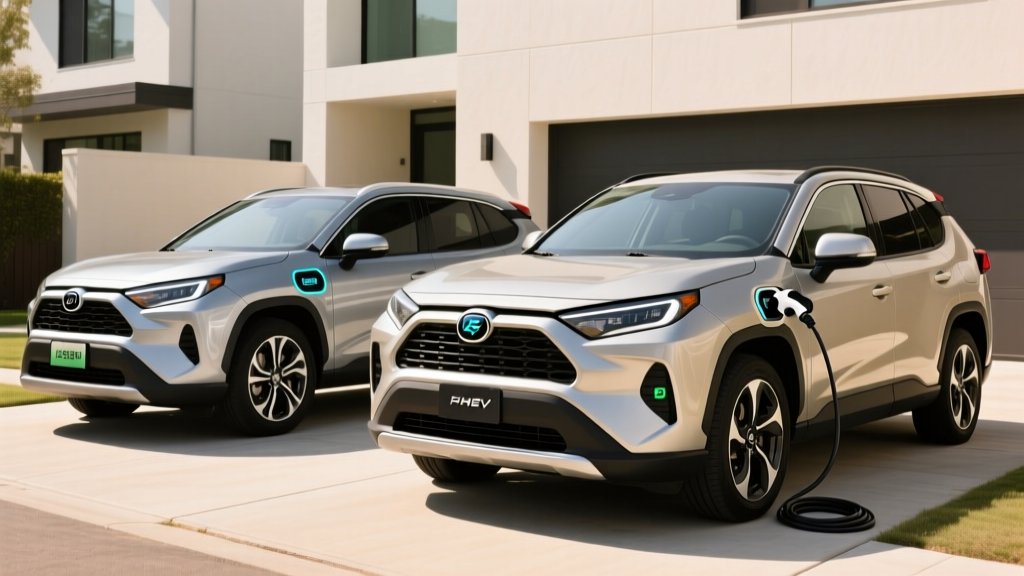
Plug-In Hybrid (PHEV / RAV4 Prime): You can plug it into a wall outlet or charging station. It features a much larger (~18.1 kWh) battery, allowing for 40+ miles of pure electric driving. Once that range is depleted, it operates exactly like a conventional hybrid.
Fuel Economy and Real-World MPG
When buyers ask how many MPG the 2026 RAV4 Hybrid gets, the numbers are impressive, especially for city driving where hybrids excel. According to fueleconomy.gov, the 2026 RAV4 Hybrid AWD achieves an EPA-estimated 41 MPG city, 38 MPG highway, and 40 MPG combined.
| Model | City MPG | Highway MPG | Combined MPG | Electric-Only Range |
|---|---|---|---|---|
| 2026 RAV4 Hybrid (HEV) AWD | 41 | 38 | 40 | N/A |
| 2026 RAV4 Prime (PHEV) AWD | 40 (Hybrid mode) | 36 (Hybrid mode) | 38 (Hybrid mode) | 42 miles |
| 2026 RAV4 Gas AWD (Baseline) | 27 | 35 | 30 | N/A |
Real-World Expectations vs. EPA Stickers
In real-world testing, the RAV4 Hybrid often exceeds its EPA city estimate in stop-and-go traffic because the electric motors do the heavy lifting while the engine stays off. However, on long highway road trips at speeds above 70 mph, expect fuel economy to dip closer to 34–36 MPG as the aerodynamic drag increases and the engine runs more frequently. The RAV4 Prime offers a unique advantage: if your daily commute is under 42 miles and you charge at home, you may use almost zero gasoline for months at a time.
RAV4 Prime (PHEV): Electric Range and Charging Specs
For those considering the RAV4 Prime, the electric-only range is the headline feature. The 2026 model retains an EPA-estimated 42 miles of pure electric driving, which covers the average American's daily commute with room to spare.
| Specification | 2026 RAV4 Prime (PHEV) |
|---|---|
| Battery Capacity | 18.1 kWh (Lithium-ion) |
| Electric-Only Range | 42 miles |
| Total Combined Range | ~520 miles (Electric + Gas) |
| Level 1 Charging (120V) | ~12 hours (0-100%) |
| Level 2 Charging (240V) | ~2.5 hours (0-100%) |
| DC Fast Charging | Not Supported |
One critical limitation to note: the RAV4 Prime does not support DC fast charging. It is limited to Level 2 AC charging (up to 6.6 kW). This means it is designed for home or workplace charging rather than quick top-ups at highway rest stops.
Performance and Powertrain Output
The hybrid and plug-in hybrid models offer very different performance profiles. The standard RAV4 Hybrid produces a combined 219 horsepower, which provides adequate acceleration for daily driving. The RAV4 Prime, however, is the performance flagship of the RAV4 family.
With a combined output of 302 horsepower, the RAV4 Prime can sprint from 0–60 mph in approximately 5.5 seconds, making it one of the quickest vehicles in Toyota's lineup outside of the GR sports cars. This power comes from a combination of the 2.5-liter engine and dual electric motors that provide instant torque to all four wheels.
Pricing and Tax Credit Eligibility
Pricing for the 2026 RAV4 Hybrid typically starts in the mid-$33,000 range, while the RAV4 Prime starts significantly higher, often around $45,000, due to its larger battery and more complex powertrain. When evaluating the cost, you must consider federal and state incentives.
Does the 2026 RAV4 Qualify for a Tax Credit?
Under the IRS §30D rules, the RAV4 Prime (PHEV) may qualify for a federal tax credit of up to $7,500, provided you meet specific requirements. The conventional RAV4 Hybrid (HEV) does not qualify for the §30D credit because it lacks the required battery capacity and plug-in capability.
- MSRP Cap: The vehicle must be under $80,000 (SUVs).
- Income Cap: Buyer AGI must be under $150k (single) or $300k (joint).
- Battery Sourcing: Specific percentages of critical minerals and battery components must be sourced from the U.S. or free-trade partners.
- Assembly: The vehicle must undergo final assembly in North America.
Always check the latest IRS guidance and the manufacturer's certification before purchasing, as these sourcing requirements can change model eligibility throughout the year.
Battery Warranty and Long-Term Reliability
One of the most common questions we hear is about the lifespan of the hybrid battery. Toyota has extensive experience with hybrid technology, and their batteries are designed to last the life of the vehicle.
Toyota Hybrid Battery Warranty
For the 2026 model year, Toyota covers the hybrid battery and related components for 10 years or 150,000 miles, whichever comes first. This warranty applies to both the HEV and the PHEV models.
Battery Replacement Cost
If a battery does fail outside of warranty, replacement costs for the RAV4 Hybrid (HEV) battery typically range from $3,000 to $5,000, including labor. The RAV4 Prime (PHEV) battery is much larger and more expensive, with replacement costs potentially exceeding $10,000. However, with Toyota's 10-year warranty and the proven durability of their hybrid systems, out-of-pocket replacement is relatively rare for the original owner.
Who Should Choose the Hybrid, PHEV, or Gas?
Deciding between the three RAV4 versions comes down to your charging access and driving habits.
Choose the RAV4 Hybrid (HEV) if:
- You do not have access to home or workplace charging.
- You want excellent fuel economy without changing your habits.
- You do a lot of city driving where the hybrid system shines.
Choose the RAV4 Prime (PHEV) if:
- You can install a Level 2 charger at home or have charging at work.
- Your daily commute is under 42 miles.
- You want the performance of a V6 with the efficiency of an EV for local trips.
- You qualify for the $7,500 federal tax credit.
Choose the Gas RAV4 if:
- You are on the strictest initial budget and drive relatively few miles per year.
- You plan to keep the vehicle for a very short time and want the lowest monthly payment.
Frequently Asked Questions
Are all 2026 RAV4 hybrids?
No. The 2026 RAV4 is available as a standard gas vehicle, a conventional hybrid (HEV), and a plug-in hybrid (RAV4 Prime).
Do I have to plug in the RAV4 Hybrid?
No. The conventional RAV4 Hybrid (HEV) charges its battery through regenerative braking and the gas engine. You only put gas in it. Only the RAV4 Prime (PHEV) requires plugging in to utilize its electric-only range.
How long does the RAV4 Prime battery last?
Toyota warranties the hybrid battery for 10 years or 150,000 miles. Real-world data from previous generations suggests these batteries often last well beyond 200,000 miles with proper maintenance.
Does the RAV4 Prime qualify for the $7,500 tax credit in 2026?
It may, but eligibility depends on your income, the vehicle's MSRP, and the battery component sourcing at the time of purchase. You must verify the specific VIN's eligibility with your dealer and the IRS.
Which is more reliable: RAV4 Hybrid or RAV4 Prime?
Both are highly reliable. The HEV has a simpler system with fewer charging components, while the PHEV has a more complex powertrain but benefits from Toyota's extensive hybrid engineering history.