The 2026 Honda CR-V Hybrid at a Glance
The Honda CR-V Hybrid remains one of the best-selling electrified compact SUVs in the United States, and for good reason: it delivers meaningful fuel savings over its gasoline counterpart without requiring a plug, a lifestyle change, or a steep price premium. For the 2026 model year, Honda carries forward the sixth-generation CR-V Hybrid with a refreshed palette of exterior colors, minor trim-level adjustments, and the proven two-motor hybrid powertrain that has earned this SUV a reputation for efficiency and reliability.
If you've landed here searching for 2026 Honda CR-V Hybrid colors, you'll find the full breakdown below — along with the real-world MPG data, powertrain specs, pricing, and ownership insights that matter just as much as the paint on the outside.
| Spec | Value |
|---|---|
| Powertrain | 2.0L Atkinson-cycle 4-cyl + 2-motor hybrid system |
| Combined Horsepower | 204 hp (combined system output) |
| Combined Torque | 247 lb-ft (electric motor) |
| Drivetrain | FWD (standard) / AWD (available) |
| EPA MPG (FWD) | 43 city / 36 hwy / 40 combined |
| EPA MPG (AWD) | 40 city / 34 hwy / 37 combined |
| Fuel Tank Capacity | 14.5 gallons |
| Total Range (AWD) | ~536 miles |
| 0–60 mph | ~7.6 seconds (est.) |
| Cargo Volume | 36.3 cu ft (rear seats up) / 76.5 cu ft (folded) |
| Towing Capacity | 1,000 lbs |
| Battery Warranty | 8 years / 100,000 miles (10 yr/150k mi in CARB states) |
| Starting MSRP | ~$36,395 (Sport FWD, including destination) |
2026 Honda CR-V Hybrid: All Available Colors
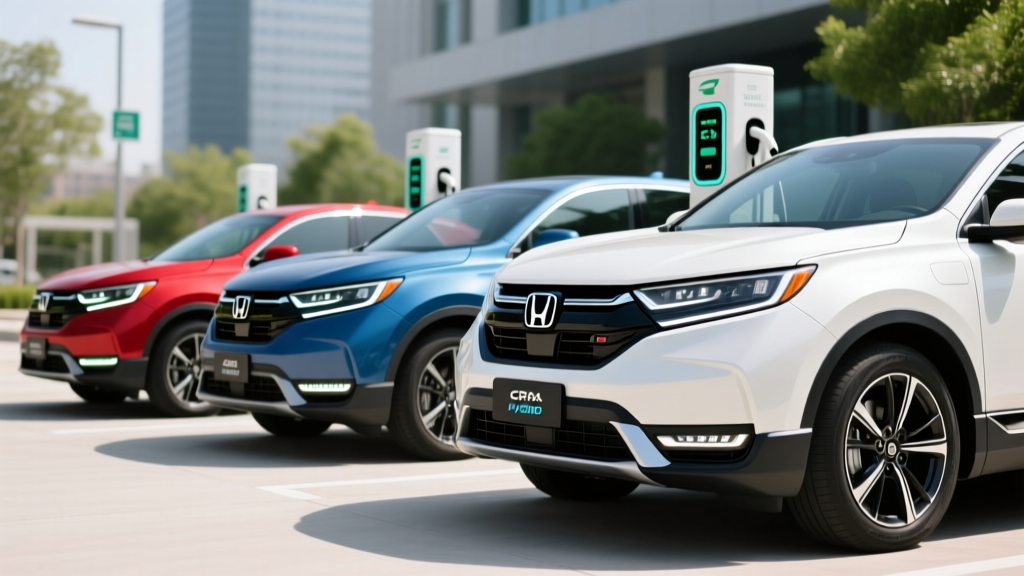
Honda offers the 2026 CR-V Hybrid across several exterior colors, with availability varying by trim level. The Sport and Sport Touring trims — which are the hybrid-exclusive grades — feature a slightly more curated color palette compared to the gasoline LX and EX-L trims. Here's what's available for 2026:
- Canyon River Blue Metallic — A rich, deep blue that reads as sophisticated rather than flashy. Available on Sport and Sport Touring.
- Crystal Black Pearl — A perennial favorite. Glossy, easy to maintain, and available across all hybrid trims.
- Platinum White Pearl — Honda's tri-coat white with a subtle pearl finish. Shows dirt more readily but remains the most popular choice among buyers.
- Meteorite Gray Metallic — A medium gray with metallic flake. A strong alternative to black for buyers wanting understated elegance.
- Urban Gray Pearl — A darker, moodier gray with pearl undertones. Exclusive to the Sport Touring trim in 2026.
- Lunar Silver Metallic — A lighter silver that hides dust and light scratches well. Available on Sport trim.
- Radiant Red Metallic — A warm, deep red. One of the bolder choices in the lineup; available on select trims.
Buyer tip: Pearl and metallic finishes typically carry no upcharge on the CR-V Hybrid, unlike some competitors. However, Crystal Black Pearl and Platinum White Pearl tend to hold marginally better resale value due to their broad market appeal. If you plan to keep the vehicle 8+ years, choose what you love — color impact on depreciation fades over longer ownership periods.
HEV vs. PHEV: What the CR-V Hybrid Is (and Isn't)
This is a critical distinction that trips up many shoppers. The Honda CR-V Hybrid is a conventional hybrid electric vehicle (HEV). It does not plug in. It has no electric-only driving range. It charges its own small lithium-ion battery pack through regenerative braking and the gasoline engine.
| Feature | HEV (CR-V Hybrid) | PHEV (e.g., Toyota RAV4 Prime) | BEV (e.g., Hyundai Ioniq 5) |
|---|---|---|---|
| Plugs in? | No | Yes (Level 1/2) | Yes (Level 1/2/DC) |
| Electric-only range | None (EV assist only) | ~42 miles | 250–310+ miles |
| EPA combined MPG / MPGe | 37–40 MPG | 94 MPGe (elec) / 38 MPG (gas) | 114–132 MPGe |
| Gas engine? | Yes (always) | Yes (backup) | No |
| Home charging needed? | No | Recommended | Essential |
| Federal tax credit | None | Up to $7,500 (if eligible) | Up to $7,500 (if eligible) |
| Starting MSRP range | ~$36,000 | ~$44,000 | ~$42,000 |
| Best for | No-plug buyers, renters | Home chargers w/ short commutes | Home chargers, low-cost miles |
If you need a plug-in hybrid with electric-only range, Honda does not currently offer a CR-V PHEV in the United States. The closest Honda plug-in option is the Clarity Plug-In Hybrid, which was discontinued after 2022. Buyers wanting a PHEV compact SUV should look at the Toyota RAV4 Prime or the Hyundai Tucson PHEV.
Real-World MPG: How the CR-V Hybrid Actually Performs
The EPA rates the 2026 CR-V Hybrid AWD at 40 city / 34 highway / 37 combined MPG, while the FWD model achieves 43 city / 36 highway / 40 combined. These are strong numbers for a compact SUV, but real-world results depend heavily on your driving mix.
| Driving Scenario | EPA Sticker | Real-World Expectation |
|---|---|---|
| City (stop-and-go) | 40 MPG (AWD) | 38–44 MPG — hybrids often exceed EPA city ratings due to heavy regen use |
| Highway (70+ mph) | 34 MPG (AWD) | 30–34 MPG — hybrid advantage diminishes at sustained high speeds |
| Mixed commuting | 37 MPG (AWD) | 35–39 MPG — most owners report landing near or slightly above EPA combined |
| Cold weather (below 32°F) | N/A | 28–33 MPG — engine runs more often for cabin heat, reducing electric assist |
Key insight: Like all hybrids, the CR-V Hybrid shines in city driving where regenerative braking recaptures energy at every stoplight. If your commute is 80%+ highway miles, the fuel-economy advantage over the gasoline CR-V (28 city / 34 hwy / 30 combined AWD) narrows considerably. Hybrid buyers with predominantly urban routes will see the largest real-world payoff.
Powertrain Deep Dive: Two-Motor Hybrid System
The 2026 CR-V Hybrid uses Honda's fourth-generation two-motor hybrid system, pairing a 2.0-liter Atkinson-cycle inline-four engine with two electric motors and a lithium-ion battery pack. Total system output is 204 horsepower and 247 lb-ft of torque.
Unlike Toyota's planetary-gear hybrid system, Honda's setup operates primarily in series-hybrid mode at low and moderate speeds: the engine drives a generator motor that produces electricity, which then powers the propulsion motor connected to the wheels. At highway speeds, a lock-up clutch engages to connect the engine directly to the wheels for better efficiency. This architecture delivers smooth, electric-like acceleration from a stop while maintaining strong highway cruising manners.
The AWD system adds a rear-mounted electric motor that provides torque to the rear axle when needed — there is no mechanical driveshaft connecting the engine to the rear wheels. This gives the CR-V Hybrid AWD a responsive, on-demand all-wheel-drive character without the parasitic loss of a traditional AWD system.
Pricing, Trims, and Tax Credit Eligibility
The 2026 CR-V Hybrid is offered in three trims, all of which are hybrid-exclusive:
- Sport (FWD): ~$36,395 — 18-inch black alloy wheels, Apple CarPlay/Android Auto (wireless on upper trims), Honda Sensing suite, 7-inch touchscreen
- Sport (AWD): ~$37,895 — Adds real-time AWD with the rear electric motor
- Sport Touring (AWD standard): ~$41,795 — 9-inch touchscreen, wireless CarPlay/Android Auto, Bose 12-speaker audio, heated steering wheel, power tailgate with hands-free access, leather-trimmed seats, navigation
Federal tax credit: The CR-V Hybrid is a conventional HEV and does not qualify for the federal §30D clean vehicle tax credit. That credit, which offers up to $7,500, applies only to plug-in electric vehicles (BEVs and PHEVs) that meet battery-sourcing, MSRP, and buyer-income requirements per current IRS rules. Some states offer modest hybrid incentives — check your state energy office or the Alternative Fuels Data Center for local programs.
Battery and Powertrain Warranty
Honda covers the CR-V Hybrid's lithium-ion battery pack and hybrid system components for 8 years or 100,000 miles, whichever comes first. In states that follow California Air Resources Board (CARB) emissions standards — including California, New York, Massachusetts, Colorado, and approximately a dozen others — that coverage extends to 10 years or 150,000 miles. The conventional powertrain (engine, transmission) carries a 5-year/60,000-mile warranty.
Reliability, Battery Longevity, and Replacement Cost
The CR-V Hybrid's two-motor system is now in its fourth generation and has proven to be one of the most dependable hybrid setups on the market. Honda's hybrid components — including the battery pack, inverter, and electric motors — have demonstrated strong longevity in real-world ownership, with many Honda hybrid owners (particularly Accord Hybrid and earlier CR-V Hybrid drivers) reporting well over 150,000 miles with no hybrid-system issues.
Battery replacement cost: If the hybrid battery pack does require replacement outside of warranty, expect to pay between $2,000 and $4,000 for a new OEM pack, including labor. Refurbished or aftermarket packs may be available for $1,000–$2,000. For context, the CR-V Hybrid's battery is significantly smaller than a BEV or PHEV battery (roughly 1–2 kWh versus 15–80+ kWh), which keeps replacement costs manageable.
Honda's hybrid battery degradation is typically minimal over the warranty period. Unlike BEV batteries that lose range as they age, the CR-V Hybrid's small buffer battery is managed conservatively by the powertrain control system — it never fully charges or fully depletes, which significantly extends cycle life. Most owners will never need a hybrid battery replacement during their ownership.
Who Should Choose the CR-V Hybrid?
Choose the CR-V Hybrid if:
- You want better fuel economy without plugging in or changing your routine
- Your commute involves significant city or stop-and-go driving
- You rent your home or lack access to Level 2 charging
- You want a proven, reliable hybrid from a mainstream brand
- You need AWD capability for snow or rain without a fuel-economy penalty
- You want a lower purchase price than a PHEV or BEV alternative
Look elsewhere if:
- You want electric-only driving for short commutes (consider a PHEV like the RAV4 Prime)
- You have home charging and want the lowest per-mile cost (a BEV like the Ioniq 5 costs ~$0.04/mile to fuel)
- You need more than 1,000 lbs of towing capacity
- You want to qualify for the $7,500 federal tax credit (requires a plug-in vehicle)
- Off-road capability is a priority (ground clearance is modest at 8.2 inches)
The CR-V Hybrid occupies a specific and practical niche: it's the right choice for buyers who want electrified efficiency with zero infrastructure requirements. If you can install a Level 2 charger at home and your daily driving is under 40 miles, a PHEV or BEV will save you more money per mile. But if you want the simplicity of a gas station fill-up with 37–40 MPG on top, the CR-V Hybrid is hard to beat in its class.
Frequently Asked Questions
How many MPG does the 2026 Honda CR-V Hybrid get?
The EPA rates the CR-V Hybrid at 43 city / 36 highway / 40 combined MPG for FWD models, and 40 city / 34 highway / 37 combined MPG for AWD models. Real-world results typically land within 2–3 MPG of the combined rating, with city-heavy drivers often exceeding the EPA city number.
Does the Honda CR-V Hybrid need to be plugged in?
No. The CR-V Hybrid is a conventional hybrid (HEV), not a plug-in hybrid (PHEV). It charges its battery internally through regenerative braking and the gasoline engine. You fuel it exclusively at a gas station, just like a conventional car.
Does the 2026 CR-V Hybrid qualify for any tax credit?
No federal tax credit is available for conventional hybrids under current IRS §30D rules. The federal clean vehicle credit applies only to plug-in EVs and PHEVs. Some states or local utilities may offer small rebates for hybrid purchases — check your state energy office for details.
Is the CR-V Hybrid reliable? What about battery replacement?
Honda's hybrid system has an excellent reliability track record across multiple model lines. The hybrid battery is covered for 8 years/100,000 miles (10 years/150,000 miles in CARB states). Replacement costs, if needed out of warranty, typically range from $2,000–$4,000 for an OEM pack. Most owners never require a battery replacement.
What's the difference between the CR-V Hybrid Sport and Sport Touring?
The Sport is the base hybrid trim, offering the core hybrid powertrain with FWD or AWD, 18-inch wheels, and Honda Sensing safety tech. The Sport Touring adds premium features: leather seats, Bose 12-speaker audio, a 9-inch touchscreen with wireless smartphone integration, heated steering wheel, navigation, and a hands-free power tailgate. AWD is standard on the Sport Touring.
How does the CR-V Hybrid compare to the Toyota RAV4 Hybrid?
The RAV4 Hybrid (39 city / 35 hwy / 38 combined AWD) is the CR-V Hybrid's closest competitor. The Honda holds a slight edge in combined EPA MPG and cargo volume, while the Toyota offers the RAV4 Prime PHEV variant (42 miles electric-only range) for buyers who want plug-in capability. Both are strong choices with excellent reliability records. Cross-shop both and prioritize the features and driving feel that matter to you.
Which 2026 CR-V Hybrid color holds its value best?
Crystal Black Pearl and Platinum White Pearl historically maintain the strongest resale value due to broad buyer appeal. Radiant Red Metallic and Canyon River Blue Metallic may appeal to a narrower audience at trade-in time, though the difference is typically small ($200–$500 over a 5-year ownership period). Choose the color you'll enjoy daily — the MPG savings over the gas model will far outweigh any minor color-related depreciation difference.