Quick Verdict: The Benchmark Hybrid Crossover SUV
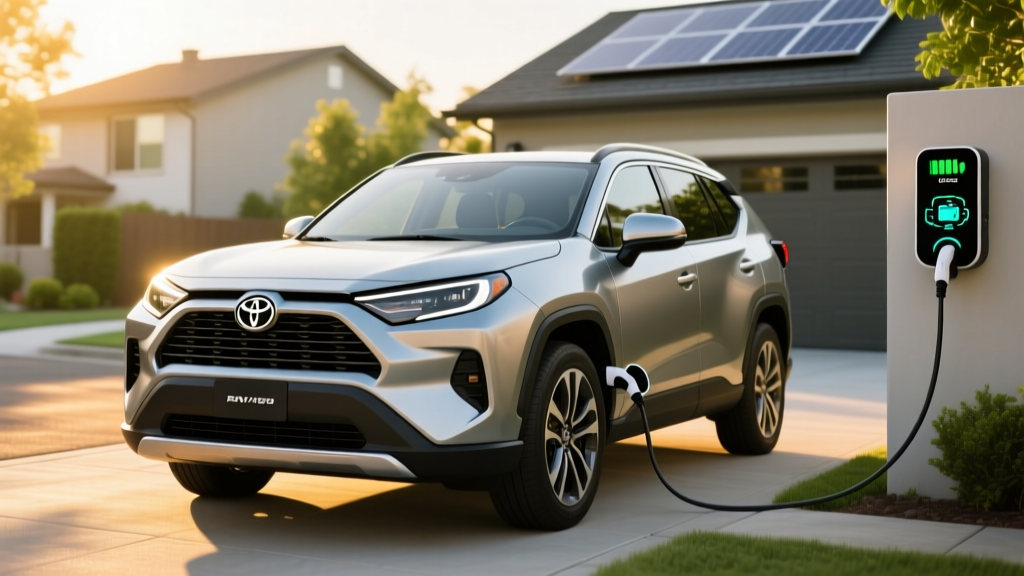
The Toyota RAV4 Hybrid remains the best-selling hybrid crossover SUV in America for good reason. For 2026, Toyota continues offering two electrified flavors: the conventional RAV4 Hybrid (HEV) and the plug-in RAV4 Prime (PHEV). The HEV delivers a stout 39 MPG combined without ever needing a plug, while the Prime adds 42 miles of electric-only commuting and a combined 302 horsepower. Both variants share Toyota's proven hybrid synergy drive architecture, an 8-year/100,000-mile hybrid battery warranty, and a starting price that undercuts most competitors in the segment.
Whether you're cross-shopping the Honda CR-V Hybrid, Hyundai Tucson PHEV, or considering a full battery-electric vehicle like the Tesla Model Y, this guide breaks down exactly what the 2026 RAV4 Hybrid and RAV4 Prime deliver — with real-world numbers, not just EPA stickers.
| Specification | RAV4 Hybrid (HEV) | RAV4 Prime (PHEV) |
|---|---|---|
| Powertrain | 2.5L I4 + 3 electric motors (AWD) | 2.5L I4 + 2 electric motors (AWD) |
| Combined Horsepower | 219 hp | 302 hp |
| 0-60 mph | 7.4 seconds | 5.7 seconds |
| EPA Combined MPG | 39 MPG | 38 MPG (gas) / 94 MPGe (electric) |
| EPA City / Highway | 41 city / 38 highway | 40 city / 36 highway (gas-only) |
| Electric-Only Range | N/A | 42 miles |
| Total Combined Range | ~580 miles | ~600 miles (gas + electric) |
| Traction Battery | 1.6 kWh NiMH (sealed) | 18.1 kWh lithium-ion |
| Level 2 Charge Time | N/A (self-charging) | ~2.5 hours (240V, 32A) |
| DC Fast Charge | N/A | Not supported |
| Cargo Volume | 37.5 cu ft (rear up) | 33.5 cu ft (rear up) |
| Towing Capacity | 1,750 lbs | 2,500 lbs |
| Base MSRP (2026) | $33,425 (LE AWD) | $44,515 (SE) |
| Federal Tax Credit (§30D) | Not eligible | Up to $7,500 (eligibility varies) |
| Hybrid Battery Warranty | 10 yr / 150,000 mi | 10 yr / 150,000 mi |
HEV vs PHEV: Which RAV4 Hybrid Crossover SUV Is Right for You?
Before diving into MPG and pricing, it's essential to understand the fundamental difference between the two RAV4 hybrid models. This distinction trips up many buyers, so let's be precise:
| Factor | RAV4 Hybrid (HEV) | RAV4 Prime (PHEV) |
|---|---|---|
| Plug-in required? | No — regenerative braking and engine recharge the small battery | Yes — plug in to access 42 mi electric range |
| Battery size | 1.6 kWh (small, buffer-style) | 18.1 kWh (large enough for EV-only driving) |
| Electric-only driving | Brief low-speed EV mode only (~1 mi) | 42 miles at highway-capable speeds (up to ~84 mph) |
| Home charging needed? | No — works like a gas car at the pump | Recommended — 120V takes ~10 hrs; 240V takes ~2.5 hrs |
| Ideal driver | No home charging access; wants MPG gains with zero behavior change | Has home/work charging; short commute; wants EV daily, gas for road trips |
| Price premium over gas RAV4 | ~$1,500 | ~$12,500 (before tax credit) |
The conventional RAV4 Hybrid is a "no-compromise" choice: you fill up at gas stations exactly as before, and the hybrid system recovers energy during braking and deceleration to boost MPG. The RAV4 Prime is for drivers who can charge at home or work and want to complete most daily driving (the average American commute is under 40 miles round-trip) on electricity alone, while retaining a gas engine for longer trips without range anxiety.
Fuel Economy: Real-World MPG vs EPA Sticker
| Condition | City | Highway | Combined |
|---|---|---|---|
| EPA Estimate (fueleconomy.gov) | 41 MPG | 38 MPG | 39 MPG |
| Real-World City (owner-reported avg) | 42-44 MPG | 35-37 MPG | 38-41 MPG |
| Cold Weather (below 30°F, short trips) | 34-37 MPG | 32-34 MPG | 33-35 MPG |
Toyota's hybrid system excels in stop-and-go city driving, where regenerative braking recovers energy that gas-only vehicles waste as heat. Many RAV4 Hybrid owners report exceeding the EPA city estimate of 41 MPG on suburban commutes with frequent stops. Highway driving is the opposite: at sustained 70-80 mph speeds, the gasoline engine does most of the work, and the hybrid advantage narrows. Expect 35-37 MPG highway in real-world conditions, particularly with roof racks, cargo loads, or headwinds.
Cold weather hits all hybrids harder. Short trips in sub-freezing temperatures force the engine to run continuously for cabin heat, eliminating the electric-only assist. Expect a 10-15% MPG reduction in winter conditions — still better than most non-hybrid competitors.
RAV4 Prime (PHEV) efficiency note: When operating in hybrid mode (battery depleted), the Prime achieves 38 MPG combined — slightly lower than the standard Hybrid due to the heavier 18.1 kWh battery pack. However, on commutes under 42 miles with daily charging, your effective "MPG" is nearly infinite for those miles. The EPA rates the Prime at 94 MPGe when factoring in electric operation.
RAV4 Prime PHEV: Electric-Only Range and Charging
The RAV4 Prime's 18.1 kWh lithium-ion battery pack delivers an EPA-rated 42 miles of electric-only range. In real-world testing, expect 38-42 miles in mild weather and 32-36 miles in cold conditions (battery efficiency drops and cabin heating draws significant power).
Charging details:
- Level 1 (120V household outlet): ~10 hours for a full charge. This works for overnight charging if your daily driving is under 42 miles.
- Level 2 (240V, 32A home charger): ~2.5 hours for a full charge. A Level 2 home charger (typically $500-$800 for equipment, plus $500-$2,000 for electrician installation) is strongly recommended for Prime owners.
- DC Fast Charging: Not supported. The RAV4 Prime uses a J1772 connector for Level 1 and Level 2 only. You cannot use DC fast chargers (Electrify America, EVgo, etc.) with this vehicle.
Hybrid Battery Warranty & Replacement Cost
Both the RAV4 Hybrid and RAV4 Prime carry Toyota's enhanced hybrid battery warranty: 10 years or 150,000 miles (whichever comes first) in all 50 states. This covers the hybrid traction battery against defects and capacity loss below a defined threshold.
Replacement cost if out of warranty:
- RAV4 Hybrid (1.6 kWh NiMH): $2,000-$3,500 for a refurbished or new battery pack
- RAV4 Prime (18.1 kWh lithium-ion): $6,000-$9,000 for a new battery pack
Toyota's hybrid batteries have an excellent longevity track record. Many first-generation RAV4 Hybrids (2016-2018) have surpassed 150,000 miles on the original battery. Individual cell replacement (rather than the full pack) is increasingly available from independent hybrid specialists for $500-$1,500, extending the pack's life at lower cost.
Performance and Powertrain Details
The 2026 RAV4 Hybrid uses Toyota's fifth-generation Hybrid Synergy Drive. A 2.5-liter Atkinson-cycle four-cylinder engine pairs with three electric motor-generators (one on the front axle, one integrated into the transaxle, and one powering the rear axle for electronic AWD). Combined output is 219 horsepower, and the 0-60 mph time of 7.4 seconds is competitive with turbocharged rivals.
The RAV4 Prime bumps output to 302 combined horsepower with a more powerful electric motor system and the larger battery. Its 5.7-second 0-60 time makes it the quickest RAV4 in the lineup — faster than the gas-only turbo RAV4 TRD Off-Road. The AWD system on both models is electronic (no mechanical driveshaft to the rear), using the rear electric motor to provide torque to the rear wheels when slip is detected or during hard acceleration.
Neither variant uses a traditional stepped automatic transmission. Both employ Toyota's e-CVT (planetary gearset), which provides seamless, shift-free acceleration. If you dislike the "rubber band" feel of some CVTs, note that Toyota's e-CVT behaves differently — it's a mechanical gearset, not a belt-and-cone design, and it's proven extremely reliable over millions of vehicles.
Pricing, Trims, and Tax Credit Eligibility
2026 RAV4 Hybrid pricing starts at $33,425 for the LE AWD trim, rising through XLE ($35,075), XLE Premium ($37,265), Woodland Edition ($36,825), Limited ($40,355), and the new Hybrid SE ($37,500). Fully loaded Limited models with options approach $45,000.
The RAV4 Prime starts at $44,515 for the SE trim and reaches $48,515 for the XSE. With packages, a top-spec Prime XSE can exceed $53,000.
Federal Tax Credit (§30D) Eligibility
- RAV4 Hybrid (HEV): NOT eligible for the federal §30D Clean Vehicle Credit. Conventional hybrids do not qualify — the credit requires a minimum 7 kWh battery and plug-in capability.
- RAV4 Prime (PHEV): May qualify for up to $7,500 under IRS §30D rules, but eligibility depends on multiple factors:
- MSRP cap: SUVs must have an MSRP at or below $80,000 — all RAV4 Prime trims qualify.
- Buyer income cap: Modified AGI must not exceed $150,000 (single), $225,000 (head of household), or $300,000 (joint filers).
- Battery sourcing: As of 2026, critical minerals and battery component requirements have phased in further. Toyota has worked to localize RAV4 Prime battery supply, but the exact credit amount ($3,750 or $7,500) depends on current sourcing compliance. Check the fueleconomy.gov tax credit lookup for the latest determination.
- Point-of-sale transfer: You can transfer the credit to the dealer at purchase to reduce your out-of-pocket cost, rather than waiting to claim it on your tax return.
- Assembly: The RAV4 Prime is assembled in Japan, which may affect eligibility under final assembly requirements. Verify current status before purchasing.
Some states offer additional incentives for PHEVs. California, Colorado, and New York have their own rebate programs that may stack with the federal credit. Check your state's energy office for current programs.
Hybrid vs PHEV vs Full EV: Decision Framework
Choose the RAV4 Hybrid (HEV) if:
- You cannot install a home charger (apartment, street parking, no garage)
- You want maximum MPG with zero behavioral change — just drive and fill up normally
- Your budget is under $40,000 and you don't qualify for PHEV tax credits
- You take frequent road trips and don't want to plan around charging
Choose the RAV4 Prime (PHEV) if:
- You have access to Level 2 charging at home or work
- Your daily round-trip commute is under 42 miles (covers ~80% of American commutes)
- You qualify for the federal tax credit (bringing the effective price closer to the Hybrid)
- You want EV-like daily driving with a gas safety net for longer trips
Choose a Full EV (e.g., Tesla Model Y, Hyundai Ioniq 5) if:
- You can install Level 2 charging at home
- Your daily driving rarely exceeds 200 miles and you're comfortable with road-trip charging planning
- You want to eliminate gasoline costs and maintenance entirely (no oil changes, fewer moving parts)
- Your household has a second gas vehicle for rare long trips
Reliability, Ownership Costs, and Long-Term Value
The RAV4 Hybrid platform has earned top reliability marks from Consumer Reports and J.D. Power across multiple model years. The e-CVT transmission, lacking the clutch packs and bands of conventional automatics, is one of the most durable drivetrain components in the industry. The hybrid battery warranty of 10 years/150,000 miles provides strong protection against the most expensive potential failure.
Pros
- 39 MPG combined (HEV) — among the best in the compact crossover segment
- Standard electronic AWD on all Hybrid trims
- 10-year/150,000-mile hybrid battery warranty
- Strong resale value — RAV4 Hybrids hold value better than most EVs
- No charging infrastructure required (HEV)
- RAV4 Prime: 302 hp and 42 mi electric range make it a dual-personality vehicle
Cons
- RAV4 Prime's $44,515+ starting price is a significant premium over the HEV
- No DC fast charging on the Prime (limits road-trip electric convenience)
- Prime's cargo volume reduced to 33.5 cu ft (vs 37.5 in HEV) due to battery
- Infotainment system trails competitors in responsiveness and screen size
- HEV not eligible for any federal tax credit
- RAV4 Prime assembled in Japan — verify §30D final assembly eligibility
Frequently Asked Questions
How many MPG does the 2026 RAV4 Hybrid get?
The EPA rates the 2026 RAV4 Hybrid AWD at 41 city / 38 highway / 39 combined MPG. In real-world city and suburban driving, many owners report 42-44 MPG thanks to frequent regenerative braking. Highway-only trips at 75+ mph typically return 35-37 MPG.
How far can the RAV4 Prime go on electric only?
The EPA rates the RAV4 Prime at 42 miles of electric-only range. Real-world results vary: expect 38-42 miles in mild weather (60-80°F) and 32-36 miles in cold weather (below 30°F). Highway speeds above 70 mph and aggressive acceleration also reduce electric range.
Is the RAV4 Hybrid reliable and what does battery replacement cost?
Yes. The RAV4 Hybrid has consistently earned above-average reliability ratings. The hybrid battery is warranted for 10 years/150,000 miles. Out-of-warranty replacement costs $2,000-$3,500 for the HEV and $6,000-$9,000 for the Prime's larger pack. However, many Toyota hybrid batteries last well beyond 200,000 miles, and individual cell repair is increasingly available for $500-$1,500.
Does the RAV4 Hybrid qualify for a tax credit?
The conventional RAV4 Hybrid (HEV) does NOT qualify for the federal §30D tax credit — it lacks the required battery capacity and plug-in capability. The RAV4 Prime (PHEV) may qualify for up to $7,500, depending on your income, the vehicle's battery sourcing compliance, and final assembly requirements. Always verify current eligibility on IRS.gov and fueleconomy.gov before purchasing.
Do I need to plug in the RAV4 Hybrid?
No. The conventional RAV4 Hybrid (HEV) never needs to be plugged in. Its small 1.6 kWh battery is recharged entirely through regenerative braking and the gasoline engine. You simply fill it at a gas station like any other vehicle. Only the RAV4 Prime (PHEV) benefits from plugging in.
Hybrid vs PHEV vs EV — which is right for me?
Choose the HEV if you lack home charging access and want effortless MPG improvement. Choose the PHEV if you can charge at home and want electric commuting with gas-engine flexibility for road trips. Choose a full EV if you have reliable home charging, your daily driving is predictable, and you want to eliminate gasoline entirely. The RAV4 Hybrid and Prime represent two of the lowest-risk entry points into electrified driving — no charging infrastructure required for the HEV, and a gas backup for the Prime.