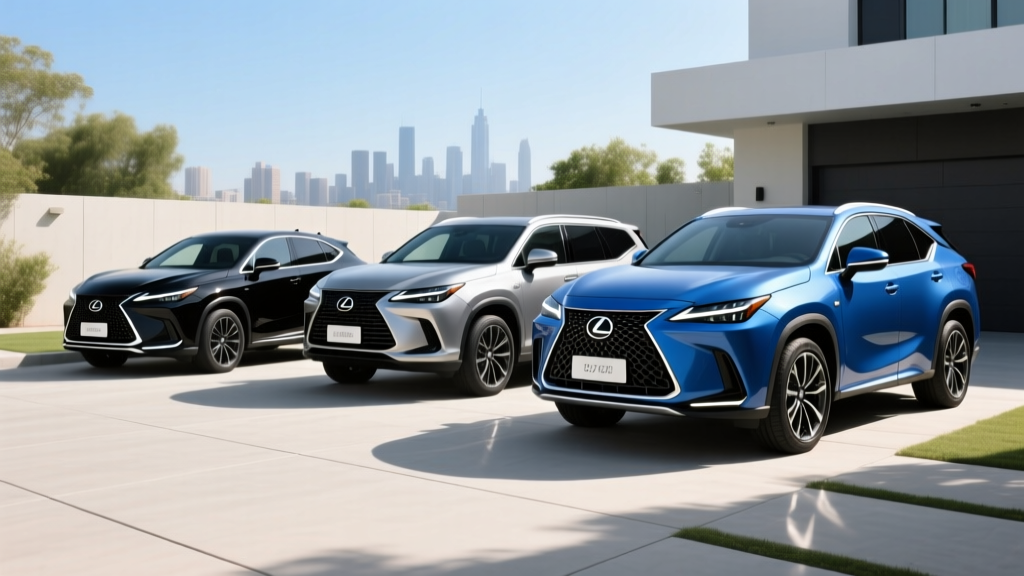
If you've been searching for a Lexus SUV hybrid, the 2026 lineup presents one of the most comprehensive electrified luxury offerings on the market. Lexus has spent over two decades refining its hybrid systems, and today's portfolio spans compact crossovers to full-size three-row haulers — each pairing proven Toyota Hybrid Synergy technology with Lexus refinement. But with four distinct hybrid models (and one plug-in hybrid variant), choosing the right one requires more than a glance at the badge.
This guide breaks down every 2026 Lexus SUV hybrid with the exact numbers that matter: EPA MPG by city and highway, powertrain output, battery chemistry and warranty, real-world efficiency observations, pricing by trim, and federal tax credit eligibility under current IRS §30D rules.
The 2026 Lexus SUV Hybrid Lineup at a Glance
Lexus currently offers five electrified SUV configurations in the U.S. market. Understanding which are conventional hybrids (HEV) versus plug-in hybrids (PHEV) is the first critical distinction:
HEV vs. PHEV — What's the Difference?
| Feature | Conventional Hybrid (HEV) | Plug-In Hybrid (PHEV) |
|---|---|---|
| Needs to plug in? | No — charges via engine and regenerative braking | Yes — plug in for electric-only driving |
| Electric-only range | Less than 1 mile at low speed | 20–40+ miles on battery alone |
| Battery size | 1–2 kWh (small buffer) | 14–22 kWh usable |
| Fuel economy | Consistent MPG in all conditions | MPGe on electric; MPG after battery depletes |
| Tax credit | Generally not eligible for §30D credit | May qualify for up to $7,500 (subject to rules) |
| Best for | Drivers without reliable home charging | Drivers with home charging and short commutes |
| Model | Type | Powertrain | Combined HP | EPA MPG (City/Hwy/Combined) | Base MSRP |
|---|---|---|---|---|---|
| NX 350h | HEV | 2.5L I4 + 3 motors (AWD) | 240 hp | 41 / 37 / 39 | $43,965 |
| NX 450h+ | PHEV | 2.5L I4 + 3 motors (AWD) | 304 hp | 84 MPGe; 36 MPG (gas) | $59,965 |
| RX 350h | HEV | 2.5L I4 + 2 motors (AWD) | 250 hp | 37 / 34 / 36 | $53,150 |
| RX 500h | HEV (Performance) | 2.4L turbo I4 + 2 motors (AWD) | 371 hp | 29 / 28 / 28 | $64,300 |
| TX 500h | HEV | 2.4L turbo I4 + 2 motors (AWD) | 371 hp | 27 / 28 / 27 | $71,550 |
NX 350h and NX 450h+: The Compact Hybrid Crossovers
The NX is Lexus's entry point into the hybrid SUV segment and its best-selling electrified nameplate. The NX 350h uses a naturally aspirated 2.5-liter inline-four paired with three electric motors (two front, one rear) delivering 240 combined horsepower through an electronically controlled CVT. Standard electronic AWD (e-AWD) means the rear motor activates on demand — no mechanical driveshaft.
The EPA rates the NX 350h at 41 city / 37 highway / 39 combined MPG (source: fueleconomy.gov). In real-world driving, this is one of those rare hybrids where city MPG often exceeds the sticker. Stop-and-go traffic maximizes regenerative braking and electric-motor assist, and owners regularly report 42–44 MPG in urban commutes. Highway driving at 75+ mph will see figures dip to 34–36 MPG — the aerodynamic penalty of a crossover body style.
The NX 450h+ is the plug-in variant, using a larger 18.1 kWh lithium-ion battery pack to deliver an EPA-estimated 37 miles of electric-only range. Once that battery depletes, it operates as a conventional hybrid at 36 MPG combined. Total system output jumps to 304 hp, and 0–60 mph drops to 6.0 seconds (versus 7.2 for the 350h).
NX 450h+ Charging Details
The 450h+ accepts Level 2 AC charging at up to 3.3 kW via a J1772 connector. A full 0–100% charge takes approximately 5.5 hours on a 240V Level 2 home charger. There is no DC fast charging capability — this is typical for PHEVs in this class. The onboard charger is simply too small to justify a DC port, and for 37 miles of range, overnight Level 2 charging is more than adequate.
RX 350h and RX 500h: Midsize Hybrid, Two Personalities
The RX is Lexus's volume leader and the hybrid version maintains the model's comfort-first character. The RX 350h uses a 2.5L I4 hybrid system producing 250 combined horsepower with e-AWD. The EPA rates it at 37 city / 34 highway / 36 combined MPG — a remarkable figure for a 4,500-pound midsize luxury SUV.
Real-world observations from owner forums and long-term testing suggest the RX 350h delivers very close to its EPA numbers in mixed driving. City-heavy commuters may see 38–39 MPG, while sustained 80-mph highway cruising can drop to 31–33 MPG. The hybrid system's seamless engine shutoff at stops and aggressive regen on deceleration keep urban numbers strong.
The RX 500h F SPORT Performance takes a fundamentally different approach. Its 2.4-liter turbocharged inline-four pairs with a DIRECT4 all-wheel-drive system using front and rear electric motors for a combined 371 hp and 406 lb-ft of torque. This is a performance hybrid — think of it as Lexus's answer to BMW's M-lite models. The trade-off is efficiency: 29 city / 28 highway / 28 combined MPG. Still better than a comparable turbo-six gas SUV, but the gap narrows considerably.
TX 500h: The Three-Row Hybrid for Families
Introduced for the 2024 model year, the TX replaced the aging RX L as Lexus's three-row offering. The TX 500h shares the RX 500h's turbo-hybrid powertrain (2.4L turbo + DIRECT4, 371 hp) but stretches it across a larger, 2,845-pound-heavier body. EPA fuel economy comes in at 27 city / 28 highway / 27 combined MPG.
For a 5,000+ pound three-row SUV with third-row seating, 27 MPG combined is genuinely competitive. The closest gas-only rival — the BMW X5 xDrive40i — returns 23 MPG combined. Over 15,000 miles per year at $3.50/gallon, that's roughly $400 in annual fuel savings for the TX 500h, not counting the smoother stop-start experience hybrids provide in school-dropoff and grocery-run traffic.
As of the 2026 model year, Lexus does not offer a PHEV variant of the TX. Families needing plug-in electric range in a three-row Lexus will need to look outside the brand or wait for future model announcements.
Real-World MPG: What Owners Actually See
| Model | EPA Combined | Real-World City | Real-World Highway (75 mph) | Cold-Weather Impact |
|---|---|---|---|---|
| NX 350h | 39 MPG | 41–44 MPG | 34–36 MPG | -3 to -5 MPG in sub-30°F |
| NX 450h+ (gas mode) | 36 MPG | 37–39 MPG | 33–35 MPG | -3 to -5 MPG; EV range drops ~20% |
| RX 350h | 36 MPG | 37–39 MPG | 31–33 MPG | -2 to -4 MPG in sub-30°F |
| RX 500h | 28 MPG | 27–29 MPG | 26–28 MPG | -1 to -3 MPG |
| TX 500h | 27 MPG | 26–28 MPG | 25–27 MPG | -1 to -3 MPG |
Hybrids inherently outperform their EPA city ratings in stop-and-go traffic because the electric motor handles low-speed propulsion while the engine shuts off entirely at stops. Highway driving reverses this advantage — the engine runs continuously, and aerodynamic drag dominates. Cold weather reduces efficiency across the board: the engine runs more often to provide cabin heat, battery internal resistance increases, and winter fuel blends contain less energy per gallon.
Battery Warranty, Lifespan, and Replacement Cost
Lexus Hybrid Battery Warranty (2026 Models)
All 2026 Lexus hybrid and PHEV models carry a hybrid battery warranty of 10 years / 150,000 miles (whichever comes first), transferable to subsequent owners. The general hybrid system components (inverter, control module, motors) are covered for 8 years / 100,000 miles.
This warranty guarantees the battery will retain sufficient capacity to function as designed — it is not a percentage-retention guarantee like you'll see on full EVs (which typically warrant 70% capacity retention). If the hybrid battery fails within the warranty period, Lexus replaces it at no cost.
Lexus hybrid batteries have an exceptional longevity track record. The nickel-metal hydride (NiMH) packs in earlier models routinely surpassed 200,000 miles, and today's lithium-ion packs are expected to last the life of the vehicle under normal use. Unlike full EV batteries, hybrid batteries are small (1–2 kWh for HEVs, 18.1 kWh for the NX PHEV) and operate within a narrow state-of-charge window — typically 40% to 80% — which dramatically reduces degradation stress.
Out-of-Warranty Replacement Costs
If a hybrid battery does need replacement outside warranty coverage:
- NX 350h / RX 350h (HEV): $3,000–$4,500 (battery + labor)
- NX 450h+ (PHEV): $7,000–$9,500 (larger lithium-ion pack)
- RX 500h / TX 500h: $4,000–$5,500
These figures are based on current dealer parts pricing and independent hybrid-shop estimates. Refurbished and aftermarket options may reduce costs by 30–40%. Given the 10-year/150,000-mile warranty and documented longevity, out-of-pocket replacement is rare for first owners.
Pricing and Federal Tax Credit Eligibility
| Model | Base Trim | MSRP | Fully Loaded (approx.) |
|---|---|---|---|
| NX 350h | Premium | $43,965 | $55,000 |
| NX 450h+ (PHEV) | Premium | $59,965 | $67,000 |
| RX 350h | Premium | $53,150 | $65,000 |
| RX 500h | F SPORT Performance | $64,300 | $73,000 |
| TX 500h | Premium | $71,550 | $82,000 |
Does a Lexus SUV Hybrid Qualify for the Federal Tax Credit?
Under the IRS §30D Clean Vehicle Credit, only plug-in hybrid and full-electric vehicles are potentially eligible — conventional hybrids (HEVs) like the NX 350h, RX 350h, RX 500h, and TX 500h do not qualify. The credit applies exclusively to vehicles with a battery capacity of at least 7 kWh that can be plugged in to recharge.
The NX 450h+ is the only Lexus SUV hybrid with potential §30D eligibility, but qualification depends on several requirements that change frequently:
IRS §30D Credit Requirements (2026 Tax Year)
- Battery sourcing: Critical minerals and battery components must meet phased-in domestic/free-trade-agreement sourcing thresholds (increasing annually through 2029)
- MSRP cap: SUVs must have an MSRP at or below $80,000 (NX 450h+ qualifies)
- Buyer income cap: Modified AGI ≤ $150,000 (single), ≤ $225,000 (head of household), ≤ $300,000 (joint)
- Assembly: Vehicle must undergo final assembly in North America (NX 450h+ is assembled in Japan — this currently disqualifies it from §30D)
- Point-of-sale transfer: Eligible buyers can transfer the credit to the dealer at purchase for an immediate price reduction
Source: IRS.gov §30D guidelines. Consult a tax professional for your specific situation.
Key takeaway: As of the 2026 model year, the NX 450h+ is assembled in Tahara, Japan, which means it does not meet the North American final assembly requirement for §30D. Unless production shifts or rules change, buyers should not expect the $7,500 federal credit on any current Lexus hybrid or PHEV. Some state-level incentives may still apply — check your state's energy office or DMV for local PHEV rebates.
Hybrid vs. PHEV vs. Full EV: Which Lexus SUV Fits You?
Choose a Lexus HEV (NX 350h, RX 350h, RX 500h, TX 500h) If:
- You don't have access to reliable home or workplace charging
- You want maximum simplicity — no plug, no charging apps, no range planning
- Your driving mix includes frequent long road trips
- You want the lowest total cost of entry into an electrified SUV
- You live in an apartment or condo without charging infrastructure
Choose the Lexus PHEV (NX 450h+) If:
- You have Level 2 home charging (or can install it)
- Your daily commute is under 35 miles round-trip
- You want electric-only daily driving with gas-engine road-trip flexibility
- You want the most powerful NX variant (304 hp)
- You want to reduce fuel consumption to near-zero on weekdays
When to Skip the Hybrid and Go Full EV Instead
A full battery-electric vehicle (BEV) makes more sense if you have reliable home charging, your daily driving is predictable, and you want to eliminate gasoline entirely. Models like the Tesla Model Y, Hyundai Ioniq 5, or BMW iX offer 280–320 miles of EPA range and DC fast charging at 150–250 kW. The trade-off: longer road trips require charging-stop planning, cold weather reduces range by 20–30%, and upfront cost is typically higher before incentives.
For buyers who frequently tow, drive in extreme cold, or take 500+ mile road trips without time for charging stops, a Lexus hybrid remains the pragmatic choice. You get 30–40% better fuel economy than a gas-only equivalent without changing any habits.
Reliability: The Lexus Hybrid Advantage
Lexus consistently ranks at or near the top of J.D. Power Vehicle Dependability Studies and Consumer Reports reliability surveys, and the hybrid powertrain is a significant part of that reputation. The e-CVT transmission used in Lexus hybrids has no traditional gears, belts, or clutches — it's a planetary gearset that's virtually wear-free. Brake pad life extends significantly because regenerative braking handles most deceleration, often pushing pad replacement past 80,000–100,000 miles.
The hybrid system also eliminates the conventional starter motor and alternator — two common failure points in gas-only vehicles. The engine itself starts and stops dozens of times per drive cycle, but Toyota/Lexus has engineered these systems for millions of cycles. There are documented cases of Prius and Lexus hybrid taxis surpassing 400,000 miles on original hybrid components.
The IIHS has awarded multiple Lexus SUV models Top Safety Pick ratings, and the hybrid variants share identical crash structures with their gas counterparts. NHTSA five-star ratings apply across the lineup.
Frequently Asked Questions
How many MPG does the Lexus NX 350h hybrid get?
The 2026 Lexus NX 350h is EPA-rated at 41 city / 37 highway / 39 combined MPG. Real-world city driving often yields 41–44 MPG thanks to regenerative braking, while sustained highway driving above 75 mph drops to 34–36 MPG.
How far can the Lexus NX 450h+ drive on electric only?
The NX 450h+ PHEV delivers an EPA-estimated 37 miles of electric-only range on a full charge of its 18.1 kWh battery. In warm weather with gentle acceleration, some owners report 39–41 miles. Cold weather (below freezing) can reduce electric range to approximately 28–32 miles due to cabin heating demands and battery chemistry limitations.
Do Lexus hybrid SUVs need to be plugged in?
No. The NX 350h, RX 350h, RX 500h, and TX 500h are conventional hybrids (HEVs) that charge their batteries entirely through the gasoline engine and regenerative braking. You fuel them like any other car. Only the NX 450h+ is a plug-in hybrid (PHEV) that benefits from being plugged in for electric-only driving, though it will still function as a regular hybrid if you never plug it in.
Is the Lexus hybrid battery reliable and what does replacement cost?
Lexus hybrid batteries are among the most reliable in the industry. The 10-year/150,000-mile hybrid battery warranty covers premature failure, and real-world data shows these batteries routinely lasting 150,000–200,000+ miles. Out-of-warranty replacement costs range from $3,000–$4,500 for HEV models and $7,000–$9,500 for the NX 450h+ PHEV.
Does any Lexus SUV hybrid qualify for the $7,500 federal tax credit?
As of the 2026 model year, no Lexus hybrid SUV qualifies for the IRS §30D Clean Vehicle Credit. Conventional hybrids are ineligible by definition (they can't be plugged in). The NX 450h+ PHEV meets the battery-capacity and MSRP requirements but is assembled in Japan, failing the North American final assembly mandate. State-level incentives may still apply — check your local energy office.
Which Lexus hybrid SUV is best for a family of five?
The TX 500h is the only Lexus hybrid with a usable third row, seating up to seven. For families of five who don't need the third row, the RX 350h offers the best balance of interior space, fuel economy (36 MPG combined), and cargo volume. The NX 350h works for smaller families but has noticeably less rear legroom and cargo capacity.
How does the RX 500h compare to the RX 350h?
The RX 350h prioritizes efficiency (36 MPG combined, 250 hp) while the RX 500h prioritizes performance (28 MPG combined, 371 hp with DIRECT4 AWD). The 500h costs roughly $11,000 more at base and uses a turbocharged 2.4L engine versus the 350h's naturally aspirated 2.5L. Choose the 350h for daily commuting efficiency; choose the 500h if you want sports-sedan acceleration in an SUV body.