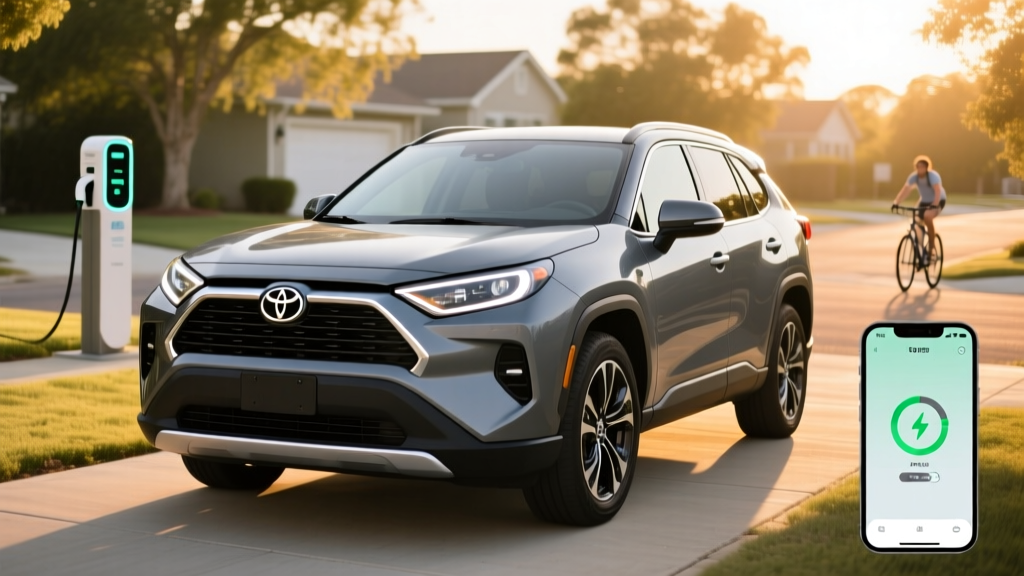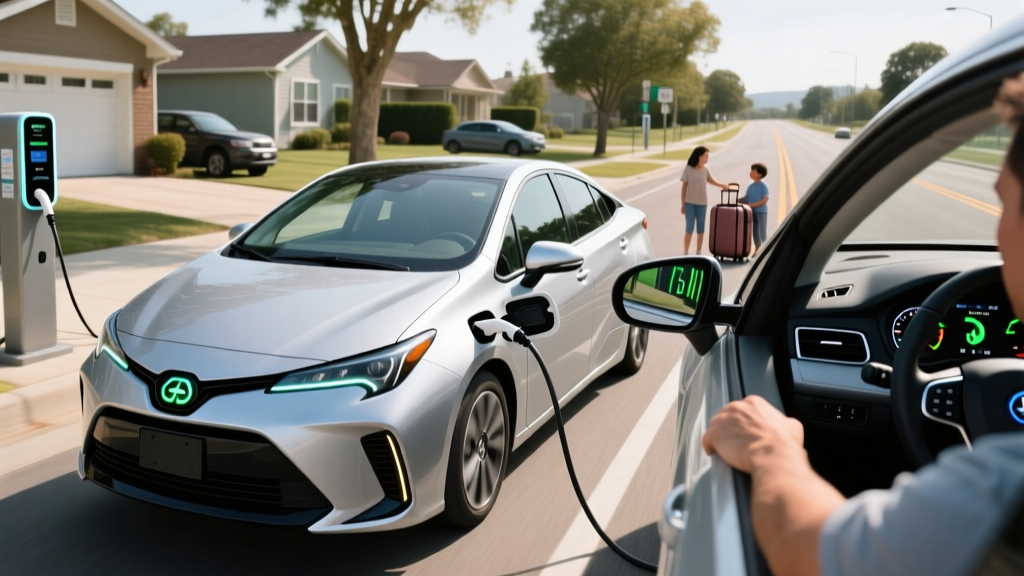
Quick Verdict: The 2026 Prius Plug-In Hybrid Bridges Two Worlds
The 2026 Prius Plug-In Hybrid (formerly Prius Prime) occupies a narrow but highly practical sweet spot: 44 miles of electric-only driving for daily commutes, backed by Toyota's proven hybrid system for weekend road trips where charging infrastructure remains unreliable. With a combined 220 horsepower from its 2.0-liter four-cylinder engine and two electric motors, it no longer feels like a penalty box — it genuinely accelerates with confidence. For buyers who want EV-like daily driving without range anxiety or home-charger dependency, this is one of the most rational vehicles on the market in 2026.
HEV vs PHEV: Which Prius Actually Fits Your Life?
Conventional Prius (HEV)
- No plug required — the 1.3 kWh battery recharges via regenerative braking and the engine
- EPA: 57 city / 52 highway / 54 combined MPG
- Best for: drivers without home charging access, high-mileage commuters, rideshare drivers
- Starts at: ~$28,350 MSRP
Prius Plug-In Hybrid (PHEV)
- Plugs in to a 13.6 kWh lithium-ion battery for 44 miles of pure electric range
- EPA: 52 MPGe (electric+gas) / 48 MPG combined (gas only)
- Best for: drivers with home/workplace charging, sub-40-mile daily commutes, weekend trippers
- Starts at: ~$33,445 MSRP
The distinction matters. A conventional HEV never needs a plug and operates as a self-charging system. A PHEV can operate identically once its battery depletes — but if you plug it in nightly, you may go months without visiting a gas station. According to fueleconomy.gov, a driver covering 30 miles daily on a PHEV with nightly charging could use less than 15 gallons of fuel per year.
Electric-Only Range and Total Range: The Numbers That Matter
EPA Electric-Only Range: 44 miles
Real-World Expectation: 38–42 miles in mixed suburban/highway driving at 65–70°F; expect 30–35 miles in freezing weather with cabin heat active. Highway-speed driving (75+ mph) depletes the battery faster than the EPA cycle suggests.
Total Combined Range (electric + gas): approximately 520 miles
The 13.6 kWh lithium-ion pack (11.1 kWh usable, preserving a buffer to protect long-term cell health) powers the front axle through an 83 kW (111 hp) electric motor. Once depleted, the 2.0-liter Atkinson-cycle engine seamlessly engages, and the car operates as a conventional hybrid at 48 MPG combined. There is no jarring transition — Toyota's power-split device blends sources imperceptibly.
| Specification | Value |
|---|---|
| EPA Electric-Only Range | 44 miles |
| Total Combined Range | ~520 miles |
| Battery Capacity | 13.6 kWh total / 11.1 kWh usable (lithium-ion) |
| Combined System Horsepower | 220 hp |
| Gas Engine | 2.0L 4-cylinder Atkinson cycle, 150 hp |
| Electric Motor (front) | 83 kW (111 hp) |
| EPA MPGe (electric+gas) | 52 MPGe combined |
| EPA MPG (gas-only, after depletion) | 48 combined / 45 city / 50 highway |
| 0–60 mph | 6.6 seconds |
| Level 1 Charging (120V) | ~10 hours (0–100%) |
| Level 2 Charging (240V, 3.3 kW) | ~4 hours (0–100%) |
| DC Fast Charging | Not supported |
| Cargo Volume (rear seats up) | 20.3 cu ft |
| Base MSRP (SE trim) | $33,445 |
Fuel Economy: EPA Ratings and Real-World MPG
| Mode | City | Highway | Combined |
|---|---|---|---|
| Electric + Gas (MPGe) | 53 MPGe | 50 MPGe | 52 MPGe |
| Gas Only (after battery depletion) | 45 MPG | 50 MPG | 48 MPG |
In real-world testing, the PHEV consistently matches or slightly exceeds its EPA highway rating — hybrids tend to benefit from regenerative braking in stop-and-go traffic, which keeps the engine off longer. On a 200-mile highway loop at 70 mph with the battery already depleted, expect 46–49 MPG. In city driving with frequent stops, 48–52 MPG gas-only is achievable, and if you're starting with a full charge and driving under 44 miles, you'll burn zero gasoline.
One practical note: the Prius PHEV's efficiency advantage over a conventional Prius (54 MPG combined) only materializes if you charge regularly. If you never plug in, you're carrying 250+ lbs of battery you're not using, and you'll see roughly 48 MPG — slightly less than the HEV variant. Buy the PHEV only if you have reliable access to a Level 1 or Level 2 outlet at home or work.
Charging: What You Need to Know Before You Plug In
The 2026 Prius Plug-In Hybrid uses a standard J1772 connector for AC charging. It does not support DC fast charging — there is no CCS or NACS port. This is a deliberate engineering decision: the 13.6 kWh pack is small enough that overnight Level 1 charging (a standard 120V household outlet) fully replenishes it, making expensive home charging upgrades unnecessary for most owners.
| Level | Voltage / Power | Time (0–100%) | Miles of EV Range Added per Hour |
|---|---|---|---|
| Level 1 | 120V / ~1.4 kW | ~10 hours | ~4–5 miles |
| Level 2 | 240V / 3.3 kW | ~4 hours | ~11 miles |
| DC Fast Charge | N/A | N/A | Not supported |
For most PHEV owners, Level 1 is sufficient. Plug in when you get home; wake up to a full battery. A Level 2 wallbox ($300–$600 for equipment, $500–$1,500 for electrician installation) cuts charge time to four hours — useful if you need a midday top-up or drive more than 44 miles between plug-in opportunities. The onboard charger maxes at 3.3 kW, so installing a 48-amp charger won't speed things up; a basic 16-amp, 240V circuit is all you need.
Performance: 220 HP Changes the Prius Story
The previous-generation Prius Prime produced 121 combined horsepower and felt sluggish in highway merging situations. The 2026 model's 220 hp — combining the 2.0-liter engine's 150 hp with the front electric motor's 111 hp through Toyota's power-split e-CVT — transforms the driving character. The 0–60 mph time of 6.6 seconds places it alongside sporty compact sedans, and the electric motor's instant torque makes city acceleration feel even quicker than the number suggests.
Three drive modes manage the powertrain: EV Mode (electric-only up to 84 mph), Hybrid Mode (seamless blending), and a driver-selectable EV/HV toggle that lets you preserve battery charge for later use — useful if your commute starts on the highway but ends in an emissions-restricted city zone or you want electric-only driving for a quiet neighborhood arrival.
Pricing, Trims, and Federal Tax Credit Eligibility
The 2026 Prius Plug-In Hybrid is offered in three trims:
- SE: $33,445 MSRP — 17-inch alloy wheels, 8-inch touchscreen, wireless Apple CarPlay/Android Auto, Toyota Safety Sense 3.0
- XSE: $36,745 MSRP — 19-inch wheels, 12.3-inch touchscreen, heated front seats, SofTex upholstery
- XSE Premium: $39,670 MSRP — panoramic fixed-glass roof, JBL premium audio, digital rearview mirror, heated/ventilated front seats
Federal Tax Credit (§30D) — 2026 Rules
The 2026 Prius Plug-In Hybrid may qualify for a partial federal tax credit of up to $3,750, subject to the following IRS requirements per irs.gov:
- MSRP cap: Vehicle MSRP must not exceed $55,000 (sedans) — all Prius PHEV trims qualify
- Buyer income cap: Modified AGI must not exceed $150,000 (single) / $300,000 (joint filing)
- Battery sourcing: The $3,750 amount depends on critical-mineral and battery-component sourcing requirements that phase in annually. Toyota's supply chain has historically met the component requirement but may not fully satisfy the critical-minerals threshold for the full $7,500
- Point-of-sale transfer: Eligible buyers can transfer the credit to the dealer at purchase, reducing the out-of-pocket price immediately
Important: Credit amounts and sourcing rules change. Verify current-year eligibility on irs.gov or with a tax professional before purchasing. Some states (California, Colorado, New York, Massachusetts) offer additional PHEV rebates of $1,000–$4,000 that stack with federal credits.
Reliability, Battery Warranty, and Long-Term Costs
Hybrid Battery Warranty: 10 years / 150,000 miles (whichever comes first) in all 50 states, covering defects and capacity loss below a specified threshold (typically 60–70% of original capacity).
Powertrain Warranty: 5 years / 60,000 miles
Basic Warranty: 3 years / 36,000 miles
Toyota's hybrid systems are among the most proven in the industry. The original Prius, launched in Japan in 1997, demonstrated that nickel-metal hydride and later lithium-ion hybrid batteries can exceed 200,000 miles with minimal degradation. The PHEV's larger lithium-ion pack operates within a conservative state-of-charge window (roughly 15%–90% of true capacity), which dramatically reduces cell stress. Real-world data from fleet operators and high-mileage owners suggests 10–15 years of usable battery life is typical.
If replacement is needed out of warranty, a refurbished Prius PHEV battery currently costs $2,500–$4,000 installed at a Toyota dealer, with aftermarket options emerging at lower prices. This is a fraction of a full-EV battery replacement ($8,000–$20,000+) because the PHEV pack is much smaller.
According to IIHS, the Prius platform has earned top safety marks, and Toyota Safety Sense 3.0 includes pre-collision braking with pedestrian detection, lane-departure alert with steering assist, full-speed adaptive cruise control, and road-sign assist as standard equipment on every trim.
Pros
- 44 miles EV range covers most daily commutes gasoline-free
- 520+ mile total range eliminates road-trip anxiety
- 220 hp delivers confident acceleration (6.6s 0–60)
- No DC fast-charging dependency — Level 1 outlet is sufficient
- 10-year/150,000-mile hybrid battery warranty
- Eligible for partial federal tax credit + state incentives
- Proven Toyota reliability and strong resale value
Cons
- No DC fast charging — not ideal for apartment dwellers relying on public chargers
- 20.3 cu ft cargo space is modest for a hatchback
- XSE Premium trim pushes near $40K, encroaching on full-EV territory
- If you never plug in, you're carrying dead weight — HEV is more efficient unplugged
- Rear-seat headroom is tight for passengers over 6'2"
- Federal tax credit is partial ($3,750), not the full $7,500
Who Should Choose the Prius PHEV vs. a Full EV or Gas Car?
Choose the 2026 Prius Plug-In Hybrid if:
- You have access to a 120V or 240V outlet at home or work
- Your daily round-trip commute is under 45 miles
- You take road trips where charging infrastructure is sparse or unreliable
- You want to reduce gasoline consumption by 70–90% without committing to full electric
- You live in a cold climate where EV range loss (20–40% in winter) is a concern — the PHEV's engine provides cabin heat without draining the battery
Choose a full BEV (Tesla Model 3, Hyundai Ioniq 6, Chevrolet Equinox EV) if:
- You have reliable Level 2 home charging and access to DC fast chargers for road trips
- You want zero tailpipe emissions and minimal maintenance (no oil changes, no engine)
- Your daily driving exceeds 44 miles but stays under 250 miles (most BEVs' range)
- You want to qualify for the full $7,500 federal tax credit (available on several BEVs)
Choose the conventional Prius HEV if:
- You lack any access to plug-in charging (apartment, street parking)
- You drive 30,000+ miles per year and want maximum fuel efficiency without behavioral changes
- You want the lowest purchase price and simplest ownership experience
Frequently Asked Questions
How many MPG does the 2026 Prius Plug-In Hybrid get?
The EPA rates it at 52 MPGe combined when using both electric and gas power, and 48 MPG combined (45 city / 50 highway) once the battery is depleted and it operates as a conventional hybrid. In real-world city driving with regenerative braking, expect 48–52 MPG gas-only.
How far can the Prius Plug-In Hybrid go on electric only?
The EPA rates it at 44 miles of electric-only range. In real-world conditions at moderate temperatures, expect 38–42 miles. In freezing weather with the heater running, plan for 30–35 miles. Highway driving above 70 mph also reduces EV range.
Does the 2026 Prius Plug-In Hybrid qualify for a tax credit?
It may qualify for a partial federal tax credit of up to $3,750 under IRS §30D rules, depending on battery-component and critical-mineral sourcing requirements for the current tax year. Buyer income caps ($150K single / $300K joint) and the $55,000 sedan MSRP cap apply. Verify current eligibility on irs.gov. Several states offer additional rebates.
Is the hybrid battery reliable and what does replacement cost?
Toyota's hybrid batteries are among the most durable in the industry, backed by a 10-year/150,000-mile warranty. The PHEV's lithium-ion pack operates in a conservative charge window that minimizes degradation. Out-of-warranty replacement runs $2,500–$4,000 installed — far less than a full-EV battery. Many Prius batteries last 15+ years or 200,000+ miles.
Do I need to install a Level 2 charger at home?
No. The 13.6 kWh battery fully charges overnight on a standard 120V Level 1 outlet in about 10 hours. A Level 2 (240V) charger reduces this to approximately 4 hours, which is convenient but not essential. The onboard charger caps at 3.3 kW, so an expensive high-amperage wallbox provides no speed benefit.
Hybrid vs PHEV vs EV — which fits me?
Choose the HEV if you can't plug in at all. Choose the PHEV if you can plug in at home/work and want electric daily driving with gas-engine freedom for road trips. Choose a full EV if you have reliable charging access, want zero emissions, and are comfortable planning road-trip charging stops. The PHEV is the lowest-risk bridge between gas and electric ownership.
Can the Prius Plug-In Hybrid use DC fast chargers?
No. The 2026 Prius PHEV only supports AC charging via its J1772 port (Level 1 at 120V or Level 2 at 240V). It cannot connect to CCS, NACS, or CHAdeMO DC fast-charging stations. This is typical for PHEVs — their small batteries make DC fast-charging infrastructure unnecessary for daily use.