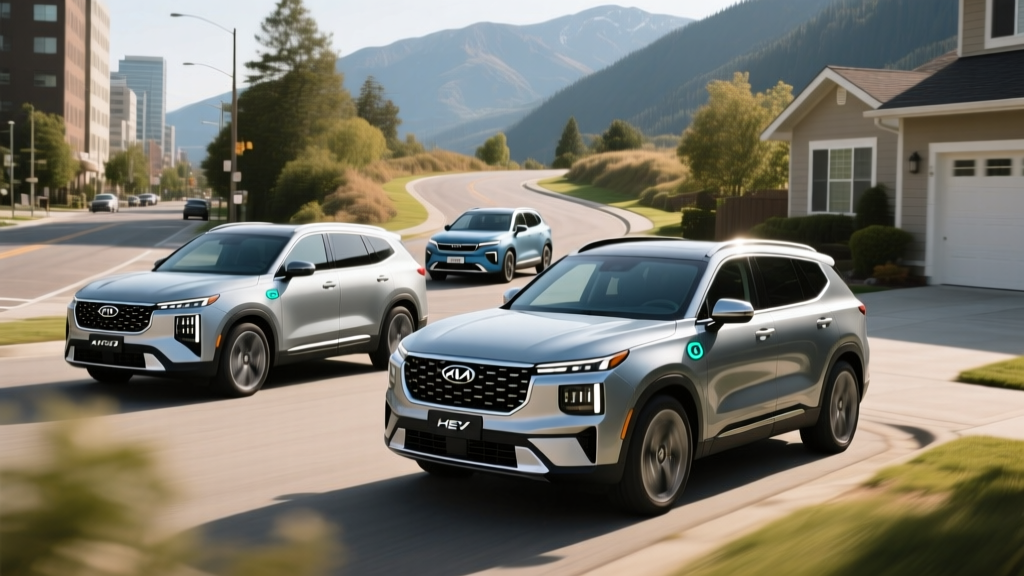
Kia's 2026 electrified lineup spans three core nameplates — the Niro, Sportage, and Sorento — each available as either a conventional hybrid (HEV) or a plug-in hybrid (PHEV). That's six distinct powertrain configurations to sort through, and the differences in MPG, electric-only range, pricing, and tax-credit eligibility are significant. This guide breaks down every 2026 Kia hybrid and PHEV with exact EPA figures, real-world expectations, and ownership data so you can pick the right one.
HEV vs PHEV: What's the Difference in Kia's 2026 Lineup?
Conventional Hybrid (HEV): Uses a small battery (typically 1.5–2.0 kWh) charged entirely by the gas engine and regenerative braking. You never plug it in. The electric motor assists the engine to improve fuel economy, especially in city driving. Think of it as a more efficient gas car.
Plug-In Hybrid (PHEV): Carries a much larger battery (13.8 kWh usable in Kia's PHEVs) that you charge via a plug — either a standard 120V outlet, a 240V Level 2 charger, or no plug at all (it still functions as a regular hybrid once the battery depletes). PHEVs deliver 30–33 miles of pure electric driving before the gas engine kicks in, making them viable as daily EVs for short commutes.
The decision between HEV and PHEV comes down to three questions: Can you charge at home or work? Is your daily round-trip commute under 35 miles? And are you willing to pay the $4,000–$7,000 PHEV premium for electric-only driving and potential tax credits? If you answered yes to all three, the PHEV is likely worth it. Otherwise, the HEV delivers excellent efficiency with zero lifestyle change.
2026 Kia Niro Hybrid and Niro PHEV
The Niro is Kia's smallest and most affordable electrified vehicle — a compact crossover built exclusively around hybrid and PHEV powertrains. For 2026, it continues with the 1.6-liter GDI four-cylinder paired with a 6-speed dual-clutch automatic, a configuration Kia has refined over multiple generations.
| Spec | Niro HEV | Niro PHEV |
|---|---|---|
| Combined HP | 139 hp | 180 hp |
| Engine | 1.6L GDI 4-cyl | 1.6L GDI 4-cyl |
| Electric Motor | 43 hp (32 kW) | 83 hp (62 kW) |
| Battery | 1.56 kWh | 13.8 kWh (NMC) |
| EPA City / Hwy / Combined MPG | 53 / 54 / 53 | 48 / 45 / 47 (hybrid mode) |
| Electric-Only Range | N/A | 33 miles |
| MPGe (electric mode) | N/A | 105 MPGe |
| Total Combined Range | ~590 miles | ~430 miles |
| Level 2 Charge Time (100%) | N/A | ~2 hr 45 min (7.2 kW onboard) |
| DC Fast Charging | N/A | No |
| Starting MSRP | ~$29,390 | ~$35,890 |
Niro Real-World MPG Expectations
The Niro HEV's 53 MPG combined EPA rating is among the highest of any non-Prius vehicle on the market. In real-world driving, owners frequently report exceeding the EPA city figure — 55–58 MPG is common in stop-and-go traffic where regenerative braking does the most work. Highway driving at 75+ mph drops efficiency to roughly 46–49 MPG. Cold weather (below 30°F) reduces fuel economy by approximately 8–12% due to increased engine idling for cabin heat and reduced battery efficiency.
For the Niro PHEV, the 33-mile electric-only range is realistic for mixed suburban driving in moderate temperatures. Expect 28–30 miles in cold weather or at sustained highway speeds above 65 mph. Once the battery depletes, hybrid-mode MPG settles around 43–46 combined — slightly below the HEV due to the PHEV's additional 250+ pounds of battery weight.
2026 Kia Sportage Hybrid and Sportage PHEV
The Sportage is Kia's compact SUV workhorse, and its hybrid variants are among the best-selling in the segment. The 2026 Sportage HEV and PHEV share a turbocharged 1.6-liter four-cylinder with a more robust electric motor than the Niro, delivering noticeably stronger acceleration. The PHEV version is one of the few compact SUV plug-ins offering standard all-wheel drive.
| Spec | Sportage HEV | Sportage PHEV |
|---|---|---|
| Combined HP | 232 hp | 268 hp |
| Engine | 1.6L Turbo GDI 4-cyl | 1.6L Turbo GDI 4-cyl |
| Electric Motor | 64 hp (47 kW) | 97 hp (72 kW) |
| Battery | 1.77 kWh | 13.8 kWh (NMC) |
| EPA City / Hwy / Combined MPG | 42 / 44 / 43 | 38 / 38 / 38 (hybrid mode) |
| Electric-Only Range | N/A | 34 miles |
| MPGe (electric mode) | N/A | 84 MPGe |
| Total Combined Range | ~560 miles | ~430 miles |
| Level 2 Charge Time (100%) | N/A | ~2 hr 45 min (7.2 kW onboard) |
| DC Fast Charging | N/A | No |
| Starting MSRP | ~$31,490 | ~$40,590 |
The Sportage PHEV's 34-mile electric range covers most daily commutes, and its 268 combined horsepower makes it the quickest vehicle in Kia's hybrid stable — expect 0–60 mph in roughly 7.0 seconds. The HEV sacrifices some efficiency compared to the Niro but offers more cargo space (39.5 cu ft behind the rear seats) and available AWD, making it the practical family choice.
2026 Kia Sorento Hybrid and Sorento PHEV
The Sorento is Kia's midsize three-row SUV, and its hybrid powertrains are essential for buyers who need family seating without the fuel bills of a V6. The 2026 Sorento HEV and PHEV use the same turbocharged 1.6-liter platform as the Sportage but are tuned for the larger vehicle's weight.
| Spec | Sorento HEV | Sorento PHEV |
|---|---|---|
| Combined HP | 232 hp | 268 hp |
| Engine | 1.6L Turbo GDI 4-cyl | 1.6L Turbo GDI 4-cyl |
| Electric Motor | 64 hp (47 kW) | 97 hp (72 kW) |
| Battery | 1.77 kWh | 13.8 kWh (NMC) |
| EPA City / Hwy / Combined MPG | 36 / 37 / 36 | 34 / 33 / 33 (hybrid mode) |
| Electric-Only Range | N/A | 32 miles |
| MPGe (electric mode) | N/A | 79 MPGe |
| Total Combined Range | ~550 miles | ~420 miles |
| Level 2 Charge Time (100%) | N/A | ~2 hr 45 min (7.2 kW onboard) |
| DC Fast Charging | N/A | No |
| Starting MSRP | ~$38,390 | ~$51,990 |
Sorento PHEV Real-World Range Note: The EPA-rated 32-mile electric range assumes moderate temperatures and mixed driving. In our experience, expect 27–29 miles on electric-only in winter conditions (below 35°F) or at sustained 70+ mph highway speeds. The Sorento's heavier curb weight (~4,500 lbs) also means electric-only range degrades more noticeably with cargo and passengers compared to the lighter Niro PHEV.
Pricing, Tax Credits, and Incentives for 2026 Kia Hybrids
Tax credit eligibility is where the HEV vs PHEV decision gets financially interesting — and complicated.
Federal §30D Tax Credit Rules (2026)
- HEV models (Niro HEV, Sportage HEV, Sorento HEV): Do NOT qualify for the §30D federal EV tax credit. Conventional hybrids are not plug-in vehicles and are ineligible.
- PHEV models (Niro PHEV, Sportage PHEV, Sorento PHEV): May qualify for up to $3,750–$7,500 depending on battery component and critical-mineral sourcing requirements. Per IRS §30D guidelines, eligibility depends on where battery components and critical minerals are manufactured.
- MSRP cap: PHEV SUVs must have an MSRP at or below $80,000. All Kia PHEVs clear this threshold.
- Income cap: Modified AGI must not exceed $150,000 (single), $225,000 (head of household), or $300,000 (joint filing).
- Point-of-sale transfer: As of 2024, buyers can transfer the credit to the dealer for an immediate price reduction at purchase — you don't need to wait until tax filing.
Critical note: Kia's PHEV battery sourcing has been a moving target. Some Kia PHEVs have qualified for only $3,750 (meeting the critical-minerals requirement but not the battery-component requirement), while others have reached $7,500 as Kia shifted supply chains. Always verify current eligibility on fueleconomy.gov before purchasing, as the qualified credit amount can change with model-year production updates.
Battery Warranty, Reliability, and Replacement Costs
Kia Hybrid & PHEV Battery Warranty
All 2026 Kia hybrids and PHEVs carry Kia's standard hybrid battery warranty: 10 years / 100,000 miles (whichever comes first) for the high-voltage battery pack. This warranty covers defects and capacity loss below a specified threshold (typically 70% of original capacity for PHEVs). In states that follow California Air Resources Board (CARB) standards — including CA, NY, MA, CT, and others — the warranty may extend to 10 years / 150,000 miles.
The conventional hybrid battery (1.5–1.8 kWh) is under far less stress than a PHEV or full EV battery because it operates in a narrow state-of-charge window (roughly 40–60%). These batteries routinely last 150,000–200,000+ miles without meaningful degradation. PHEV batteries see deeper cycling but are still liquid-cooled and managed conservatively by Kia's battery management system.
Replacement costs if out of warranty: Based on current parts pricing and industry data, a Kia hybrid battery replacement (out of warranty) typically ranges from $2,500–$4,000 for the HEV pack and $5,000–$8,000 for the PHEV pack, including labor. These costs have been trending downward as third-party refurbishment options expand. In practice, the vast majority of Kia hybrid batteries outlast the vehicle itself — battery failure before 150,000 miles is uncommon based on long-term owner data.
Kia's overall reliability ratings for its hybrid powertrains have been solid. The 1.6-liter turbo used in the Sportage and Sorento has been in production since 2022 and has a maturing track record. The 6-speed DCT in the Niro has been smoother in recent model years compared to early-generation units.
Who Should Buy a 2026 Kia Hybrid vs a PHEV vs a Full EV?
Choose a Kia HEV (Niro, Sportage, or Sorento) if:
- You cannot charge at home or work (apartment, street parking, no garage).
- You want maximum MPG with zero behavior change — just fill up with gas.
- Your budget is tighter and you don't want to pay the $4,000–$7,000 PHEV premium.
- You drive more than 40 miles daily and want the simplest, most proven setup.
Choose a Kia PHEV (Niro, Sportage, or Sorento) if:
- You can install a Level 2 charger at home or have reliable workplace charging.
- Your daily round-trip commute is under 35 miles — you'll rarely use gas on weekdays.
- You want EV-like daily driving but need gas-engine flexibility for road trips.
- You qualify for the §30D federal tax credit, which can offset the PHEV price premium significantly.
Choose a Full EV (like the Kia EV6 or EV9) instead if:
- You have reliable home charging and your daily driving is under 250 miles.
- You want zero tailpipe emissions and the lowest per-mile fuel cost.
- You want to eliminate oil changes, spark plugs, and transmission fluid entirely.
- You qualify for the full $7,500 federal EV tax credit on a qualifying BEV.
The PHEV sweet spot is narrow but real: home-charging access plus a short commute plus tax-credit eligibility. If you miss any of those three criteria, the HEV or a full BEV will serve you better financially.
Pros of 2026 Kia Hybrids & PHEVs
- Class-leading MPG in the Niro HEV (53 combined)
- 10-year / 100,000-mile hybrid battery warranty
- PHEVs offer 32–34 miles electric-only — enough for most commutes
- Sportage PHEV is one of few compact SUV PHEVs with AWD and 268 hp
- Sorento PHEV is one of the only 3-row PHEV SUVs on the market
- No range anxiety — gas engine provides 420–590 miles total range
Cons of 2026 Kia Hybrids & PHEVs
- No DC fast charging on any PHEV — Level 2 only
- PHEV premium of $4,000–$7,000 over HEV trims
- Federal tax credit amount for PHEVs is variable ($3,750–$7,500) and subject to sourcing rules
- HEVs do not qualify for any federal EV tax credit
- Sorento PHEV starting at ~$52K is expensive for the segment
- Real-world electric-only range drops to 27–29 miles in cold weather
Frequently Asked Questions
How many MPG do 2026 Kia hybrids get?
It depends on the model. The Niro HEV leads at 53 MPG combined (53 city / 54 highway). The Sportage HEV achieves 43 combined (42 city / 44 highway). The Sorento HEV delivers 36 combined (36 city / 37 highway). In real-world city driving, all three tend to match or slightly exceed their EPA city ratings thanks to aggressive regenerative braking. Highway driving above 70 mph typically drops MPG by 5–10% below the EPA highway figure.
How far can the Kia PHEVs go on electric only?
The Niro PHEV achieves 33 miles of EPA-rated electric-only range, the Sportage PHEV gets 34 miles, and the Sorento PHEV gets 32 miles. Real-world range in moderate conditions is close to these figures, but expect a 10–15% reduction in cold weather (below 35°F) or at sustained highway speeds above 65 mph. Once the battery depletes, all three seamlessly switch to hybrid mode — you're never stranded.
Do Kia PHEVs support DC fast charging?
No. None of Kia's current PHEVs support DC fast charging. They are limited to Level 2 (240V) AC charging at a maximum of 7.2 kW, which fully replenishes the 13.8 kWh battery in approximately 2 hours and 45 minutes. This is typical for the PHEV segment — DC fast charging is generally reserved for full BEVs. On a standard 120V household outlet (Level 1), a full charge takes roughly 10–12 hours, which works fine for overnight charging.
Do 2026 Kia hybrids qualify for a federal tax credit?
Conventional Kia hybrids (HEV) do not qualify for the federal §30D clean vehicle credit — it applies only to plug-in vehicles. Kia's PHEV models may qualify for $3,750 to $7,500 depending on current battery-sourcing compliance. The exact amount varies by production batch and model year. Check the vehicle's eligibility on fueleconomy.gov or with your dealer at the time of purchase. Income and MSRP caps also apply per IRS guidelines.
How long will the hybrid battery last, and what does replacement cost?
Kia covers all hybrid and PHEV batteries with a 10-year / 100,000-mile warranty (10 years / 150,000 miles in CARB states). In practice, Kia's hybrid batteries — particularly the smaller HEV packs — routinely last 150,000–200,000+ miles. Out-of-warranty replacement costs range from approximately $2,500–$4,000 for an HEV battery and $5,000–$8,000 for a PHEV battery, including labor. These are worst-case scenarios; most owners never face a hybrid battery replacement.
Should I get a Kia hybrid or just buy a full EV?
If you have home charging, drive under 250 miles daily, and want the lowest operating cost, a full EV like the Kia EV6 (310-mile EPA range) is the better long-term play. Choose a Kia hybrid if you lack reliable charging access or regularly drive longer distances where charging infrastructure is sparse. The PHEV is the middle ground — electric commuting with gas-engine road-trip freedom — but only if you can charge at home to capture its value.