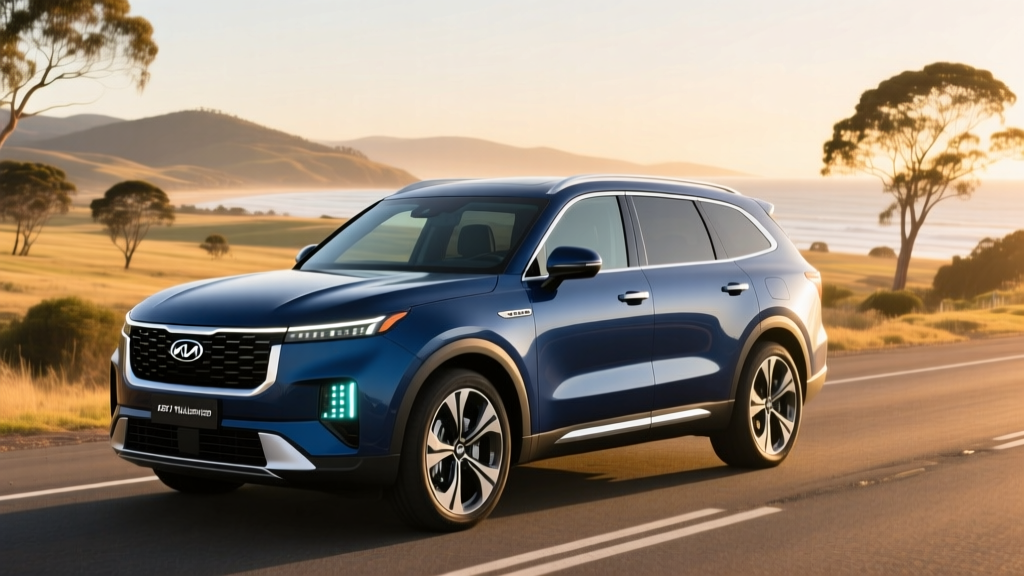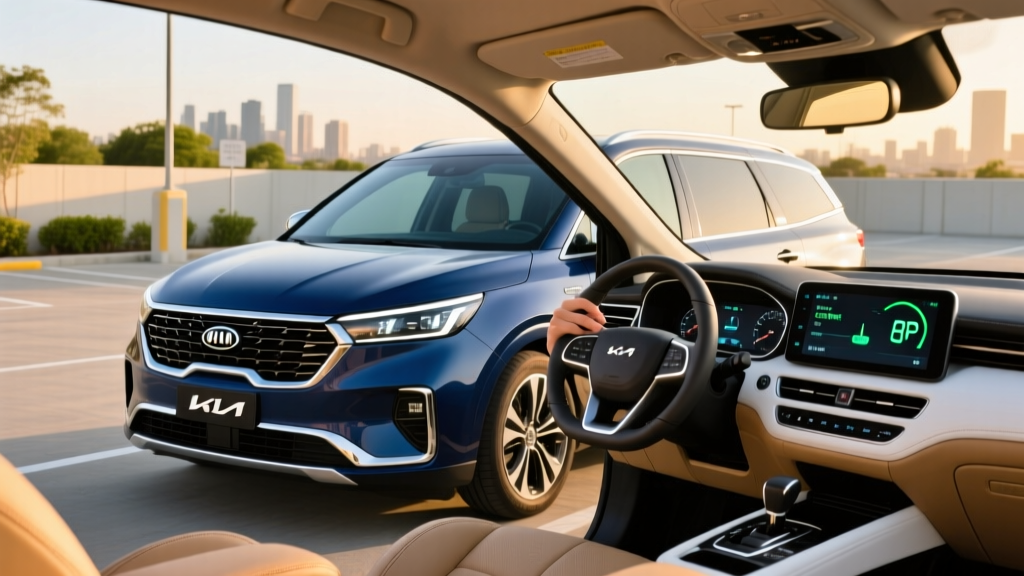
The minivan segment has gone hybrid, and the 2026 Kia Carnival Hybrid SX sits at the intersection of family utility and fuel-thrifty electrification. Unlike a plug-in hybrid or a full battery-electric vehicle, the Carnival Hybrid is a conventional hybrid electric vehicle (HEV) — it generates its own electricity through regenerative braking and its turbocharged gasoline engine. You never plug it in. For large families who need three usable rows, serious cargo space, and want to cut fuel costs without changing their refueling habits, the Carnival Hybrid SX is one of the most compelling options on the market.
This guide breaks down everything you need to know about the 2026 Carnival Hybrid SX: real-world MPG versus the EPA sticker, the turbo hybrid powertrain, pricing across trims, battery longevity, and whether this HEV makes more sense for your household than a PHEV or full EV.
2026 Kia Carnival Hybrid SX: Key Specifications at a Glance
| Spec | 2026 Kia Carnival Hybrid SX |
|---|---|
| Powertrain | 1.6L Turbo GDI 4-cyl + electric motor (HEV) |
| Combined Horsepower | 245 hp / 271 lb-ft torque |
| Transmission | 6-speed automatic |
| Drivetrain | Front-wheel drive |
| EPA MPG (City / Hwy / Combined) | 34 / 31 / 33 |
| Fuel Tank Capacity | 16.9 gallons |
| Total Driving Range (est.) | ~557 miles |
| Seating Capacity | 7 or 8 passengers |
| Cargo Volume (behind 3rd row) | 41.1 cu ft |
| Max Cargo Volume | 145.1 cu ft |
| Towing Capacity | 3,500 lbs |
| Hybrid Battery Warranty | 10 years / 100,000 miles |
| Starting MSRP (SX trim) | ~$43,600 |
How Many MPG Does the 2026 Carnival Hybrid Actually Get?
The EPA rates the 2026 Kia Carnival Hybrid at 34 mpg city, 31 mpg highway, and 33 mpg combined across all trims, including the SX. These figures come from fueleconomy.gov and represent the official government testing cycle.
| Driving Scenario | EPA Estimate | Real-World Expectation |
|---|---|---|
| City (stop-and-go) | 34 mpg | 33–36 mpg (hybrids excel here) |
| Highway (70+ mph) | 31 mpg | 28–31 mpg (aero drag hurts boxy vans) |
| Combined (mixed) | 33 mpg | 30–34 mpg |
| Cold weather (below 32°F) | — | 26–30 mpg (engine runs more for cabin heat) |
| Loaded (7 passengers + cargo) | — | 27–30 mpg |
The hybrid advantage is most pronounced in city driving. Regenerative braking recaptures energy at every stoplight, and the electric motor handles low-speed propulsion where gasoline engines are least efficient. On the highway, the turbocharged 1.6L engine does most of the work, and the Carnival's boxy minivan profile creates more aerodynamic drag than a sleek sedan, explaining the slight city-over-highway MPG split that's typical of hybrid minivans.
In real-world testing by owners and automotive reviewers, the Carnival Hybrid consistently meets or slightly exceeds its combined EPA estimate in suburban and city-heavy commutes. Highway-only road trips at 75–80 mph tend to return 28–30 mpg, especially with a full load of passengers and luggage — still a significant improvement over the non-hybrid Carnival's 22 mpg combined rating.
Turbo Hybrid Powertrain: How the 245-hp System Works
The 2026 Carnival Hybrid pairs a 1.6-liter turbocharged GDI 4-cylinder engine with an electric motor integrated into the transmission housing. Together, they produce 245 horsepower and 271 lb-ft of torque, routed through a conventional 6-speed automatic transmission to the front wheels.
This is a conventional HEV system, meaning the small lithium-ion battery pack (approximately 1.5 kWh) recharges through regenerative braking and the gasoline engine. There is no plug, no electric-only driving mode, and no need to install home charging equipment. The system automatically manages when to use electric assist, when to run the engine, and when to blend both — the driver simply drives.
The turbocharger gives the Carnival Hybrid solid passing power even at highway speeds with a full load, a meaningful advantage over naturally aspirated hybrid competitors that can feel strained during uphill merges. The 0–60 mph time falls in the low 8-second range, which is respectable for a 4,700-lb minivan.
The Carnival Hybrid is a conventional hybrid (HEV). It never plugs in and has no electric-only range. Kia does not currently offer a Carnival PHEV in the U.S. market. If you want plug-in capability with electric-only commuting in a Kia, the Sorento PHEV (32 miles electric-only) is the closest alternative in Kia's lineup — though it's a midsize SUV, not a minivan.
Pricing, Trims, and Tax Credit Eligibility
The 2026 Kia Carnival Hybrid is offered across multiple trims. The SX trim sits in the upper-middle of the range and is one of the most popular configurations for families wanting premium features without stepping to the top-tier SX Prestige.
| Trim | MSRP (est.) | Key Features |
|---|---|---|
| LXS | ~$40,600 | Base hybrid, 8-passenger seating, dual-screen infotainment |
| EX | ~$42,100 | Power sliding doors, leatherette seats, smart power liftgate |
| SX | ~$43,600 | Navigation, Bose audio, Highway Driving Assist, sunroof |
| SX Prestige | ~$47,500 | Nappa leather, VIP rear lounge seats, dual 12.3" displays |
Does the Carnival Hybrid Qualify for a Federal Tax Credit?
No. The 2026 Kia Carnival Hybrid does not qualify for the federal §30D clean vehicle tax credit. That credit — up to $7,500 — applies only to plug-in electric vehicles (BEVs and PHEVs) that meet battery sourcing, MSRP cap, and buyer income requirements. Conventional hybrids like the Carnival HEV are excluded under current IRS rules.
Some states and local utilities offer rebates or incentives for hybrid purchases, but these vary widely by jurisdiction. Check your state energy office or utility provider for current programs. While the lack of a federal credit stings compared to a PHEV or BEV, the Carnival Hybrid's lower purchase price and zero charging infrastructure cost partially offset this gap.
Battery Longevity, Warranty, and Replacement Costs
Kia covers the Carnival Hybrid's lithium-ion battery pack for 10 years or 100,000 miles, whichever comes first. This is one of the strongest hybrid battery warranties in the industry and matches the coverage Kia provides across its entire hybrid and PHEV lineup. The warranty covers defects and capacity loss below a functional threshold.
Hybrid battery replacement cost is a top concern for buyers, but the data is reassuring. Modern lithium-ion hybrid packs — especially the small ~1.5 kWh unit in the Carnival — experience minimal degradation because they operate in a narrow state-of-charge window (typically 40–60%). Unlike a full EV battery that cycles from 10% to 90%, a hybrid battery is baby-stepped by the powertrain computer, dramatically extending its cycle life.
Based on long-term data from Hyundai-Kia hybrid platforms sharing this powertrain architecture, hybrid battery failures before 150,000 miles are rare. Should a replacement be needed out of warranty, expect a cost in the $2,000–$3,500 range for the battery module, plus labor. This is significantly less than EV battery replacements, which can exceed $10,000.
The conventional powertrain warranty covers 5 years/60,000 miles, and Kia's roadside assistance runs 5 years/60,000 miles as well.
Carnival Hybrid vs. PHEV vs. Full EV: Which Fits Your Family?
Choosing between a conventional hybrid, a plug-in hybrid, and a full electric vehicle depends on your daily routine, home charging access, and how you use your minivan.
| Factor | Carnival Hybrid (HEV) | PHEV Minivan (e.g., Chrysler Pacifica Hybrid) | Full EV (e.g., Kia EV9) |
|---|---|---|---|
| Plug-in required? | No | Yes (Level 2 recommended) | Yes (Level 2 essential) |
| Electric-only range | 0 miles | ~32 miles | 250–310 miles |
| Total range | ~557 miles | ~460 miles combined | 250–310 miles |
| Combined MPG / MPGe | 33 mpg | 30 mpg + 82 MPGe (elec) | 85–89 MPGe |
| Federal tax credit | $0 | Up to $7,500* | Up to $7,500* |
| Home charger install | Not needed | ~$500–$2,000 | ~$500–$2,000 |
| Best for | No charging access, road trips | Short commute + road trips | Home charging + mostly under 250 mi |
*Federal §30D credit subject to MSRP caps, buyer income limits, and battery sourcing requirements. Verify eligibility at irs.gov before purchasing.
- You rent or live somewhere you can't install a Level 2 charger
- You regularly take road trips exceeding 300 miles
- You want lower fuel costs with zero behavior change
- You need 7–8 seats and maximum cargo volume
- You have home charging and a commute under 30 miles (PHEV covers it on electricity)
- You want to maximize federal tax incentives
- You're ready to eliminate gasoline entirely (full EV)
Is the 2026 Carnival Hybrid Reliable?
Kia's 1.6L turbo hybrid powertrain has been in production since the 2022 model year across the Sorento Hybrid, Tucson Hybrid (corporate cousin Hyundai), and Carnival Hybrid. Early reliability data is encouraging. The conventional 6-speed automatic avoids the complexity of a CVT, and the hybrid system has fewer moving parts than a traditional powertrain — no alternator, no starter motor, and regenerative braking extends brake pad life significantly.
The National Highway Traffic Safety Administration (NHTSA) and Insurance Institute for Highway Safety (IIHS) have evaluated the Carnival platform favorably for crashworthiness, and the hybrid variant shares the same structural safety design. Standard driver-assistance features on the SX trim include Highway Driving Assist (a Level 2 system combining adaptive cruise and lane centering), forward collision avoidance, blind-spot monitoring, and rear cross-traffic alert.
Common owner-reported considerations include slightly firmer ride quality compared to the non-hybrid Carnival (the hybrid battery adds weight over the rear axle) and the absence of all-wheel drive — the Carnival Hybrid is front-wheel drive only, which may concern buyers in heavy snow regions.
Pros and Cons of the 2026 Carnival Hybrid SX
- 33 mpg combined in a 3-row minivan — saves ~$800–$1,000/yr vs. gas-only Carnival
- 245 hp turbo hybrid provides confident highway merging
- No plug-in charging needed — zero infrastructure cost
- 10-year / 100,000-mile hybrid battery warranty
- Class-leading cargo volume (145.1 cu ft max)
- 3,500-lb towing capacity
- SX trim well-equipped with premium tech and safety
- No federal tax credit (HEV excluded from §30D)
- Front-wheel drive only — no AWD option
- No electric-only driving mode
- Highway MPG drops to ~28 when fully loaded at 80 mph
- Heavier than gas Carnival — slightly firmer ride
- SX Prestige trim pushes price near $48K
Frequently Asked Questions
How many MPG does the 2026 Kia Carnival Hybrid SX get?
The EPA rates it at 34 mpg city, 31 mpg highway, and 33 mpg combined. Real-world city driving often returns 33–36 mpg thanks to regenerative braking, while highway-only trips at 75+ mph with a full load typically yield 28–30 mpg.
Does the Carnival Hybrid need to be plugged in?
No. The Carnival Hybrid is a conventional HEV, not a plug-in hybrid. Its small battery recharges through regenerative braking and the gasoline engine. You fuel it like a normal car at any gas station.
How far can the Carnival Hybrid go on electric only?
It cannot. Unlike a PHEV, the Carnival Hybrid has no electric-only driving range. The electric motor assists the gasoline engine but cannot propel the vehicle independently for any meaningful distance.
Is the hybrid battery reliable and what does replacement cost?
Kia covers the hybrid battery for 10 years/100,000 miles. Based on data from Kia-Hyundai hybrid platforms, failures before 150,000 miles are uncommon. Out-of-warranty replacement costs approximately $2,000–$3,500 for the battery module.
Does the 2026 Carnival Hybrid qualify for any tax credit?
It does not qualify for the federal §30D clean vehicle credit, which is reserved for plug-in vehicles (BEVs and PHEVs). Some state or utility-level hybrid incentives may apply — check your local programs.
How does the Carnival Hybrid compare to the Chrysler Pacifica Hybrid?
The Pacifica Hybrid is a PHEV with ~32 miles of electric-only range and eligibility for the federal tax credit, but it requires home charging to realize its efficiency advantage. The Carnival Hybrid offers more cargo space, a longer total range (~557 vs. ~460 miles), and zero plug-in hassle — making it simpler for buyers without charging access.
Is the Carnival Hybrid SX worth the premium over the LXS trim?
The SX adds navigation, a premium Bose audio system, Highway Driving Assist, a sunroof, and upgraded interior materials. At roughly $3,000 over the LXS, it's a strong value for families who spend long hours in the car and want advanced driver-assist features for highway road trips.