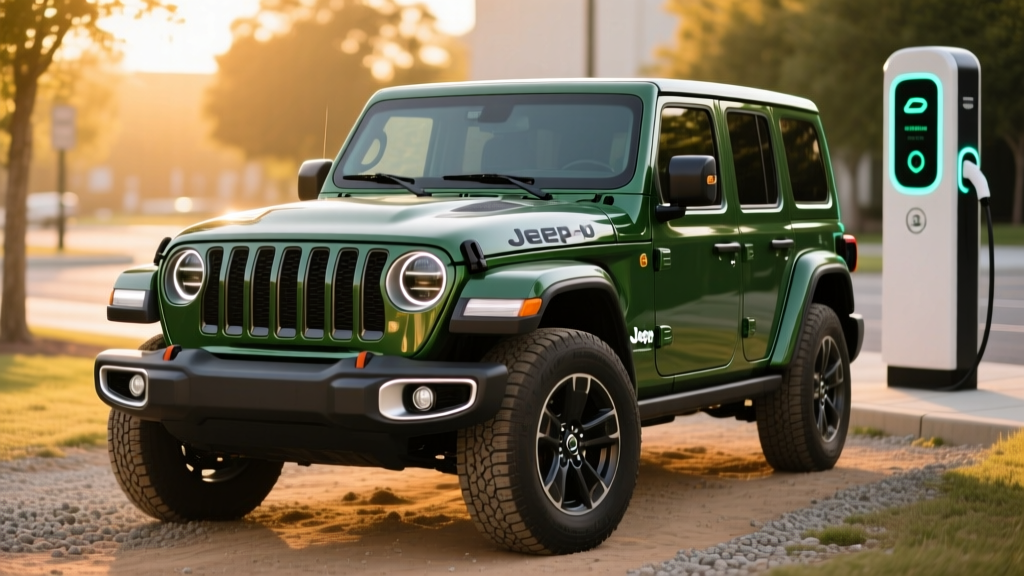
The Jeep Wrangler 4xe has held its position as America's best-selling plug-in hybrid for several years running, and for 2026, it returns with a formula that works: serious off-road capability paired with enough electric-only range to handle most daily commutes without burning a drop of gasoline. But the Wrangler 4xe is not without compromises. Its boxy aerodynamics and heavy curb weight mean fuel economy drops sharply once the battery is depleted, and its pricing has climbed steadily. This guide breaks down every number that matters—from EPA MPG to real-world efficiency, battery warranty details, charging times, and current federal tax credit eligibility under IRS §30D rules.
2026 Wrangler 4xe Powertrain: 375 HP From a Turbo Four and Two Electric Motors
The 2026 Jeep Wrangler 4xe pairs a 2.0-liter turbocharged inline-four gasoline engine with two electric motors integrated into the 8-speed automatic transmission. One motor sits between the engine and transmission (P1 position), and a second, more powerful traction motor is mounted in the transmission housing (P2 position). The combined system output is 375 horsepower and 470 lb-ft of torque—figures that give the 4xe more low-end grunt than the standard 3.6-liter V6 Wrangler and put it in the same torque neighborhood as the 392 V8 variant, albeit at a fraction of the fuel cost for daily driving.
The gasoline engine alone produces 270 HP and 295 lb-ft, while the electric motors contribute up to 134 HP and 181 lb-ft. All of this power routes through a TorqueFlite 8-speed automatic and Jeep's Selec-Trac or Rock-Trac 4x4 systems depending on trim. The 4xe is available on the Willys, Sahara, Rubicon, and High Altitude trims for 2026, with Rubicon models getting Dana 44 axles, electronic locking differentials, and a 4:1 low-range transfer case.
HEV vs. PHEV — Where the 4xe Fits
The Wrangler 4xe is a plug-in hybrid (PHEV), not a conventional hybrid (HEV). That means it has a larger battery you charge by plugging in, and it can drive on electric power alone for a meaningful distance. A conventional hybrid like the Toyota RAV4 Hybrid cannot plug in and has no electric-only range beyond low-speed creep. The 4xe's PHEV architecture lets you commute 25 miles on electricity before the gas engine starts, then operate as a hybrid for longer trips.
| Specification | Detail |
|---|---|
| Engine | 2.0L Turbocharged Inline-4 |
| Electric Motors | Two (P1 + P2 integrated in transmission) |
| Combined Horsepower | 375 HP |
| Combined Torque | 470 lb-ft |
| Transmission | 8-Speed Automatic |
| Drivetrain | 4WD (Selec-Trac or Rock-Trac) |
| Battery Capacity | 17.3 kWh (total) / ~14.0 kWh usable |
| Battery Chemistry | NMC (Nickel Manganese Cobalt) |
| 0–60 MPH | ~6.0 seconds |
| Towing Capacity | 3,500 lbs |
Electric-Only Range and Total Driving Range
The EPA rates the 2026 Jeep Wrangler 4xe at 25 miles of electric-only range. That figure is measured on a combined cycle and represents what you can expect with mixed city and highway driving at moderate temperatures. In practice, city driving at lower speeds can stretch this to 27–28 miles thanks to regenerative braking recapturing energy at stops. Highway driving at 70+ MPH will compress it to roughly 20–22 miles, as the Wrangler's flat-front aerodynamics create significant drag at speed.
Real-World Range Callout
EPA Electric-Only: 25 miles
Real-World City: ~27–28 miles
Real-World Highway (70 MPH): ~20–22 miles
Cold Weather (below 30°F): ~17–20 miles (battery chemistry loses efficiency, cabin heating draws from pack)
Total Combined Range (EV + Gas): ~370 miles with a full 21.5-gallon tank
The total combined range—electric plus the full gasoline tank—comes to approximately 370 miles. This positions the 4xe as a genuine road-trip vehicle: you get electric commuting during the week and unrestricted range for weekend trails or cross-country drives without route-planning around chargers.
Fuel Economy: EPA MPG and Real-World Numbers
The EPA rates the 2026 Wrangler 4xe at 49 MPGe combined when operating in electric mode, which is the miles-per-gallon-equivalent measure that lets you compare electric driving efficiency against gasoline vehicles. Once the battery is depleted and the Wrangler operates as a conventional hybrid, the EPA rates it at 20 MPG combined (20 city / 20 highway).
These hybrid-mode MPG numbers deserve context. The Wrangler is a 5,000+ pound vehicle with the aerodynamics of a brick. When you're driving on electricity, the cost per mile is dramatically lower than gasoline. When the engine fires up, you're hauling that mass with a turbo four that wasn't designed for peak thermal efficiency—it was designed for torque. Expect real-world hybrid-mode MPG to vary significantly:
| Mode | EPA Estimate | Real-World Expectation |
|---|---|---|
| Electric-Only (MPGe) | 49 MPGe combined | 45–52 MPGe depending on speed and terrain |
| Hybrid Mode – Combined MPG | 20 MPG | 18–22 MPG (city driving can exceed EPA via regen) |
| Hybrid Mode – City MPG | 20 MPG | 19–23 MPG (regen braking helps at low speeds) |
| Hybrid Mode – Highway MPG | 20 MPG | 17–20 MPG (aero drag and weight dominate at 70+ MPH) |
| Gas-Only Wrangler (3.6L V6, for comparison) | 19 MPG combined | 17–21 MPG |
The honest assessment: if you charge daily and your commute is under 25 miles round-trip, you'll burn very little gasoline during the work week. If you frequently drive long distances without charging, the 4xe's hybrid-mode MPG is only marginally better than a standard V6 Wrangler—and in some highway scenarios, slightly worse due to the added weight of the battery pack.
Charging the Wrangler 4xe: Level 1, Level 2, and What You Need to Know
The 2026 Wrangler 4xe uses a J1772 connector for AC charging. There is no DC fast charging capability—this is a common limitation among PHEVs with smaller battery packs, and it's important to understand before you buy. The 17.3 kWh battery (approximately 14.0 kWh usable, with the remainder held as a buffer to protect battery health) is designed to charge overnight or during the workday, not at highway rest stops.
| Charging Level | Power (kW) | 0–100% Time | Notes |
|---|---|---|---|
| Level 1 (120V household outlet) | ~1.4 kW | ~12 hours | Included cordset; sufficient for overnight if you drive <25 miles daily |
| Level 2 (240V, 32A) | ~7.7 kW (max onboard charger) | ~2 hours | Requires home Level 2 charger or public Level 2 station |
| DC Fast Charging | Not supported | N/A | PHEV battery is too small to justify DCFC hardware |
Most 4xe owners will want a Level 2 home charger. A quality Level 2 unit (such as a ChargePoint Home Flex or Emporia Vue) costs $400–$700 for the equipment, with professional installation by a licensed electrician running $500–$1,500 depending on your electrical panel's proximity to the garage and whether a panel upgrade is needed. Total home charging setup typically lands between $900 and $2,200. If your home has a 200-amp electrical panel with spare capacity, installation is on the lower end. Older homes with 100-amp service may require a panel upgrade costing $1,500–$3,000 additional—consult a licensed electrician for your specific situation.
One practical note: because the 4xe lacks DC fast charging, public charging is limited to Level 2 stations. That's fine for topping up at the office or a shopping center, but you won't find the 4xe at a Tesla Supercharger or Electrify America DC fast-charging plaza.
Pricing, Trims, and Federal Tax Credit Eligibility
The 2026 Jeep Wrangler 4xe starts at a base MSRP of $49,995 for the Willys trim (including destination charge) and climbs through the lineup:
| Trim | Starting MSRP |
|---|---|
| Willys 4xe | $49,995 |
| Sahara 4xe | $54,995 |
| Rubicon 4xe | $57,995 |
| High Altitude 4xe | $62,995 |
Regarding the federal §30D tax credit: the Wrangler 4xe has historically qualified for a partial or full credit, but eligibility under current IRS rules depends on several factors that change periodically. Under the Inflation Reduction Act provisions in effect for 2026, the key requirements include:
- MSRP cap: SUVs must have an MSRP at or below $80,000 (all Wrangler 4xe trims qualify)
- Buyer income cap: Modified adjusted gross income must not exceed $150,000 (single), $225,000 (head of household), or $300,000 (married filing jointly)
- Battery component sourcing: A percentage of battery components must be manufactured or assembled in North America, and critical minerals must meet sourcing thresholds—Jeep has adjusted supply chains to maintain eligibility, but specific trim-level qualification can shift
- Point-of-sale transfer: Eligible buyers can transfer the credit to the dealer at purchase, reducing the purchase price directly rather than waiting for a tax refund
Because critical-mineral and battery-component sourcing requirements tighten each year, we recommend verifying current eligibility on the IRS clean vehicle credit page and confirming with your dealer before purchase. State incentives vary by jurisdiction—check your state's energy office or fueleconomy.gov for local rebates.
Battery Warranty, Reliability, and Replacement Cost
Battery & Powertrain Warranty
High-Voltage Battery: 8 years / 100,000 miles (whichever comes first), with a capacity retention threshold of 70%—if the battery drops below 70% of original capacity within the warranty period, Jeep will repair or replace it.
Powertrain (engine, transmission, motors): 5 years / 60,000 miles
Bumper-to-Bumper: 3 years / 36,000 miles
The 4xe's high-voltage battery is an NMC (nickel manganese cobalt) lithium-ion pack. NMC chemistry offers higher energy density than LFP (lithium iron phosphate), which is important in a vehicle where packaging space is limited. Based on data from 2021–2025 model-year Wrangler 4xe vehicles now accumulating significant mileage, battery degradation has been modest—most owners report retaining 90%+ of original capacity after 60,000 miles, well above the warranty threshold.
Reliability data from sources including Consumer Reports and J.D. Power place the Wrangler 4xe in the average-to-below-average range for the brand, though many reported issues relate to build quality (soft-top leaks, interior trim, infotainment glitches) rather than the hybrid powertrain itself. The 2.0L turbo engine and 8-speed automatic have proven durable in the broader Stellantis lineup.
Should the battery require replacement outside warranty, current estimates place the cost between $8,000 and $12,000 including parts and labor. This is a significant expense, but the 8-year/100,000-mile warranty coverage means most original owners will never face it, and Jeep has maintained parts availability for the 4xe platform since its 2021 launch.
Who Should Buy the Wrangler 4xe — and Who Shouldn't
The Wrangler 4xe occupies a narrow but real sweet spot. It makes sense if you need genuine off-road capability (locking differentials, solid axles, serious ground clearance), want to commute on electricity, and still need unlimited range for road trips or remote trail access where chargers don't exist. It's the only plug-in hybrid that can tackle a Rubicon Trail on electric torque and then drive home on the highway.
It makes less sense if your primary concern is fuel efficiency above all else. A Toyota RAV4 Prime delivers 42 miles of electric range and 38 MPG in hybrid mode for $10,000 less. A full EV like the Ford Bronco (if and when an electric variant arrives) or the Rivian R1S eliminates gasoline entirely but sacrifices the trail-ready solid-axle architecture. If you never go off-road and rarely drive beyond 30 miles, a smaller, lighter PHEV will deliver better economics.
✓ Choose the Wrangler 4xe If…
- You need serious off-road capability (Rubicon-level trail running)
- Your daily commute is under 25 miles and you can charge at home
- You want unlimited range for road trips without route-planning
- You value 470 lb-ft of instant electric torque for rock crawling
- You want to reduce fuel consumption without range anxiety
✗ Look Elsewhere If…
- Maximum fuel economy is your top priority (RAV4 Prime gets 38 MPG hybrid)
- You don't need off-road capability or 4WD
- You want more than 25 miles of electric range
- You want DC fast charging for long electric-only trips
- Budget is a concern—starting near $50K is steep for a compact SUV
Frequently Asked Questions
How many MPG does the 2026 Jeep Wrangler 4xe get?
The EPA rates the Wrangler 4xe at 20 MPG combined in hybrid mode (gas engine running) and 49 MPGe combined in electric mode. Real-world hybrid-mode MPG typically ranges from 18–22 depending on driving style, speed, and terrain. City driving with frequent stops can push slightly above 20 MPG thanks to regenerative braking, while sustained highway driving at 75+ MPH may dip to 17–18 MPG.
How far can the Wrangler 4xe go on electric only?
The EPA rates it at 25 miles of electric-only range. Real-world results vary: expect 27–28 miles in stop-and-go city driving, 20–22 miles at highway speeds, and 17–20 miles in freezing temperatures when the battery is less efficient and cabin heating draws additional power.
Does the 2026 Wrangler 4xe qualify for the federal tax credit?
The Wrangler 4xe has qualified for the §30D federal clean vehicle credit in recent years, but eligibility depends on current battery-sourcing requirements, your income, and the vehicle's MSRP (which must be at or below $80,000 for SUVs—all 4xe trims pass). Because sourcing rules tighten annually, verify eligibility on irs.gov before purchasing. The credit can be applied at point of sale to reduce your purchase price directly.
Is the Wrangler 4xe reliable, and what does battery replacement cost?
The hybrid powertrain (engine, motors, transmission) has proven reliable since the 4xe's 2021 introduction, with most complaints centered on typical Wrangler build-quality items rather than the electrified drivetrain. The high-voltage battery carries an 8-year/100,000-mile warranty with a 70% capacity retention guarantee. Out-of-warranty battery replacement is estimated at $8,000–$12,000, though degradation data from early models suggests most batteries will retain well above 70% capacity through the warranty period.
Can I charge the Wrangler 4xe at a Tesla Supercharger or DC fast charger?
No. The Wrangler 4xe only supports AC charging via a J1772 connector at Level 1 (120V) or Level 2 (240V) speeds. It does not have DC fast charging hardware. This is typical for PHEVs—the 17.3 kWh battery is small enough that Level 2 charging fills it in about 2 hours, making DC fast charging unnecessary for the intended use case.
Hybrid vs. PHEV vs. full EV — which should I choose?
A conventional hybrid (HEV) like the Toyota RAV4 Hybrid needs no plug-in charging and delivers 35–40 MPG everywhere. A plug-in hybrid (PHEV) like the Wrangler 4xe adds 20–40 miles of electric-only range for daily commuting but reverts to hybrid operation on longer trips. A full EV (BEV) like the Rivian R1S eliminates gasoline entirely but requires reliable charging access and route planning for long trips. If you have home charging and a short commute but also need long-range flexibility or off-road capability, the PHEV is the right middle ground.