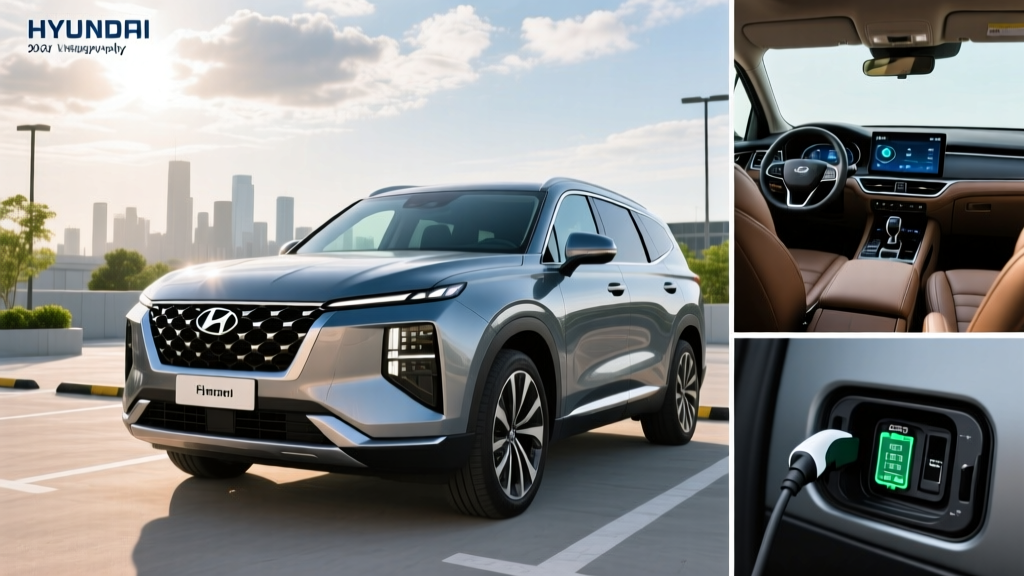
After years of offering only a 3.8-liter V6, the Hyundai Palisade finally adds a hybrid powertrain for the 2026 model year. For families who want three rows of seating, modern safety tech, and better fuel economy without plugging in, the 2026 Hyundai Palisade Hybrid (HEV) arrives as a conventional hybrid—no charging required. A plug-in hybrid (PHEV) variant has been rumored but remains unconfirmed for the US market as of early 2026.
This guide breaks down everything confirmed about the 2026 Palisade Hybrid: EPA fuel economy, real-world MPG expectations, powertrain specs, pricing, tax-credit eligibility, and whether this HEV is the right move versus a PHEV or full battery-electric vehicle (BEV).
2026 Palisade Hybrid Powertrain and Performance
The 2026 Palisade Hybrid pairs a turbocharged 1.6-liter four-cylinder engine with an electric motor integrated into a 6-speed automatic transmission. This is Hyundai's proven TMED (Transmission-Mounted Electric Drive) hybrid architecture, shared with the Kia Sorento Hybrid and Hyundai Tucson Hybrid, but tuned for the Palisade's larger, heavier platform.
| Specification | Value |
|---|---|
| Engine | 1.6L Turbocharged GDI 4-cylinder |
| Engine Output | 180 hp / 195 lb-ft torque |
| Electric Motor | 47.7 kW (64 hp) integrated into transmission |
| Combined System Output | 232 hp / 271 lb-ft torque |
| Transmission | 6-speed automatic |
| Drivetrain | HTRAC AWD standard |
| Towing Capacity | 4,000 lbs (est.) |
| 0–60 mph | ~7.8 seconds (est.) |
The combined 232 horsepower is modest for a large three-row SUV, but the hybrid system's instant electric torque fills in the low-end gap that small-displacement turbo engines typically struggle with. Expect confident around-town acceleration and adequate highway merging, though this is not a performance-oriented powertrain. The HTRAC all-wheel-drive system comes standard on all hybrid trims, using a rear-mounted electric drive unit on some configurations to improve traction without a mechanical driveshaft.
Fuel Economy: EPA Ratings and Real-World MPG
Hyundai targets a meaningful improvement over the gas-only V6 Palisade, which returns an EPA-estimated 21 MPG combined. The hybrid powertrain pushes that figure substantially higher, particularly in city driving where regenerative braking and electric-motor assist shine.
| Driving Cycle | EPA Estimated MPG |
|---|---|
| City | 29 MPG |
| Highway | 26 MPG |
| Combined | 27 MPG |
For context, the gas-only 2026 Palisade V6 AWD returns approximately 21 MPG combined. That's a 6 MPG—or roughly 28%—improvement with the hybrid. Over 15,000 annual miles, that translates to approximately 140 fewer gallons of fuel per year, or roughly $450–$550 in annual savings at $3.50/gallon.
HEV vs. PHEV: What the Palisade Hybrid Is (and Isn't)
It's critical to understand what you're buying. The 2026 Palisade Hybrid is a conventional hybrid electric vehicle (HEV). It does not have a plug. You cannot charge it from a wall outlet or public charger. The small battery (approximately 1.5 kWh) recharges through regenerative braking and the gasoline engine. There is no meaningful electric-only driving range—the motor assists the engine but cannot propel the vehicle alone for more than brief, low-speed moments.
Conventional Hybrid (HEV)
- No plug required
- Small battery (~1–2 kWh)
- Electric motor assists gas engine
- No electric-only range to speak of
- Lower upfront cost
- No federal tax credit (§30D)
Plug-In Hybrid (PHEV)
- Plugs into Level 1 or Level 2 charger
- Larger battery (~12–25 kWh)
- 20–40+ miles electric-only range
- Gas engine kicks in after battery depletes
- Higher upfront cost
- May qualify for up to $7,500 federal credit
As of this writing, Hyundai has not confirmed a Palisade PHEV for the US market. If one arrives, expect a larger battery (likely 18–25 kWh), roughly 30–40 miles of electric-only range, and a price premium of $5,000–$8,000 over the HEV. We will update this guide if a PHEV variant is officially announced.
Pricing, Trims, and Tax Credit Eligibility
The 2026 Palisade Hybrid is offered across multiple trims, mirroring the gas model's lineup but with a hybrid premium of roughly $2,000–$3,000 over equivalent gas trims.
| Trim | Estimated MSRP |
|---|---|
| SEL Premium (Hybrid) | $44,500 |
| Limited (Hybrid) | $49,500 |
| Calligraphy (Hybrid) | $54,000 |
Note: Pricing is estimated based on Hyundai's typical hybrid premium and current model-year positioning. Confirm exact MSRP with your dealer at time of purchase.
Federal Tax Credit: Does the Palisade Hybrid Qualify?
No. The 2026 Palisade Hybrid (HEV) does not qualify for the IRS §30D Clean Vehicle Credit. That credit—up to $7,500—applies only to battery-electric vehicles (BEVs) and plug-in hybrids (PHEVs) with sufficient battery capacity. Conventional hybrids that cannot be plugged in are excluded entirely from §30D.
Some states offer their own incentives for hybrid vehicles, though these are increasingly rare as state programs shift focus to zero-emission vehicles. Check your state's energy or environmental agency website for current programs. There is no federal income-cap or MSRP-cap concern here because the vehicle simply doesn't qualify regardless of buyer income or sticker price.
Battery Warranty, Reliability, and Replacement Cost
Hybrid battery longevity is consistently a top concern for first-time hybrid buyers. The Palisade Hybrid uses a lithium-ion polymer battery pack, and Hyundai backs it with one of the industry's strongest warranty packages.
- 10 years / 100,000 miles — Hybrid battery and hybrid system components (original owner)
- 10 years / 100,000 miles — Powertrain warranty
- Second-owner coverage: typically transfers as 5 years / 60,000 miles depending on state and transfer conditions
Source: Hyundai USA Warranty Information
Hyundai's hybrid systems have proven reliable across the Tucson, Sonata, and Santa Fe lineups. The 1.6L turbo hybrid powertrain has been in production since 2020, and large-scale failure patterns have not emerged in NHTSA complaint databases or major reliability surveys.
What Does a Hybrid Battery Replacement Cost?
If the hybrid battery fails outside of warranty coverage—which is rare within the first 150,000 miles based on industry data—replacement cost for a Hyundai/Kia hybrid battery pack typically ranges from $2,500 to $4,500 including parts and labor. This is far less than a full BEV battery replacement (which can exceed $10,000–$20,000) because the HEV battery is small (~1.5 kWh). Individual module replacement is sometimes possible, further reducing cost. Most hybrid batteries outlast 200,000 miles with gradual capacity loss rather than sudden failure.
Who Should Buy the Palisade Hybrid vs. a Full EV or Gas SUV?
The Palisade Hybrid sits in a specific ownership niche. Here's a practical decision framework:
Decision Framework
Choose the Palisade Hybrid (HEV) if:
- You want a 3-row SUV with better fuel economy but can't charge at home
- You take frequent long road trips and don't want to plan around charging stops
- You want lower fuel costs without the upfront premium of a PHEV or BEV
- You live in an apartment or lack access to Level 2 charging
Choose a PHEV (like the Kia Sorento PHEV or Toyota Grand Highlander Hybrid MAX) if:
- You can install a Level 2 charger at home
- Most of your daily driving is under 30 miles (you could run mostly on electricity)
- You want to reduce gasoline use significantly while keeping a gas engine for road trips
Choose a full BEV (like the Kia EV9 or Rivian R1S) if:
- You have reliable home charging (Level 2)
- You want zero tailpipe emissions and the lowest per-mile "fuel" cost
- You're eligible for the $7,500 federal tax credit, which can offset the higher purchase price
- You're comfortable with public DC fast charging on road trips
2026 Palisade Hybrid vs. Key Competitors
| Model | Type | EPA Combined MPG | HP | Starting MSRP (est.) |
|---|---|---|---|---|
| Hyundai Palisade Hybrid | HEV | 27 MPG | 232 hp | $44,500 |
| Toyota Grand Highlander Hybrid | HEV | 35 MPG | 245 hp | $46,500 |
| Kia Sorento Hybrid | HEV | 34 MPG | 227 hp | $39,500 |
| Mazda CX-90 PHEV | PHEV | 25 MPG + 26 mi EV | 323 hp | $51,500 |
The Toyota Grand Highlander Hybrid leads on fuel economy thanks to its fourth-generation Toyota Hybrid System, which is exceptionally efficient for its class. However, the Palisade Hybrid competes on interior space, ride refinement, and Hyundai's warranty coverage. The Kia Sorento Hybrid is smaller (tight third row) but more affordable. The Mazda CX-90 PHEV offers more power and electric-only commuting but at a significant price premium and with the requirement to plug in for maximum benefit.
Frequently Asked Questions
How many MPG does the 2026 Palisade Hybrid get?
The 2026 Hyundai Palisade Hybrid is estimated to achieve 29 MPG city, 26 MPG highway, and 27 MPG combined (EPA). Real-world results in mixed driving typically fall between 26–30 MPG combined, with city driving often exceeding the EPA estimate due to regenerative braking.
Does the Palisade Hybrid need to be plugged in?
No. The Palisade Hybrid is a conventional HEV. It charges its own small battery through regenerative braking and the gasoline engine. There is no plug, no charging cable, and no electric-only driving range. You fuel it like any other gas vehicle.
Is there a Palisade PHEV (plug-in hybrid)?
As of early 2026, Hyundai has not confirmed a Palisade PHEV for the US market. If announced, it would likely offer 30–40 miles of electric-only range, a larger battery (~18–25 kWh), and potential eligibility for the §30D federal tax credit. We will update this article if that changes.
Does the 2026 Palisade Hybrid qualify for a federal tax credit?
No. The IRS §30D Clean Vehicle Credit applies only to plug-in vehicles (BEVs and PHEVs). Conventional hybrids like the Palisade HEV are not eligible regardless of price, buyer income, or battery sourcing. Check your state's incentive programs for any local hybrid rebates.
Is the Palisade Hybrid reliable? What about battery replacement?
Hyundai's hybrid powertrain has demonstrated strong reliability across its model lineup. The hybrid battery is covered for 10 years/100,000 miles. Out-of-pocket replacement, should it ever be needed, typically costs $2,500–$4,500—far less than a BEV battery. Most hybrid batteries last well beyond 200,000 miles.
How does the Palisade Hybrid compare to the gas-only Palisade?
The hybrid delivers approximately 6 MPG better combined fuel economy (27 vs. 21 MPG), saving roughly $450–$550 per year in fuel costs. The trade-off is a $2,000–$3,000 higher purchase price and slightly less peak power (232 hp vs. 291 hp for the V6). For most family-SUV buyers, the fuel savings pay back the premium within 4–6 years.