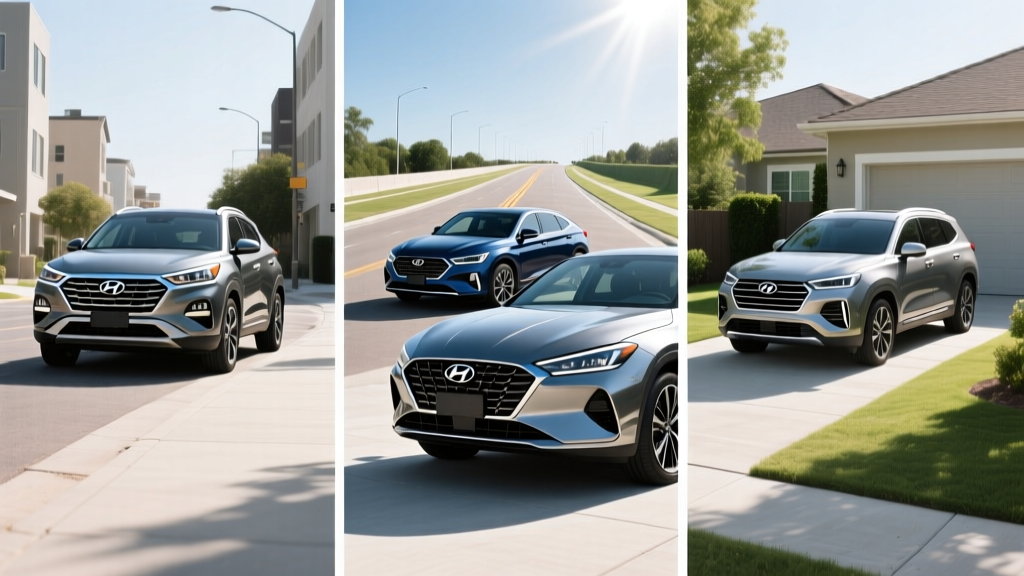
If you're researching a Hyundai hybrid in 2026, you're looking at one of the broadest electrified lineups from any mainstream automaker. Hyundai offers conventional hybrids (HEVs) and plug-in hybrids (PHEVs) across three core nameplates: the Tucson compact SUV, the Sonata midsize sedan, and the Santa Fe midsize SUV. Each comes in both HEV and PHEV flavors, meaning there are six distinct powertrain configurations to evaluate — and the differences in fuel economy, electric-only range, pricing, and tax-credit eligibility are substantial.
This guide breaks down every 2026 Hyundai hybrid and plug-in hybrid with exact EPA numbers, real-world expectations, battery specs, warranty coverage, and a clear framework for deciding which one fits your driving pattern — or whether a full BEV or a conventional gas car makes more sense.
HEV vs PHEV: Understanding Hyundai's Two Hybrid Types
Before comparing models, it's critical to understand the fundamental difference between Hyundai's hybrid types, because it affects everything from daily fuel cost to whether you need a home charger.
Conventional Hybrid (HEV)
How it works: A small battery (typically 1.5–2.0 kWh) and electric motor assist a gasoline engine. The battery recharges through regenerative braking and the engine — you never plug it in.
Best for: Drivers without access to home or workplace charging who want better MPG without changing their fueling routine.
Tax credit: Not eligible for the federal §30D clean vehicle credit.
Plug-In Hybrid (PHEV)
How it works: A larger battery (13.8–22.6 kWh usable) powers an electric-only driving mode for 30–40+ miles. Once depleted, it operates as a conventional hybrid. You plug it in to access the electric range.
Best for: Drivers with home Level 2 charging and commutes under 40 miles who want EV-like daily driving with gas-engine flexibility for road trips.
Tax credit: May qualify for a partial or full §30D federal credit (up to $7,500), subject to MSRP caps, buyer income limits, and battery-sourcing requirements.
2026 Hyundai Tucson Hybrid and PHEV: Specs and MPG
The Tucson remains Hyundai's highest-volume hybrid nameplate. For 2026, it continues with the proven 1.6-liter turbocharged four-cylinder paired with an electric motor, offered in both HEV and PHEV configurations.
| Spec | Tucson HEV | Tucson PHEV |
|---|---|---|
| Powertrain | 1.6L turbo I4 + electric motor | 1.6L turbo I4 + larger electric motor |
| Combined Horsepower | 231 hp | 268 hp |
| Battery Capacity | 1.49 kWh (lithium-ion) | 13.8 kWh usable (lithium-ion polymer) |
| EPA Combined MPG | 38 MPG | 35 MPG (charge-sustaining) / 80 MPGe (charge-depleting) |
| EPA City / Highway | 38 city / 38 highway | 33 city / 36 highway (hybrid mode) |
| Electric-Only Range | N/A | 33 miles (EPA) |
| Total Range | ~530 miles | ~420+ miles combined |
| Level 2 Charge Time (0–100%) | N/A (self-charging) | ~2.0 hours at 7.2 kW |
| DC Fast Charging | No | No |
| 0–60 mph | 7.7 sec (est.) | 7.0 sec (est.) |
| Starting MSRP | ~$33,500 | ~$40,500 |
Real-World MPG Note: Hyundai's HEV system excels in city driving, where regenerative braking recaptures energy frequently. Owners consistently report 40–43 MPG in city-heavy commutes, exceeding the EPA estimate. Highway-only driving at 75+ mph tends to yield 34–36 MPG. For the PHEV, expect the 33-mile electric range to drop to 26–28 miles in cold weather (below 40°F) or at sustained highway speeds. Source: fueleconomy.gov.
2026 Hyundai Sonata Hybrid: The Efficiency Leader
The Sonata Hybrid is the fuel-economy champion in Hyundai's lineup. As a sedan with lower weight and better aerodynamics than the SUVs, it extracts more miles per gallon from the same 1.6L hybrid architecture. For 2026, the Sonata Hybrid is offered only as a conventional HEV — Hyundai discontinued the Sonata PHEV in the US market after the 2024 model year.
| Trim | EPA City | EPA Highway | EPA Combined |
|---|---|---|---|
| SEL / SEL Premium | 44 MPG | 51 MPG | 47 MPG |
| Limited | 44 MPG | 51 MPG | 47 MPG |
Powertrain: 1.6L naturally aspirated four-cylinder + electric motor producing a combined 192 hp. The 1.32 kWh lithium-ion polymer battery is small but sufficient for frequent electric assist at low speeds.
Starting MSRP: ~$30,250 (SEL trim).
Real-world MPG: The Sonata Hybrid is one of the few vehicles where real-world owners regularly beat the EPA estimate, particularly in suburban and city driving. Expect 48–53 MPG in mixed city driving; highway cruising at 70 mph yields roughly 44–47 MPG. This is a car where gentle driving habits pay enormous dividends.
2026 Hyundai Santa Fe Hybrid and PHEV: Three-Row Versatility
The redesigned Santa Fe brings boxy styling and standard third-row seating to Hyundai's midsize SUV segment. For families who need more space than the Tucson offers but don't want a full-size SUV's fuel bill, the Santa Fe HEV and PHEV are compelling.
| Spec | Santa Fe HEV | Santa Fe PHEV |
|---|---|---|
| Powertrain | 1.6L turbo I4 + electric motor | 1.6L turbo I4 + larger electric motor |
| Combined Horsepower | 230 hp | 258 hp |
| Battery Capacity | 1.49 kWh | 22.6 kWh usable |
| EPA Combined MPG | 34 MPG | 31 MPG (hybrid) / 76 MPGe (electric) |
| EPA City / Highway | 33 city / 35 highway | 30 city / 32 highway (hybrid mode) |
| Electric-Only Range | N/A | 40 miles (EPA) |
| Total Range | ~500 miles | ~470+ miles combined |
| Level 2 Charge Time (0–100%) | N/A | ~3.5 hours at 7.2 kW |
| DC Fast Charging | No | No |
| Starting MSRP | ~$40,000 | ~$47,500 |
The Santa Fe PHEV's larger 22.6 kWh battery is notable — it's the biggest pack in any Hyundai PHEV, giving it a genuine 40-mile electric commute capability. However, like all Hyundai PHEVs, it does not support DC fast charging. You're limited to Level 1 (120V, ~9 hours) or Level 2 (240V, ~3.5 hours) AC charging. For overnight home charging, this is perfectly adequate; for mid-day top-ups on road trips, it means the electric range is a one-shot resource each day.
Federal Tax Credits: Which Hyundai Hybrids Qualify?
This is where the HEV/PHEV distinction matters enormously for your wallet.
Federal §30D Clean Vehicle Credit — 2026 Rules (per IRS.gov):
- Conventional HEVs (Tucson HEV, Sonata HEV, Santa Fe HEV): NOT eligible. The §30D credit requires a minimum 7 kWh battery and plug-in capability.
- PHEVs (Tucson PHEV, Santa Fe PHEV): Potentially eligible for up to $7,500, subject to:
- MSRP cap: Vans/SUVs ≤ $80,000; sedans ≤ $55,000 (Santa Fe PHEV qualifies; Tucson PHEV qualifies)
- Buyer income cap: AGI ≤ $150K single / $225K head of household / $300K joint
- Battery component sourcing: Must meet critical-mineral and battery-component manufacturing requirements (these thresholds increase annually — verify current-year compliance on IRS.gov)
- Point-of-sale transfer: Eligible buyers can apply the credit as an immediate dealer discount rather than waiting to claim it on their tax return
Important caveat: Battery-sourcing requirements have tightened significantly by 2026. Some PHEV trims may qualify for only the $3,750 partial credit (critical-minerals half) if they fail the battery-component test. Always verify the specific VIN's eligibility with your dealer and cross-reference the fueleconomy.gov tax credit lookup before signing paperwork.
Battery Warranty, Reliability, and Replacement Costs
Hyundai Hybrid/PHEV Battery Warranty:
Hyundai covers the high-voltage hybrid battery for 10 years / 100,000 miles (whichever comes first) under the powertrain warranty. In California-emissions states (CA, CO, CT, ME, MA, NJ, NY, OR, RI, VT, WA), the warranty extends to 10 years / 150,000 miles for certain emissions-related components.
The warranty guarantees the battery will retain sufficient capacity to function as designed. If it fails or degrades below threshold within the warranty period, Hyundai replaces it at no cost.
Out-of-warranty replacement cost: Based on current parts pricing and industry data, a Hyundai hybrid battery replacement (post-warranty) runs approximately $2,500–$4,500 for HEV models and $5,000–$8,000 for PHEV models, depending on the pack size and labor rates. However, Hyundai's hybrid batteries have shown strong longevity — widespread failure reports are rare, and many units last well beyond 150,000 miles with gradual capacity loss rather than catastrophic failure.
Reliability context: Hyundai's hybrid powertrains have earned solid reliability ratings. The 1.6L turbo hybrid system has been in production since 2021 with iterative improvements. The conventional six-speed automatic transmission used in Hyundai hybrids (rather than a CVT) is a proven design that avoids the reliability concerns associated with some CVT-equipped competitors. According to IIHS, Hyundai's hybrid models also perform well in crash testing.
Hyundai Hybrid vs PHEV vs Full EV: Which Should You Choose?
Choose a Hyundai HEV (Tucson, Sonata, Santa Fe) if:
- You lack access to home or workplace Level 2 charging
- You want better fuel economy without any behavioral change
- Your budget is tighter (HEVs cost $4,000–$8,000 less than PHEV equivalents)
- You drive mostly highway miles (where the HEV/PHEV efficiency gap narrows)
Choose a Hyundai PHEV (Tucson, Santa Fe) if:
- You have a garage or driveway where you can install a Level 2 charger
- Your daily commute is under 35–40 miles round-trip (Tucson: 33 mi; Santa Fe: 40 mi electric)
- You want EV-like daily operating costs with gas-engine backup for road trips
- You qualify for the §30D tax credit, narrowing the price gap with the HEV
Choose a full EV (Ioniq 5, Ioniq 6, Kona Electric) if:
- You have reliable home charging and your daily driving is under 250 miles
- You want zero tailpipe emissions and minimal maintenance (no oil changes, no engine)
- You want the full $7,500 federal tax credit (most Hyundai BEVs qualify with fewer sourcing restrictions)
- You rarely take road trips over 300 miles, or you're comfortable planning DC fast-charging stops
Pricing Summary: 2026 Hyundai Hybrid Lineup
| Model | Type | Base MSRP | Est. After §30D Credit | EPA Combined |
|---|---|---|---|---|
| Sonata Hybrid SEL | HEV | ~$30,250 | $30,250 (no credit) | 47 MPG |
| Tucson Hybrid SEL | HEV | ~$33,500 | $33,500 (no credit) | 38 MPG |
| Tucson PHEV SEL | PHEV | ~$40,500 | ~$33,000–$40,500 | 33 mi EV + 35 MPG |
| Santa Fe Hybrid SEL | HEV | ~$40,000 | $40,000 (no credit) | 34 MPG |
| Santa Fe PHEV SEL | PHEV | ~$47,500 | ~$40,000–$47,500 | 40 mi EV + 31 MPG |
Note: "Est. After §30D Credit" reflects the range from full $7,500 credit (if all eligibility criteria are met) to no credit (if sourcing or income thresholds disqualify you). Verify your specific eligibility before purchase.
Pros of Hyundai Hybrids
- Class-leading warranty: 10-year/100,000-mile hybrid battery coverage
- Sonata HEV achieves up to 47 MPG combined — best in its segment
- Santa Fe PHEV's 40-mile EV range covers most commutes gas-free
- Conventional six-speed automatic (no CVT drone)
- PHEVs eligible for up to $7,500 federal tax credit
- No range anxiety — gas engine provides 400–530 miles of total range
Cons of Hyundai Hybrids
- No DC fast charging on any PHEV (limits road-trip EV utility)
- HEV models get no federal tax credit
- Tucson and Santa Fe HEV MPG trails Toyota RAV4 Hybrid and Highlander Hybrid
- PHEV cargo space reduced vs. gas models due to battery placement
- Turbo engine requires premium fuel for maximum performance (regular acceptable with slight power reduction)
Frequently Asked Questions
How many MPG does a Hyundai hybrid get?
It depends on the model. The 2026 Sonata Hybrid leads at 47 MPG combined (44 city / 51 highway). The Tucson Hybrid delivers 38 MPG combined, and the Santa Fe Hybrid gets 34 MPG combined. Real-world city driving often exceeds EPA estimates by 3–5 MPG in Hyundai's hybrid system due to aggressive regenerative braking.
How far can the Hyundai PHEV go on electric only?
The 2026 Tucson PHEV achieves 33 miles of EPA-rated electric-only range. The Santa Fe PHEV, with its larger 22.6 kWh battery, reaches 40 miles. In real-world cold-weather conditions (below 40°F), expect a 15–20% reduction — roughly 26–28 miles for the Tucson and 32–34 miles for the Santa Fe.
Do Hyundai hybrids need to be plugged in?
No. Conventional Hyundai hybrids (HEVs) charge their small batteries through regenerative braking and the gasoline engine. You never plug them in. Only the PHEV models (Tucson PHEV, Santa Fe PHEV) require plugging in to access their electric-only driving range. If you never plug in a PHEV, it still functions as a regular hybrid — you just won't benefit from the electric-only miles.
Is a Hyundai hybrid reliable, and what does battery replacement cost?
Hyundai's hybrid powertrains have demonstrated strong reliability since the system's introduction. The high-voltage battery is covered by a 10-year/100,000-mile warranty. Out-of-warranty replacement costs range from approximately $2,500–$4,500 for HEV batteries and $5,000–$8,000 for PHEV batteries. Widespread premature battery failures are uncommon based on owner reports and industry data.
Does a Hyundai hybrid qualify for a tax credit?
Only the plug-in hybrid models (Tucson PHEV, Santa Fe PHEV) are potentially eligible for the federal §30D clean vehicle credit of up to $7,500. Conventional hybrids (HEVs) do not qualify because their batteries are too small and they lack plug-in capability. PHEV eligibility depends on the buyer's income, the vehicle's MSRP, and battery-component/critical-mineral sourcing requirements that tighten annually. Check IRS.gov for current-year rules.
Should I buy a Hyundai hybrid or a full EV?
If you have home charging, drive under 250 miles daily, and rarely road-trip, a full EV like the Ioniq 5 offers lower operating costs, less maintenance, and typically a larger tax credit. If you lack reliable charging access, frequently drive over 300 miles, or live in an area with sparse public charging infrastructure, a Hyundai hybrid or PHEV gives you fuel-economy gains without range anxiety.