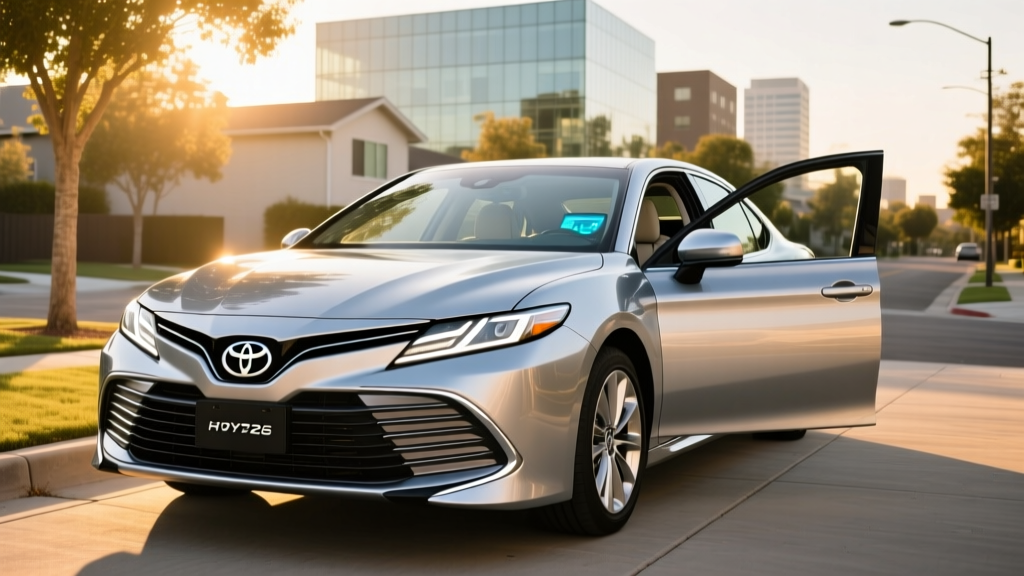
Toyota made a bold move with the current-generation Camry: every model is a hybrid. There's no gas-only option, no V6, just a refined fifth-generation Toyota Hybrid System (THS) powering one of America's best-selling sedans. For the 2026 model year, the Hybrid Camry continues to build on that formula with incremental tech upgrades and a lineup that starts under $30,000 — making it one of the most accessible high-MPG vehicles on the market.
Whether you're cross-shopping against a full EV, a plug-in hybrid, or a conventional gas sedan, this guide covers exactly what the 2026 Hybrid Camry delivers in fuel economy, powertrain performance, pricing, and long-term ownership costs.
HEV vs PHEV: Where the Camry Hybrid Fits
Before diving into specs, it's critical to understand what the Camry Hybrid is — and what it isn't. The Camry Hybrid is a conventional hybrid electric vehicle (HEV). It pairs a gasoline engine with an electric motor and a small battery pack that charges through regenerative braking and the engine. You never plug it in.
This distinguishes it from a plug-in hybrid (PHEV) like the Toyota RAV4 Prime or the now-discontinued Prius Prime, which features a larger battery, an electric-only driving mode (typically 25–44 miles), and a charge port for Level 1 or Level 2 AC charging.
| Feature | Camry Hybrid (HEV) | Typical PHEV (e.g., RAV4 Prime) |
|---|---|---|
| Plug-in charging required? | No | Yes (optional but recommended) |
| Electric-only range | None (EV assist only) | 25–44 miles |
| Battery size | ~1.6 kWh (sealed NiMH/Li-ion) | 18.1 kWh (Li-ion) |
| Federal tax credit (§30D) | Not eligible | Up to $7,500 (if sourcing rules met) |
| Best for | Drivers without home charging access | Drivers with short commutes + home charging |
If you want electric-only commuting, the Camry Hybrid isn't the answer — look at the Prius Prime or a PHEV SUV. But if you want maximum MPG with zero lifestyle change, the HEV approach is ideal.
Fuel Economy: EPA Ratings and Real-World MPG
The 2026 Hybrid Camry's fuel economy varies by trim and drivetrain. Front-wheel-drive (FWD) models achieve the highest numbers, while all-wheel-drive (AWD) variants sacrifice a small amount of efficiency for extra traction.
| Configuration | City MPG | Highway MPG | Combined MPG |
|---|---|---|---|
| FWD (LE trim) | 53 | 50 | 51 |
| FWD (SE/XSE trims) | 48 | 47 | 47 |
| AWD (all trims) | 51 | 49 | 50 |
Source: EPA Fuel Economy
Real-World MPG: What Owners Actually See
Toyota hybrids tend to perform well against their EPA estimates, especially in city driving where regenerative braking recaptures energy at every stop. Based on aggregated owner data and testing from the current generation:
- City driving: Many drivers report 50–55 MPG in stop-and-go traffic, sometimes exceeding the EPA estimate.
- Highway cruising (70+ mph): Expect 42–47 MPG. Aerodynamic drag and the engine running continuously at speed reduce the hybrid advantage.
- Cold weather (below 32°F): A 5–10% drop is typical as the engine runs more often to heat the cabin and warm up the catalytic converter.
- Combined real-world: Most owners land between 46–52 MPG depending on driving mix and climate.
At 51 MPG combined and $3.40/gallon (national average as of early 2026), your annual fuel cost is roughly $1,000 for 15,000 miles of driving. A comparable gas-only midsize sedan at 30 MPG combined would cost about $1,700 — a $700/year savings with the Camry Hybrid.
Powertrain Specs: Horsepower, Engine, and Drivetrain
Toyota's fifth-generation hybrid system in the Camry pairs a 2.5-liter Dynamic Force four-cylinder engine with one or two electric motors, depending on drivetrain.
| Specification | Detail |
|---|---|
| Engine | 2.5L 4-cylinder Atkinson-cycle |
| Engine horsepower | 184 hp @ 5,700 rpm |
| Front electric motor | 100 kW (134 hp) |
| Combined system output (FWD) | 225 hp |
| Combined system output (AWD) | 232 hp (rear motor adds 40 kW) |
| Transmission | eCVT (planetary gearset, no belt) |
| Drivetrain | FWD standard; electronic AWD available |
| 0–60 mph (estimated) | ~7.0 seconds (FWD) |
| Battery type | Lithium-ion (current gen) |
| Battery capacity | ~1.6 kWh (hybrid buffer, not plug-in) |
The AWD system uses a separate rear-mounted electric motor — there's no mechanical driveshaft connecting the front and rear axles. This "e-AWD" engages automatically under acceleration or low-traction conditions and doesn't meaningfully impact cargo space or interior packaging.
The eCVT is worth clarifying: unlike a traditional belt-driven CVT, Toyota's hybrid transaxle uses a planetary gearset that seamlessly blends engine and motor power. It's one of the most durable transmissions in the industry, with no belts, clutches, or bands to wear out.
Pricing, Trims, and Tax Credit Eligibility
The 2026 Hybrid Camry lineup spans four trims, all hybrid-only:
| Trim | Drivetrain | MSRP (est.) |
|---|---|---|
| LE | FWD | $29,990 |
| LE | AWD | $31,390 |
| SE | FWD | $31,490 |
| SE | AWD | $32,890 |
| XSE | FWD | $34,090 |
| XSE | AWD | $35,490 |
| XLE | FWD | $34,590 |
| XLE | AWD | $35,990 |
Pricing is estimated based on current-gen MSRP structure. Final 2026 pricing confirmed at dealer launch.
Federal Tax Credit: Not Eligible
Under current IRS §30D Clean Vehicle Credit rules, conventional hybrids like the Camry Hybrid do not qualify for the federal $7,500 tax credit. That credit is reserved for battery electric vehicles (BEVs) and plug-in hybrids (PHEVs) that meet battery sourcing, critical mineral, MSRP cap, and buyer income requirements.
What you may qualify for:
- State-level hybrid incentives: Some states (e.g., Colorado, California's Clean Fuel Reward — check current availability) offer rebates for high-MPG vehicles.
- Employer or utility rebates: Some utility companies offer incentives for purchasing fuel-efficient vehicles.
- Lower total cost of ownership: The fuel savings alone offset the lack of a federal credit within 3–5 years of ownership compared to a gas-only competitor.
Battery Warranty, Lifespan, and Replacement Cost
Toyota Hybrid Battery Warranty: 10 years / 150,000 miles (whichever comes first) in all 50 states. This covers defects and capacity loss below a defined threshold under normal use.
Toyota's hybrid battery warranty is one of the strongest in the industry. The current-generation Camry Hybrid uses a lithium-ion hybrid battery pack (not the larger traction battery found in EVs), and real-world data from millions of Toyota hybrids on the road shows these packs routinely last well beyond the warranty period.
How Long Do Toyota Hybrid Batteries Actually Last?
Based on long-term fleet data and owner reports from the Prius, Camry Hybrid, and RAV4 Hybrid platforms:
- Typical lifespan: 150,000–200,000+ miles before significant capacity degradation.
- Degradation pattern: Gradual — you may notice a 1–3 MPG decline over 100,000 miles, not a sudden failure.
- Failure mode: Individual cell imbalance is more common than total pack failure; some shops offer cell-level reconditioning.
Replacement Cost if Out of Warranty
- New OEM battery pack: $2,500–$4,000 (parts + labor at a Toyota dealer)
- Refurbished/reconditioned pack: $1,500–$2,500 from independent hybrid specialists
- Cell-level repair: $500–$1,200 if only a few modules need replacing
For context, a conventional gas car's transmission replacement or engine rebuild often costs more than a hybrid battery swap — and those components don't carry a 10-year/150,000-mile warranty.
Reliability and Long-Term Ownership Costs
Toyota's hybrid powertrain has an exceptionally strong reliability track record. The eCVT has no friction bands or clutch packs to fail. The regenerative braking system reduces wear on the friction brakes — many owners report original brake pads lasting 80,000–100,000 miles.
Maintenance advantages over a gas-only vehicle:
- Brake pad life: 2–3× longer due to regenerative braking handling most deceleration
- No starter motor: The hybrid motor starts the engine — no traditional starter to replace
- No alternator: The hybrid system handles all 12V charging
- Engine wear: The Atkinson-cycle engine runs at lower stress and is supplemented by the electric motor during high-load situations
Estimated 5-year total cost of ownership (purchase price + fuel + maintenance + insurance − depreciation) places the Camry Hybrid among the most affordable midsize sedans to own, often undercutting gas competitors despite the slightly higher purchase price.
Who Should Buy the 2026 Hybrid Camry — And Who Shouldn't
Choose the Camry Hybrid If:
- You want 50+ MPG without changing your fueling habits
- You don't have access to home or workplace EV charging
- You want a proven, low-risk powertrain with a strong warranty
- Your budget is $30,000–$36,000 for a new midsize sedan
- You drive a mix of city and highway miles
- You want AWD availability in a fuel-efficient sedan
Look Elsewhere If:
- You want electric-only driving (consider a PHEV or BEV)
- You want to qualify for the $7,500 federal tax credit (requires a BEV or PHEV)
- You need SUV cargo space or towing capacity
- You want a sporty driving experience (the Camry prioritizes comfort and efficiency)
- You drive mostly highway miles at high speed (the hybrid advantage narrows above 75 mph)
HEV vs PHEV vs EV: Quick Decision Guide
Choose the Camry Hybrid (HEV) if you can't charge at home and want maximum MPG with zero behavioral change.
Choose a PHEV (e.g., Prius Prime) if you have home charging and a commute under 40 miles — you'll drive mostly on electricity with a gas backup.
Choose a full EV (e.g., Tesla Model 3, Hyundai Ioniq 6) if you have reliable home charging, want the lowest per-mile energy cost, and are ready to plan around DC fast charging on road trips.
Frequently Asked Questions
How many MPG does the 2026 Hybrid Camry get?
The FWD LE trim achieves an EPA-estimated 53 city / 50 highway / 51 combined MPG. AWD models are rated at 51 city / 49 highway / 50 combined. Sport-tuned SE and XSE trims are rated slightly lower at 47 combined (FWD). Real-world results typically land between 46–52 MPG combined.
Does the Camry Hybrid need to be plugged in?
No. The Camry Hybrid is a conventional hybrid (HEV). Its battery charges through regenerative braking and the gasoline engine. There is no charge port and no electric-only driving mode.
How far can the Camry Hybrid drive on electric power alone?
The Camry Hybrid cannot drive on electric power alone for any meaningful distance. The electric motor assists the gas engine during acceleration and low-speed maneuvers, but the engine is always available. For electric-only driving, you need a PHEV like the Prius Prime (up to 44 miles EV range).
Is the Camry Hybrid battery reliable, and what does replacement cost?
Toyota's hybrid batteries are among the most reliable in the industry, with many lasting 150,000–200,000+ miles. The battery is covered by a 10-year/150,000-mile warranty. Out-of-warranty replacement costs $2,500–$4,000 for a new OEM pack, or $1,500–$2,500 for a refurbished unit.
Does the 2026 Hybrid Camry qualify for a federal tax credit?
No. Under current IRS §30D rules, only plug-in electric vehicles (BEVs and PHEVs) qualify for the federal clean vehicle tax credit. The Camry Hybrid, as a conventional HEV, is not eligible. Some state or local incentives may apply — check your state's energy office for details.
Is the Camry Hybrid slower than a gas Camry?
The previous-generation gas Camry with the 2.5L engine produced 203 hp. The current hybrid-only Camry produces 225 hp (FWD) or 232 hp (AWD), making it quicker than the old gas model. Expect 0–60 mph in approximately 7.0 seconds — adequate for confident highway merging and passing.
Does AWD hurt fuel economy significantly?
The AWD Camry Hybrid achieves 50 MPG combined versus 51 combined for the FWD LE — a negligible 1 MPG difference. The electronic AWD system only engages the rear motor when needed, so it doesn't impose a meaningful efficiency penalty.
For the latest EPA fuel economy data, visit fueleconomy.gov. For current federal tax credit rules, consult the IRS Clean Vehicle Credits page. Safety ratings are available at NHTSA.gov and IIHS.org.