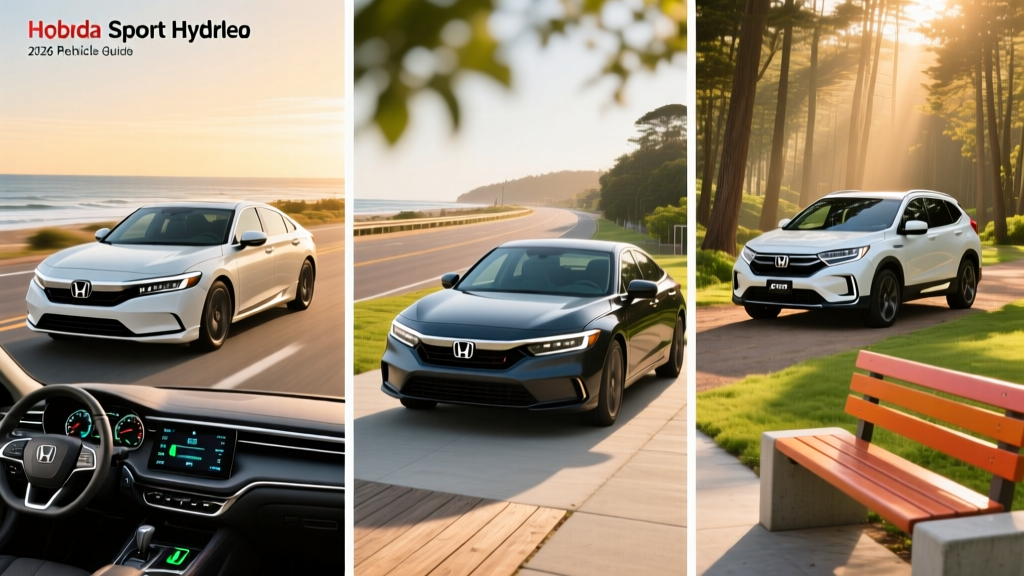
If you have searched for a "2026 Honda sport hybrid," you likely already know Honda does not sell a single model by that badge. Instead, Honda applies its two-motor hybrid system across its sportiest, most popular vehicles — the Accord, the Civic, and the CR-V. Each delivers a different blend of fuel economy, electric-assist performance, and practicality. The challenge for buyers is figuring out which Honda hybrid actually fits their commute, budget, and charging situation.
This guide breaks down the 2026 Honda hybrid lineup with exact EPA figures, real-world MPG expectations, powertrain specs, and current federal tax credit eligibility so you can make a data-driven decision.
HEV vs PHEV: What Honda Actually Sells in 2026
Before comparing trims, it is essential to distinguish Honda's hybrid approach from plug-in competitors. All three 2026 Honda hybrids — Accord, Civic, and CR-V — are conventional hybrids (HEVs). They use a small lithium-ion battery paired with a gasoline engine and electric motors but do not plug in. You refuel at a gas station exactly as you would with any ICE vehicle.
| Feature | Honda HEV (2026) | Typical PHEV (e.g., Toyota RAV4 Prime) | Full EV (BEV) |
|---|---|---|---|
| Plug-in charging required? | No | Yes (Level 1 or 2) | Yes (Level 2 or DC) |
| Electric-only range | ~1-2 mi at low speed | 25-42 mi | 200-400+ mi |
| Fuel source | Gasoline only | Gasoline + electricity | Electricity only |
| Federal §30D tax credit | Not eligible | Up to $7,500 (if qualified) | Up to $7,500 (if qualified) |
| Best for | No home charging, long highway drives | Home charging + short commutes | Home charging, low daily miles |
Honda's strategy is deliberate: by eliminating the plug, they keep curb weight lower, cargo space intact, and purchase price competitive. The trade-off is zero meaningful electric-only range and no eligibility for the federal §30D clean vehicle credit, which requires a plug-in battery of at least 7 kWh.
2026 Honda Hybrid Lineup: Side-by-Side Specs
Honda's fourth-generation two-motor hybrid system powers all three models. Here is how they stack up with exact EPA and manufacturer figures.
| Spec | 2026 Accord Hybrid Sport | 2026 Civic Hybrid Sport Touring | 2026 CR-V Hybrid Sport Touring |
|---|---|---|---|
| Body style | Midsize sedan | Compact sedan | Compact SUV |
| Engine | 2.0L 4-cyl + 2 motors | 2.0L 4-cyl + 2 motors | 2.0L 4-cyl + 2 motors |
| Combined horsepower | 204 hp | 200 hp | 204 hp |
| Combined torque | 247 lb-ft | 232 lb-ft | 247 lb-ft |
| Drivetrain | FWD | FWD | FWD / AWD available |
| EPA city MPG | 46 | 50 | 40 (AWD) |
| EPA highway MPG | 41 | 47 | 34 (AWD) |
| EPA combined MPG | 44 | 49 | 37 (AWD) |
| Hybrid battery | ~1.0 kWh Li-ion | ~1.0 kWh Li-ion | ~1.0 kWh Li-ion |
| 0-60 mph (est.) | ~7.0 sec | ~7.2 sec | ~7.6 sec |
| Cargo volume | 16.7 cu ft | 14.8 cu ft | 39.3 cu ft (rear seats up) |
| Base MSRP (Sport trim) | $34,750 | $32,450 | $38,350 (Sport AWD) |
Sources: fueleconomy.gov, Honda Newsroom. MPG figures reflect EPA estimates; AWD trims carry a 2-3 MPG penalty vs FWD.
How Many MPG Do 2026 Honda Hybrids Actually Get?
The EPA numbers above tell part of the story, but Honda's hybrid system has a distinct real-world characteristic: city MPG often exceeds the sticker. Here is why.
Honda's two-motor system operates primarily in EV drive mode at low speeds, using the gasoline engine as a generator to feed the electric motor rather than directly turning the wheels. This means stop-and-go traffic — where conventional engines waste fuel idling — is exactly where Honda hybrids shine. The engine only mechanically connects to the wheels at sustained highway cruising speeds via a single-speed clutch.
| Model | EPA Combined | Real-World City (owner reports) | Real-World Highway (75 mph) | Real-World Winter |
|---|---|---|---|---|
| Accord Hybrid Sport | 44 MPG | 47-52 MPG | 38-41 MPG | 36-40 MPG |
| Civic Hybrid Sport Touring | 49 MPG | 52-58 MPG | 42-46 MPG | 40-44 MPG |
| CR-V Hybrid Sport Touring AWD | 37 MPG | 38-42 MPG | 30-34 MPG | 28-32 MPG |
Key takeaway: If your commute is mostly urban or suburban with frequent stops, expect to beat EPA combined figures. If you drive 80%+ highway miles at 75+ mph, expect 3-6 MPG below the combined sticker. Cold weather (below 32°F) typically reduces hybrid efficiency by 10-15% due to increased engine-on time for cabin heat and battery thermal management.
Powertrain Deep Dive: Honda's Two-Motor Hybrid System
Honda's fourth-generation hybrid powertrain is an Atkinson-cycle series-parallel system. Here is how power flows:
- Low-speed / city driving: The gasoline engine generates electricity, which feeds the primary drive motor. The battery buffers excess energy. The engine never directly turns the wheels.
- Hard acceleration: Both the engine-generator and the hybrid battery simultaneously supply the drive motor for maximum output (204 hp combined in Accord/CR-V).
- Steady highway cruising: A lock-up clutch mechanically connects the 2.0L engine to the front wheels for maximum efficiency at sustained speed.
- Deceleration / braking: The drive motor reverses into a generator, recapturing kinetic energy into the ~1.0 kWh battery (regenerative braking).
The 2.0L Atkinson-cycle four-cylinder produces roughly 146 hp on its own, but the electric motor contributes up to 184 hp. Combined system output is governed to 200-204 hp depending on the model. Torque delivery is immediate from the electric motor, which gives all three models a responsive, "sport hybrid" feel off the line despite their efficiency focus.
Battery Warranty, Lifespan, and Replacement Cost
Honda Hybrid Battery Warranty (2026 models):
- Coverage: 8 years / 100,000 miles (10 years / 150,000 miles in CARB states including CA, NY, MA, CT, RI, VT, ME, NJ, OR, WA, CO, MD)
- Capacity threshold: Warranty covers defects and significant capacity loss that impairs hybrid system function
- Typical hybrid battery size: ~1.0 kWh (much smaller than a PHEV or BEV battery)
Because Honda HEVs use a relatively small battery that never deeply discharges (the system maintains a state-of-charge buffer between roughly 20-80%), degradation is minimal. Owner data from third-generation Honda hybrids (2018-2022 Accord, Insight) shows most hybrid batteries retain 90%+ capacity after 150,000 miles. Battery failures before 200,000 miles are uncommon.
If replacement is needed out of warranty, expect the following:
- OEM battery pack: $2,000 - $3,500 (parts + labor at a Honda dealer)
- Refurbished / aftermarket: $1,200 - $2,000 (available from hybrid specialists)
For context, this is a fraction of BEV battery replacement costs ($8,000-$20,000+), because the Honda hybrid battery stores roughly 1/60th to 1/80th the energy of a full EV pack.
Tax Credits and Incentives: What You Need to Know
This is where Honda's HEV strategy has a real financial limitation for 2026 buyers:
- Federal §30D Clean Vehicle Credit ($7,500): NOT eligible. Honda's conventional hybrids do not have plug-in capability and do not meet the minimum 7 kWh battery requirement. Only new PHEVs and BEVs qualify.
- Federal Used Clean Vehicle Credit (§25E, up to $4,000): NOT eligible for the same reason — requires plug-in.
- State incentives: Some states offer rebates for any hybrid purchase (check your state energy office). These are typically $250-$1,000 and vary widely.
- Insurance discounts: Some carriers (e.g., Liberty Mutual, Travelers) offer 5-10% discounts for hybrid vehicles.
Bottom line: The 2026 Honda hybrid lineup will not reduce your tax burden via §30D. If tax credit eligibility is a priority, you would need to look at a PHEV like the Toyota RAV4 Prime or a BEV like the Hyundai Ioniq 5. However, Honda's lower purchase price (starting under $33K for the Civic Hybrid) and absence of home charging requirements can offset this for many buyers.
Hybrid vs PHEV vs EV: Which Honda Buyer Are You?
Choose a 2026 Honda HEV (Accord, Civic, or CR-V Hybrid) if:
- You cannot install a Level 2 charger at home (apartment, street parking, older electrical panel)
- Your daily driving exceeds 40 miles, making PHEV electric-only range insufficient
- You take frequent road trips and do not want to plan around DC fast charging
- You want a lower upfront purchase price ($32K-$39K) without credit-dependency
- You live in a region with extreme cold where EV range loss of 20-30% is a concern
Choose a PHEV (e.g., Toyota RAV4 Prime, Hyundai Tucson PHEV) if:
- You have home Level 2 charging AND a commute under 35 miles round trip
- You want to drive mostly on electricity with gas backup for road trips
- You qualify for the $7,500 federal tax credit (income and sourcing requirements met)
Choose a full EV (e.g., Tesla Model Y, Hyundai Ioniq 5) if:
- You have reliable home charging and your daily driving is under 200 miles
- You want the lowest per-mile "fuel" cost (~$0.04/mi on home electricity vs ~$0.12/mi on hybrid gasoline)
- You want zero tailpipe emissions and minimal maintenance (no oil changes, no engine)
Pros and Cons: 2026 Honda Sport Hybrids
Pros
- Class-leading city MPG (Civic Hybrid achieves 50 EPA / 52-58 real-world city)
- No plug-in charging required — works with existing gas-station infrastructure
- Responsive electric torque delivery; 204 hp in Accord/CR-V feels genuinely sporty
- Proven hybrid battery longevity with 8-10 year warranty
- Lower purchase price than comparable PHEVs and EVs
- Honda Sensing ADAS suite standard on all trims
Cons
- No federal tax credit eligibility (§30D requires plug-in)
- Highway MPG is 5-10 MPG lower than city MPG (engine directly drives wheels)
- AWD only available on CR-V Hybrid (Accord and Civic are FWD only)
- ~1.0 kWh battery provides virtually no electric-only driving
- Still requires all ICE maintenance (oil changes, spark plugs, transmission fluid)
- CR-V Hybrid AWD highway MPG (34 EPA) trails FWD competitors
Frequently Asked Questions
How many MPG does the 2026 Honda Civic Hybrid get?
The 2026 Honda Civic Hybrid Sport Touring achieves an EPA-estimated 50 city / 47 highway / 49 combined MPG. In real-world city driving, many owners report 52-58 MPG thanks to Honda's electric-motor-dominant low-speed operation. Highway driving at 75+ mph typically yields 42-46 MPG.
Does the 2026 Honda Accord Hybrid need to be plugged in?
No. The Accord Hybrid is a conventional hybrid (HEV). It charges its small battery through regenerative braking and the onboard gasoline engine-generator. You never plug it in — you simply refuel with gasoline as you would any conventional car.
How far can Honda hybrids drive on electric only?
Effectively 1-2 miles at very low speeds (under 25 mph) in ideal conditions. Honda's ~1.0 kWh hybrid battery is designed to assist the gasoline engine, not to replace it. If you want meaningful electric-only range (25-42 miles), you need a PHEV, which Honda does not currently sell in the US market.
Is the 2026 Honda hybrid battery reliable, and what does replacement cost?
Yes. Honda's hybrid batteries are among the most reliable in the industry, with most retaining 90%+ capacity past 150,000 miles. The battery is covered by an 8-year/100,000-mile warranty (10 years/150,000 miles in CARB states). Out-of-warranty replacement costs $2,000-$3,500 for an OEM pack, or $1,200-$2,000 for a refurbished unit.
Does any 2026 Honda hybrid qualify for the $7,500 federal tax credit?
No. Under current IRS §30D rules, the federal clean vehicle credit requires a plug-in vehicle with a battery capacity of at least 7 kWh. All 2026 Honda hybrids are conventional HEVs with ~1.0 kWh batteries and no plug-in capability. They are not eligible for the federal credit. Some states may offer smaller hybrid rebates — check your state energy office for current programs.
Which 2026 Honda hybrid gets the best fuel economy?
The 2026 Honda Civic Hybrid Sport Touring leads the lineup at 49 MPG combined (50 city / 47 highway). The Accord Hybrid Sport follows at 44 combined, and the CR-V Hybrid Sport Touring AWD at 37 combined. If maximum fuel savings is your priority, the Civic Hybrid is the clear winner.
Is the CR-V Hybrid available with AWD?
Yes. The 2026 CR-V Hybrid offers Honda's Real Time AWD system on Sport and Sport Touring trims. AWD adds roughly $1,500 to the MSRP and reduces fuel economy by 2-3 MPG compared to FWD variants. The Accord and Civic Hybrid are FWD only.