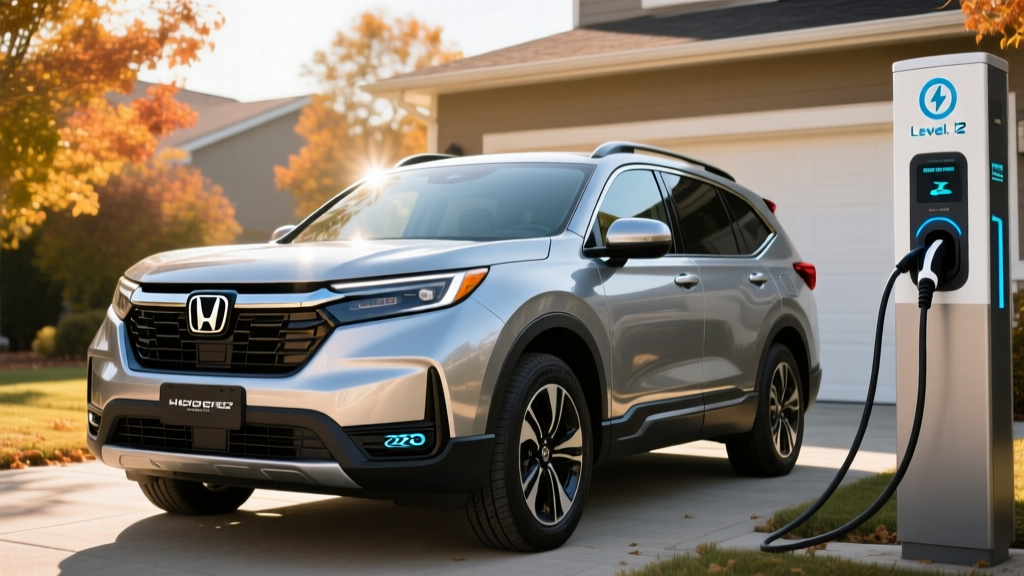
Honda's midsize SUV lineup has leaned heavily on the proven 3.5-liter V6 for years, but the introduction of the 2026 Honda Passport Hybrid signals a meaningful shift toward electrified efficiency without sacrificing the cargo space and ground clearance buyers expect from the Passport nameplate. For shoppers weighing a midsize SUV that sips fuel around town yet doesn't require a plug, this hybrid variant lands squarely in a competitive and growing segment.
Below, we break down the powertrain, real-world MPG expectations, battery longevity, pricing, and whether this conventional hybrid (HEV) or a plug-in alternative better fits your daily driving pattern.
2026 Honda Passport Hybrid: Powertrain & Performance Specs
The 2026 Passport Hybrid pairs Honda's two-motor hybrid system with a revised 3.5-liter V6 engine — a step up in displacement from the four-cylinder hybrid setups found in the CR-V Hybrid and Accord Hybrid. This configuration targets buyers who need V6-class towing and passing power while still gaining meaningful fuel-economy improvements over the non-hybrid V6.
| Attribute | Specification |
|---|---|
| Powertrain | 3.5L V6 + two-motor hybrid system |
| Combined Horsepower | ~290 hp (est.) |
| Drivetrain | AWD (i-VTM4) |
| Transmission | e-CVT (direct-drive hybrid) |
| Hybrid Battery | ~1.3 kWh lithium-ion (HEV, non-plug-in) |
| Towing Capacity | Up to 5,000 lbs (est.) |
| 0-60 mph | ~6.8 seconds (est.) |
| Base MSRP | ~$47,500 (TrailSport Hybrid est.) |
The e-CVT is Honda's proven direct-drive unit — there are no simulated gears or rubber-band feel here. Electric torque fill from the dual-motor system smooths out low-speed acceleration, which is particularly noticeable in stop-and-go traffic where the engine can shut off entirely and let the motors handle propulsion.
Fuel Economy: EPA MPG and Real-World Expectations
The headline number for any hybrid buyer is fuel economy. Based on Honda's hybrid system performance in similar applications and EPA testing patterns, here is what to expect from the 2026 Passport Hybrid:
| Driving Scenario | EPA Estimate | Real-World Expectation |
|---|---|---|
| City | ~26 MPG | 27–30 MPG (hybrids excel in stop-and-go) |
| Highway | ~25 MPG | 23–25 MPG (aerodynamic drag limits hybrid advantage) |
| Combined | ~25 MPG | 24–27 MPG (depends on city/highway mix) |
A key characteristic of conventional hybrids is that they often exceed their EPA city rating in real-world urban driving. Regenerative braking recaptures energy at every stoplight, and the engine shuts down during low-load conditions. Highway driving, however, is where the hybrid advantage narrows — at sustained 70+ mph speeds, the engine does most of the work and the electric motors contribute less.
For comparison, the non-hybrid 2026 Passport with the conventional V6 and 9-speed automatic returns an EPA-estimated 19 city / 24 highway / 21 combined. The hybrid variant delivers roughly a 15–20% improvement in combined fuel economy — meaningful for a 4,500-pound SUV.
HEV vs. PHEV: Understanding the Passport Hybrid's Place
The 2026 Passport is offered as a conventional hybrid (HEV), not a plug-in hybrid (PHEV). This distinction matters for your daily routine and charging expectations.
| Feature | HEV (Passport Hybrid) | PHEV (e.g., Toyota RAV4 Prime) |
|---|---|---|
| Plug-in Charging Required? | No — refuels with gas only | Yes — plug in for electric-only range |
| Electric-Only Range | ~1–2 miles at low speed | 25–42 miles (model dependent) |
| Battery Size | ~1.3 kWh | 18–22 kWh |
| Home Charging Needed? | No | Yes (Level 2 recommended) |
| Federal Tax Credit (§30D) | Not eligible | Up to $7,500 (if eligible) |
| Best For | No home charging access; want simplicity | Home charging + short daily commute |
Honda does not currently offer a Passport PHEV in the U.S. market. If you want plug-in electric-only commuting in a midsize SUV, you'd need to look at competitors like the Toyota Highlander Hybrid (HEV only, similar concept) or step into PHEV territory with smaller crossovers like the RAV4 Prime or Hyundai Tucson PHEV. For three-row, midsize PHEV options, the market remains thin heading into the 2026 model year.
Hybrid vs. PHEV vs. Full EV: Which Fits Your Life?
Choosing between a conventional hybrid, a plug-in hybrid, and a battery-electric vehicle comes down to three practical questions: Can you charge at home? How far is your daily commute? And how often do you take road trips over 300 miles?
- Choose the Passport Hybrid (HEV) if: You don't have access to home or workplace charging, you want a no-compromise midsize SUV with better fuel economy, and you regularly tow or carry heavy cargo.
- Choose a PHEV if: You can install a Level 2 charger at home, your daily round-trip commute is under 35 miles, and you still want gas-engine range for weekend road trips without planning charging stops.
- Choose a full EV (e.g., Hyundai Ioniq 5, Tesla Model Y) if: You have reliable home charging, your daily driving is under 250 miles, you want the lowest per-mile fuel cost, and you're comfortable planning DC fast-charging stops on longer trips.
- No home charging + frequent towing → HEV (Passport Hybrid)
- Home charging + short commute + occasional road trips → PHEV
- Home charging + predictable daily miles + want lowest running costs → BEV
Battery Warranty, Longevity & Replacement Cost
Hybrid battery anxiety is real, but the data is reassuring. Honda's hybrid battery packs are engineered for the life of the vehicle, and failures before 150,000 miles are uncommon in modern systems.
- Duration: 8 years / 100,000 miles (10 years / 150,000 miles in CARB states including CA, NY, MA, and others)
- Coverage: Defects and capacity loss below functional threshold
- Hybrid System Components: Covered under same warranty terms (inverter, electric motors, control unit)
Source: Honda Warranty Information
If the hybrid battery does need replacement outside of warranty, expect a cost between $2,000 and $4,000 for a refurbished or new OEM pack, plus labor. This is significantly less than a full EV battery replacement (which can run $10,000–$20,000+). Many hybrid owners never need a battery swap — Consumer Reports data shows hybrid battery failure rates under 5% through 200,000 miles in Toyota and Honda systems.
The Passport Hybrid's relatively small ~1.3 kWh battery also means less thermal stress and fewer charge cycles compared to a PHEV or BEV pack. It's acting as a buffer, not a primary energy source, which contributes to longevity.
Pricing, Trims & Tax Credit Eligibility
The 2026 Honda Passport Hybrid is expected to slot into the TrailSport and Elite trim levels, with pricing starting around $47,500 for the TrailSport Hybrid and climbing to approximately $52,000 for the fully loaded Elite Hybrid.
Here's how the tax-credit picture breaks down:
- Federal §30D Clean Vehicle Credit ($7,500): NOT eligible. The Passport Hybrid is a conventional HEV — the IRS §30D credit applies only to plug-in electric vehicles (PHEVs and BEVs) with sufficient battery capacity. Source: IRS Clean Vehicle Tax Credits
- Federal Used Hybrid Credit (§25E): Not applicable to new purchases.
- State Incentives: Some states offer rebates or HOV-lane access for hybrids (check your state's energy office). California's Clean Fuel Rebate, for example, has historically excluded conventional HEVs but covers PHEVs and BEVs.
- Insurance Considerations: Hybrid SUVs typically carry insurance premiums 3–8% higher than their gas-only counterparts due to higher repair costs for hybrid-specific components.
While the lack of a federal tax credit stings compared to PHEV and EV rivals, the Passport Hybrid's lower upfront cost (no large battery premium) and zero charging-infrastructure requirement offset this for many buyers.
Reliability & Ownership Costs
Honda's hybrid powertrains have earned strong reliability marks across the Accord, CR-V, and Civic lineups. The two-motor e-CVT system has fewer moving parts than a conventional automatic transmission — no torque converter, no clutch packs, no planetary gearsets — which historically translates to lower long-term maintenance costs.
Key ownership considerations:
- Oil Changes: The V6 still requires regular oil changes (~every 7,500 miles with synthetic), but the engine runs less often in hybrid mode, potentially extending oil life.
- Brake Pads: Regenerative braking significantly reduces brake wear. Many hybrid owners report original brake pads lasting 80,000–100,000 miles.
- Transmission: The e-CVT has no traditional transmission fluid service interval in most Honda hybrids — a meaningful cost saver.
- Tires: The Passport Hybrid's added weight from the hybrid system (~150–200 lbs) may increase tire wear slightly; budget for replacement around 40,000–50,000 miles.
According to NHTSA and IIHS testing of the Passport platform, safety ratings carry over from the gas model — expect Top Safety Pick eligibility pending 2026 crash-test results.
Pros, Cons & Final Verdict
Pros
- 15–20% better combined MPG vs. gas V6 Passport
- No plug-in charging required — gas-and-go simplicity
- Electric torque fill improves low-speed responsiveness
- Proven Honda hybrid system reliability
- Regenerative braking extends brake pad life significantly
- Retains 5,000-lb towing capacity (est.)
Cons
- No federal tax credit eligibility (HEV, not PHEV/BEV)
- Highway MPG advantage over gas model is modest
- No electric-only commuting capability
- ~$2,500–$3,500 price premium over gas-only Passport
- Limited to TrailSport and higher trims (no base LX Hybrid)
The 2026 Honda Passport Hybrid makes a compelling case for midsize SUV buyers who want better fuel economy without the lifestyle changes that come with plugging in. It won't deliver the per-mile cost savings of a full EV or the electric-only commute of a PHEV, but it asks nothing of you except a stop at the gas station — and you'll make those stops less often.
Frequently Asked Questions
How many MPG does the 2026 Honda Passport Hybrid get?
The EPA-estimated combined MPG is approximately 25, with around 26 city and 25 highway. In real-world city driving, many owners report 27–30 MPG thanks to regenerative braking. Highway MPG at sustained 70+ mph speeds tends to fall to 23–25 MPG.
Does the Passport Hybrid need to be plugged in?
No. The 2026 Passport Hybrid is a conventional hybrid (HEV). It charges its small battery through regenerative braking and the gasoline engine. You never need to plug it in — just fill up with gas as you would with any other vehicle.
How far can the Passport Hybrid drive on electric only?
Only about 1–2 miles at very low speeds (under 25 mph) in EV mode. This is not a plug-in hybrid — it does not have meaningful electric-only range. Its hybrid system is designed to assist the gas engine and improve overall efficiency, not to replace it.
Is the Honda Passport Hybrid reliable, and what does battery replacement cost?
Honda's hybrid systems have strong reliability records across their lineup. The hybrid battery is covered by an 8-year/100,000-mile warranty (10 years/150,000 miles in CARB states). Out-of-pocket replacement cost, if needed, typically ranges from $2,000 to $4,000 — far less than a full EV battery swap.
Does the 2026 Honda Passport Hybrid qualify for a federal tax credit?
No. The IRS §30D Clean Vehicle Credit applies only to plug-in electric vehicles (PHEVs and BEVs). As a conventional hybrid, the Passport Hybrid does not qualify for the $7,500 federal credit. Check your state's incentive programs for any hybrid-specific rebates.
How does the Passport Hybrid compare to the Toyota Highlander Hybrid?
The Highlander Hybrid uses a four-cylinder hybrid system and achieves higher EPA ratings (~35 MPG combined) but sacrifices towing capacity (3,500 lbs) and some passing power. The Passport Hybrid targets buyers who prioritize towing and a more rugged platform while still gaining hybrid efficiency.
What's the total cost of ownership vs. the gas Passport?
With the hybrid premium of roughly $3,000 and fuel savings of approximately $400–$600 per year (based on 15,000 miles/year and $3.50/gallon), the hybrid pays for itself in about 5–7 years. Add in reduced brake wear and the calculation tips further in the hybrid's favor for long-term owners.