Quick Verdict: The Odyssey Goes Hybrid for 2026
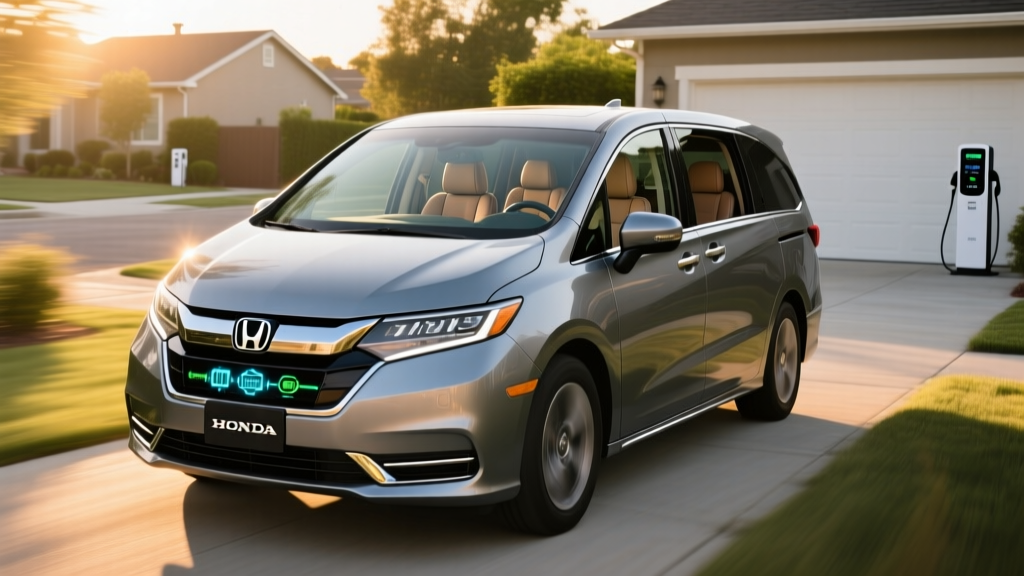
For the 2026 model year, Honda has finally brought its two-motor hybrid powertrain to the Odyssey minivan, replacing the V6-only lineup that defined the nameplate for decades. The result is a three-row family hauler that delivers an EPA-estimated 36 MPG combined — a massive jump from the outgoing 22 MPG combined of the previous 3.5L V6. Crucially, the 2026 Odyssey Hybrid is a conventional hybrid (HEV), not a plug-in hybrid (PHEV). You never plug it in; you just fuel it like any other car and let the hybrid system do the work.
This guide breaks down every spec that matters: real-world fuel economy, the two-motor hybrid system, battery longevity, pricing across trims, and whether this hybrid minivan — or a PHEV or full EV alternative — fits your family.
2026 Honda Odyssey Hybrid — Key Specifications
| Spec | Value |
|---|---|
| Powertrain | 2.0L 4-cyl Atkinson-cycle + 2-motor hybrid system |
| Combined Horsepower | 204 hp (system net) |
| EPA MPG (City / Hwy / Combined) | 38 / 33 / 36 MPG |
| Hybrid Battery | ~1.3 kWh lithium-ion (self-charging HEV) |
| Plug-in Required? | No — conventional hybrid (HEV) |
| Drivetrain | FWD (standard); AWD available on select trims |
| Seating | 7–8 passengers |
| Base MSRP (LX Hybrid) | $40,110 |
| Battery Warranty | 8 years / 100,000 miles (10 yr / 150,000 mi in CARB states) |
HEV vs. PHEV: What the 2026 Odyssey Actually Is
Before digging into fuel economy, it's essential to distinguish what the 2026 Odyssey Hybrid is — and what it isn't. Honda uses its proven two-motor hybrid system (the same architecture found in the Accord Hybrid and CR-V Hybrid). This is a conventional hybrid electric vehicle (HEV), meaning:
- The small ~1.3 kWh battery charges exclusively through regenerative braking and the gasoline engine.
- There is no plug, no charging cable, and no electric-only driving range to manage.
- The electric motor assists the gas engine and enables brief low-speed electric-only operation (typically under 1–2 miles at very low speeds), but the system is designed for fuel-economy optimization, not electric-range extension.
HEV vs. PHEV vs. EV — Which Minivan Fits You?
| Factor | HEV (Odyssey Hybrid) | PHEV (e.g., Chrysler Pacifica Hybrid) | Full EV (e.g., Kia EV9) |
|---|---|---|---|
| Plug-in Required? | No | Yes (for max benefit) | Yes (mandatory) |
| Electric-Only Range | ~1 mi at low speed | ~32 mi (Pacifica Hybrid) | 230–310 mi |
| Fuel/Energy Cost | Gas only (~$0.11/mi) | Electric + gas (~$0.05–$0.11/mi) | Electric only (~$0.04–$0.06/mi) |
| Home Charging Needed? | No | Recommended (Level 2) | Essential (Level 2) |
| Federal Tax Credit (§30D) | Not eligible | Up to $7,500 (if eligible) | Up to $7,500 (if eligible) |
| Best For | No garage/outlet access; want simplicity | Short commutes + home charging | Home charging + low running costs |
If you lack access to a garage or outdoor outlet for charging, the Odyssey HEV is the pragmatic choice: zero behavior change, significant fuel savings.
Fuel Economy: EPA Numbers and Real-World MPG
The EPA rates the 2026 Odyssey Hybrid at 38 MPG city, 33 MPG highway, and 36 MPG combined, per fueleconomy.gov. That's a 64% improvement in combined fuel economy over the prior V6 generation.
EPA Fuel Economy Breakdown
| Driving Cycle | EPA MPG | Real-World Expectation |
|---|---|---|
| City | 38 MPG | 37–41 MPG (hybrids often exceed EPA in stop-and-go) |
| Highway | 33 MPG | 30–33 MPG (less regen benefit at sustained speed) |
| Combined | 36 MPG | 33–38 MPG depending on driving mix |
Why Hybrids Often Beat EPA in the City
Conventional hybrids recapture kinetic energy during braking and low-speed driving through regenerative braking. City driving — with its frequent stops — maximizes regen opportunities and allows the electric motor to handle more of the propulsion load. Highway driving, by contrast, demands sustained engine output with fewer braking events, so the hybrid advantage narrows. Many Odyssey Hybrid owners report exceeding the 38 MPG city estimate in suburban stop-and-go traffic, especially in mild weather.
Real-World Variables That Affect MPG
- Cold weather: Expect a 5–10% fuel economy drop in winter. The engine runs more frequently to generate cabin heat and maintain battery temperature.
- Cargo and passengers: A fully loaded Odyssey (7 passengers + cargo) will see 1–3 MPG reduction vs. solo driving.
- Terrain: Mountainous routes reduce efficiency; however, downhill regen partially offsets the climbing penalty.
- AWD models: All-wheel-drive variants carry a slight 1–2 MPG penalty due to drivetrain weight and mechanical losses.
Powertrain Deep Dive: Two-Motor Hybrid System
The 2026 Odyssey Hybrid uses Honda's fourth-generation two-motor hybrid system, pairing a 2.0-liter Atkinson-cycle four-cylinder engine with two electric motors. One motor functions primarily as a generator, while the second drives the wheels directly. This architecture enables three operating modes:
- EV Drive: Battery powers the drive motor for low-speed, short-distance operation (limited to ~1 mile at speeds under 25 mph).
- Hybrid Drive: The engine spins the generator motor, which powers the drive motor. This is the primary mode for city and suburban driving.
- Engine Drive: At highway cruising speeds, a lock-up clutch connects the engine directly to the wheels for maximum efficiency.
The system produces a combined 204 horsepower. While that's less than the outgoing V6's 280 hp, the electric motor delivers instant torque from a standstill, making the Odyssey Hybrid feel responsive in daily driving. The 0–60 mph time is approximately 7.8 seconds — adequate for merging and passing, though not sporty. Honda's e-CVT (electronic continuously variable transmission) provides seamless power delivery without traditional gear shifts.
Pricing, Trims, and Tax Credit Eligibility
The 2026 Odyssey Hybrid starts at $40,110 for the LX Hybrid trim, including destination. Higher trims add features and AWD availability:
| Trim | MSRP | Key Additions |
|---|---|---|
| LX Hybrid | $40,110 | Base hybrid, Honda Sensing suite, 7-passenger |
| EX-L Hybrid | $43,850 | Leather, power tailgate, 8-passenger |
| Touring Hybrid | $47,990 | Navigation, rear entertainment, AWD available |
| Elite Hybrid | $50,490 | AWD standard, premium audio, ventilated front seats |
Federal Tax Credit: Not Eligible
Because the 2026 Odyssey Hybrid is a conventional HEV (not a PHEV or BEV), it does not qualify for the federal §30D clean vehicle tax credit. The IRS restricts this credit to plug-in electric vehicles with battery capacities of at least 7 kWh and the ability to recharge from an external power source. The Odyssey's ~1.3 kWh self-charging battery does not meet these criteria.
For full details on which vehicles do qualify, consult the IRS clean vehicle tax credits page. Some states offer separate rebates or reduced registration fees for hybrids — check your state's energy or DMV website for current programs.
Battery Longevity, Warranty, and Replacement Cost
Hybrid battery anxiety is the most common concern among first-time hybrid buyers. Here's what the data shows:
2026 Odyssey Hybrid Battery Warranty
- Standard warranty: 8 years / 100,000 miles
- CARB-state warranty: 10 years / 150,000 miles (California, New York, Massachusetts, and other states adopting CARB emissions standards)
- Capacity threshold: Honda warrants the hybrid battery against failure or significant capacity loss that impairs vehicle operation
How Long Do Honda Hybrid Batteries Last?
Honda's two-motor hybrid system uses a relatively small lithium-ion pack (~1.3 kWh) that operates within a narrow state-of-charge window — typically between 40% and 80%. This shallow cycling dramatically reduces degradation compared to full EV batteries that cycle from 10% to 90%+. Based on long-term data from Accord Hybrid and CR-V Hybrid owners, Honda hybrid batteries routinely last 150,000–200,000+ miles before any significant capacity loss. Many exceed the vehicle's useful life.
Replacement Cost If Needed
If a hybrid battery does fail outside of warranty, replacement costs for Honda's two-motor system typically range from $2,500 to $4,500 including parts and labor at a dealership. Independent hybrid specialists often offer refurbished packs for $1,500–$2,500. Given the battery's track record, this is a low-probability expense — but it's worth budgeting for on high-mileage used examples.
Ownership Economics: Hybrid vs. Gas vs. EV Minivan
At 36 MPG combined and a national average gas price of ~$3.30/gallon (early 2026), the Odyssey Hybrid costs approximately $0.092 per mile in fuel. Compare that to the outgoing V6 Odyssey at 22 MPG combined ($0.150/mi) — a savings of roughly $870 per year for a driver covering 15,000 miles annually.
| Vehicle Type | Example | Annual Fuel/Energy Cost (15K mi) | 5-Year Cost |
|---|---|---|---|
| Gas V6 Minivan (prior gen) | 2024 Odyssey (22 MPG) | $2,250 | $11,250 |
| HEV Minivan | 2026 Odyssey Hybrid (36 MPG) | $1,375 | $6,875 |
| PHEV Minivan | Pacifica Hybrid (32 mi EV + 30 MPG gas) | $900–$1,400* | $4,500–$7,000* |
| Full EV SUV (3-row) | Kia EV9 (89 MPGe) | $750–$1,050** | $3,750–$5,250** |
*PHEV cost varies widely based on how much driving is done on electricity vs. gas. Assumes home Level 2 charging.
**EV cost depends on local electricity rates ($0.12–$0.18/kWh typical) and charging mix (home vs. public DC fast charging).
The Odyssey Hybrid's advantage is that it requires zero infrastructure investment — no home charger installation ($500–$2,000+), no behavior change, no range planning. You save fuel from day one with only a gas station stop.
Who Should Choose the 2026 Odyssey Hybrid?
Choose the Odyssey Hybrid If:
- You want a three-row minivan with no charging hassle
- Your home lacks a garage or 240V outlet for Level 2 charging
- You drive 12,000–20,000+ miles/year and want to cut fuel costs significantly
- You take frequent long road trips and don't want to plan charging stops
- You value Honda's reliability track record and dealer network
- You want proven hybrid tech with a strong battery warranty
Consider a PHEV or EV Instead If:
- You have home Level 2 charging and a short daily commute (PHEV: drive gas-free most days)
- You want to maximize fuel savings and qualify for the $7,500 federal tax credit (EV or eligible PHEV)
- You want the quietest, smoothest driving experience with instant full-electric torque (EV)
- You primarily drive in urban/suburban areas under 40 miles per day (PHEV covers this entirely on electricity)
Frequently Asked Questions
How many MPG does the 2026 Honda Odyssey Hybrid get?
The EPA rates it at 38 MPG city, 33 MPG highway, and 36 MPG combined. Real-world results typically range from 33–38 MPG combined, with city-heavy driving often exceeding the EPA estimate thanks to regenerative braking.
Does the 2026 Odyssey Hybrid need to be plugged in?
No. The Odyssey Hybrid is a conventional HEV. Its small battery recharges through regenerative braking and the gasoline engine. You simply fill up at a gas station like any other vehicle.
Does the 2026 Odyssey Hybrid qualify for a tax credit?
No. The federal §30D clean vehicle tax credit applies only to plug-in electric vehicles (PHEVs and BEVs) with battery packs of at least 7 kWh. The Odyssey Hybrid's ~1.3 kWh self-charging battery does not qualify. Check your state's energy office for any local hybrid incentives.
Is the hybrid battery reliable, and what does replacement cost?
Honda's hybrid batteries are proven to last 150,000–200,000+ miles based on long-term Accord and CR-V Hybrid data. The battery carries an 8-year/100,000-mile warranty (10 years/150,000 miles in CARB states). Out-of-warranty replacement typically costs $2,500–$4,500 at a dealer, or $1,500–$2,500 for a refurbished pack from an independent specialist.
How does the Odyssey Hybrid compare to the Chrysler Pacifica Hybrid?
The Pacifica Hybrid is a PHEV offering ~32 miles of electric-only range before the gas engine engages. If you have home charging and a short commute, the Pacifica Hybrid can run mostly on electricity for daily driving and may qualify for the $7,500 federal tax credit. However, once its battery depletes, its gas-only MPG drops to around 30 MPG combined — less than the Odyssey Hybrid's 36 MPG. The Odyssey Hybrid is the better choice if you can't charge at home or want consistent efficiency without plugging in.
Is AWD available on the 2026 Odyssey Hybrid?
Yes. AWD is available on Touring Hybrid and standard on Elite Hybrid trims. AWD models carry a slight 1–2 MPG penalty due to added drivetrain weight.
How much towing capacity does the Odyssey Hybrid have?
Honda rates the 2026 Odyssey Hybrid at up to 3,500 pounds of towing capacity on properly equipped trims — sufficient for a small trailer, pair of jet skis, or light camper.