Quick Verdict: Honda's 2026 Hybrid Strategy
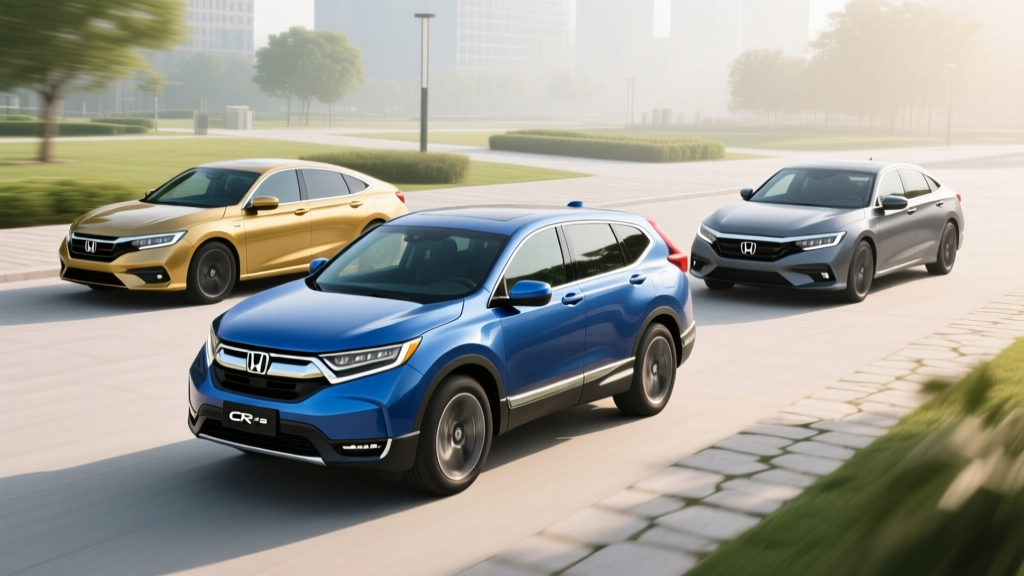
Honda has doubled down on conventional hybrids (HEVs) rather than plug-in hybrids for the US market in 2026. The strategy is straightforward: offer hybrid powertrains across the Civic, Accord, and CR-V — three of the best-selling nameplates in America — without requiring buyers to install home chargers or adapt their routines. If you've been searching for a new Honda hybrid, you're looking at three distinct vehicles that share Honda's fourth-generation two-motor hybrid system but deliver very different ownership experiences.
Here's what matters: the Accord Hybrid leads with up to 48 MPG combined, the CR-V Hybrid offers practical SUV versatility at 40 MPG combined, and the Civic Hybrid delivers 49 MPG combined in a compact package starting under $30,000. None of these are plug-in hybrids — they're self-charging HEVs that use regenerative braking and the gasoline engine to maintain battery charge. That distinction matters for your daily routine, your wallet, and your expectations.
HEV vs PHEV: What Honda Offers (and Doesn't)
Conventional Hybrid (HEV) — What Honda Sells
- No plug-in charging required
- Small battery (~1.0–1.1 kWh) charged by engine and regen
- Short electric-only driving bursts at low speeds
- Lower upfront cost, no range anxiety
- No federal EV tax credit eligibility
Plug-In Hybrid (PHEV) — What Honda Doesn't Currently Offer in the US
- Requires plug-in charging for EV mode benefits
- Larger battery (15–20+ kWh) enabling 25–40 miles electric-only
- Sustained electric-only highway driving capability
- Higher purchase price, home charging infrastructure needed
- May qualify for up to $7,500 federal tax credit under §30D
Honda previously sold the Clarity Plug-In Hybrid (discontinued after 2021) with 47 miles of electric range, but as of 2026, Honda's US hybrid lineup is exclusively conventional HEV. If plug-in capability is essential to your commute, you'll need to look at competitors like the Toyota RAV4 Prime or Hyundai Tucson PHEV. Honda's bet is that most buyers want the fuel savings of hybridization without the complexity and cost of plug-in infrastructure.
2026 Honda Hybrid Lineup: Side-by-Side Specs
| Specification | 2026 Civic Hybrid | 2026 Accord Hybrid | 2026 CR-V Hybrid |
|---|---|---|---|
| Powertrain | 2.0L I-4 + 2 motors | 2.0L I-4 + 2 motors | 2.0L I-4 + 2 motors |
| Combined Horsepower | 200 hp | 204 hp | 204 hp |
| Combined Torque | 232 lb-ft | 247 lb-ft | 247 lb-ft |
| Battery Capacity | ~1.0 kWh (lithium-ion) | ~1.1 kWh (lithium-ion) | ~1.1 kWh (lithium-ion) |
| EPA City MPG | 50 | 51 | 43 |
| EPA Highway MPG | 47 | 44 | 36 |
| EPA Combined MPG | 49 | 48 | 40 |
| Drivetrain | FWD | FWD (AWD unavailable) | FWD or AWD |
| 0–60 mph (est.) | ~7.2 sec | ~7.0 sec | ~7.8 sec |
| Starting MSRP | $29,845 | $34,895 | $36,395 |
| Federal Tax Credit | Not eligible | Not eligible | Not eligible |
Sources: fueleconomy.gov, Honda Newsroom. Pricing reflects base Sport Hybrid or equivalent hybrid trim. AWD on CR-V Hybrid adds approximately $1,500.
Real-World MPG: What to Actually Expect
EPA estimates are a starting point, not a guarantee. Honda's hybrid system excels in city driving, where the electric motors handle low-speed propulsion and regenerative braking recaptures energy at every stoplight. Here's what real-world data and owner reports suggest:
Real-World MPG Expectations
Civic Hybrid: EPA 49 combined — expect 48–53 MPG in mixed city/highway driving. City-dominant commuters regularly report 52–55 MPG. Sustained highway driving at 75+ mph drops to 42–45 MPG.
Accord Hybrid: EPA 48 combined — expect 46–51 MPG in mixed use. The Accord's larger size and weight penalize highway efficiency more noticeably; expect 40–43 MPG on long interstate trips.
CR-V Hybrid: EPA 40 combined (FWD) / 37 combined (AWD) — expect 37–42 MPG mixed. AWD models see a 2–3 MPG penalty. Cold-weather driving with cabin heat demands can drop city MPG to the low 30s on short trips.
The physics here are straightforward: hybrids shine in stop-and-go traffic where the engine shuts off frequently and regenerative braking feeds energy back to the battery. Highway driving at sustained speed relies more heavily on the gasoline engine, narrowing the gap between a hybrid and a conventional efficient sedan. If your commute is 80% city, a Honda hybrid will consistently beat its EPA rating. If you're primarily a highway driver, the fuel savings over a non-hybrid are real but more modest — roughly 5–8 MPG better than a comparable gas-only model.
Pricing, Trims, and Tax Credit Reality
Honda positions its hybrid trims as the value play in each lineup, often pricing the hybrid at or near the mid-tier gas trim. Here's the 2026 pricing breakdown:
| Model | Hybrid Trim | MSRP | Hybrid Premium vs. Gas Base |
|---|---|---|---|
| Civic Hybrid | Sport Hybrid | $29,845 | +$1,500 |
| Accord Hybrid | Sport Hybrid | $34,895 | +$2,200 |
| CR-V Hybrid | Sport Hybrid (FWD) | $36,395 | +$2,800 |
| CR-V Hybrid | Sport Touring Hybrid (AWD) | $41,895 | Top-tier trim |
Federal Tax Credit Eligibility for Honda Hybrids
- §30D Clean Vehicle Credit: NOT eligible. Conventional hybrids (HEVs) do not meet the battery capacity threshold (≥7 kWh) or plug-in requirement under IRS rules.
- Used hybrid credit (§25E): Not applicable to new vehicle purchases.
- State incentives: Some states (CA, CO, NY, others) offer rebates for hybrids, but amounts and eligibility vary significantly. Check your state energy office or DMV for current programs.
- Bottom line: You pay full MSRP for a new Honda hybrid. The ROI comes from fuel savings, not purchase incentives.
The hybrid premium pays back through fuel savings. At $3.50/gallon and 12,000 miles annually, the Civic Hybrid saves approximately $550–$650 per year versus the gas-only Civic (35 MPG combined), recovering the $1,500 premium in roughly 2.5 years. The CR-V Hybrid's payback is longer at 3.5–4 years versus a gas CR-V (30 MPG combined). These calculations assume stable gas prices and don't account for potential resale-value premiums hybrids tend to command.
Powertrain Deep Dive: Honda's Two-Motor Hybrid System
All three 2026 Honda hybrids use the fourth-generation of Honda's two-motor hybrid system, but the execution varies by vehicle. The architecture pairs a 2.0-liter Atkinson-cycle four-cylinder engine with two electric motors — one functioning primarily as a generator, the other as the drive motor. A lock-up clutch enables direct engine-to-wheel connection at highway cruising speeds where the engine operates most efficiently.
The system operates in three modes:
- EV Drive: Battery powers the drive motor alone. Used for low-speed starts, gentle acceleration, and short distances (typically under 1–2 miles at low speed). The small ~1 kWh battery limits sustained electric-only driving.
- Hybrid Drive: Engine spins the generator motor, which feeds electricity to the drive motor. The engine isn't mechanically connected to the wheels — it acts as an onboard generator. This is the primary mode for city and suburban driving.
- Engine Drive: Lock-up clutch engages, connecting the engine directly to the front wheels. Used at steady highway speeds (roughly 45–80 mph) where the Atkinson-cycle engine hits its efficiency sweet spot.
The result is seamless power delivery that feels more like an EV than a traditional hybrid. There's no conventional transmission — the e-CVT effect comes from the motor-generator interplay, eliminating the "rubber band" feel that plagued earlier CVT-equipped hybrids. The 200–204 hp combined output provides confident merging and passing, a meaningful step up from Honda's earlier Integrated Motor Assist (IMA) hybrids that prioritized efficiency over performance.
Battery Warranty, Reliability, and Replacement Costs
Honda Hybrid Battery Warranty
Coverage: 8 years / 100,000 miles (10 years / 150,000 miles in CARB states including CA, CO, CT, ME, MD, MA, NJ, NY, OR, RI, VT, WA)
What's covered: Hybrid battery pack, power control unit, and hybrid-system components against defects and abnormal capacity loss
Capacity threshold: Honda does not publish a specific degradation percentage trigger, but warranty replacement is authorized when the battery fails to hold sufficient charge for normal hybrid operation
Honda's hybrid battery track record is strong. The lithium-ion packs in the current-generation system are smaller and less stressed than those in PHEVs or BEVs, which works in their favor for longevity. The batteries operate in a narrow state-of-charge window (roughly 40–60% SoC in normal driving), minimizing degradation. Real-world data from earlier-generation Honda hybrids shows battery packs routinely lasting 150,000–200,000+ miles before significant capacity loss.
If replacement is needed out of warranty, expect the following approximate costs (parts + labor, 2026 estimates):
- Civic Hybrid battery: $2,000–$3,000
- Accord Hybrid battery: $2,500–$3,500
- CR-V Hybrid battery: $2,800–$4,000
These figures are substantially lower than BEV battery replacements ($8,000–$20,000+) because Honda's hybrid packs are 10–80× smaller. Third-party refurbishment shops also offer reconditioned hybrid batteries at 30–50% below OEM pricing, though this may affect remaining warranty coverage. For most buyers planning to own the vehicle 8–10 years, the battery warranty provides adequate coverage, and the probability of out-of-pocket replacement during typical ownership is low.
In terms of overall reliability, Honda's hybrid powertrains carry strong ratings. The e-CVT architecture has fewer moving parts than a conventional automatic transmission, and the Atkinson-cycle engine operates under less stress than a performance-tuned powerplant. IIHS has awarded both the Accord and CR-V Top Safety Pick+ ratings in recent model years, and Honda Sensing (adaptive cruise, lane-keeping, automatic emergency braking) comes standard on all hybrid trims.
Pros and Cons: Honda's Hybrid Lineup
Pros
- Class-leading city MPG — Accord and Civic exceed 50 MPG in urban driving
- No plug-in required — zero lifestyle change from a gas car
- Low hybrid premium — $1,500–$2,800 over gas equivalents with 2.5–4 year payback
- Smooth, EV-like power delivery without range anxiety
- Strong battery warranty (8–10 years depending on state)
- AWD available on CR-V Hybrid
- Honda Sensing safety suite standard on all trims
- Proven reliability with low battery replacement cost risk
Cons
- No plug-in hybrid option — zero sustained electric-only range
- No federal tax credit eligibility for any Honda hybrid
- Highway MPG advantage narrows vs. efficient gas models
- Accord Hybrid not available with AWD
- Small battery limits regenerative braking capacity on long descents
- CR-V Hybrid AWD fuel economy drops to 37 combined
- Cold-weather short-trip efficiency degrades noticeably
Who Should Buy a New Honda Hybrid — And Who Shouldn't
Choose a Honda Hybrid If:
- Your commute is city-heavy or suburban with frequent stops
- You want better fuel economy without installing a home charger
- You plan to own the vehicle 6–10 years (warranty coverage + fuel payback)
- You want a mainstream brand with strong dealer support and parts availability
- Your annual mileage is 10,000–15,000+ (higher miles = faster payback)
Consider a Full EV Instead If:
- You have reliable home Level 2 charging access
- Your daily commute is under 50 miles round-trip
- You want to qualify for the $7,500 federal tax credit (§30D)
- You want zero tailpipe emissions and lower per-mile "fuel" cost
- You're open to a Tesla Model 3, Hyundai Ioniq 6, or Chevrolet Equinox EV
Consider a PHEV Instead If:
- You want electric-only commuting but need gas flexibility for road trips
- You can install a Level 2 home charger
- You're willing to pay a $5,000–$8,000 premium over a conventional hybrid
- Models like the Toyota RAV4 Prime or Jeep Wrangler 4xe fit your needs
Frequently Asked Questions
How many MPG does a new Honda hybrid get?
The 2026 Civic Hybrid achieves an EPA-estimated 49 MPG combined (50 city / 47 highway). The Accord Hybrid gets 48 combined (51 city / 44 highway). The CR-V Hybrid achieves 40 combined with FWD and 37 combined with AWD. In real-world city-dominant driving, all three tend to exceed their EPA ratings by 2–5 MPG.
Does any Honda hybrid have electric-only range?
Honda's current US hybrid lineup consists exclusively of conventional HEVs, not plug-in hybrids. The small ~1 kWh battery enables brief electric-only movement at very low speeds (parking lots, gentle starts) for roughly 1 mile or less, but it cannot sustain electric-only driving at meaningful speeds. If you need 25–40 miles of electric-only range, you need a PHEV from another manufacturer.
Do I need to plug in a Honda hybrid?
No. All 2026 Honda hybrids are conventional HEVs that charge their batteries through regenerative braking and the gasoline engine. You fuel them like any other car — there is no plug, no charging cable, and no home charging infrastructure required.
Does a Honda hybrid qualify for a federal tax credit?
No. Under IRS §30D rules, the Clean Vehicle Credit requires a plug-in vehicle with a battery capacity of at least 7 kWh. Honda's conventional hybrids have batteries around 1 kWh and do not plug in, making them ineligible for the federal EV tax credit. Some state-level incentives may apply — check your state's energy office for current programs.
How long will the Honda hybrid battery last?
Honda covers the hybrid battery for 8 years/100,000 miles (10 years/150,000 miles in CARB states). Based on real-world data from earlier Honda hybrid generations, the lithium-ion battery packs commonly last 150,000–200,000+ miles before significant capacity loss. The narrow state-of-charge operating window minimizes degradation. Out-of-warranty replacement costs range from approximately $2,000–$4,000 depending on the model.
Is the CR-V Hybrid available with AWD?
Yes. The 2026 CR-V Hybrid offers available real-time AWD, which adds approximately $1,500 to the MSRP and reduces combined fuel economy from 40 MPG (FWD) to 37 MPG (AWD). The Accord Hybrid and Civic Hybrid are front-wheel drive only.
How does the Honda hybrid compare to Toyota's hybrid system?
Both Honda and Toyota use series-parallel hybrid architectures, but Honda's two-motor system leans more heavily on electric-motor drive at lower speeds, giving it a smoother, more EV-like feel. Toyota's Hybrid Synergy Drive uses a planetary gearset that blends engine and motor power more continuously. Real-world MPG is competitive between the two — the Toyota Camry Hybrid and Accord Hybrid trade blows at 48–52 MPG combined, while the RAV4 Hybrid (39 MPG combined) slightly trails the CR-V Hybrid (40 MPG FWD). Toyota offers PHEV options (RAV4 Prime) that Honda does not currently match in the US market.
For the latest EPA fuel economy data, visit fueleconomy.gov. For current Honda pricing and specifications, see the Honda official site. Tax credit rules referenced are based on IRS §30D guidelines and are subject to change — consult a tax professional for your specific eligibility.