Quick Verdict: The 2026 Honda CR-V Sport Hybrid
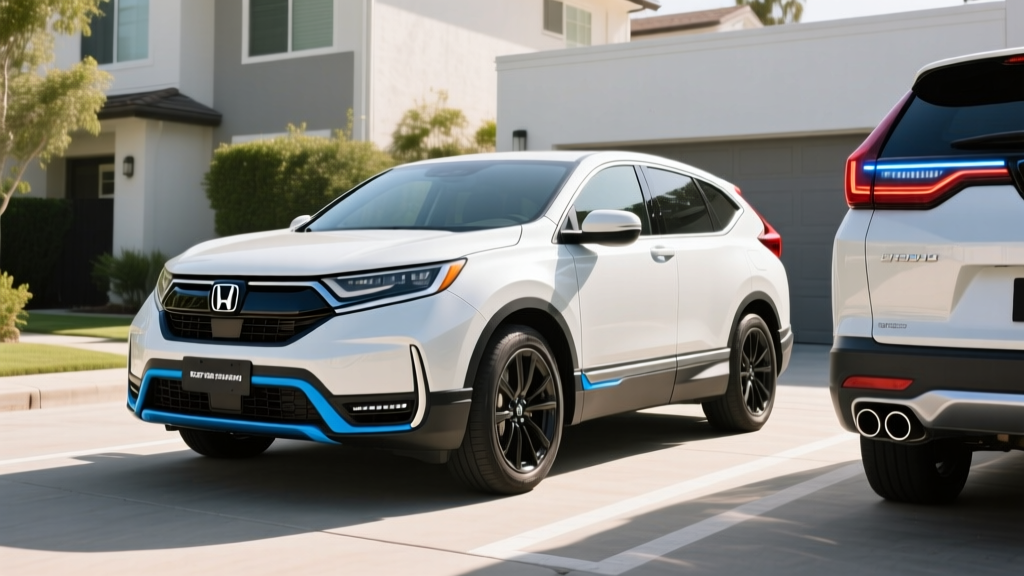
The 2026 Honda CR-V Sport Hybrid sits at the intersection of practicality and efficiency for buyers who want electric-motor smoothness without the lifestyle change of plugging in. With an EPA-rated 40 MPG combined, a proven two-motor hybrid powertrain, and a starting MSRP around $36,300, it undercuts most plug-in hybrids and full EVs on upfront cost while delivering fuel economy that rivals vehicles half its size. This is a conventional hybrid (HEV), not a plug-in — it generates its own electricity and never needs a charging cable.
| Spec | Value |
|---|---|
| Powertrain | 2.0L Atkinson-cycle 4-cyl + two-motor hybrid system |
| Combined Horsepower | 204 hp |
| Combined Torque | 247 lb-ft (motor) |
| EPA MPG (City / Hwy / Combined) | 43 / 36 / 40 (FWD); 40 / 34 / 37 (AWD) |
| Drivetrain | FWD standard, AWD available |
| 0–60 mph | ~7.8 seconds |
| Cargo Volume (behind rear seats) | 36.3 cu ft |
| Towing Capacity | 1,000 lbs |
| Hybrid Battery Warranty | 8 years / 100,000 miles |
| Starting MSRP (Sport Hybrid FWD) | $36,300 |
| Federal §30D Tax Credit | Not eligible (HEV) |
How Many MPG Does the 2026 CR-V Sport Hybrid Get?
Honda's fourth-generation two-motor hybrid system pairs a 2.0-liter Atkinson-cycle engine with twin electric motors. The result is EPA-estimated fuel economy that punches well above the compact-SUV weight class.
| Drivetrain | City | Highway | Combined |
|---|---|---|---|
| FWD | 43 MPG | 36 MPG | 40 MPG |
| AWD | 40 MPG | 34 MPG | 37 MPG |
Source: fueleconomy.gov (EPA estimates).
Real-World MPG vs. EPA Sticker
Conventional hybrids like the CR-V Sport Hybrid often exceed their EPA city estimate in stop-and-go driving because regenerative braking recaptures energy that a gas-only car wastes as heat. In real-world mixed commuting, owners frequently report 41–45 MPG in city-heavy routines. Highway driving is the opposite story: above 70 mph, the gasoline engine carries most of the load with less regen benefit, so expect 33–36 MPG on the interstate.
Cold weather reduces fuel economy by roughly 5–10% in winter months due to cabin heating demands and reduced battery efficiency — a factor that affects all hybrids and EVs. Over a 15,000-mile year at $3.40/gallon, the FWD Sport Hybrid costs approximately $1,275 in fuel, compared to $1,890 for a comparable gas-only compact SUV rated at 28 MPG combined.
HEV vs. PHEV vs. EV: Which Fits Your Lifestyle?
One of the most common questions we field: should you buy a conventional hybrid (HEV), a plug-in hybrid (PHEV), or go full battery-electric (BEV)? The CR-V Sport Hybrid is an HEV — it never plugs in. Here is how the three powertrain types compare for a compact-SUV buyer.
| Factor | HEV (CR-V Sport Hybrid) | PHEV (e.g., Toyota RAV4 Prime) | BEV (e.g., Tesla Model Y) |
|---|---|---|---|
| Plug-in Required? | No | Yes (for EV range) | Yes (always) |
| Electric-Only Range | ~1 mile at low speed | 35–42 miles | 260–330 miles |
| Combined MPG / MPGe | 37–40 MPG | 38 MPG + 94 MPGe | 117–122 MPGe |
| Home Charging Needed? | No | Recommended (Level 2) | Essential |
| Starting Price Range | $36,000–$39,000 | $44,000–$48,000 | $44,000–$52,000 |
| Federal Tax Credit (§30D) | Not eligible | Up to $7,500 (if eligible) | Up to $7,500 (if eligible) |
| Best For | No home charging, budget-first buyers | Short commutes + road trips | Home charging + low running costs |
The CR-V Sport Hybrid wins on simplicity and entry price. If you cannot install a home charger, live in an apartment, or simply want to minimize upfront cost without thinking about plugs, the HEV is the pragmatic choice. The PHEV makes financial sense if you have a sub-35-mile commute and access to Level 2 charging. The BEV delivers the lowest per-mile energy cost but demands reliable charging infrastructure.
Powertrain Deep Dive: How the Two-Motor System Works
Honda's hybrid system operates primarily in EV mode at low speeds, where the drive motor (181 hp, 247 lb-ft) propels the vehicle using electricity from a compact lithium-ion battery pack. At higher speeds or under heavy load, the 2.0L engine either generates electricity for the motor (series-hybrid mode) or directly drives the wheels through a lock-up clutch (parallel-hybrid mode). The system transitions seamlessly — most drivers never feel the handoffs.
The combined system output of 204 hp provides confident merging and passing. The 0–60 mph time of approximately 7.8 seconds is competitive within the segment, and the electric motor's instant torque makes the CR-V Sport Hybrid feel quicker in urban driving than the number suggests. Honda's AWD system adds a rear-mounted motor for traction, sacrificing about 3 MPG combined compared to FWD.
2026 CR-V Sport Hybrid Pricing and Tax Credit Eligibility
The 2026 CR-V Sport Hybrid is available in two trims:
- Sport Hybrid FWD: $36,300 MSRP
- Sport Hybrid AWD: $37,800 MSRP
- Sport Touring Hybrid AWD (top trim): ~$41,500 MSRP
Destination charge adds approximately $1,350.
Federal Tax Credit Status
The CR-V Sport Hybrid is a conventional hybrid (HEV) and does not qualify for the federal §30D Clean Vehicle Credit. Under current IRS rules, the §30D credit applies only to plug-in electric vehicles (PHEVs and BEVs) that meet battery sourcing, critical minerals, MSRP caps, and buyer income thresholds. Conventional hybrids are excluded.
Some states offer rebates or reduced registration fees for hybrids — check your state energy office or the AFDC state incentive database for current local programs. These vary by jurisdiction and change frequently.
Why the CR-V Sport Hybrid does not qualify for §30D:
- It is a conventional HEV, not a plug-in vehicle
- §30D requires a minimum battery capacity of 7 kWh with external charging capability
- The CR-V Hybrid battery is approximately 1.1 kWh — far below the threshold
Reliability, Battery Warranty, and Replacement Cost
Hybrid battery longevity is consistently a top concern for first-time hybrid buyers. Here is the data:
Honda Hybrid Battery Warranty
- Coverage: 8 years / 100,000 miles (10 years / 150,000 miles in CARB states including CA, NY, MA, and others)
- What's covered: Hybrid battery pack, hybrid control module, DC-DC converter, and related hybrid-system components
- Capacity threshold: Honda warrants against defects and abnormal degradation; there is no published minimum capacity-retention percentage as there is for EVs
Real-World Longevity
Honda's hybrid systems have been in production since the early 2000s (Insight, Civic Hybrid, Accord Hybrid). The current two-motor architecture, introduced in 2014 and refined across generations, uses a relatively small lithium-ion pack (~1.1 kWh) that operates in a narrow state-of-charge window — typically between 20% and 80%. This shallow cycling dramatically reduces stress on the cells compared to a full EV battery that cycles from 10% to 90% daily.
Based on fleet data and owner reports from earlier-generation Honda hybrids, the traction battery typically lasts 150,000–200,000+ miles before any meaningful degradation occurs. Many Honda hybrids reach high mileage on the original battery pack.
Battery Replacement Cost
If the hybrid battery does require replacement out of warranty, expect a dealer-installed replacement to cost between $2,000 and $4,000 depending on the specific pack and labor rates. Independent hybrid-battery specialists can often refurbish or replace individual modules for $1,000–$2,000. This is a fraction of the $8,000–$20,000 cost associated with full EV battery replacements, owing to the much smaller pack size.
The gasoline engine and conventional powertrain components are covered under Honda's standard 5-year/60,000-mile powertrain warranty, and the vehicle carries a 3-year/36,000-mile bumper-to-bumper limited warranty.
Pros and Cons of the 2026 CR-V Sport Hybrid
Pros
- 40 MPG combined EPA (FWD) — class-leading for a compact SUV
- No plug-in charging required — ideal for apartment dwellers and street parkers
- Strong electric-motor torque for responsive city driving
- Lower entry price than PHEV and BEV competitors
- Proven Honda hybrid reliability with 8–10 year battery warranty
- Spacious 36.3 cu ft cargo area with no battery-pack intrusion
- Honda Sensing ADAS suite standard on all trims
Cons
- Not eligible for the $7,500 federal §30D tax credit
- AWD reduces combined MPG to 37
- Engine drone under hard acceleration (CVT-like behavior)
- Towing limited to 1,000 lbs — below some turbocharged gas rivals
- EV-only driving limited to ~1 mile at very low speeds
- No DC fast charging capability (not applicable — HEV)
Who Should Buy the 2026 Honda CR-V Sport Hybrid?
The CR-V Sport Hybrid is the right pick if you want maximum fuel efficiency with zero behavioral change. It is specifically ideal for:
- Buyers without home charging access — apartment renters, street parkers, condo owners without garage outlets
- High-mileage commuters — at 40 MPG combined, a 30-mile daily commute costs roughly $2.55 in fuel versus $3.75 in a 28 MPG gas SUV
- Budget-conscious families — $36,300 starting MSRP with no dependency on tax-credit eligibility or income caps
- Long-term ownership planners — proven hybrid reliability, minimal maintenance (no oil changes are more frequent than a gas car, and regen braking extends pad life)
Consider a PHEV or full EV instead if:
- You have home Level 2 charging and a short commute (PHEV delivers 35+ electric-only miles)
- You want to qualify for the §30D federal credit (PHEVs and BEVs may be eligible for up to $7,500)
- You prioritize the lowest possible per-mile energy cost (BEVs average $0.04–$0.06/mile on electricity vs. $0.08–$0.10/mile for this hybrid on gasoline)
Decision Framework
Choose the CR-V Sport Hybrid if: You want 40 MPG, cannot plug in at home, and prefer a sub-$40,000 price tag with no tax-credit paperwork.
Choose a PHEV (e.g., Honda CR-V e:PHEV or Toyota RAV4 Prime) if: You have a sub-35-mile commute, can install a Level 2 charger, and want electric-only daily driving with gas-engine backup.
Choose a BEV (e.g., Tesla Model Y, Hyundai Ioniq 5) if: You have reliable home charging, drive under 300 miles daily, and want the lowest operating cost plus federal tax credit eligibility.
Frequently Asked Questions
Does the 2026 Honda CR-V Sport Hybrid need to be plugged in?
No. The CR-V Sport Hybrid is a conventional hybrid (HEV). It charges its own small battery through regenerative braking and the gasoline engine. You simply fill it with gas and drive. There is no plug, no charging cable, and no need for home electrical work.
How far can the CR-V Sport Hybrid drive on electric power alone?
Approximately 1 mile at very low speeds (under 25 mph) in EV mode. This is normal for conventional hybrids — the electric motor assists primarily with acceleration and low-speed maneuvering, not sustained driving. For meaningful electric-only range (30+ miles), you need a plug-in hybrid (PHEV).
Is the 2026 CR-V Sport Hybrid reliable?
Honda's two-motor hybrid system has been in production since 2014 and has demonstrated strong long-term reliability. The hybrid battery is warranted for 8 years/100,000 miles (10 years/150,000 miles in CARB states). Historical data from earlier Honda hybrids suggests the battery pack typically lasts 150,000–200,000+ miles. Honda Sensing safety features are standard across all trims. The IIHS and NHTSA ratings should be checked once crash tests are published for the 2026 model year.
How much does it cost to replace the hybrid battery?
Out-of-warranty replacement costs approximately $2,000–$4,000 at a Honda dealer. Independent hybrid specialists can often refurbish the pack for $1,000–$2,000. This is significantly less than full EV battery replacements because the CR-V Hybrid uses a ~1.1 kWh pack versus 60–80+ kWh in a BEV.
Does the 2026 CR-V Sport Hybrid qualify for any tax credit?
It does not qualify for the federal §30D Clean Vehicle Credit because it is a conventional hybrid, not a plug-in vehicle. Some states and utilities offer rebates for hybrids — check the Alternative Fuels Data Center for programs in your area. The absence of a federal credit is offset by the CR-V Hybrid's lower base price compared to PHEV and BEV alternatives.
How does the CR-V Sport Hybrid compare to the gas-only CR-V?
The gas-only 2026 CR-V (1.5L turbo) is rated at approximately 30 MPG combined (FWD). The Sport Hybrid delivers 40 MPG combined — a 33% improvement. The hybrid also provides smoother, more responsive acceleration from its electric motor. The price premium for the hybrid powertrain is roughly $2,500–$3,000 over the gas equivalent, which is typically recouped in fuel savings within 3–4 years at 15,000 miles/year.
Is AWD worth the MPG penalty?
The AWD Sport Hybrid drops from 40 to 37 MPG combined — a 3 MPG difference that costs approximately $95 more per year in fuel at 15,000 miles and $3.40/gallon. If you regularly drive in snow, rain, or on unpaved roads, AWD is worth the trade-off. For dry-climate commuters, FWD maximizes efficiency and savings.