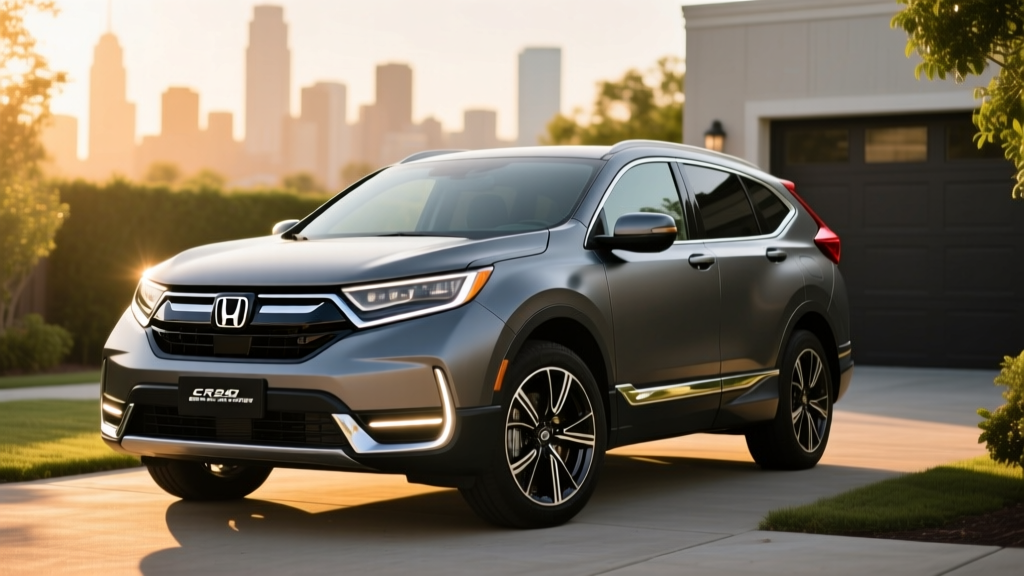
The 2026 Honda CR-V Sport Touring Hybrid sits at the top of the CR-V hybrid lineup, bundling all-wheel drive, Honda's fourth-generation two-motor hybrid system, and a premium feature set into one of the most popular compact SUVs on the road. If you're cross-shopping electrified SUVs but aren't ready to commit to a full battery-electric vehicle, this trim demands a close look — not for hype, but for the specific numbers it delivers at the pump and the ownership math that follows.
This guide breaks down the 2026 Honda CR-V Sport Touring Hybrid's EPA fuel economy, real-world MPG expectations, powertrain specs, battery warranty, pricing, tax-credit eligibility, and how it stacks up against PHEV and full-EV alternatives.
HEV vs PHEV: Where the CR-V Sport Touring Hybrid Fits
Before evaluating the numbers, it's essential to understand what this vehicle is — and isn't. The 2026 CR-V Sport Touring Hybrid is a conventional hybrid electric vehicle (HEV). It has no plug, no electric-only driving mode of meaningful distance, and no external charging requirement. Its 1.3 kWh lithium-ion battery is charged entirely through regenerative braking and the gasoline engine.
HEV vs PHEV vs BEV — Quick Reference
| Feature | HEV (e.g., CR-V Hybrid) | PHEV (e.g., Toyota RAV4 Prime) | BEV (e.g., Tesla Model Y) |
|---|---|---|---|
| Plugs in? | No | Yes | Yes |
| Electric-only range | ~1 mi (low-speed assist) | 25–42 mi typical | 250–330+ mi |
| Battery size | ~1.3 kWh | 13–18 kWh | 60–82 kWh |
| Federal tax credit (§30D) | Not eligible | Up to $7,500 (if eligible) | Up to $7,500 (if eligible) |
| Home charging needed? | No | Recommended for EV range | Essential |
The CR-V Hybrid is designed for buyers who want fuel savings with zero change to their fueling routine.
Honda does not currently offer a plug-in hybrid version of the CR-V in the United States. If electric-only commuting is a priority, you'll need to look at competitors like the Toyota RAV4 Prime or a full BEV.
Fuel Economy: EPA Ratings and Real-World MPG
The 2026 CR-V Sport Touring Hybrid comes standard with all-wheel drive (AWD), which slightly reduces fuel economy compared to the front-wheel-drive Sport Hybrid trim. Here are the EPA-estimated figures as published on fueleconomy.gov:
| Metric | EPA Estimate | Real-World Expectation |
|---|---|---|
| City MPG | 40 MPG | 38–43 MPG |
| Highway MPG | 34 MPG | 30–34 MPG |
| Combined MPG | 37 MPG | 34–38 MPG |
For a compact AWD SUV, 40/34/37 MPG is competitive with the Toyota RAV4 Hybrid (41/38/39 AWD) and well ahead of the Hyundai Tucson Hybrid AWD (38/38/38). The CR-V's city advantage comes from Honda's series-hybrid-dominant architecture, which runs the engine primarily as a generator at low speeds rather than driving the wheels directly.
Powertrain Specs: Horsepower, Engine, and Motors
| Specification | 2026 CR-V Sport Touring Hybrid |
|---|---|
| Engine | 2.0L DOHC 4-cylinder Atkinson-cycle |
| Engine output | 145 hp / 138 lb-ft |
| Drive motors (dual) | 181 hp / 247 lb-ft (propulsion motor) |
| Combined system output | 204 hp / 247 lb-ft |
| Drivetrain | Real Time AWD (standard on Sport Touring) |
| Transmission | e-CVT (single-speed direct drive w/ lock-up clutch) |
| 0–60 mph | ~7.6 seconds (est.) |
| Hybrid battery | ~1.3 kWh lithium-ion |
| Towing capacity | 1,000 lbs |
| Cargo volume (behind rear seats) | 36.3 cu ft |
| Cargo volume (seats folded) | 76.5 cu ft |
Honda's fourth-generation two-motor hybrid system operates in three modes seamlessly: EV Drive (battery powers the propulsion motor for short low-speed bursts), Hybrid Drive (engine spins the generator motor, which feeds electricity to the propulsion motor), and Engine Drive (a lock-up clutch connects the engine directly to the front wheels at steady highway speeds for efficiency). The rear axle is driven mechanically via a driveshaft from the front transaxle — this is not a through-the-road electric AWD system like some competitors use.
Pricing and Tax Credit Eligibility
The 2026 Honda CR-V Sport Touring Hybrid carries a starting MSRP of approximately $40,850 (including destination charge). As the top-of-line hybrid trim, it includes features such as a 9-inch touchscreen with wireless Apple CarPlay/Android Auto, a 12-speaker Bose audio system, heated front and rear seats, a heated steering wheel, wireless phone charging, a hands-free power tailgate, and Honda Sensing® (ADAS suite with adaptive cruise, lane-keeping, and collision mitigation).
The CR-V Hybrid is a conventional HEV, not a plug-in vehicle. Under IRS §30D rules, the federal clean vehicle credit (up to $7,500) is only available for plug-in electric vehicles (BEVs and PHEVs) meeting battery sourcing, MSRP, and buyer income requirements. The CR-V Hybrid does not qualify. Some states may offer minor incentives for high-efficiency vehicles, but these vary by jurisdiction — check your state's energy office for specifics.
Without the federal credit, the ownership math rests entirely on fuel savings. At 37 MPG combined and $3.40/gallon gas (2026 national average), annual fuel cost for 12,000 miles is roughly $1,103. A comparable gas-only AWD compact SUV at 28 MPG combined would cost about $1,457 annually — a savings of ~$354/year with the hybrid. Over a 5-year ownership period, that's approximately $1,770 in fuel savings, which partially offsets the hybrid powertrain premium over a gas-only CR-V EX-L AWD (~$38,500 MSRP).
Battery Warranty, Reliability, and Replacement Cost
Honda Hybrid Battery Warranty
- Hybrid battery: 8 years / 100,000 miles (10 years / 150,000 miles in CARB states including CA, NY, MA, and others)
- Hybrid system components: 8 years / 100,000 miles
- Powertrain warranty: 5 years / 60,000 miles
- Limited vehicle warranty: 3 years / 36,000 miles
Warranty covers battery capacity degradation below a functional threshold and defects. Honda does not publish a specific percentage retention guarantee, unlike some BEV manufacturers that warrant 70% capacity.
Honda's hybrid battery track record is strong. The company has been refining its hybrid systems since the 1999 Insight, and the current fourth-generation two-motor system has been in production since the 2023 model year. The 1.3 kWh battery is small and operates in a shallow state-of-charge window (roughly 20–80% SoC), which significantly reduces degradation stress compared to the deep-cycle demands of a full EV battery.
Battery replacement cost: If the hybrid battery fails out of warranty, replacement typically runs $2,000–$4,000 for parts and labor at a Honda dealer. Independent hybrid specialists may offer refurbished units for less. Given the battery's small size and conservative management, most owners will never face this expense — the battery is designed to outlast the vehicle's typical ownership life.
For reliability data, the CR-V consistently earns strong marks. The IIHS typically rates it a Top Safety Pick when equipped with specific headlights, and NHTSA has historically awarded it 5 stars overall.
Hybrid vs PHEV vs EV: Which Fits Your Driving Life?
Choose the CR-V Sport Touring Hybrid if:
- You don't have access to home or workplace charging (apartment, street parking)
- You want fuel savings without changing your refueling routine at all
- Your typical drive is a mix of city and highway with no single dominant pattern
- You want AWD capability for snow/rain without a range penalty
- You plan to keep the vehicle 8+ years and value a proven hybrid system
Consider a PHEV (e.g., Toyota RAV4 Prime) if:
- You can install a Level 2 charger at home and want 40+ miles of electric-only commuting
- You want partial EV benefits but need gas-engine range for road trips
- You qualify for the $7,500 federal tax credit (subject to IRS §30D income, MSRP, and sourcing rules)
Consider a full BEV (e.g., Tesla Model Y, Hyundai Ioniq 5) if:
- You have reliable home Level 2 charging
- Your daily driving is under 250 miles and you road-trip infrequently
- You want the lowest per-mile energy cost (~$0.04/mile on home electricity vs ~$0.09/mile on gas at 37 MPG)
- You want to maximize federal tax credit savings
Pros and Cons at a Glance
✓ Pros
- 40 MPG city — among the best in the compact AWD SUV class
- Standard AWD on Sport Touring with no plug-in requirement
- Refined, quiet hybrid operation with seamless mode transitions
- Spacious cargo area (36.3 cu ft) — no battery-pack intrusion
- Top-tier Honda Sensing ADAS suite included
- Strong hybrid battery warranty (8yr/100k mi; 10yr/150k in CARB states)
- Proven reliability track record for Honda hybrid systems
✗ Cons
- No federal tax credit eligibility (HEV, not plug-in)
- Highway MPG drops noticeably at 75+ mph (~30–32 observed)
- AWD is mechanical, not torque-vectoring — adequate, not sporty
- 1,000-lb towing capacity is low for the segment
- Sport Touring MSRP (~$40,850) is a premium over gas-only trims
- No PHEV variant available in the CR-V lineup
- Infotainment still uses Honda's older interface (functional but dated)
Ownership Economics: 5-Year Cost Snapshot
| Cost Factor (5 years / 60,000 mi) | CR-V Sport Touring Hybrid | Gas AWD Compact SUV (28 MPG) |
|---|---|---|
| Fuel cost (@ $3.40/gal) | ~$5,514 | ~$7,286 |
| Federal tax credit | $0 | $0 |
| Estimated maintenance | ~$2,400 | ~$2,800 |
| Total operating cost | ~$7,914 | ~$10,086 |
Estimates based on 12,000 miles/year, $3.40/gallon national average, and standard maintenance schedules. Insurance, depreciation, and registration not included. Actual costs vary by driving pattern, fuel prices, and location.
Frequently Asked Questions
How many MPG does the 2026 Honda CR-V Sport Touring Hybrid get?
The EPA rates the AWD Sport Touring Hybrid at 40 city / 34 highway / 37 combined MPG. In real-world driving, city mileage can exceed 40 MPG in warm stop-and-go conditions, while sustained highway driving above 75 mph may drop to the low 30s. Cold weather typically reduces combined MPG by 5–10%.
Does the CR-V Hybrid need to be plugged in?
No. The CR-V Sport Touring Hybrid is a conventional hybrid (HEV). Its small 1.3 kWh battery recharges through regenerative braking and the gasoline engine. You fuel it exactly like a regular gas car — there is no plug, no charging cable, and no change to your routine.
Does the 2026 CR-V Hybrid qualify for any tax credit?
No. Under current IRS §30D rules, only plug-in electric vehicles (BEVs and PHEVs) qualify for the federal clean vehicle credit. The CR-V Hybrid, as an HEV, is not eligible. Check with your state energy office for any local efficiency incentives, and consult a tax professional for personalized guidance.
How long will the hybrid battery last, and what does replacement cost?
Honda warranties the hybrid battery for 8 years/100,000 miles (10 years/150,000 miles in CARB states). The battery is small and managed conservatively, so most will last the life of the vehicle. If replacement is needed out of warranty, expect $2,000–$4,000 at a dealer. Independent hybrid shops may offer lower-cost refurbished options.
Is the CR-V Sport Touring Hybrid better than a PHEV or full EV?
It depends on your situation. The HEV is ideal if you can't charge at home and want fuel savings with zero lifestyle change. A PHEV is better if you have home charging and a short commute (capturing electric-only miles). A full BEV offers the lowest operating cost but requires charging infrastructure and acceptance of range planning on road trips.
How does the CR-V Hybrid AWD system work?
The CR-V Hybrid uses Honda's Real Time AWD, a mechanical system with a driveshaft from the front transaxle to the rear differential. Under normal conditions, most power goes to the front wheels. The system sends torque rearward when slip is detected or under hard acceleration. It is not a torque-vectoring or on-demand electric rear axle like some competitors offer.