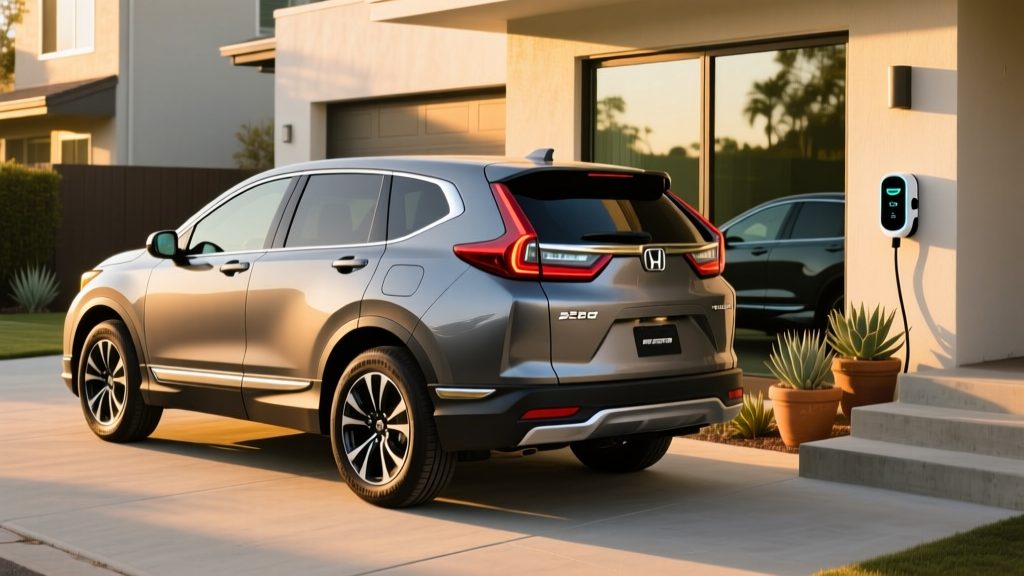
The Honda CR-V has been one of America's best-selling compact SUVs for over two decades, and its hybrid variant has quietly become the version most worth buying. For 2026, the Honda CR-V Hybrid carries forward the sixth-generation platform introduced for 2023, now with Honda's updated two-motor hybrid system standard on the Sport, Sport Touring, and the new Sport-L trims. It's a conventional hybrid (HEV) — meaning no plug, no charging cable, no range anxiety — just a noticeably more efficient powertrain wrapped in a practical, well-equipped crossover.
But does the 2026 Honda CR-V Hybrid SUV deliver on its 40 MPG EPA promise in real-world driving? And how does it stack up against plug-in hybrid rivals and full EVs in this price range? Let's break down every number that matters.
2026 Honda CR-V Hybrid Powertrain and Performance Specs
The 2026 CR-V Hybrid uses Honda's fourth-generation two-motor hybrid system, pairing a 2.0-liter Atkinson-cycle four-cylinder engine with two electric motors integrated into the e-CVT transmission. Unlike Toyota's planetary-gear hybrid system, Honda's setup can mechanically disconnect the engine and drive the wheels purely with the electric motors at low speeds — functioning much like a series hybrid in city driving, then engaging a direct clutch at highway speeds for efficiency.
| Specification | Value |
|---|---|
| Engine | 2.0L Atkinson-cycle DOHC i-VTEC 4-cylinder |
| Engine Output | 146 hp @ 6,100 rpm / 134 lb-ft torque |
| Drive Motor Output | 181 hp / 247 lb-ft torque |
| Combined System Output | 204 hp / 247 lb-ft torque |
| Transmission | e-CVT (two-motor hybrid system) |
| Drivetrain | AWD standard (all trims) |
| 0-60 mph (est.) | ~7.6 seconds |
| Towing Capacity | 1,000 lbs |
| Hybrid Battery | ~1.1 kWh lithium-ion (nominal) |
With 204 combined horsepower and 247 lb-ft of torque available nearly instantly from the electric drive motor, the CR-V Hybrid feels noticeably more responsive off the line than its turbocharged gas-only sibling (190 hp, 179 lb-ft). The AWD system uses a rear-mounted electric motor rather than a mechanical driveshaft, which improves packaging and response time.
Fuel Economy: EPA Ratings vs. Real-World MPG
This is the number most buyers are here for. According to fueleconomy.gov, the 2026 Honda CR-V Hybrid AWD earns the following EPA estimates:
| Driving Cycle | EPA Estimate |
|---|---|
| City | 40 MPG |
| Highway | 34 MPG |
| Combined | 37 MPG |
For context, the gas-only 2026 CR-V AWD with the 1.5L turbo earns 27 city / 32 highway / 29 combined MPG. That's a meaningful 27% improvement in combined driving with the hybrid, and an extraordinary 48% improvement in city driving.
The hybrid's advantage is largest in urban environments. If your driving is 70%+ highway, the gap between the hybrid and the turbo gas model narrows to roughly 4–5 MPG. If your driving skews toward city and suburban errands, the gap widens to 12–15 MPG — and the hybrid becomes a no-brainer.
HEV vs. PHEV vs. EV: Which Powertrain Fits Your Life?
One of the most common questions we field: should you buy the CR-V Hybrid (HEV), a plug-in hybrid like the Toyota RAV4 Prime or Hyundai Tucson PHEV, or go full EV with something like the Hyundai Ioniq 5 or Tesla Model Y? Here's the decision framework:
- You cannot install a home charger (apartment, street parking, condo without EV infrastructure)
- Your budget is $35,000–$42,000 and you want maximum value per dollar
- You take frequent long road trips and don't want to plan around charging stops
- You want zero behavior change — just drive it like a normal car
- You can charge at home (Level 2) and your daily commute is under 35–42 miles round trip
- You want electric-only daily driving but also want gas-engine flexibility for road trips
- You qualify for the federal §30D tax credit (up to $7,500 on eligible PHEVs)
- You have reliable home charging and your daily driving is under 250 miles
- You want the lowest per-mile fuel cost and minimal maintenance
- You want the strongest tax-credit eligibility and lowest long-term operating cost
The CR-V Hybrid occupies a specific and valuable niche: it's the most efficient option for buyers who cannot or will not plug in. Honda does not currently offer a CR-V plug-in hybrid in the U.S. market — if PHEV capability is a priority, you'll need to look at the RAV4 Prime, Tucson PHEV, or Mitsubishi Outlander PHEV.
2026 Honda CR-V Hybrid Pricing by Trim
For 2026, Honda offers the CR-V Hybrid across three trims, all with AWD as standard equipment:
| Trim | MSRP (est.) | Key Features |
|---|---|---|
| Sport Hybrid | ~$36,395 | 18" wheels, heated front seats, 7" display, wireless CarPlay/Android Auto, Honda Sensing suite |
| Sport-L Hybrid | ~$39,095 | Leather-trimmed seats, power liftgate, wireless phone charger, heated steering wheel |
| Sport Touring Hybrid | ~$42,195 | 9" touchscreen, Bose 12-speaker audio, panoramic moonroof, heated rear seats, navigation, hands-free liftgate |
Destination charge adds approximately $1,350. These prices represent a roughly $1,500 premium over equivalent gas-only trims — a premium you'll typically recoup in fuel savings within 2–3 years of average driving (12,000 miles/year at $3.50/gallon).
Tax Credit Eligibility: What Can You Actually Claim?
Here's where the distinction between HEV and PHEV matters enormously:
What the CR-V Hybrid may qualify for:
- State-level hybrid incentives: Some states (e.g., Colorado, Connecticut) offer rebates or tax credits for high-efficiency hybrids. Check your state's energy office for current programs.
- Insurance discounts: Several insurers offer 5–10% green-vehicle discounts for hybrids.
- HOV lane access: In certain states (Virginia, Maryland, others), hybrids meeting specific emissions thresholds may qualify for clean-vehicle HOV stickers — though many of these programs have sunset or have income caps.
If the federal tax credit is a dealbreaker for your purchase math, you'll need to look at PHEVs or BEVs. Consult IRS.gov's §30D guidance and a tax professional for your specific eligibility.
Hybrid Battery Longevity, Warranty, and Replacement Cost
Battery lifespan is the single biggest concern for hybrid shoppers, and it's also the one where the data is most reassuring.
- Hybrid battery: 8 years / 100,000 miles (10 years / 150,000 miles in CARB states — CA, CT, MA, ME, MD, NJ, NY, OR, RI, VT, WA)
- Hybrid system components: 8 years / 100,000 miles
- Powertrain: 5 years / 60,000 miles
- New vehicle: 3 years / 36,000 miles
Honda's hybrid battery is relatively small (~1.1 kWh) and operates within a conservative state-of-charge window — it never fully charges or fully depletes. This shallow-cycling strategy dramatically extends cell life. Real-world data from earlier Honda hybrids (Insight, Accord Hybrid, previous-gen CR-V Hybrid) shows minimal measurable degradation at 150,000+ miles. The battery simply isn't stressed the way a full EV's large pack is.
If replacement is eventually needed out of warranty, expect a dealer-installed hybrid battery to cost between $2,000 and $3,500 including labor. Independent hybrid specialists and refurbished options can reduce that to $1,200–$2,000. For comparison, a full EV battery replacement runs $10,000–$20,000+.
The CR-V Hybrid also uses Honda Sensing as standard across all trims — adaptive cruise control, lane-keeping assist, automatic emergency braking, and traffic sign recognition. The IIHS typically rates the CR-V as a Top Safety Pick when equipped with specific headlights (check the current rating for your trim).
Who Should Buy the 2026 Honda CR-V Hybrid — and Who Shouldn't
- 37 MPG combined EPA; 40+ achievable in city driving
- 204 hp with strong electric torque — quicker feel than gas model
- AWD standard on every hybrid trim
- No plug required — zero infrastructure dependency
- Spacious cargo area (36.3 cu ft rear, 76.5 cu ft max)
- Honda Sensing safety suite standard
- Proven hybrid system with excellent reliability track record
- Strong resale value (CR-V historically retains 55–60% at 5 years)
- No federal tax credit eligibility (HEV, not PHEV)
- Highway MPG drops to 30–32 at sustained 75+ mph
- Only 1,000-lb towing capacity (hybrid limitation)
- No plug-in hybrid CR-V option from Honda in the U.S.
- Road noise on coarse surfaces (improved but still present in gen 6)
- Sport trim lacks leather; must step up to Sport-L for premium interior
- Infotainment lag on base 7" screen (Sport Touring's 9" is better)
Frequently Asked Questions
How many MPG does the 2026 Honda CR-V Hybrid get?
The EPA rates the 2026 CR-V Hybrid AWD at 40 city / 34 highway / 37 combined MPG. In real-world city and suburban driving, owners frequently report 41–44 MPG thanks to aggressive regenerative braking. Highway-only driving at high speeds or in cold weather can reduce that to 30–32 MPG. Expect a realistic mixed-driving average of 35–39 MPG.
Does the CR-V Hybrid need to be plugged in?
No. The CR-V Hybrid is a conventional hybrid (HEV), not a plug-in hybrid. It charges its small battery entirely through regenerative braking and the gasoline engine. You fuel it exactly like any other gas car — just with significantly better MPG.
Is the CR-V Hybrid reliable? What does a battery replacement cost?
Honda's two-motor hybrid system has an excellent reliability record spanning multiple model lines and over a decade of production. The hybrid battery is warrantied for 8 years/100,000 miles (10/150,000 in CARB states), and real-world data shows these batteries lasting well beyond warranty. If replacement is needed out of warranty, expect $2,000–$3,500 at a dealer or $1,200–$2,000 through independent hybrid specialists.
Does the 2026 CR-V Hybrid qualify for a federal tax credit?
No. The federal §30D Clean Vehicle Credit requires plug-in capability and a minimum 7 kWh battery. The CR-V Hybrid's ~1.1 kWh battery and conventional hybrid powertrain make it ineligible. Some state-level incentives or insurance discounts may apply — check with your state energy office and insurer.
Should I buy the CR-V Hybrid or wait for a plug-in hybrid or EV?
If you can't charge at home, the CR-V Hybrid is the right call now — it's the most efficient option that requires zero infrastructure change. If you have home charging and a short commute, a PHEV like the RAV4 Prime (42 miles electric-only) or a full EV will save you more per mile and may qualify for up to $7,500 in federal tax credits. The CR-V Hybrid is the pragmatic choice for buyers who want efficiency without complexity.
How does the CR-V Hybrid compare to the Toyota RAV4 Hybrid?
The 2026 RAV4 Hybrid AWD is rated at 41 city / 38 highway / 39 combined MPG — slightly better on the highway due to Toyota's different hybrid system tuning. The CR-V Hybrid counters with more horsepower (204 vs. 219 for the RAV4 Hybrid, though the Honda feels punchier at low speeds), a more refined interior on upper trims, and arguably better cargo space. Both are segment benchmarks; test-drive both and let the dealer pricing and availability decide.