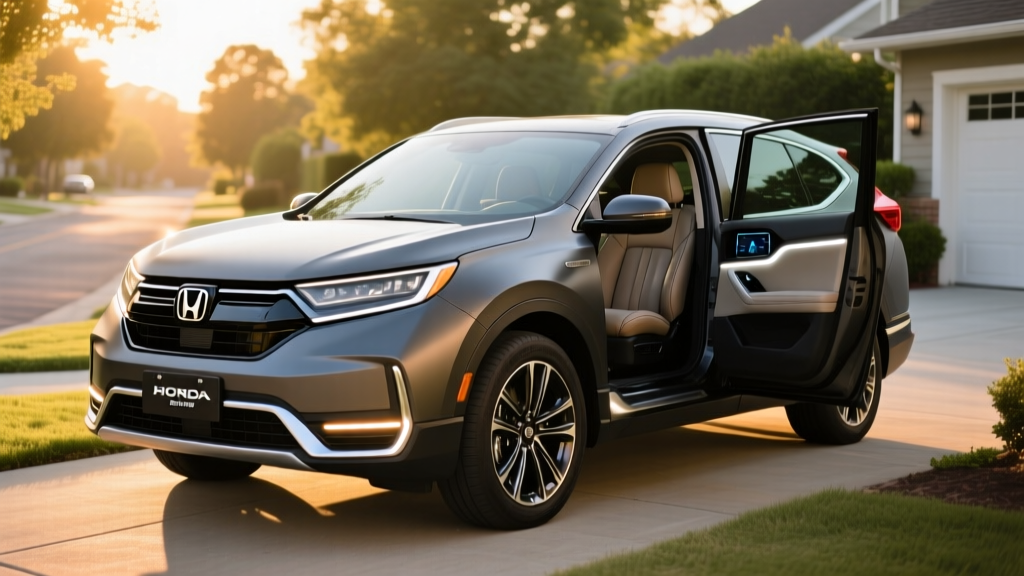
The 2026 Honda CR-V Hybrid Sport Touring AWD sits at the top of Honda's hybrid compact-SUV lineup, blending a proven two-motor hybrid system with the premium features buyers expect from a range-topping trim. For shoppers weighing a hybrid against a plug-in hybrid or a full battery-electric vehicle, the CR-V Hybrid represents a no-plug, no-compromise approach to electrified driving. Here's everything you need to know — from exact EPA fuel economy to real-world MPG, battery longevity, and whether this hybrid earns any tax incentives.
Quick Verdict: Who Should Buy the 2026 CR-V Hybrid Sport Touring AWD?
Look elsewhere if: You have access to home charging and want electric-only daily commuting (consider a PHEV like the Toyota RAV4 Prime or a full BEV like the Hyundai Ioniq 5), or if you need more than 204 horsepower for frequent mountain-pass towing.
HEV vs PHEV: Where the CR-V Hybrid Fits
Before diving into specs, it's critical to distinguish Honda's offering from plug-in competitors. The CR-V Hybrid is a conventional hybrid (HEV) — it uses a small lithium-ion battery that recharges through regenerative braking and the gasoline engine. You never plug it in. The battery assists the engine during acceleration, enables brief low-speed electric-only driving, and recovers energy during deceleration.
| Attribute | HEV (CR-V Hybrid) | PHEV (e.g., RAV4 Prime) | BEV (e.g., Ioniq 5) |
|---|---|---|---|
| Plug in to charge? | No | Yes | Yes |
| Electric-only range | ~1 mi (low speed) | 30–42 mi | 250–350+ mi |
| Runs on gas? | Yes, always available | Yes, after battery depletes | No — electric only |
| Federal tax credit (§30D)? | No | Up to $7,500 (if eligible) | Up to $7,500 (if eligible) |
| Home charger needed? | No | Recommended (Level 2) | Essential (Level 2) |
The CR-V Hybrid is ideal for drivers who want electrified efficiency without any change in refueling habits. If you can install a Level 2 home charger and want to commute on electricity alone, a PHEV or BEV may serve you better — but at higher upfront cost.
Fuel Economy: EPA Ratings and Real-World MPG
| Metric | EPA Rating |
|---|---|
| City | 40 MPG |
| Highway | 34 MPG |
| Combined | 37 MPG |
Source: fueleconomy.gov
With a 15.3-gallon fuel tank, the CR-V Hybrid AWD delivers a practical total range of roughly 565 miles at the EPA combined rating — enough for most drivers to visit the gas station only once every two weeks.
Powertrain and Performance Specs
| Spec | Value |
|---|---|
| Engine | 2.0L Atkinson-cycle 4-cylinder |
| Electric Motors | Two-motor hybrid system (drive + generator) |
| Combined System Horsepower | 204 HP |
| Combined Torque (Motor) | 247 lb-ft |
| Drivetrain | Real Time AWD™ (rear electric motor) |
| Transmission | e-CVT (no traditional gears) |
| 0–60 MPH (est.) | ~7.6 seconds |
| Towing Capacity | 1,000 lbs |
| Cargo Volume (behind 2nd row) | 36.3 cu ft |
| Cargo Volume (seats folded) | 76.5 cu ft |
Honda's fourth-generation two-motor hybrid system uses the gasoline engine primarily as a generator at low-to-mid speeds, with the electric drive motor propelling the wheels. At highway cruising speeds, a lock-up clutch connects the engine directly to the wheels for efficiency. The result is smooth, linear acceleration with the instant torque response that makes hybrids feel quicker than their 0–60 times suggest.
The AWD system uses a dedicated rear-mounted electric motor that engages the rear wheels when the system detects slip or during hard acceleration. Unlike mechanical AWD systems, there is no driveshaft — this reduces weight and parasitic loss, contributing to the strong MPG figures.
Pricing, Trim Features, and Tax Credit Eligibility
The 2026 Honda CR-V Hybrid Sport Touring AWD carries an MSRP of approximately $42,350 (including destination charge). As the top hybrid trim, it includes:
- Leather-trimmed seats with heated front and rear outboard seats
- Heated steering wheel
- 9-inch touchscreen with wireless Apple CarPlay and Android Auto
- 12-speaker Bose premium audio system
- Wireless phone charging pad
- Hands-free power tailgate
- Honda Sensing® suite (adaptive cruise control, lane-keeping assist, collision mitigation, blind-spot monitoring)
- Low Speed Braking Control and Traffic Jam Assist
Battery Warranty, Reliability, and Replacement Cost
- Hybrid battery: 8 years / 100,000 miles (10 years / 150,000 miles in CARB states including CA, CO, CT, ME, MA, NJ, NY, OR, RI, VT, WA)
- Hybrid system components: 8 years / 100,000 miles
- Powertrain warranty: 5 years / 60,000 miles
- Limited vehicle warranty: 3 years / 36,000 miles
Honda's hybrid battery is a relatively small lithium-ion pack (approximately 1.1 kWh usable) designed for frequent shallow charge-discharge cycles rather than deep cycling. This is fundamentally different from a BEV battery that undergoes full depth-of-discharge daily. As a result, HEV batteries experience minimal degradation — many Honda hybrid owners report no noticeable efficiency loss at 150,000+ miles.
Battery replacement cost: If the hybrid battery fails outside warranty, expect a replacement cost of $2,000–$4,000 (parts and labor) at a Honda dealer. Third-party hybrid battery refurbishers offer reconditioned packs for $1,000–$2,500. However, real-world failure rates on Honda's current-generation hybrid systems are low, and most batteries outlast the vehicle's practical lifespan.
Reliability outlook: Honda's two-motor hybrid powertrain has been in production since the 2014 Accord Hybrid and has undergone multiple generations of refinement. The e-CVT design eliminates traditional transmission wear components (no clutch packs, torque converters, or gear sets to fail). The IIHS has historically rated the CR-V as a Top Safety Pick+; check their site for the latest 2026 crash-test results once published.
CR-V Hybrid vs PHEV vs EV: Which Is Right for You?
Choose the CR-V Hybrid (HEV) if:
- You don't have access to home or workplace charging
- You want maximum simplicity — no plug, no app, no charging-network dependency
- Your budget is under $45,000 and you want AWD with strong cargo space
- You regularly take long road trips where charging infrastructure is sparse
Choose a PHEV (e.g., Toyota RAV4 Prime, Hyundai Tucson PHEV) if:
- You can install a Level 2 charger at home
- Your daily commute is under 40 miles round-trip (enabling electric-only commuting most days)
- You want the flexibility of gas for longer trips without range anxiety
- You qualify for the §30D federal tax credit (income and sourcing requirements apply)
Choose a full BEV (e.g., Hyundai Ioniq 5, Tesla Model Y) if:
- You have reliable home charging and access to DC fast charging
- You want the lowest per-mile fuel cost (electricity at $0.12/kWh ≈ $0.04/mile vs gas at $3.50/gal ≈ $0.12/mile)
- You want zero tailpipe emissions and minimal maintenance (no oil changes, fewer brake replacements)
- You qualify for the full §30D credit, bringing effective purchase price closer to a hybrid
5-Year Ownership Cost Snapshot
| Category | Estimated Cost |
|---|---|
| Fuel (37 MPG combined, $3.50/gal avg) | ~$7,095 |
| Maintenance (oil, tires, brakes) | ~$2,800 |
| Insurance (national avg) | ~$8,500 |
| Depreciation (est. 45% over 5 yr) | ~$19,058 |
| Total estimated 5-yr cost | ~$37,453 |
Fuel and insurance costs vary significantly by region, driving habits, and individual profile. Depreciation based on historical Honda CR-V resale value data from Kelley Blue Book and Edmunds.
Pros and Cons
- 40 MPG city — real-world city driving often exceeds EPA
- No plug-in charging required — zero lifestyle change
- Spacious cabin with 36.3 cu ft cargo area
- Standard AWD with electric rear motor
- Strong reliability record; 8–10 yr hybrid battery warranty
- Honda Sensing safety suite standard
- Excellent resale value
- No federal tax credit eligibility
- 1,000-lb towing capacity limits utility
- Highway MPG drops to ~31–34 at sustained 75+ MPH
- Sport Touring trim starts above $42K — premium over base hybrid
- No DC fast charging or meaningful electric-only range
- Rear seats don't slide or recline as much as some rivals
Frequently Asked Questions
How many MPG does the 2026 CR-V Hybrid Sport Touring AWD get?
The EPA rates it at 40 MPG city, 34 MPG highway, and 37 MPG combined. In real-world city driving, many owners consistently achieve 42–45 MPG thanks to the regenerative braking system's efficiency in stop-and-go traffic. Highway fuel economy at 70–80 MPH typically ranges from 31–34 MPG.
Does the CR-V Hybrid need to be plugged in?
No. The CR-V Hybrid is a conventional hybrid (HEV). Its small lithium-ion battery recharges automatically through regenerative braking and the gasoline engine. You refuel only at gas stations, exactly like a traditional vehicle.
Is the CR-V Hybrid reliable, and what does battery replacement cost?
Honda's hybrid system has a strong reliability record spanning over a decade of production. The hybrid battery is covered by an 8-year/100,000-mile warranty (10 years/150,000 miles in CARB states). Out-of-warranty battery replacement costs approximately $2,000–$4,000 at a dealer, or $1,000–$2,500 through a third-party refurbisher. Most hybrid batteries last the lifetime of the vehicle.
Does the 2026 CR-V Hybrid qualify for any tax credit?
No. The federal §30D Clean Vehicle Credit applies only to plug-in vehicles (PHEVs and BEVs) with qualifying battery capacity and sourcing. The CR-V Hybrid, as a conventional HEV, is not eligible. Some states may offer small incentives for hybrid purchases — check the AFDC state incentives database for your area.
How does the CR-V Hybrid compare to the RAV4 Hybrid and Tucson Hybrid?
The CR-V Hybrid (37 MPG combined, 204 HP) competes closely with the Toyota RAV4 Hybrid (39–41 MPG combined, 219 HP) and the Hyundai Tucson Hybrid (37–38 MPG combined, 226 HP). The RAV4 Hybrid edges ahead on fuel economy and horsepower, while the Tucson Hybrid offers slightly more standard features at comparable trims. The CR-V Hybrid differentiates with Honda's reputation for long-term reliability, a more refined ride, and class-leading cargo volume.
Can I tow with the CR-V Hybrid?
The 2026 CR-V Hybrid is rated for 1,000 lbs of towing capacity — adequate for a small utility trailer or a pair of jet skis, but not sufficient for most campers or boats. If towing is a priority, consider a body-on-frame SUV or a truck-based hybrid like the Ford Maverick Hybrid (2,000 lbs).