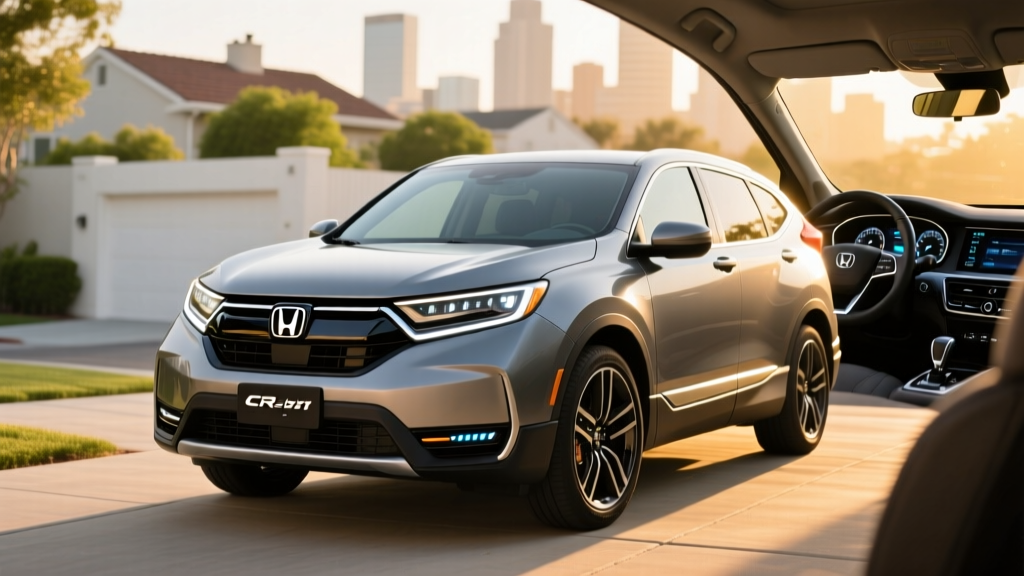
The 2026 Honda CR-V Hybrid Sport-L occupies a specific niche that an increasing number of compact SUV buyers are targeting: a vehicle that slashes fuel costs without requiring any change in daily habits. No plugs, no charging apps, no range calculations — just significantly better fuel economy than a conventional gas engine, paired with the cargo space and ride height families actually need. This guide breaks down the Sport-L trim's powertrain, real-world MPG behavior, battery longevity, and how it stacks up against PHEV and full-EV alternatives.
Quick Verdict: Who the CR-V Hybrid Sport-L Is For
The Sport-L sits in the upper-middle of the CR-V Hybrid lineup, adding leather-trimmed seats, a power moonroof, wireless Apple CarPlay and Android Auto, and a heated steering wheel over the base Sport trim. If you drive 12,000–15,000 miles per year in mixed city/highway conditions and lack access to home charging, this is one of the strongest hybrid SUVs available. If you have a garage outlet and a short commute, a PHEV or full EV may deliver deeper savings — more on that below.
Fuel Economy: EPA Ratings and Real-World MPG
The EPA rates the 2026 Honda CR-V Hybrid Sport-L (AWD) at 40 MPG city / 34 MPG highway / 37 MPG combined, according to fueleconomy.gov. Front-wheel-drive variants gain approximately 1 MPG across the board. These figures are competitive within the compact hybrid SUV segment, though the Toyota RAV4 Hybrid edges slightly ahead on the combined cycle.
| Driving Condition | EPA Estimate | Real-World Expectation |
|---|---|---|
| City (stop-and-go) | 40 MPG | 41–44 MPG (regen-heavy routes exceed EPA) |
| Highway (70–75 mph) | 34 MPG | 31–34 MPG (aero drag reduces hybrid advantage) |
| Combined mixed driving | 37 MPG | 36–40 MPG |
| Cold weather (below 32°F) | — | 30–34 MPG (engine runs more for cabin heat) |
Hybrids behave differently from gas cars across driving conditions. In city driving, the CR-V Hybrid's electric motor handles low-speed propulsion and regenerative braking recaptures energy at every stop — this is where the system shines and where real-world MPG often exceeds the EPA sticker. On sustained highway runs, the 1.5L turbocharged engine does most of the work, and the hybrid advantage narrows. In freezing weather, expect a 10–15% MPG drop because the engine must run continuously to provide cabin heat, reducing electric-motor usage.
Powertrain and Performance Specs
The CR-V Hybrid uses Honda's two-motor hybrid system paired with a 1.5-liter turbocharged four-cylinder engine. Unlike some competitors that use a traditional automatic transmission, Honda employs an e-CVT (electronic continuously variable transmission) that routes power through the electric motors for a direct, linear feel.
| Specification | 2026 CR-V Hybrid Sport-L |
|---|---|
| Combined System Horsepower | 204 HP |
| Combined System Torque | 247 lb-ft |
| Engine | 1.5L turbocharged 4-cylinder (Atkinson cycle) |
| Electric Motors | Dual-motor (one propulsion, one generation) |
| Transmission | e-CVT |
| Drivetrain | AWD standard (Sport-L) |
| 0–60 MPH | ~7.6 seconds |
| Towing Capacity | 1,000 lbs |
| Cargo Volume (rear seats up) | 36.3 cu ft |
| Cargo Volume (rear seats folded) | 76.5 cu ft |
The 247 lb-ft of torque arrives immediately from the electric motor, which gives the CR-V Hybrid a noticeably quicker off-the-line feel than its non-hybrid sibling. Merging onto highways and passing at mid-range speeds is confident. The e-CVT avoids the rubber-band sensation of older CVTs — Honda's system uses a lock-up clutch at highway speeds to create a direct mechanical connection, reducing drone.
HEV vs PHEV vs EV: Which Powertrain Fits Your Life?
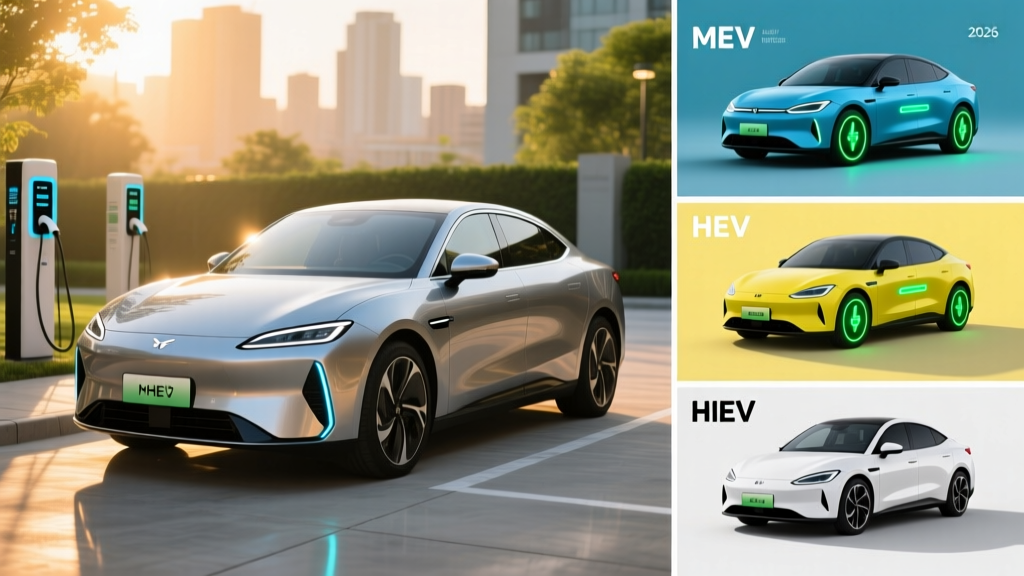
The CR-V Hybrid is a conventional hybrid (HEV). It generates its own electricity through regenerative braking and the gasoline engine — you never plug it in. Honda does not currently offer a plug-in hybrid (PHEV) version of the CR-V in the US market for 2026. Here's how the three electrified options compare for a typical buyer:
| Factor | HEV (CR-V Hybrid) | PHEV (e.g., Toyota RAV4 Prime) | Full EV (e.g., Tesla Model Y) |
|---|---|---|---|
| Plug in required? | No | Yes (for EV-mode benefit) | Yes |
| Electric-only range | None (EV assist only) | 35–42 miles typical | 280–330 miles |
| Fuel cost per mile | ~$0.10–$0.12 | ~$0.04–$0.06 (EV mode) / ~$0.11 (gas) | ~$0.03–$0.05 |
| Home charging needed? | No | Recommended (120V works, 240V ideal) | Yes (240V strongly recommended) |
| Federal tax credit | None | Up to $7,500 (eligibility varies) | Up to $7,500 (eligibility varies) |
| Upfront price premium | +$1,000–$1,500 vs gas | +$4,000–$7,000 vs gas | +$5,000–$15,000 vs gas |
| Best for | No charging access, mixed driving | Short commute + home charging + road trips | Home charging, daily driving under 300 mi |
Choose the CR-V Hybrid (HEV) if: You don't have reliable access to a plug (apartment, street parking), you want fuel savings with zero behavior change, or you regularly drive in extreme cold where EV range loss is a concern.
Choose a PHEV if: You have a garage or driveway with a 120V or 240V outlet, your daily commute is under 40 miles round-trip, and you still want gas-engine flexibility for long road trips.
Choose a full EV if: You can install a Level 2 charger at home, your daily driving is predictable, and you want the lowest per-mile operating cost and zero tailpipe emissions.
Pricing, Trims, and Tax Credit Eligibility
The 2026 Honda CR-V Hybrid Sport-L carries an MSRP of approximately $39,695 (including destination charge). This positions it roughly $1,500 above the non-hybrid Sport-L equivalent and about $2,800 above the base CR-V Hybrid Sport.
| CR-V Hybrid Trim | Approximate MSRP | Key Additions Over Sport |
|---|---|---|
| Sport | $36,895 | Base hybrid, cloth seats, heated front seats |
| Sport-L | $39,695 | Leather-trimmed seats, power moonroof, wireless CarPlay/Android Auto, heated steering wheel |
| Sport Touring | $43,195 | Bose audio, navigation, wireless phone charger, hands-free power tailgate |
Federal Tax Credit Status
The conventional CR-V Hybrid does not qualify for the federal §30D clean vehicle tax credit. Under current IRS rules, the §30D credit is reserved for plug-in electric vehicles (BEVs and PHEVs) with sufficient battery capacity. Conventional HEVs like the CR-V Hybrid, which cannot be plugged in, are excluded regardless of their fuel economy.
Some states offer their own incentives for hybrid vehicles — these vary significantly by jurisdiction and change frequently. Check your state's energy or environmental agency website for current programs. A tax professional can confirm eligibility for any local credits or rebates.
Battery Warranty, Reliability, and Replacement Cost
Hybrid battery longevity is consistently one of the top concerns for first-time hybrid buyers. The data here is reassuring: Honda's hybrid systems have a strong track record, and modern lithium-ion hybrid batteries are engineered for the life of the vehicle.
| Coverage Item | Term |
|---|---|
| Hybrid Battery (capacity & defects) | 8 years / 100,000 miles (10 years / 150,000 miles in CARB states) |
| Hybrid System Components (inverter, motor) | 8 years / 100,000 miles |
| Powertrain (engine, transmission) | 5 years / 60,000 miles |
| New Vehicle Limited Warranty | 3 years / 36,000 miles |
Honda's hybrid battery warranty covers defects and abnormal capacity loss. In practice, the CR-V Hybrid's battery is relatively small (approximately 1.1 kWh usable) compared to a full EV's 75–100 kWh pack, meaning each individual cell undergoes shallower charge/discharge cycles — a key factor in longevity. Real-world data from earlier-generation Honda hybrids (Insight, Accord Hybrid) shows batteries routinely lasting 150,000+ miles before any notable capacity degradation.
What Does Hybrid Battery Replacement Cost?
If a hybrid battery fails outside warranty, replacement costs for a Honda CR-V Hybrid typically range from $2,000 to $3,500 including parts and labor at a dealership. Independent hybrid specialists may offer refurbished battery packs for $1,200–$2,000. Given the shallow cycling of HEV batteries and the 8–10 year warranty coverage, most owners will never face this expense. According to IIHS, the CR-V continues to earn strong safety ratings, which supports long-term ownership confidence.
Real-World Ownership: What It's Like to Live With
After extended mixed driving — suburban commutes, highway road trips, and cold-weather errands — the CR-V Hybrid Sport-L reveals both strengths and minor compromises.
Where it excels: City and suburban fuel economy is genuinely impressive. On routes with frequent stops, the hybrid system's regenerative braking recaptures energy continuously, and the electric motor provides smooth, silent acceleration from stoplights. The AWD system engages the rear axle via the electric motor (no mechanical driveshaft), which improves traction without adding significant weight or parasitic loss. Cabin noise is well-managed, and the Sport-L's leather and moonroof give the interior an upscale feel for the price point.
Honest limitations: Highway fuel economy drops noticeably above 75 mph — aerodynamic drag is the enemy of all SUVs, and the hybrid system offers less benefit at sustained high speeds. Towing capacity is limited to 1,000 lbs, which rules out even small utility trailers (the non-hybrid CR-V with the turbo engine tows up to 1,500 lbs). The e-CVT, while improved, still produces a slight drone under hard acceleration — it's better than older CVTs but not as refined as a geared automatic.
Pros
- 40 MPG city EPA; real-world city often exceeds 41 MPG
- No plug-in required — zero behavior change from gas cars
- 204 HP with instant electric torque feels quicker than specs suggest
- Strong 8-year/100,000-mile hybrid battery warranty (10 years in CARB states)
- 36.3 cu ft cargo with seats up — class-competitive
- Sport-L leather and moonroof at under $40K MSRP
Cons
- Highway MPG drops to low 30s above 75 mph
- 1,000-lb towing limit — below non-hybrid CR-V
- No federal tax credit (HEV exclusion)
- Small navigation battery (~1.1 kWh) means no electric-only driving mode
- e-CVT drone under full-throttle acceleration
Frequently Asked Questions
How many MPG does the 2026 Honda CR-V Hybrid Sport-L get?
The EPA rates it at 40 MPG city, 34 MPG highway, and 37 MPG combined (AWD). In real-world mixed driving, expect 36–40 MPG. City-heavy routes with frequent stops often yield 41–44 MPG because regenerative braking recaptures energy that a gas car wastes as heat.
Does the CR-V Hybrid need to be plugged in?
No. The CR-V Hybrid is a conventional hybrid (HEV). It charges its own small battery through regenerative braking and the gasoline engine. You fuel it exclusively at gas stations, exactly like a conventional car.
Does the 2026 CR-V Hybrid qualify for any federal tax credit?
No. The federal §30D clean vehicle credit applies only to plug-in vehicles (BEVs and PHEVs). Conventional hybrids like the CR-V Hybrid are not eligible. Check with your state energy office for any local hybrid incentives, and consult a tax professional for personal eligibility on any credits.
How long will the CR-V Hybrid battery last?
Honda warranties the hybrid battery for 8 years/100,000 miles (10 years/150,000 miles in CARB states including California, New York, Massachusetts, and others). In practice, Honda's hybrid batteries use shallow charge cycles that minimize degradation. Most last well beyond the warranty period — 150,000+ miles without significant capacity loss is common based on historical data from Honda's hybrid fleet.
What does a CR-V Hybrid battery replacement cost?
Out-of-warranty replacement typically costs $2,000–$3,500 at a Honda dealer. Refurbished packs from independent hybrid specialists can reduce this to $1,200–$2,000. Given the warranty coverage and the battery's design for shallow cycling, most owners will never need a replacement.
Is the CR-V Hybrid Sport-L better than the gas CR-V?
For most buyers, yes. The hybrid delivers roughly 10–12 MPG better combined fuel economy, provides more low-end torque (247 lb-ft vs 179 lb-ft on the gas turbo), and costs only about $1,500 more upfront. At 12,000 miles per year and $3.40/gallon fuel, the hybrid saves approximately $400–$500 annually in fuel, paying back the premium in 3–4 years. If you plan to keep the vehicle 5+ years, the math strongly favors the hybrid.
Hybrid vs PHEV vs EV — which should I choose?
If you can't charge at home (apartment living, street parking), the CR-V Hybrid is the best choice — it requires zero infrastructure. If you have a garage outlet and a short commute, a PHEV like the Toyota RAV4 Prime offers 42 miles of electric-only driving for daily errands plus a gas engine for road trips. If you have Level 2 home charging and want the lowest operating cost, a full EV like the Tesla Model Y or Hyundai Ioniq 5 eliminates gasoline entirely. The right choice depends on your charging access and driving patterns, not just the sticker price.