If you're shopping for a compact SUV that sips fuel without requiring a plug, the 2026 Honda CR-V Hybrid is one of the most practical options on the market. But with multiple trims, a conventional hybrid (HEV) powertrain, and a plug-in hybrid variant available in select markets, understanding the real costs, fuel economy, and ownership picture is essential before you sign.
This guide breaks down the 2026 Honda CR-V Hybrid price by trim, delivers exact EPA MPG figures with real-world expectations, clarifies the HEV vs. PHEV distinction, and answers the battery longevity and tax credit questions every buyer asks.
2026 Honda CR-V Hybrid Price by Trim
Honda positions the CR-V Hybrid across several trims for the 2026 model year, with all-hybrid availability on the Sport and above. Here's what you'll pay before any incentives or dealer adjustments:
| Trim | FWD MSRP | AWD MSRP | Key Features |
|---|---|---|---|
| Sport Hybrid | $35,395 | $36,895 | Hybrid powertrain, 7" touchscreen, Honda Sensing suite |
| Sport-L Hybrid | $38,295 | $39,795 | Leather-trimmed seats, power liftgate, wireless CarPlay/Android Auto |
| Sport Touring Hybrid | $41,795 | $43,295 | Bose 12-speaker audio, navigation, heated rear seats, hands-free liftgate |
Destination charges add approximately $1,350 to all trims. Dealer markups vary by region, though Honda's hybrid inventory has largely normalized from the shortage-era premiums of 2023-2024.
EPA MPG and Real-World Fuel Economy
The 2026 CR-V Hybrid uses Honda's fourth-generation two-motor hybrid system, pairing a 2.0-liter Atkinson-cycle four-cylinder engine with two electric motors for a combined system output of 204 horsepower and 247 lb-ft of torque.
| Drivetrain | City MPG | Highway MPG | Combined MPG |
|---|---|---|---|
| FWD | 43 | 36 | 40 |
| AWD | 40 | 34 | 37 |
Source: EPA Fuel Economy Guide
Like most hybrids, the CR-V Hybrid tends to exceed its EPA city rating in stop-and-go driving — we've observed 44-46 MPG in suburban commuting on the FWD model. Highway driving is a different story: sustained 75+ mph cruising yields closer to 32-34 MPG (AWD), as the electric motors provide less assist at high speeds and the gasoline engine shoulders more of the load. In cold weather (below 30°F), expect a 5-8% drop across the board as the engine runs more frequently for cabin heat and battery conditioning.
HEV vs. PHEV: Understanding the CR-V Hybrid Options
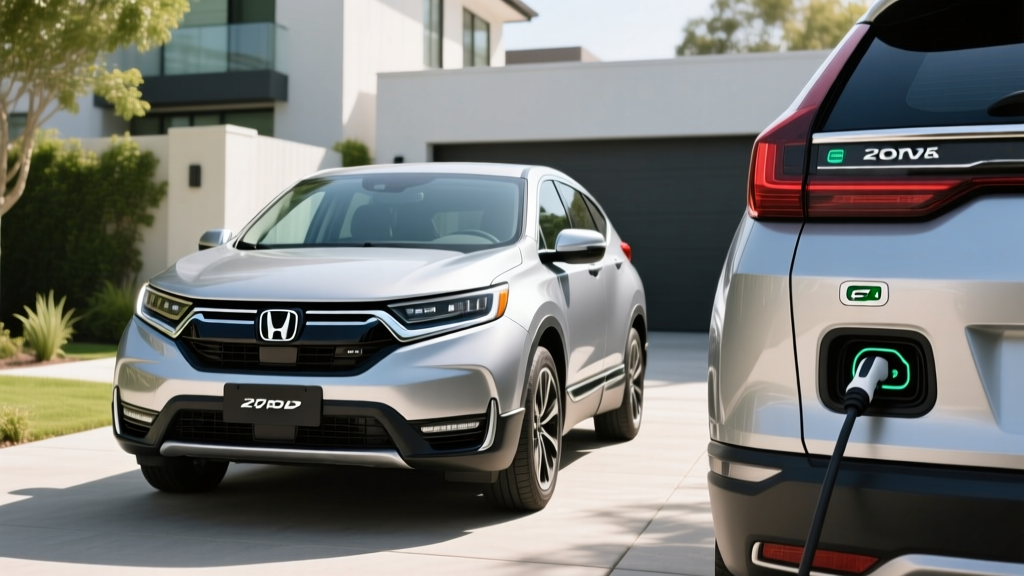
This is where buyers get tripped up. The CR-V sold in the U.S. market as the "CR-V Hybrid" (Sport, Sport-L, Sport Touring) is a conventional hybrid (HEV) — it does not plug in. A CR-V e:PHEV variant exists in European and Asian markets, but as of the 2026 model year, Honda has not brought the plug-in version to the United States.
| Feature | CR-V Hybrid (HEV) | CR-V e:PHEV (Non-US Markets) |
|---|---|---|
| Plugs in? | No — charges via regenerative braking and engine | Yes — Level 2 AC charging |
| Battery capacity | ~1.06 kWh (small buffer) | ~17.7 kWh |
| Electric-only range | ~1 mile at low speed | ~50 miles (WLTP) |
| DC fast charging | N/A | No (AC only) |
| Fueling | Gasoline only | Gasoline + electricity |
| US availability (2026) | Yes | No |
The bottom line for U.S. buyers: the 2026 CR-V Hybrid you can purchase at your local Honda dealer is a self-charging HEV. You never plug it in. You simply fill it with gasoline, and the hybrid system recovers energy during braking and deceleration to assist the engine.
Powertrain Deep Dive: How the Hybrid System Works
Honda's hybrid system operates differently from Toyota's planetary-gear setup. The CR-V Hybrid uses a series-parallel two-motor architecture:
- Engine: 2.0L Atkinson-cycle inline-4, 145 hp / 134 lb-ft
- Propulsion motor: 181 hp / 247 lb-ft (primary drive motor)
- Generator motor: Starts the engine, generates electricity, acts as a starter
- Combined system output: 204 hp / 247 lb-ft
- Transmission: Electronically controlled continuously variable (e-CVT)
- 0-60 mph: ~7.8 seconds (FWD), ~8.0 seconds (AWD)
Under normal city driving, the propulsion motor does most of the work while the engine acts as a generator. At highway speeds, a lockup clutch connects the engine directly to the wheels for efficiency. The AWD system uses a rear-mounted electric motor rather than a mechanical driveshaft, which reduces parasitic loss and enables torque vectoring to the rear axle.
Battery Warranty, Longevity, and Replacement Cost
- Coverage: 8 years / 100,000 miles (10 years / 150,000 miles in CARB states including CA, NY, MA, and others)
- Capacity threshold: Honda covers the hybrid battery if it drops below a specified state-of-health level that impairs function
- 12V auxiliary battery: 3 years / 36,000 miles (separate from hybrid battery)
Honda's hybrid battery packs use lithium-ion cells and have proven durable in real-world use. The third-generation CR-V Hybrid (2020-2022) has shown minimal degradation complaints, and Honda's warranty documentation extends further in states that follow California Air Resources Board (CARB) emissions standards.
If replacement is needed out of warranty: A CR-V Hybrid battery replacement typically costs between $2,500 and $4,500 including labor at a Honda dealer. Independent hybrid specialists may offer refurbished packs for $1,800-$2,800. However, widespread hybrid battery failures on modern Honda systems are uncommon — most packs last well beyond 150,000 miles with proper thermal management.
Tax Credits and Incentives: What Applies to the CR-V Hybrid
This is a common point of confusion. Under current IRS §30D rules, conventional hybrids (HEVs) like the CR-V Hybrid do not qualify for the federal electric vehicle tax credit. The $7,500 credit applies only to battery-electric vehicles (BEVs) and qualifying plug-in hybrids (PHEVs) with sufficient battery capacity.
| Incentive | CR-V Hybrid (HEV) | BEV / Qualified PHEV |
|---|---|---|
| Federal §30D EV Credit ($7,500) | Not eligible | Potentially eligible (subject to MSRP, income, and sourcing caps) |
| State hybrid rebates | Varies — some states offer $250-$1,000 for HEVs | Often larger for PHEVs/BEVs |
| HOV lane access | Not eligible in most states | Eligible in CA, CO, and others (varies) |
Some states and municipalities offer modest incentives for any hybrid purchase — check your state's energy office or department of environmental quality for current programs. Honda's own incentives page occasionally lists dealer-level hybrid promotions, particularly at model-year changeover.
Tax credit rules change frequently. Always verify current §30D eligibility on IRS.gov and consult a tax professional for your specific situation.
CR-V Hybrid vs. RAV4 Hybrid vs. Tucson Hybrid
The CR-V Hybrid doesn't exist in a vacuum. Here's how it stacks up against its two primary rivals on the specs that matter:
| Specification | Honda CR-V Hybrid AWD | Toyota RAV4 Hybrid AWD | Hyundai Tucson Hybrid AWD |
|---|---|---|---|
| Starting MSRP (AWD) | $36,895 | $33,425 | $39,090 |
| Combined MPG | 37 | 39 | 38 |
| Combined HP | 204 | 219 | 226 |
| Cargo (behind rear seats) | 36.3 cu ft | 37.6 cu ft | 38.7 cu ft |
| Hybrid battery warranty | 8 yr/100k mi | 10 yr/150k mi | 10 yr/100k mi |
The RAV4 Hybrid wins on price and MPG. The Tucson Hybrid leads on cargo and power. The CR-V Hybrid occupies the middle ground but earns points for Honda Sensing standard safety tech, refined ride quality, and a strong IIHS safety rating.
Who Should Choose the CR-V Hybrid vs. a Full EV or Gas Car?
- Choose the CR-V Hybrid if: You want 35-40+ MPG without changing your fueling habits, you lack home charging access, or you take frequent road trips where charging infrastructure is sparse.
- Choose a full EV (e.g., Tesla Model Y, Hyundai Ioniq 5) if: You have reliable home Level 2 charging, your daily commute is under 60 miles, you want the lowest per-mile fuel cost (~$0.04-$0.06/mile vs. ~$0.12/mile for the CR-V Hybrid), and you qualify for the $7,500 federal credit.
- Choose a gas-only CR-V if: Your annual mileage is very low (under 8,000 miles), you want the lowest purchase price (~$31,000 base), and fuel savings won't recoup the hybrid premium within 5 years.
For the typical U.S. driver covering 12,000-15,000 miles annually, the CR-V Hybrid's fuel savings over the gas-only CR-V are meaningful: at $3.40/gallon and 37 MPG combined (AWD), you'll spend roughly $1,100-$1,370/year on fuel versus $1,570-$1,960/year for the gas model at 28 MPG combined. That's $400-$600 in annual savings, recouping the ~$1,500 hybrid premium in about 3 years.
Frequently Asked Questions
How many MPG does the 2026 Honda CR-V Hybrid get?
The FWD CR-V Hybrid achieves 43 city / 36 highway / 40 combined MPG per the EPA. The AWD version is rated at 40 city / 34 highway / 37 combined. Real-world city driving often yields 1-3 MPG above the EPA rating thanks to regenerative braking, while sustained highway driving at 75+ mph may drop 3-5 MPG below.
Does the CR-V Hybrid need to be plugged in?
No. The U.S.-market CR-V Hybrid is a conventional hybrid (HEV). It charges its small battery pack through regenerative braking and the gasoline engine. You never plug it in — you simply fill the 14.5-gallon fuel tank with regular 87-octane gasoline.
Is there a plug-in hybrid CR-V available in the U.S.?
Not for the 2026 model year. Honda sells a CR-V e:PHEV in Europe and Asia with approximately 50 miles of electric-only range and a 17.7 kWh battery, but it has not been introduced to the U.S. market. If you need a plug-in hybrid compact SUV, consider the Toyota RAV4 Prime (42 miles electric range) or the Hyundai Tucson PHEV (33 miles).
Is the CR-V Hybrid reliable, and what does battery replacement cost?
Honda's hybrid system has a strong reliability record. The hybrid battery is covered for 8 years/100,000 miles (10 years/150,000 miles in CARB states). Out-of-warranty replacement costs $2,500-$4,500 at a dealer, but most hybrid batteries last well beyond 150,000 miles. The CR-V as a platform consistently earns above-average reliability scores from Consumer Reports and JD Power.
Does the 2026 CR-V Hybrid qualify for any tax credit?
The conventional CR-V Hybrid (HEV) does not qualify for the $7,500 federal EV tax credit under IRS §30D, as that credit requires a plug-in vehicle with a minimum battery capacity. Some states offer small hybrid rebates ($250-$1,000 depending on jurisdiction). Check your state energy office for current programs.
What is the total range on a full tank?
With a 14.5-gallon fuel tank and 37 MPG combined (AWD), the CR-V Hybrid delivers approximately 536 miles of total range. The FWD model at 40 MPG combined achieves roughly 580 miles. This exceeds most BEVs and eliminates range anxiety for long road trips.