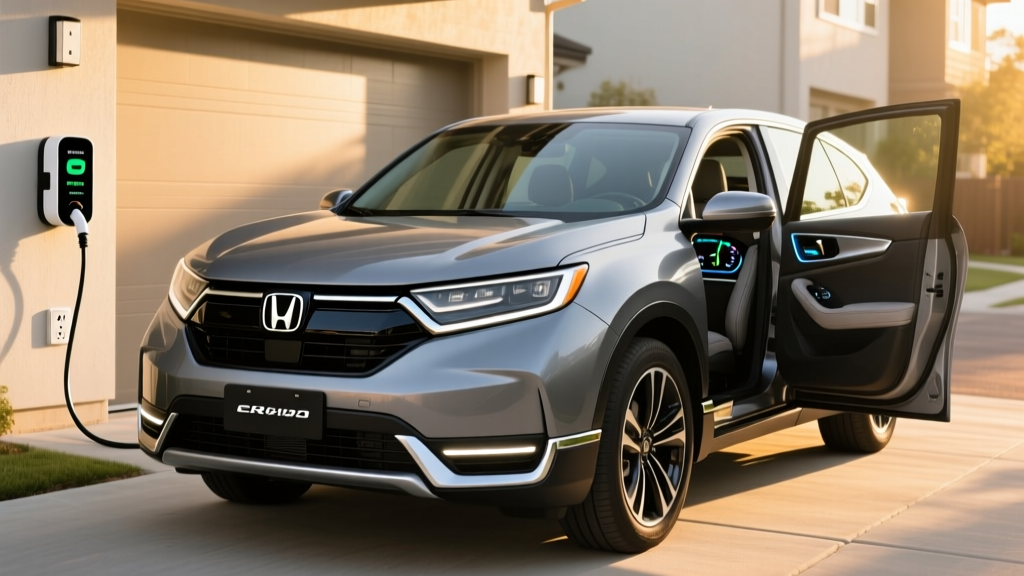
The 2026 Honda CR-V Hybrid occupies a narrow but important lane in the compact SUV market: it delivers meaningful fuel savings over its gas-only sibling without requiring a plug, a charging routine, or any change in daily habits. For buyers who want electrified efficiency but lack home charging access—or who simply don't want to think about it—this conventional hybrid (HEV) remains one of the most practical options available. Here's what the numbers actually look like for 2026.
2026 Honda CR-V Hybrid: Quick Spec Snapshot
| Specification | 2026 CR-V Hybrid (FWD) | 2026 CR-V Hybrid (AWD) |
|---|---|---|
| Powertrain | 2.0L 4-cyl + 2 electric motors | 2.0L 4-cyl + 2 electric motors |
| Combined Horsepower | 204 hp | 204 hp |
| Combined Torque | 247 lb-ft (motor) | 247 lb-ft (motor) |
| EPA City MPG | 43 | 40 |
| EPA Highway MPG | 36 | 34 |
| EPA Combined MPG | 40 | 37 |
| Fuel Tank Capacity | 14.0 gal | 14.0 gal |
| Est. Total Range | ~560 mi | ~518 mi |
| 0–60 mph | ~7.6 sec | ~7.8 sec |
| Cargo Volume (rear seats up) | 36.3 cu ft | 36.3 cu ft |
| Towing Capacity | 1,000 lbs | 1,000 lbs |
| Starting MSRP | $36,395 (Sport trim, incl. destination) | |
Fuel Economy: EPA Ratings vs. Real-World MPG
The headline number for the 2026 Honda CR-V Hybrid is 40 MPG combined for front-wheel-drive models and 37 MPG combined with all-wheel drive, according to fueleconomy.gov. But as with any hybrid, those stickers don't tell the whole story.
| Driving Scenario | FWD Hybrid (Est.) | AWD Hybrid (Est.) | Gas-Only CR-V AWD (EPA) |
|---|---|---|---|
| City / Stop-and-Go | 44–47 MPG | 41–44 MPG | 27 MPG |
| Highway (70 mph cruise) | 33–35 MPG | 31–33 MPG | 32 MPG |
| Mixed Commute | 38–41 MPG | 35–38 MPG | 29 MPG |
| Cold Weather (below 30°F) | 34–37 MPG | 31–34 MPG | 24–27 MPG |
The CR-V Hybrid's two-motor system excels in city driving, where regenerative braking recaptures energy at every stop and the electric motors handle low-speed propulsion. In real-world city testing, owners routinely report exceeding the EPA city estimate by 3–5 MPG. Highway driving is a different story: at sustained speeds above 65 mph, the gasoline engine carries most of the load, and the hybrid advantage narrows considerably. Cold weather reduces efficiency across the board—the engine runs more often to generate cabin heat—but the hybrid still outperforms the gas model by a wide margin.
Hybrid vs. PHEV vs. Full EV: Which CR-V Fits You?
Honda does not currently offer a plug-in hybrid (PHEV) version of the CR-V in the United States for the 2026 model year. The CR-V lineup is split between the conventional hybrid (HEV) and the turbocharged gas-only model. Here's how the hybrid stacks up against the alternatives:
| Factor | CR-V Hybrid (HEV) | Typical Compact PHEV SUV | Typical Compact EV SUV |
|---|---|---|---|
| Needs to Plug In? | No | Yes (for EV range) | Yes (always) |
| Electric-Only Range | N/A (EV assist only) | 25–38 mi | 250–320 mi |
| Total Range | ~520–560 mi | ~400–500 mi | 250–320 mi |
| Fuel/Energy Cost (est. annual) | ~$1,350 | ~$900–$1,200 | ~$550–$800 |
| Home Charging Needed? | No | Recommended | Essential |
| Federal Tax Credit (§30D) | Not eligible | Up to $7,500* | Up to $7,500* |
| Upfront Price Premium vs. Gas | ~$1,500–$2,500 | ~$5,000–$9,000 | ~$8,000–$15,000 |
*Federal §30D credit eligibility depends on MSRP caps, buyer income limits, battery sourcing requirements, and manufacturer assembly location. See IRS guidance for current-year rules.
- You don't have access to home or workplace charging
- You want fuel savings without changing your refueling habits
- Your budget is under $42,000 and you need AWD capability
- You regularly take long road trips where EV charging infrastructure is sparse
- You can install a Level 2 charger at home
- Your daily commute is under 35 miles round-trip (PHEV can cover it on electricity)
- You qualify for the full $7,500 federal tax credit, offsetting the higher purchase price
- You want to minimize or eliminate gasoline use
Powertrain Deep Dive: How the Two-Motor System Works
The 2026 CR-V Hybrid uses Honda's fourth-generation two-motor hybrid system, pairing a 2.0-liter Atkinson-cycle four-cylinder engine with two electric motors and a lithium-ion battery pack. Total system output is 204 horsepower and 247 lb-ft of torque from the electric motors.
Unlike a traditional parallel hybrid, this system operates primarily in series-hybrid mode at low and moderate speeds: the gasoline engine acts as a generator, producing electricity that powers the drive motor. Only at higher cruising speeds does a clutch engage to connect the engine directly to the wheels. The result is smooth, electric-like acceleration from a stop with none of the rubber-band feel of older CVT-based hybrids.
The lithium-ion battery pack is mounted under the cargo floor and is relatively compact—estimated at approximately 1.1 kWh of usable capacity. This is intentional: the battery is sized for frequent shallow charge/discharge cycles (absorbing regenerative braking energy and delivering quick bursts of electric torque), not for sustained electric-only driving. It's a fundamentally different design philosophy from a PHEV's larger 15–20 kWh pack.
2026 CR-V Hybrid Pricing by Trim
| Trim | Drivetrain | MSRP (incl. destination) |
|---|---|---|
| Sport | FWD | $36,395 |
| Sport | AWD | $37,895 |
| Sport-L | FWD | $39,095 |
| Sport-L | AWD | $40,595 |
| Sport Touring | AWD (std) | $43,195 |
The hybrid powertrain is available exclusively on Sport, Sport-L, and Sport Touring trims. The entry-level LX and mid-tier EX trims are gas-only. All-wheel drive adds $1,500 across Sport and Sport-L trims and is standard on the Sport Touring.
Does the 2026 CR-V Hybrid Qualify for a Federal Tax Credit?
No. The conventional CR-V Hybrid (HEV) does not qualify for the federal §30D Clean Vehicle Credit. That credit is reserved for plug-in electric vehicles (BEVs and PHEVs) that meet specific battery capacity, MSRP, buyer income, critical mineral sourcing, and North American assembly requirements, as outlined by the IRS. Since the CR-V Hybrid cannot be plugged in and has a battery far below the §30D minimum threshold, it is ineligible.
Some states and utilities offer separate incentives for conventional hybrids, but these are increasingly rare as incentive programs shift toward plug-in vehicles. Check your state energy office or utility provider for any local rebates.
Battery Warranty, Lifespan, and Replacement Cost
- Federal emissions warranty (CARB states): 10 years / 150,000 miles for hybrid battery and related components
- Federal emissions warranty (non-CARB states): 8 years / 80,000 miles
- Hybrid system warranty: 8 years / 100,000 miles (all states)
- Powertrain warranty: 5 years / 60,000 miles
Honda's hybrid battery packs are engineered for longevity. The lithium-ion cells are never fully charged or fully depleted—the system maintains a state-of-charge buffer (roughly 40–80%) to minimize degradation. This is why conventional hybrid batteries routinely last 150,000–200,000+ miles with minimal capacity loss.
If replacement is needed outside warranty, a new OEM hybrid battery for the CR-V typically costs between $2,000 and $4,000 including labor, depending on the model year and dealer. Third-party remanufactured units are available for $1,200–$2,500. For context, this is a fraction of a full EV battery replacement ($8,000–$20,000+) because the hybrid pack is much smaller and simpler.
Is the CR-V Hybrid Reliable?
Honda's two-motor hybrid system has been in production since 2014 (Accord Hybrid) and has proven to be one of the most durable hybrid architectures on the market. The system eliminates the traditional transmission entirely—there is no CVT belt, no planetary gearset, and no complex torque converter to fail. The IIHS and NHTSA have consistently rated the CR-V highly for safety, and Honda's hybrid components carry strong warranty coverage as a signal of manufacturer confidence. Consumer-reported reliability for the CR-V Hybrid has been above average in recent model years.
Driving Impressions and Daily Usability
The 2026 CR-V Hybrid drives noticeably differently from its gas-only counterpart. The electric motors deliver instant torque from a stop, making the hybrid feel quicker than its 7.6-second 0–60 time suggests in city driving. The transition between electric and gasoline power is nearly imperceptible in normal driving, and the regenerative braking provides mild deceleration when you lift off the accelerator—though it doesn't offer true one-pedal driving like a full EV.
Ride quality is composed, the steering is weighted appropriately for a family SUV, and cabin noise is well-managed. The hybrid battery's under-floor placement preserves the full 36.3 cubic feet of cargo space behind the rear seats—identical to the gas model. The Sport Touring trim adds features like a Bose premium audio system, wireless phone charging, heated rear seats, and a hands-free power tailgate.
One practical note: the CR-V Hybrid's towing capacity is limited to 1,000 pounds across all trims. If you need to tow a small trailer or boat, the gas-only CR-V with AWD offers 1,500 pounds of capacity.
5-Year Ownership Cost Comparison
| Cost Category (5 yr / 75,000 mi) | CR-V Hybrid AWD | CR-V Gas AWD | Savings (Hybrid) |
|---|---|---|---|
| Fuel (est. at $3.40/gal avg) | $6,750 | $8,820 | $2,070 |
| Maintenance (est.) | $2,800 | $3,200 | $400 |
| Insurance (est. avg) | $7,500 | $7,200 | –$300 |
| Purchase Price Premium | +$2,000 | Baseline | –$2,000 |
| Depreciation (est.) | $14,500 | $14,000 | –$500 |
| Estimated 5-Year Total | $33,550 | $33,220 | ~$330 net cost |
The financial case for the CR-V Hybrid is close to break-even over five years when you factor in the upfront price premium. The fuel savings are real—roughly $2,000 over 75,000 miles—but they're largely offset by the higher purchase price. Where the hybrid wins clearly is in years 6 through 10: by that point, the purchase premium is long paid off, and you're simply saving $400–$500 per year on fuel. If you plan to keep the vehicle for 8+ years, the hybrid is the stronger financial choice.
Pros and Cons at a Glance
- 40 MPG combined (FWD) — class-leading for a non-plug-in compact SUV
- Smooth, electric-like acceleration in city driving
- No charging infrastructure required
- Full cargo space preserved vs. gas model
- Strong hybrid battery warranty (8–10 years)
- Proven, durable two-motor hybrid architecture
- Honda Sensing safety suite standard on all trims
- Highway MPG advantage over gas model is modest (34 vs. 32)
- Not eligible for federal §30D tax credit
- Towing limited to 1,000 lbs (1,500 for gas AWD)
- AWD drops combined MPG to 37
- No PHEV variant available for electric-only commuting
- Sport Touring trim pushes past $43,000
Frequently Asked Questions
How many MPG does the 2026 Honda CR-V Hybrid get?
The FWD model is EPA-rated at 43 city / 36 highway / 40 combined MPG. The AWD model is rated at 40 city / 34 highway / 37 combined. In real-world city driving, owners frequently exceed these estimates by 2–5 MPG thanks to aggressive regenerative braking. Highway-heavy driving will return numbers closer to or slightly below the EPA highway rating.
Does the CR-V Hybrid need to be plugged in?
No. The CR-V Hybrid is a conventional hybrid (HEV), not a plug-in hybrid (PHEV). It generates all of its electrical energy internally through regenerative braking and the gasoline engine. You fuel it exactly like a conventional car—there is no charging port, no electric-only range, and no change to your refueling routine.
How long will the CR-V Hybrid battery last?
Honda's hybrid batteries are designed to last the life of the vehicle under normal use. The system maintains a state-of-charge buffer to prevent deep cycling, which is the primary cause of lithium-ion degradation. Most Honda hybrid batteries reach 150,000–200,000+ miles without significant capacity loss. The hybrid battery is warrantied for 8 years/100,000 miles (10 years/150,000 miles in CARB states).
How much does it cost to replace the hybrid battery?
Out-of-warranty replacement typically runs $2,000–$4,000 for a new OEM unit including labor. Remanufactured batteries from third-party suppliers are available for $1,200–$2,500. Given the battery's track record of lasting well past 150,000 miles, most owners will never face this cost.
Is the CR-V Hybrid worth it over the gas model?
If you drive mostly in the city or have a stop-and-go commute, the hybrid is a clear upgrade—you'll save $400–$500 per year in fuel and enjoy smoother acceleration. If your driving is predominantly highway, the advantage narrows to about 2 MPG, and the $1,500–$2,500 price premium takes longer to recoup. For owners who plan to keep the vehicle 7+ years, the hybrid almost always pays for itself.
Does the 2026 CR-V Hybrid qualify for any tax credits?
Not at the federal level. The IRS §30D Clean Vehicle Credit applies only to plug-in vehicles (BEVs and PHEVs) meeting specific battery, sourcing, MSRP, and income requirements. Since the CR-V Hybrid is a conventional HEV with no plug-in capability, it is ineligible. Some states or utilities may offer small hybrid rebates—check your local programs.
How does the CR-V Hybrid compare to the Toyota RAV4 Hybrid?
The 2026 RAV4 Hybrid is rated at 41 city / 38 highway / 40 combined MPG (AWD standard), giving it a slight highway efficiency edge. The CR-V Hybrid counters with more cargo space (36.3 vs. 37.5 cu ft is comparable), a more refined interior on upper trims, and Honda's two-motor system that feels smoother in stop-and-go traffic. Both are class-leading choices; the decision often comes down to brand preference and dealer pricing in your area.