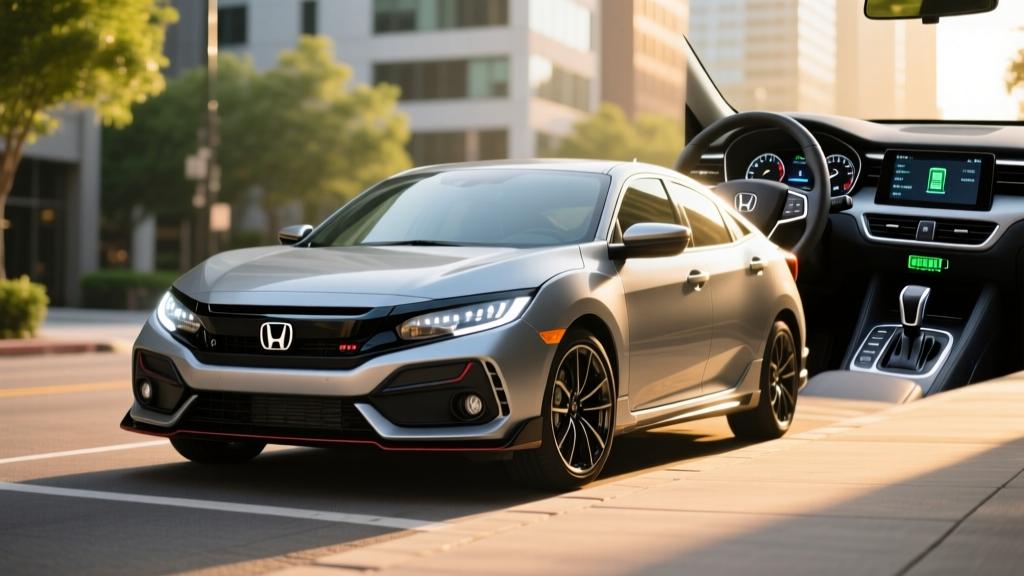
The 2026 Honda Civic Sport Hybrid sits in a sweet spot that full electric vehicles still can't reach for many buyers: genuine fuel savings without plugging in, without range anxiety, and without paying a $45,000+ starting price. With a 200-horsepower dual-motor hybrid powertrain and an EPA-estimated 49 MPG combined, the Civic Sport Hybrid is one of the most efficient compact sedans on the market — and one of the quickest in its class.
This guide breaks down the exact numbers that matter: real-world MPG versus the EPA sticker, the hybrid battery warranty and replacement cost, powertrain specifications, pricing across trims, and whether any federal tax credits apply. If you're cross-shopping this against a PHEV or a full BEV, we'll clarify which powertrain actually fits your daily driving.
HEV vs PHEV: The 2026 Civic Sport Hybrid Is a Conventional Hybrid
Before getting into specs, it's critical to establish what the Civic Sport Hybrid is — and isn't. This is a conventional hybrid electric vehicle (HEV), not a plug-in hybrid (PHEV). You never plug it in. The 1.1 kWh lithium-ion battery pack charges exclusively through regenerative braking and the gasoline engine. There is no electric-only driving range to speak of (the motor assists at low speeds but cannot propel the car alone for meaningful distances).
| Feature | HEV (Civic Sport Hybrid) | PHEV (e.g., Toyota Prius Prime) | BEV (e.g., Tesla Model 3) |
|---|---|---|---|
| Plug in to charge? | No | Yes | Yes |
| Battery capacity | ~1.1 kWh | ~13.6 kWh | 57–82 kWh |
| Electric-only range | Not applicable | ~44 miles | 272–363 miles |
| Total range | ~530 miles | ~600+ miles | 272–363 miles |
| Federal tax credit (§30D) | Not eligible | Up to $7,500* | Up to $7,500* |
| Home charging install | None needed | Level 2 recommended | Level 2 required |
| Starting price range | ~$30,000 | ~$33,000–$40,000 | ~$39,000+ |
*§30D credit eligibility depends on MSRP caps, buyer income limits, and battery sourcing requirements. See IRS.gov for current rules.
If you were searching for a Civic plug-in hybrid, Honda does not offer one for the 2026 model year. The Civic lineup includes the conventional hybrid (available in Sport and Sport Touring trims) and the standard 2.0L gasoline models. Honda's PHEV offerings in the US are limited — the Clarity Plug-In Hybrid was discontinued after 2021.
Fuel Economy: EPA Ratings and Real-World MPG
The 2026 Honda Civic Sport Hybrid carries forward the powertrain introduced with the 11th-generation refresh, and the EPA numbers remain among the best in the compact segment. Here are the official figures:
| Driving Cycle | MPG |
|---|---|
| City | 50 MPG |
| Highway | 47 MPG |
| Combined | 49 MPG |
Source: fueleconomy.gov
How Many MPG Does the Civic Sport Hybrid Actually Get?
In real-world driving, Honda's two-motor hybrid system tends to meet or exceed EPA estimates in city and suburban conditions. The system operates primarily as a series hybrid at low-to-moderate speeds — the gasoline engine generates electricity while the drive motor propels the wheels — which is exactly where hybrids shine. Owners routinely report 50–54 MPG in mixed city driving during warm weather.
Highway driving is where the Civic Hybrid falls slightly short of its sticker. At sustained 75–80 mph speeds, expect roughly 43–46 MPG. The engine directly drives the wheels via a lock-up clutch at highway speeds, but aerodynamic drag and the relatively small displacement engine working harder at speed reduce efficiency. In cold weather (below 35°F), the engine runs more frequently to maintain cabin heat and battery temperature, dropping observed economy to approximately 42–45 MPG combined until the system warms up.
- City/suburban (warm): 50–54 MPG — exceeds EPA
- Highway (75 mph cruise): 43–46 MPG — slightly below EPA
- Cold weather combined: 42–45 MPG — 8–14% reduction
- Total tank range (12.4-gallon tank): ~510–560 miles typical
Powertrain Specs: 200 HP From a Two-Motor System
The Civic Sport Hybrid uses Honda's fourth-generation two-motor hybrid system paired with a 2.0-liter Atkinson-cycle inline-4 engine. Unlike turbocharged competitors that sacrifice efficiency for power, this system delivers both.
| Engine | 2.0L DOHC Atkinson-cycle I-4 |
| Engine horsepower | 143 hp @ 6,000 rpm |
| Engine torque | 134 lb-ft @ 4,500 rpm |
| Drive motor | AC permanent-magnet synchronous |
| Drive motor output | 184 hp / 232 lb-ft |
| Generator motor | AC permanent-magnet synchronous (starts engine, generates electricity) |
| Combined system output | 200 hp / 232 lb-ft |
| Battery | ~1.1 kWh lithium-ion |
| Transmission | Electronic continuously variable (e-CVT) |
| 0–60 mph | ~7.2 seconds (manufacturer est.) |
| Drivetrain | Front-wheel drive |
| Drive modes | ECON, Normal, Sport, Individual |
The 200-horsepower combined output puts the Civic Sport Hybrid ahead of most compact competitors. The Toyota Corolla Hybrid produces 138 hp; the Hyundai Elantra Hybrid delivers 139 hp. The Civic's advantage isn't just peak power — the electric drive motor provides instant torque from a stop, making it feel substantially quicker in daily driving than its 7.2-second 0–60 time suggests.
In Sport mode, the system holds higher state of charge in the battery and sharpens throttle response. You also get simulated gear shifts via paddle shifters — a nice touch that reduces the "drone" effect common to e-CVTs under hard acceleration.
Pricing, Trims, and Tax Credit Eligibility
For 2026, the Civic Sport Hybrid is available in two trims. Pricing reflects Honda's MSRP before destination charges:
| Trim | MSRP | Key Features |
|---|---|---|
| Sport Hybrid | $29,845 | 18" alloy wheels, 7" touchscreen, wireless Apple CarPlay/Android Auto, Honda Sensing suite, sport pedals, black interior accents |
| Sport Touring Hybrid | $32,845 | 9" touchscreen, Bose 12-speaker audio, wireless phone charger, leather-trimmed seats, heated front seats, low-speed braking control, front/rear parking sensors |
Destination charge adds approximately $1,095, bringing the Sport Hybrid to roughly $30,940 out the door before taxes and fees.
Does the 2026 Civic Sport Hybrid Qualify for a Federal Tax Credit?
No. The §30D Clean Vehicle Credit under current IRS rules applies only to plug-in electric vehicles (PHEVs and BEVs) with a minimum battery capacity of 7 kWh. The Civic Sport Hybrid's ~1.1 kWh battery classifies it as a conventional hybrid, which has not qualified for the federal purchase credit since the original Hybrid Tax Credit expired for Honda vehicles in 2008.
There is no federal tax incentive for buying a conventional HEV in 2026. Some states or municipalities may offer minor incentives (HOV lane access, registration discounts), but these vary widely. Check your state's energy office for specifics.
Despite the lack of a tax credit, the Civic Sport Hybrid's sub-$31,000 starting price makes it one of the most affordable hybrid options in its segment — and the fuel savings versus a gas-only Civic (approximately 33 MPG combined) add up meaningfully over time.
- Civic Sport Hybrid (49 MPG): ~$5,204
- Civic 2.0L Gas (33 MPG): ~$7,727
- Savings with hybrid: ~$2,523 over 5 years
Battery Warranty, Reliability, and Replacement Cost
Hybrid battery longevity is consistently the top concern for buyers switching from a conventional gas car. Honda addresses this with a robust warranty and a proven track record.
- Coverage: 10 years / 150,000 miles (in CARB states: California, Colorado, Connecticut, Maine, Maryland, Massachusetts, New Jersey, New York, Oregon, Rhode Island, Vermont, Virginia, Washington)
- Coverage (non-CARB states): 8 years / 100,000 miles
- What's covered: Hybrid battery pack, hybrid control module, drive motor, generator motor, and associated power electronics
- Capacity threshold: Honda covers defects and abnormal degradation; there is no published minimum capacity retention percentage (unlike EV warranties which typically guarantee 70% SoH)
Is the Civic Sport Hybrid Reliable?
Honda's two-motor hybrid system has been in production since 2014 (Accord Hybrid) and has been refined across multiple generations. The 11th-generation Civic Hybrid system uses a smaller, lighter battery and more efficient power electronics than earlier iterations. There are no widespread reports of premature battery failure in the current-generation system.
The e-CVT in this system contains no belts, bands, or traditional friction components — it's a planetary gearset coupling two electric motors. This architecture has proven exceptionally durable across Honda and Toyota applications over two decades of real-world use.
What Does a Hybrid Battery Replacement Cost?
If the hybrid battery fails outside warranty coverage, a replacement battery pack for the Civic Hybrid typically costs between $2,000 and $3,500 for the part, plus $500–$1,000 for labor at a Honda dealer. Third-party and refurbished battery options may reduce this to $1,500–$2,500 total. For context, this is significantly less than a full EV battery replacement ($5,000–$20,000+) because the Civic's pack is roughly 1.1 kWh versus 60–80+ kWh in a BEV.
Given the 8–10 year warranty and the demonstrated longevity of Honda hybrid systems, most owners will never face an out-of-pocket battery replacement. The battery is also smaller and simpler to service than an EV pack — it's located under the rear seats and can be swapped in a few hours.
Who Should Choose the Civic Sport Hybrid vs. a PHEV or Full EV?
The right powertrain depends on your daily driving pattern, home charging access, and budget. Here's a practical decision framework:
- You cannot install a home charger (apartment, street parking, no garage)
- Your budget is under $32,000
- You want maximum simplicity — no charging apps, no plug-in routine
- You drive a mix of city and highway with no single dominant pattern
- You want strong fuel economy without behavioral changes
- You have home Level 2 charging and a commute under 40 miles round-trip
- You want electric-only daily driving but gas flexibility for road trips
- You qualify for the §30D federal tax credit (up to $7,500, subject to income and sourcing rules)
- You want to drive mostly electric without full EV commitment
- You have reliable home charging and your daily driving is under 250 miles
- You want zero tailpipe emissions and the lowest per-mile "fuel" cost
- You qualify for the §30D credit and want the maximum incentive
- You're willing to plan around DC fast charging on road trips
For the majority of US buyers without dedicated home charging infrastructure, the Civic Sport Hybrid offers the best balance of fuel savings, purchase price, and zero lifestyle adjustment. You fuel it exactly like a gas car — you just visit the gas station less often.
Pros and Cons at a Glance
Pros
- 49 MPG combined — exceeds most compact competitors by 10+ MPG
- 200 hp makes it the quickest hybrid in its class
- No plug-in required — zero infrastructure dependency
- 8–10 year hybrid battery warranty
- Honda Sensing ADAS suite standard on all trims
- Sub-$31,000 starting price (Sport Hybrid trim)
- Proven e-CVT reliability with minimal maintenance
Cons
- No federal tax credit eligibility (HEV, not PHEV)
- Highway MPG drops below EPA estimate at sustained 75+ mph
- No all-wheel-drive option (FWD only)
- Cold-weather fuel economy drops 8–14%
- 7" screen on Sport trim feels dated vs. Sport Touring's 9"
- Road noise at highway speeds is noticeable (common Civic trait)
- No plug-in hybrid variant available in the Civic lineup
Frequently Asked Questions
How many MPG does the 2026 Honda Civic Sport Hybrid get?
The EPA rates the 2026 Civic Sport Hybrid at 50 MPG city, 47 MPG highway, and 49 MPG combined. In real-world city and suburban driving, owners frequently achieve 50–54 MPG. Highway driving at 75+ mph typically yields 43–46 MPG. Cold weather reduces combined economy by approximately 8–14%.
Does the Civic Sport Hybrid need to be plugged in?
No. The Civic Sport Hybrid is a conventional hybrid (HEV), not a plug-in hybrid. The battery charges through regenerative braking and the gasoline engine. You never plug it in — you simply fill up at the gas station as you would with any other car.
Is there a plug-in hybrid version of the Honda Civic?
Honda does not offer a Civic plug-in hybrid for the 2026 model year in the United States. If you want a Honda PHEV, the Clarity was discontinued after 2021, and Honda's current US PHEV options are limited. Competitors like the Toyota Prius Prime offer plug-in hybrid capability in the compact segment.
Does the 2026 Civic Sport Hybrid qualify for a tax credit?
No. The federal §30D Clean Vehicle Credit requires a plug-in electric vehicle with a minimum 7 kWh battery. The Civic Sport Hybrid's ~1.1 kWh battery makes it ineligible. Conventional hybrids have not qualified for a federal purchase credit in many years. Some states may offer minor incentives, but these vary by jurisdiction.
How long will the Civic Hybrid battery last?
Honda covers the hybrid battery for 10 years/150,000 miles in CARB states and 8 years/100,000 miles in other states. Honda's two-motor hybrid system has been in production since 2014 with no widespread battery failure reports. Based on historical data from Honda and Toyota hybrid systems, these batteries routinely last 150,000–200,000+ miles before any capacity loss becomes noticeable.
What does it cost to replace the Civic Hybrid battery?
Out of warranty, a replacement hybrid battery pack for the Civic costs approximately $2,000–$3,500 for the part plus $500–$1,000 for dealer labor. Refurbished or third-party options may reduce total cost to $1,500–$2,500. This is far less than a full EV battery replacement due to the small 1.1 kWh pack size.
Is the Civic Sport Hybrid faster than the gas-only Civic?
Yes. The Sport Hybrid produces 200 combined horsepower versus 158 hp for the standard 2.0L gas Civic. The hybrid's 0–60 mph time of approximately 7.2 seconds is roughly 1.5 seconds quicker than the gas model. More importantly, the electric motor's instant torque makes the hybrid feel noticeably more responsive in city driving and passing maneuvers.
Does the Civic Hybrid have all-wheel drive?
No. The 2026 Civic Sport Hybrid is front-wheel drive only. Honda does not offer AWD on any Civic trim. If AWD is a priority, competitors like the Toyota Prius (available with electronic AWD) or the Subaru Impreza (standard AWD, though not a hybrid) may be worth considering.
Final Verdict
The 2026 Honda Civic Sport Hybrid earns its position as one of the best value propositions in the compact segment. At roughly $31,000 to start, it delivers 49 MPG combined, 200 horsepower, Honda's full safety suite, and the simplicity of never needing to plug in. The lack of a federal tax credit is the trade-off versus a PHEV or BEV, but the lower purchase price and zero charging infrastructure requirement make the math work for buyers who lack home charging access or who simply want a car that works like they expect a car to work — just with fewer stops at the gas station.
If you can install a Level 2 charger at home and your commute is under 40 miles, a PHEV like the Prius Prime (with up to $7,500 in federal credit) may pencil out better. If you're ready to go full electric, the savings per mile are even greater. But for the large segment of US drivers who need a reliable, efficient car without lifestyle changes, the Civic Sport Hybrid is difficult to beat.