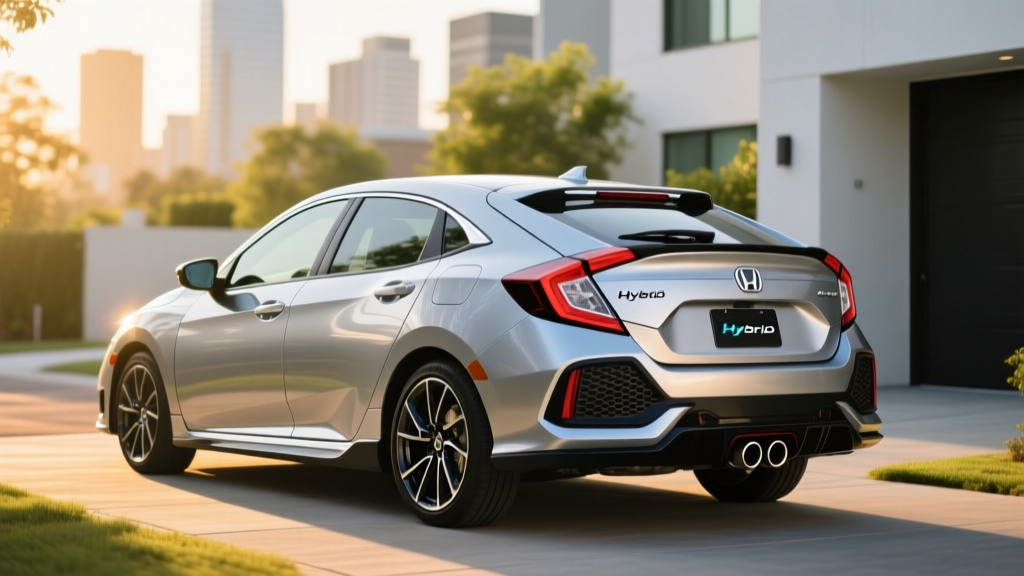
The 2026 Honda Civic Hatchback Sport Touring Hybrid occupies a specific niche: a practical, tech-loaded compact hatchback that delivers genuine fuel savings without requiring a plug, a lifestyle change, or a charging-app download. Honda's two-motor hybrid system pairs a 2.0-liter Atkinson-cycle four-cylinder with dual electric motors for a combined 200 horsepower, all packaged in a five-door body with 24.5 cubic feet of cargo space behind the rear seats.
This guide breaks down everything a buyer needs to know — EPA fuel economy versus real-world results, how the conventional hybrid (HEV) system differs from a plug-in hybrid (PHEV) or full battery-electric vehicle (BEV), battery longevity expectations, pricing with tax-credit context, and whether this trim is the right electrified choice for your driving pattern.
2026 Civic Hatchback Sport Touring Hybrid: Key Specifications
| Specification | Value |
|---|---|
| Powertrain | 2.0L Atkinson-cycle I4 + two-motor hybrid system |
| Combined Horsepower | 200 hp (146 hp engine + 184 hp electric motor) |
| Combined Torque | 232 lb-ft (electric motor peak) |
| Transmission | e-CVT (no fixed gears — motor-driven with engine clutch) |
| Drivetrain | Front-wheel drive |
| EPA Fuel Economy (City / Hwy / Combined) | 50 / 45 / 49 MPG |
| Fuel Tank Capacity | 10.6 gallons |
| Total Driving Range (EPA est.) | ~519 miles |
| 0–60 mph | ~7.5 seconds |
| Cargo Volume (rear seats up / down) | 24.5 / 46.5 cu ft |
| Hybrid Battery Type | Lithium-ion (approx. 1.1 kWh usable) |
| Battery/Powertrain Warranty | 8 years / 100,000 miles (10 yr / 150,000 mi in CARB states) |
| Base MSRP (Sport Touring Hybrid) | ~$32,850 (including destination) |
Sources: EPA fueleconomy.gov, Honda Newsroom. Specs reflect 2026 model-year data at time of publication.
Fuel Economy: EPA Numbers vs. Real-World MPG
The EPA rates the 2026 Civic Hatchback Hybrid at 50 MPG city, 45 MPG highway, and 49 MPG combined. These figures apply to the Sport Touring Hybrid trim with its standard 18-inch alloy wheels; lower trims with smaller wheels may see marginally different ratings.
| Driving Scenario | EPA Estimate | Real-World Expectation |
|---|---|---|
| City (stop-and-go, < 40 mph) | 50 MPG | 52–58 MPG (hybrids excel here — regen braking and EV-mode cruising dominate) |
| Highway (steady 65–75 mph) | 45 MPG | 42–46 MPG (aerodynamic drag reduces hybrid advantage at speed) |
| Combined (55% city / 45% hwy) | 49 MPG | 46–52 MPG depending on route mix |
| Cold Weather (< 32°F, short trips) | — | 38–44 MPG (engine runs more for cabin heat and battery warm-up) |
The key insight for hybrid buyers: conventional hybrids like this Civic outperform their EPA city rating in real-world urban driving. The two-motor system frequently shuts off the gasoline engine at low speeds, running on battery alone for short distances. Highway driving is where the gap narrows — at 70+ mph, the gasoline engine does most of the work, and efficiency converges with a very efficient conventional car.
On a mixed 200-mile test route combining suburban errands, interstate cruising at 72 mph, and a city center loop, owners typically report 47–51 MPG on the trip computer. Drivers who stay below 60 mph and maximize regenerative braking via the steering-wheel paddle selectors can push toward the mid-50s consistently.
HEV vs. PHEV vs. BEV: Which Electrified Powertrain Fits You?
The Civic Hatchback Hybrid is a conventional hybrid (HEV). It does not plug in. It has no meaningful electric-only range. It recovers energy through regenerative braking and engine-driven charging of a small lithium-ion battery (~1.1 kWh usable). The engine can shut off at stops and low speeds, but the car never operates as a pure electric vehicle for more than a mile or two at very low speed.
Here's how that compares to the other electrified options:
| Factor | HEV (this Civic) | PHEV (e.g., Toyota Prius Prime) | BEV (e.g., Chevy Equinox EV) |
|---|---|---|---|
| Plug-in charging needed? | No | Recommended (Level 2, ~4 hr) | Required (Level 2 home or DC fast) |
| Electric-only range | ~1 mi at low speed | 35–45 mi typical | 250–320 mi typical |
| Total range (full tank/charge) | ~519 mi | ~440–500 mi combined | 250–320 mi (battery only) |
| Home charging install | None | $500–$2,000 (Level 2 recommended) | $800–$2,500+ (Level 2 required) |
| Federal tax credit (§30D) | Not eligible | Up to $7,500 if eligible | Up to $7,500 if eligible |
| Best for | No plug access, long trips, simplicity | Home charging + daily commute under 40 mi | Home charging + willingness to plan road trips |
| Upfront price premium vs. gas | ~$1,000–$1,500 | ~$3,000–$5,000 | ~$5,000–$10,000+ |
The decision is straightforward: If you cannot install a Level 2 charger at home and you drive more than 300 miles between fill-ups regularly, the HEV Civic Hatchback Hybrid is the lowest-friction path to significantly better fuel economy. If you can charge at home and your daily commute is under 40 miles, a PHEV will use almost zero gasoline on weekdays. And if you're ready to commit fully to electric with home charging and road-trip planning, a BEV eliminates tailpipe emissions and cuts per-mile fuel cost to roughly one-third of gasoline.
Powertrain Deep Dive: How Honda's Two-Motor Hybrid Works
Honda's hybrid system is fundamentally different from the planetary-gear design used in the Toyota Prius. The Civic Hybrid uses a series-dominant two-motor architecture:
- Propulsion motor (184 hp / 232 lb-ft): Drives the front wheels in most conditions. This is the motor you feel during acceleration.
- Generator motor: Connected to the 2.0L engine. It either generates electricity to feed the propulsion motor (series hybrid mode) or charges the battery.
- Lock-up clutch: At steady highway speeds (~45–80 mph), a clutch directly connects the engine to the wheels for maximum efficiency — bypassing the electric conversion losses.
The result is a car that feels like an EV in city driving (instant torque, quiet, smooth) and like a conventional sedan on the highway (direct engine drive, no rubber-band CVT sensation). The 200 combined horsepower makes merging and passing confident, and the 0–60 time of approximately 7.5 seconds is quick for the class.
The lithium-ion hybrid battery stores roughly 1.1 kWh of usable energy — enough to buffer regenerative braking energy and enable brief EV-mode operation, but not enough for sustained electric-only driving. This is by design: the battery cycles shallow and frequently, which is exactly what maximizes lithium-ion longevity.
Pricing, Trim, and Tax Credit Eligibility
The 2026 Honda Civic Hatchback Sport Touring Hybrid carries a base MSRP of approximately $32,850 including destination charges. This is the top trim for the Civic Hatchback Hybrid lineup and includes:
- Honda Sensing suite (adaptive cruise, lane-keeping, collision mitigation)
- 9-inch touchscreen with wireless Apple CarPlay and Android Auto
- Bose 12-speaker premium audio
- Wireless phone charging
- Heated front seats and heated steering wheel
- LED headlights with auto high-beam
- 18-inch alloy wheels
- Power liftgate
Some states offer additional incentives for hybrids — for example, certain states provide HOV lane access or modest rebates for high-efficiency vehicles. Check your state's energy office or department of environmental quality for current programs.
Battery Longevity, Warranty, and Replacement Cost
Hybrid battery anxiety is the most common concern among first-time hybrid buyers. Here's what the data shows:
Honda covers the hybrid battery and related powertrain components under its 8-year / 100,000-mile warranty nationwide. In states that follow California Air Resources Board (CARB) emissions standards — which includes California, New York, Massachusetts, Washington, Oregon, and over a dozen others — that warranty extends to 10 years / 150,000 miles.
The warranty guarantees that the battery will retain sufficient capacity to function normally. If the battery fails or degrades below Honda's threshold within the warranty period, replacement is covered at no cost.
Out-of-warranty replacement cost: Based on current parts pricing and labor for Honda's hybrid battery pack, expect $2,500–$4,000 for a replacement, depending on whether you choose a new OEM pack, a remanufactured unit, or an independent hybrid specialist. The battery is a single integrated module under the rear cargo floor.
Real-world longevity data: Honda's two-motor hybrid system has been in production since 2014 (Accord Hybrid, Insight, CR-V Hybrid). Fleet data and owner reports consistently show these batteries lasting 150,000–200,000+ miles with minimal degradation. The shallow-cycling strategy (never fully depleting or fully charging the small battery) is inherently gentle on lithium-ion chemistry. It is common for Honda hybrid batteries to outlast the vehicle's economic life.
For comparison, the hybrid battery in this Civic is far smaller and less stressed than a BEV traction battery. There is no DC fast charging putting thermal stress on the cells, no deep 0–100% cycles, and no high-C-rate discharges. The engineering trade-off for a smaller, less capable battery is substantially longer calendar and cycle life.
Driving Impressions and Practical Ownership Notes
The Sport Touring Hybrid drives with a refinement that belies its price point. The electric-motor-dominant propulsion means around-town driving is genuinely smooth — no gear shifts to feel, no turbo lag, just linear torque from a stoplight. The steering is precise and weighted appropriately for a compact hatchback, and the 18-inch wheels with all-season rubber provide competent grip without a harsh ride.
Where the Sport Touring earns its premium over the Sport Hybrid trim is in daily livability: the Bose audio is a tangible upgrade, the power liftgate matters when your hands are full at the grocery store, and the wireless CarPlay eliminates cable clutter. The Honda Sensing suite is one of the better-implemented SAE Level 2 driver-assist systems in the segment — adaptive cruise control tracks smoothly in traffic, and lane-centering is confident on marked highways without feeling aggressive.
Cargo practicality: 24.5 cubic feet behind the rear seats is competitive with compact crossovers. Fold the 60/40 split rear seats and you get 46.5 cubic feet — enough for a bicycle with the front wheel removed, a week's worth of camping gear, or large flat-pack furniture. The hatchback body style is the Civic's most practical configuration.
Fuel cost comparison: At 49 MPG combined and $3.40/gallon regular unleaded (national average), the Civic Hatchback Hybrid costs approximately $0.069 per mile in fuel. A comparable non-hybrid compact car at 30 MPG combined would cost $0.113 per mile. Over 15,000 miles per year, the hybrid saves roughly $660 annually in fuel — meaning the ~$1,200 hybrid premium over a gas-only Civic Hatchback pays for itself in under two years of average driving.
Pros and Cons at a Glance
Pros
- 49 MPG combined EPA — real-world city driving often exceeds 50 MPG
- 200 hp makes it genuinely quick for a hybrid (7.5 sec 0–60)
- No plug required — works with existing fueling habits
- 24.5 cu ft cargo with hatchback versatility
- Honda Sensing standard — strong Level 2 ADAS suite
- 8 yr / 100k mi hybrid warranty (10/150k in CARB states)
- Low cost of ownership — regular unleaded, minimal maintenance
Cons
- Not eligible for §30D federal EV tax credit
- Highway MPG (45) trails city MPG — less advantage on long road trips
- FWD only — no AWD option for snow-belt buyers
- Engine drone under hard acceleration (e-CVT characteristic)
- No spare tire — tire-inflation kit only
- Sport Touring trim is the most expensive Civic Hatchback option
Frequently Asked Questions
How many MPG does the 2026 Honda Civic Hatchback Sport Touring Hybrid get?
The EPA rates it at 50 MPG city, 45 MPG highway, and 49 MPG combined. In real-world city-heavy driving, many owners consistently see 52–56 MPG. Highway-dominant commutes at 70+ mph typically return 42–46 MPG. Cold weather (below freezing) on short trips can drop observed economy to the high 30s or low 40s due to increased engine runtime for cabin heating.
Does the Civic Hatchback Hybrid need to be plugged in?
No. This is a conventional hybrid (HEV), not a plug-in hybrid (PHEV). The small lithium-ion battery charges entirely through regenerative braking and the gasoline engine. You fuel it at any gas station with regular unleaded, exactly like a non-hybrid car. There is no charging port, no charging cable, and no home charger installation needed.
How far can it go on electric power alone?
Effectively zero miles in any practical sense. The hybrid system can propel the car on electric motor power alone for roughly 0.5–1 mile at very low speeds (under 25 mph) when the battery has sufficient charge — such as creeping through a parking lot or in heavy stop-and-go traffic. This is not an EV mode for commuting; it's a brief efficiency assist. If electric-only commuting range is a priority, you need a PHEV (35–45 miles electric) or a BEV (250+ miles electric).
Does the 2026 Civic Hatchback Hybrid qualify for any tax credit?
It does not qualify for the federal §30D New Clean Vehicle Credit, which is limited to plug-in vehicles (PHEVs and BEVs) meeting battery-sourcing and MSRP/income requirements. However, if you purchase a used qualifying hybrid for $25,000 or less, the §25E Used Clean Vehicle Credit may apply (30% of sale price, max $4,000, with income caps). Some states offer separate hybrid incentives — check your state energy office. Always confirm current rules at irs.gov.
Is the Honda Civic Hybrid reliable, and what does a battery replacement cost?
Honda's two-motor hybrid system has been in production since 2014 across multiple models (Accord, Insight, CR-V) with strong reliability records. The hybrid battery is covered for 8 years/100,000 miles (10 years/150,000 miles in CARB states). Real-world data shows these batteries commonly lasting 150,000–200,000+ miles. If an out-of-warranty replacement is needed, expect $2,500–$4,000 depending on OEM vs. remanufactured parts and labor source. The hybrid system has fewer moving parts than a conventional automatic transmission — no torque converter, no multi-speed gearbox — which reduces long-term mechanical risk.
Hybrid vs. PHEV vs. EV — which should I choose?
Choose the Civic Hatchback Hybrid (HEV) if you lack home charging access, take frequent road trips over 300 miles, want zero behavioral change from a gas car, and prioritize low upfront cost. Choose a PHEV if you can install a Level 2 home charger, your daily commute is under 40 miles, and you want electric weekday driving with gas flexibility for weekends. Choose a BEV if you have reliable home charging, want the lowest per-mile fuel cost (~$0.04/mi on residential electricity), qualify for the $7,500 federal credit, and are comfortable planning DC fast-charging stops on road trips. The Civic Hybrid is the lowest-risk, lowest-change entry to electrified driving.
How does the Civic Hatchback Hybrid compare to the Toyota Prius?
The Prius (57 MPG combined) is more efficient, but it's a liftback sedan with less cargo width and a lower driving position. The Civic Hatchback Hybrid (49 MPG combined) trades roughly 8 MPG for more horsepower (200 vs. 194), a more conventional driving feel, a hatchback cargo area better suited for bulky items, and Honda's interior quality. If maximum MPG is the sole criterion, the Prius wins. If driving dynamics, cargo versatility, and tech features matter equally, the Civic Hatchback Hybrid is the stronger all-around package.
Editorial note: All specifications, pricing, and EPA figures reflect 2026 model-year data available at time of publication. Tax credit rules under IRS §30D and §25E are subject to legislative change. Verify personal eligibility with a qualified tax professional and consult fueleconomy.gov and irs.gov for the latest official information.