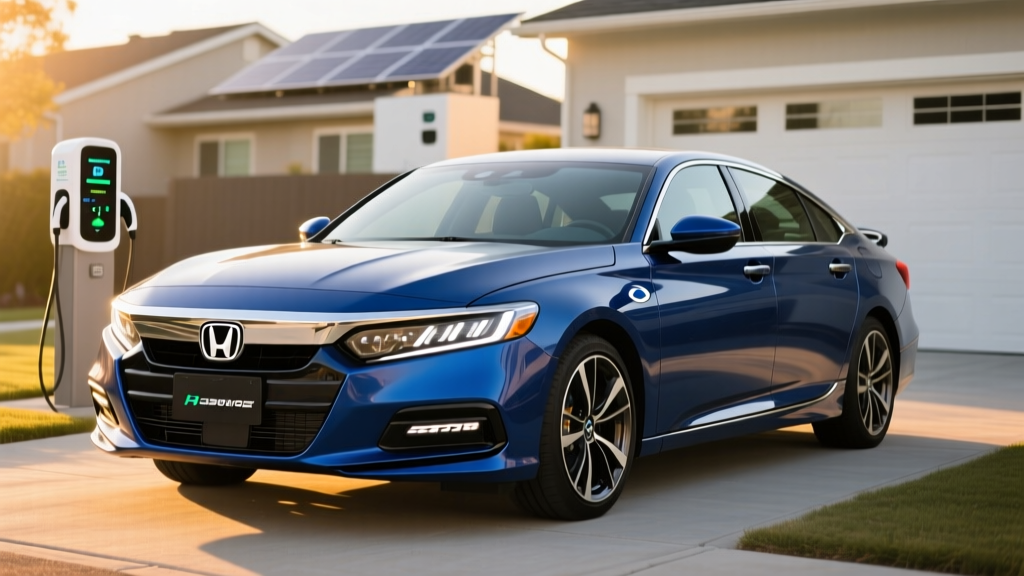
The midsize sedan segment has thinned out, but the Honda Accord remains a staple — and its hybrid powertrain is now the volume seller. The 2026 Honda Accord Sport Hybrid sits in the sweet spot of the lineup: sport-tuned styling and suspension, a two-motor hybrid system that prioritizes electric drive, and a starting price that undercuts many turbocharged gas competitors. If you're cross-shopping this against a Toyota Camry Hybrid, Hyundai Sonata Hybrid, or even a compact EV, this guide gives you every number you need to decide.
HEV vs PHEV: Where the Accord Hybrid Fits
Before we get into the specs, let's clear up a common point of confusion. The 2026 Honda Accord Sport Hybrid is a conventional hybrid electric vehicle (HEV), not a plug-in hybrid (PHEV). That distinction matters for your daily routine:
| Feature | Accord Sport Hybrid (HEV) | Typical PHEV (e.g., Toyota Prius Prime) | Battery EV (e.g., Tesla Model 3) |
|---|---|---|---|
| Plug-in charging required? | No — refuels with gas only | Yes — plug in for EV range | Yes — plug in exclusively |
| Electric-only driving | ~1 mile at low speed | 25–44 miles | 250–350+ miles |
| Battery size | 1.06 kWh (buffer-limited) | 13.6 kWh usable | 60–82 kWh usable |
| Home charger needed? | No | Recommended (Level 2) | Essential (Level 2) |
| Federal tax credit (§30D) | Not eligible | Up to $7,500 if eligible | Up to $7,500 if eligible |
| Best for | No home charging access; long commutes | Short EV commute + road trips | Home charging + lower running costs |
The Accord Hybrid does not have a plug, does not qualify for the federal EV tax credit, and does not offer meaningful electric-only range. What it does offer is seamless, no-behavior-change fuel efficiency — you fill up at a gas station and let the two-motor system handle the rest. Honda's fourth-generation hybrid system uses the gas engine primarily as a generator, with the electric drive motor handling most propulsion duties below highway speeds.
Fuel Economy: EPA Ratings and Real-World MPG
The EPA rates the 2026 Honda Accord Sport Hybrid at 46 MPG city / 41 MPG highway / 44 MPG combined according to fueleconomy.gov. The Sport trim's larger 19-inch wheels and sport suspension tuning reduce efficiency slightly compared to the EX-L Hybrid's 48 MPG combined rating.
| Driving Scenario | EPA Rating | Real-World Expectation |
|---|---|---|
| City | 46 MPG | 47–52 MPG (hybrids excel in stop-and-go) |
| Highway (70 mph) | 41 MPG | 38–42 MPG (aero drag and engine-direct drive) |
| Combined | 44 MPG | 42–47 MPG depending on route mix |
| Cold weather (below 30°F) | — | 36–40 MPG (engine runs more for cabin heat) |
Real-world note: Honda's two-motor hybrid system behaves like an EV at low and moderate speeds, where the 1.06 kWh lithium-ion battery buffers energy from regenerative braking and the engine-generator. In city driving with frequent stops, owners routinely report exceeding the EPA city estimate — 50+ MPG is achievable in warm weather on flat terrain. Highway efficiency drops because the engine must directly drive the wheels via a single-speed clutch above ~45 mph, and the Accord's 19-inch Sport wheels carry a 1–2 MPG penalty versus the 17-inch wheels on the EX-L Hybrid.
For a 15,000-mile/year driver averaging 44 MPG at $3.40/gallon, annual fuel cost lands around $1,159. A comparable gas-only midsize sedan at 30 MPG combined would cost roughly $1,700/year — a savings of about $540 annually with the hybrid.
Powertrain: Two-Motor Hybrid System Explained
| Specification | 2026 Accord Sport Hybrid |
|---|---|
| Engine | 2.0L Atkinson-cycle inline-4 |
| Engine output | 146 hp / 134 lb-ft torque |
| Drive motor | 181 hp / 247 lb-ft torque |
| Combined system output | 204 hp / 247 lb-ft torque |
| Transmission | e-CVT (single-speed direct drive + generator) |
| 0–60 mph | ~7.0 seconds |
| Drivetrain | Front-wheel drive |
| Battery | 1.06 kWh lithium-ion (NMC chemistry) |
| Fuel tank | 12.8 gallons |
| Total range (est.) | ~560 miles |
Honda's hybrid system is fundamentally different from Toyota's planetary-gear power-split design. Below roughly 45 mph, the Accord Hybrid operates as a series hybrid: the 2.0L Atkinson-cycle engine spins a generator motor that produces electricity, which either feeds the 181-hp drive motor directly or charges the small buffer battery. The engine is not mechanically connected to the wheels. Above highway speeds, a lock-up clutch engages, coupling the engine directly to the front axle for efficient cruising — similar to an overdrive gear.
The result is a driving feel closer to an EV than a traditional hybrid. Throttle response is immediate (247 lb-ft from zero RPM via the electric motor), and the engine revs independently of vehicle speed, eliminating the "rubber-band" drone associated with older e-CVTs. The Sport trim adds paddle-shifters that adjust regenerative braking intensity across four levels, though it does not offer true one-pedal driving like a full EV.
Pricing, Trims, and Tax Credit Eligibility
The 2026 Honda Accord Sport Hybrid carries an MSRP starting at approximately $34,650 (including destination). Here's how the hybrid trims stack up:
| Trim | MSRP (est.) | Key Features |
|---|---|---|
| Sport Hybrid | $34,650 | 19" wheels, sport suspension, black accents, 12.3" touchscreen, wireless CarPlay/Android Auto |
| Sport-L Hybrid | $36,650 | Leather-trimmed seats, heated front seats, wireless charging pad |
| EX-L Hybrid | $37,650 | 17" wheels (48 MPG), leather, power passenger seat, low-speed braking control |
| Touring Hybrid | $40,350 | Adaptive dampers, Bose 12-speaker audio, heated rear seats, HUD, Wi-Fi hotspot |
Federal tax credit: The Accord Hybrid is a conventional HEV, not a plug-in vehicle. It does not qualify for the IRS §30D Clean Vehicle Credit (up to $7,500), which applies only to BEVs and PHEVs that meet battery-sourcing, MSRP, and buyer-income requirements per irs.gov. The previous $2,500 alternative motor vehicle credit for hybrids expired years ago. Some states or utilities may offer minor rebates for high-efficiency vehicles — check your local programs — but there is no federal incentive for purchasing a conventional hybrid in 2026.
Battery Warranty, Reliability, and Replacement Cost
Hybrid battery warranty: Honda covers the Accord Hybrid's lithium-ion battery pack for 8 years / 100,000 miles (10 years / 150,000 miles in CARB states including California, New York, Massachusetts, and others that follow California emissions standards). The warranty guarantees the battery against defects and abnormal capacity loss.
The Accord's 1.06 kWh hybrid battery is small and operates within a narrow state-of-charge window (roughly 40–60% SoC), which dramatically reduces degradation stress compared to a full EV battery that cycles through 80–90% of its capacity daily. Honda's fourth-generation hybrid system has proven durable: the previous-generation Accord Hybrid (2018–2022) showed minimal capacity loss even at 150,000+ miles in fleet and owner reports.
Replacement cost: If the hybrid battery fails outside warranty, a replacement pack from Honda runs approximately $2,000–$3,500 including labor — far less than an EV traction battery replacement ($8,000–$20,000+). Independent hybrid battery shops can sometimes refurbish or replace individual cells for $1,000–$1,800. Given the shallow cycling and robust thermal management, most Accord Hybrid batteries outlast the vehicle's economic life.
Overall reliability ratings for the Accord Hybrid are strong. Honda's hybrid powertrain has fewer moving parts than a conventional automatic transmission (no torque converter, no multi-gear planetary sets), and the regenerative braking system reduces wear on friction brake pads — many owners report 80,000+ miles on original brake pads.
Who Should Choose the Accord Sport Hybrid?
Choose the Accord Sport Hybrid if:
- You don't have access to home or workplace charging (apartment, street parking, no garage outlet)
- Your commute involves heavy stop-and-go traffic where the hybrid system shines (46+ MPG city)
- You take frequent road trips and don't want to plan around charging stops
- You want a midsize sedan with strong resale value, Honda Safety Sense, and a comfortable ride
- You're not ready for a full EV but want to cut fuel costs 30–40% versus a gas sedan
Look at a PHEV instead if:
- You have Level 2 home charging and a commute under 30 miles (a PHEV like the Prius Prime covers most trips on electricity alone)
- You want to qualify for the $7,500 federal tax credit (requires eligible PHEV or BEV)
Look at a full EV instead if:
- You have reliable home Level 2 charging and want the lowest per-mile energy cost (~$0.04/mile vs ~$0.08/mile for the Accord Hybrid)
- Your daily driving is under 250 miles and you want to eliminate gas station visits entirely
- You want access to HOV lane stickers (available for BEVs and PHEVs in many states, not for HEVs)
Pros and Cons at a Glance
Pros
- 44 MPG combined (48 on EX-L) with no plug-in required
- EV-like throttle response: 247 lb-ft from the drive motor at low speeds
- Spacious interior: 16.7 cu-ft trunk (no battery intrusion), 40.8" rear legroom
- Honda Sensing suite standard: adaptive cruise, lane-keeping, collision mitigation
- 8 yr / 100k mi hybrid battery warranty (10/150k in CARB states)
- Strong resale value and low long-term maintenance costs
Cons
- No federal tax credit — full price at purchase
- Sport trim's 19" wheels cost 2–4 MPG vs EX-L Hybrid
- Not a PHEV: no meaningful electric-only range for short trips
- Engine drone under hard acceleration (though improved over prior gen)
- FWD only — no AWD option (unlike Toyota Camry Hybrid AWD)
- ~$34,650 starting price is competitive but not cheap for a midsize sedan
Frequently Asked Questions
How many MPG does the 2026 Honda Accord Sport Hybrid get?
The EPA rates it at 46 MPG city, 41 MPG highway, and 44 MPG combined. In real-world city driving, many owners see 47–52 MPG thanks to the series-hybrid system that runs the engine as a generator at optimal RPM. Highway driving at 70+ mph typically yields 38–42 MPG. The EX-L Hybrid with smaller 17-inch wheels achieves 48 MPG combined.
Does the Accord Hybrid need to be plugged in?
No. The 2026 Accord Sport Hybrid is a conventional HEV — it charges its small 1.06 kWh battery through regenerative braking and the onboard engine-generator. You refuel exclusively at a gas station. There is no plug, no charging cable, and no home charger required.
Does the 2026 Accord Hybrid qualify for any tax credit?
No. The federal §30D Clean Vehicle Credit applies only to plug-in vehicles (BEVs and PHEVs) that meet battery sourcing, MSRP caps, and buyer income limits. The Accord Hybrid is a conventional HEV and does not qualify for any current federal tax incentive. Check your state or utility for possible local efficiency rebates, but these are typically small ($100–$500) and vary widely.
How long will the hybrid battery last and what does replacement cost?
Honda warranties the hybrid battery for 8 years / 100,000 miles (10 years / 150,000 miles in CARB states). Because the battery operates in a shallow charge window (~40–60% SoC), degradation is minimal. Most Accord Hybrid batteries last the life of the car. Out-of-warranty replacement runs approximately $2,000–$3,500 at a Honda dealer, or $1,000–$1,800 at a specialty hybrid shop.
How does the Accord Hybrid compare to the Toyota Camry Hybrid?
The 2026 Camry Hybrid (all trims are hybrid) achieves up to 52 MPG combined on LE trim and offers an AWD option. The Accord Sport Hybrid trades 4–8 MPG for a more engaging drive, larger rear seat (40.8" vs 38.0" legroom), and bigger trunk (16.7 vs 15.1 cu-ft). If maximum MPG and AWD are priorities, the Camry wins. If interior space and driving refinement matter more, the Accord is the stronger pick.
Is the Accord Sport Hybrid good for road trips?
Yes — this is where a conventional HEV excels over a BEV. With a 12.8-gallon tank and 41 MPG highway, you can expect roughly 520–560 miles between fill-ups. There's no charging planning, no range loss from DC fast-charging unavailability, and the Honda Sensing adaptive cruise control makes long interstate stretches comfortable. The only trade-off versus a gas car is slightly less power for mountain passing (204 hp combined is adequate, not sporty).