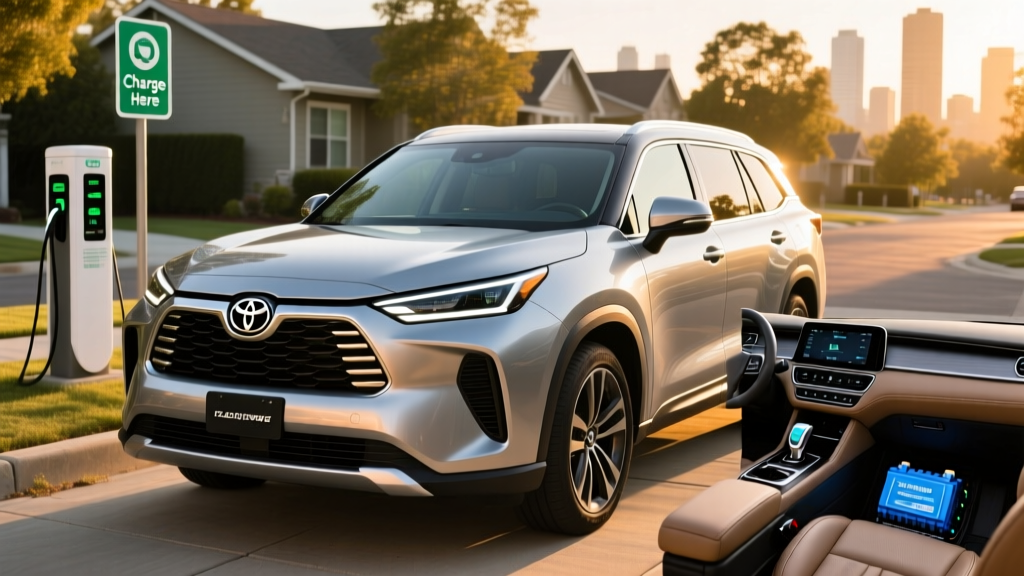
The 2026 Toyota Grand Highlander Hybrid Platinum sits at the top of Toyota's three-row hybrid SUV lineup, pairing a 2.4-liter turbocharged Hybrid MAX powertrain with a full complement of luxury and technology features. For families who need three usable rows, standard all-wheel drive, and fuel economy that shames sedans twice its size, this is one of the most compelling vehicles in the segment. But at over $53,000, buyers need to know exactly what they're getting — and what they're not.
This guide breaks down the real-world MPG you can expect, the HEV vs. PHEV distinction that trips up many shoppers, battery longevity and warranty coverage, federal tax credit eligibility, and whether this hybrid makes more sense for your driveway than a plug-in hybrid or a full battery-electric vehicle.
2026 Toyota Grand Highlander Hybrid Platinum: Spec Snapshot
| Specification | Value |
|---|---|
| Powertrain | 2.4L Turbo 4-cyl + electric motor (Hybrid MAX) |
| Combined Horsepower | 362 hp / 400 lb-ft torque |
| Drivetrain | Electronic On-Demand AWD (standard) |
| Transmission | 6-speed automatic |
| EPA Fuel Economy (City / Hwy / Combined) | 26 / 27 / 27 MPG |
| Fuel Tank Capacity | 17.1 gallons |
| Total Driving Range | ~461 miles |
| 0–60 mph | ~5.6 seconds (est.) |
| Towing Capacity | 5,000 lbs |
| Cargo Volume (behind 3rd / 2nd / 1st row) | 20.6 / 57.9 / 97.5 cu ft |
| Seating | 7 passengers (2nd-row captain's chairs) |
| Base MSRP (Platinum trim) | $53,405 (est.) |
| Federal §30D Tax Credit | Not eligible (HEV, not PHEV/BEV) |
| Hybrid Battery Warranty | 10 years / 150,000 miles |
HEV vs. PHEV: What the Grand Highlander Hybrid Actually Is
Conventional Hybrid (HEV): The Grand Highlander Hybrid is a self-charging hybrid. It has a small traction battery (approximately 1.4 kWh) that recharges through regenerative braking and the gasoline engine. You never plug it in. You simply fill up with gas and drive. The electric motor assists the engine to reduce fuel consumption — especially in city driving and stop-and-go traffic.
Plug-In Hybrid (PHEV): A PHEV like the Toyota RAV4 Prime has a much larger battery (18.1 kWh) and can drive 20–42 miles on electricity alone before the gas engine kicks in. You plug it in at home or at a public charger to replenish the battery. PHEVs can qualify for federal tax credits; conventional HEVs cannot.
Key distinction: The 2026 Grand Highlander Hybrid Platinum is an HEV. It does not have a plug, no electric-only range, and no federal EV tax credit eligibility. Toyota does not currently offer a Grand Highlander PHEV variant for the 2026 model year.
Fuel Economy: EPA Numbers vs. Real-World MPG
The Hybrid MAX powertrain in the Grand Highlander Platinum is tuned for performance — 362 horsepower is substantial for a three-row SUV — and that comes with a fuel-economy trade-off compared to the standard 2.5-liter hybrid system available in lower trims. Here's the EPA breakdown for the Hybrid MAX AWD configuration, per fueleconomy.gov:
| Driving Condition | EPA Estimate | Real-World Expectation |
|---|---|---|
| City | 26 MPG | 27–29 MPG (hybrids often exceed EPA city ratings in stop-and-go driving) |
| Highway | 27 MPG | 25–27 MPG (turbo engine works harder at sustained speed; hybrid advantage diminishes) |
| Combined | 27 MPG | 26–28 MPG depending on driving mix and conditions |
Why city MPG can beat the sticker: Hybrid systems recapture energy through regenerative braking every time you slow down. In dense urban traffic with frequent stops, the electric motor does more of the work and the engine shuts off at idle. Owners who drive primarily in city and suburban conditions commonly report 28–30 MPG in warm weather.
Why highway MPG may fall short: At steady 70–80 mph cruising, the turbocharged 2.4L engine carries most of the load. Aerodynamic drag on a vehicle this size (over 4,700 lbs curb weight) reduces efficiency. Expect 25–26 MPG on long interstate trips, especially with a full load of passengers and cargo.
Cold-weather impact: In sub-freezing temperatures, expect a 10–15% reduction in fuel economy. The engine runs longer to heat the cabin and keep the hybrid battery at optimal temperature. Winter MPG of 22–24 combined is typical in northern climates.
For comparison, the non-turbo 2.5L hybrid (available on XLE and Limited trims) achieves an EPA-estimated 34–36 MPG combined — a significant advantage if outright fuel savings matter more than acceleration. The Hybrid MAX trades roughly 8–9 MPG for 120 additional horsepower and 1,500 lbs more towing capacity.
Powertrain Deep Dive: Hybrid MAX Performance
The Hybrid MAX system pairs a turbocharged 2.4-liter inline-four engine with a high-output electric motor mounted between the engine and a 6-speed automatic transmission. Combined output is 362 horsepower and 400 lb-ft of torque. The rear axle is driven by a separate electric motor, providing electronic on-demand AWD without a mechanical driveshaft.
This setup delivers brisk acceleration — 0–60 mph in approximately 5.6 seconds — making it one of the quickest three-row hybrid SUVs available. The electric motor fills in torque at low RPMs before the turbo spools, eliminating the lag typically associated with turbocharged engines. The result is smooth, immediate response from a stop.
Towing capacity is rated at 5,000 lbs, enough for a small boat, utility trailer, or a pair of personal watercraft. This is a meaningful upgrade over the standard 2.5L hybrid's 3,500-lb rating and brings the Grand Highlander into territory normally occupied by body-on-frame SUVs.
Platinum Trim: What You Get for the Money
The Platinum is the range-topping trim for the Grand Highlander Hybrid, and for 2026 it carries an estimated MSRP of $53,405 (including destination charge). Key standard features include:
- Panoramic glass roof with power sunshade
- Heated and ventilated front seats; heated second-row seats
- Heated steering wheel
- 12.3-inch Toyota Audio Multimedia touchscreen with wireless Apple CarPlay and Android Auto
- 11-speaker JBL premium audio system
- Digital rearview mirror
- Head-up display (HUD)
- 360-degree panoramic camera with curb-view mode
- Toyota Safety Sense 3.0 (adaptive cruise, lane tracing, pre-collision with pedestrian detection, blind-spot monitor, rear cross-traffic alert)
- 20-inch machined-finish alloy wheels
- Hands-free power liftgate
At this price point, the Grand Highlander Platinum competes with the Kia Telluride SX Prestige, Hyundai Palisade Calligraphy, and Mazda CX-90 Turbo S Premium — none of which offer a hybrid powertrain with comparable fuel economy. The trade-off is that the interior materials, while good, don't quite match the premium feel of a luxury-branded three-row SUV at $65K+.
Battery Longevity, Warranty, and Replacement Cost
Hybrid Battery Warranty: Toyota covers the Grand Highlander's hybrid battery for 10 years or 150,000 miles, whichever comes first. This applies in all 50 states and is one of the most comprehensive hybrid battery warranties in the industry.
How long do Toyota hybrid batteries actually last? Toyota's hybrid synergy drive system has been in production since 1997 (Prius). Real-world data from millions of Toyota hybrids on the road shows that the vast majority of hybrid batteries last the life of the vehicle without replacement. Failures before 150,000 miles are uncommon; many units exceed 200,000 miles.
Replacement cost if out of warranty: A new OEM hybrid battery pack for a Toyota hybrid of this size typically costs between $3,000 and $5,000 including labor. Refurbished/remanufactured units are available for $1,500–$2,500. Individual cell modules can sometimes be replaced for under $1,000 at specialized hybrid repair shops.
Why hybrid batteries last longer than EV batteries: The hybrid battery in the Grand Highlander is small (~1.4 kWh) and operates in a narrow state-of-charge window (roughly 40%–80%). The battery management system never allows a full charge or full discharge, which dramatically reduces degradation compared to the deeper cycles in a full EV.
The powertrain (engine, transmission, electric motors) carries Toyota's standard 5-year/60,000-mile warranty. The basic bumper-to-bumper coverage is 3 years / 36,000 miles.
Tax Credits and Incentives: What Applies to the Grand Highlander Hybrid
This is where many buyers get confused. The 2026 Toyota Grand Highlander Hybrid Platinum is a conventional hybrid (HEV), not a plug-in hybrid or battery-electric vehicle. Under current IRS §30D Clean Vehicle Credit rules:
- Federal EV tax credit ($7,500): NOT eligible. The §30D credit applies only to plug-in vehicles (BEVs and PHEVs) with a minimum battery capacity of 7 kWh. The Grand Highlander Hybrid's ~1.4 kWh battery does not qualify.
- Federal used clean vehicle credit (§25E, up to $4,000): NOT eligible for the same reason — requires a plug-in vehicle.
- State and local incentives: Some states offer rebates or HOV lane access for hybrids. Check your state's energy or DMV website for current programs. These vary widely and change frequently.
- Employer or utility rebates: Rare for conventional hybrids but worth checking with your employer's benefits program or local utility.
The bottom line: You will not receive a federal tax credit for purchasing this vehicle. The fuel savings compared to a gas-only three-row SUV (which might achieve 19–22 MPG combined) are the primary financial benefit — roughly $400–$600 per year in fuel savings at 15,000 miles driven and $3.50/gallon gas, depending on your driving mix.
Grand Highlander Hybrid vs. PHEV vs. Full EV: Which Fits You?
Choose the Grand Highlander Hybrid (HEV) if:
- You don't have access to home charging (no garage, apartment living, no outlet nearby)
- You regularly take long road trips and don't want to plan around charging stops
- You need three rows, 5,000-lb towing, and AWD in a single package
- You want significantly better fuel economy than a gas SUV without changing your refueling habits
- You plan to keep the vehicle 8–10+ years and value Toyota's hybrid reliability track record
Choose a PHEV (e.g., Toyota Sienna, if available, or Chrysler Pacifica PHEV) if:
- You can charge at home (Level 2 or even a standard 120V outlet)
- Most daily driving is under 30–40 miles (you'd run mostly on electricity)
- You want the option of electric-only commuting with gas-engine flexibility for road trips
- You want to qualify for the $7,500 federal tax credit (if the specific PHEV model meets §30D sourcing and MSRP requirements)
Choose a full EV (e.g., Kia EV9, Rivian R1S) if:
- You have reliable home Level 2 charging
- Your daily driving is predictable and within the vehicle's range
- You want the lowest per-mile energy cost (electricity vs. gasoline)
- You want to maximize federal and state incentives
- You're willing to plan charging stops on road trips (or primarily drive under 250 miles between charges)
Pros and Cons at a Glance
Pros
- 27 MPG combined in a 4,700+ lb three-row SUV — exceptional for the class
- 362 hp and 5,000-lb towing with the Hybrid MAX powertrain
- Genuine third-row space that fits adults, not just children
- Standard AWD without a fuel-economy penalty
- 10-year/150,000-mile hybrid battery warranty
- No plug-in charging required — zero lifestyle change from a gas car
- Toyota Safety Sense 3.0 standard across all trims
Cons
- $53,405 MSRP on Platinum is steep for a Toyota badge
- No federal tax credit eligibility (HEV, not PHEV/BEV)
- Hybrid MAX fuel economy (27 MPG) trails the standard hybrid (34–36 MPG) by ~8 MPG
- Platinum trim requires captain's chairs — no 8-passenger bench option
- Infotainment, while improved, still lags behind competitors in responsiveness
- No spare tire (tire repair kit only) on Hybrid MAX trims
- Highway MPG can dip below EPA estimate at sustained 75+ mph speeds
Frequently Asked Questions
How many MPG does the 2026 Grand Highlander Hybrid Platinum get?
The Hybrid MAX AWD Platinum achieves an EPA-estimated 26 city / 27 highway / 27 combined MPG. In real-world driving, owners commonly see 27–30 MPG in city conditions and 25–27 MPG on the highway. The standard 2.5L hybrid (non-turbo, available on lower trims) achieves 34–36 MPG combined but with less power and lower towing capacity.
Does the Grand Highlander Hybrid need to be plugged in?
No. The Grand Highlander Hybrid is a conventional hybrid (HEV). It charges its own small battery through regenerative braking and the gasoline engine. You never plug it in — you simply fill up at a gas station as you would with any other vehicle.
Is the Grand Highlander available as a plug-in hybrid (PHEV)?
As of the 2026 model year, Toyota does not offer a plug-in hybrid variant of the Grand Highlander. If PHEV capability is a priority in a Toyota three-row vehicle, the Toyota Sienna (which is hybrid-only and achieves 36 MPG combined) is the closest alternative, though it is a minivan rather than an SUV. Toyota has not announced a Grand Highlander PHEV.
How long will the hybrid battery last, and what does replacement cost?
Toyota's hybrid batteries are designed to last the life of the vehicle. The battery is covered by a 10-year/150,000-mile warranty. Based on decades of Toyota hybrid data (since the 1997 Prius), most hybrid batteries outlast 200,000 miles without replacement. If replacement is needed out of warranty, expect $3,000–$5,000 for a new OEM pack or $1,500–$2,500 for a refurbished unit.
Does the 2026 Grand Highlander Hybrid qualify for any tax credit?
No. The federal §30D Clean Vehicle Credit applies only to plug-in electric vehicles (BEVs and PHEVs) with at least 7 kWh of battery capacity. The Grand Highlander Hybrid's ~1.4 kWh battery makes it ineligible. Some states offer separate incentives for hybrids — check your state energy office or DMV for current programs.
How does the Hybrid MAX compare to the standard Grand Highlander Hybrid?
The standard 2.5L 4-cylinder hybrid produces 245 hp and achieves 34–36 MPG combined with a 3,500-lb tow rating. The Hybrid MAX (2.4L turbo) produces 362 hp, achieves 26–27 MPG combined, and tows up to 5,000 lbs. Choose the standard hybrid for maximum fuel savings; choose the Hybrid MAX for performance and towing.
Is the Grand Highlander Hybrid reliable?
Toyota's hybrid powertrains have among the best reliability records in the automotive industry. The hybrid system has fewer wear components than a conventional powertrain (no traditional starter motor, no alternator, regenerative braking reduces brake pad wear). The Grand Highlander is too new for long-term reliability data specific to this model, but the underlying Hybrid MAX system shares architecture with proven Toyota hybrid platforms. NHTSA and IIHS ratings should be checked as they become available for the 2026 model year.