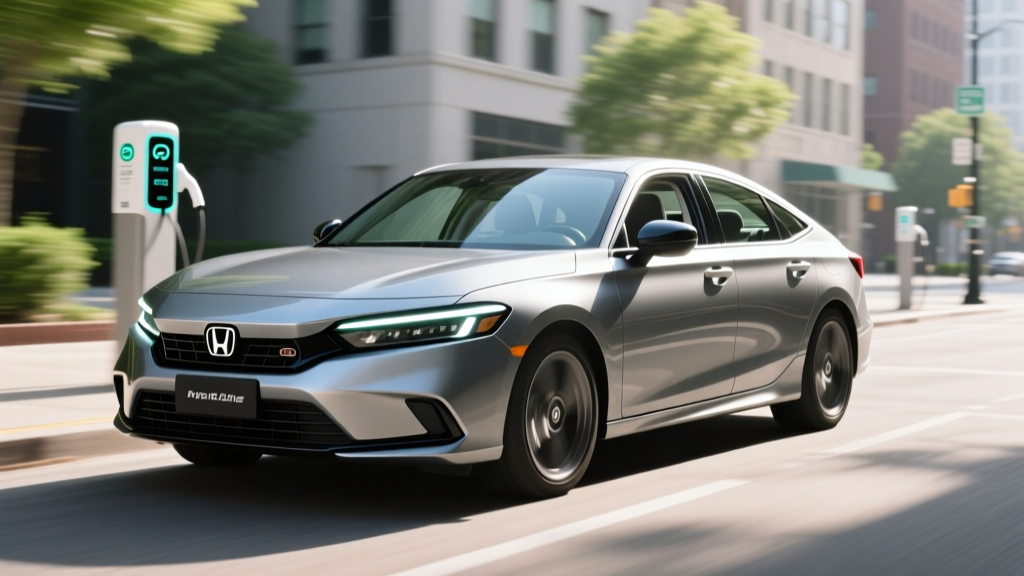
The 2026 Honda Civic Hybrid returns for its second year after a dramatic reintroduction, and it remains one of the most compelling arguments for electrification without a plug. Honda's two-motor hybrid system pairs a 2.0-liter Atkinson-cycle engine with electric motors to deliver 200 combined horsepower and an EPA-estimated 50 MPG combined — figures that make it both the most powerful and most efficient Civic in the lineup. But sticker numbers only tell part of the story. This guide covers real-world fuel economy, powertrain engineering, warranty coverage, tax-credit eligibility, and whether the Civic Hybrid is the right bridge between a conventional gas car and a full battery-electric vehicle.
HEV vs. PHEV vs. EV: Where the Civic Hybrid Fits
Before diving into specs, it's essential to clarify what the 2026 Honda Civic Hybrid is — and what it is not. The Civic Hybrid is a conventional hybrid electric vehicle (HEV). It generates all its electricity internally through regenerative braking and its gasoline engine. There is no plug, no charging port, and no electric-only driving mode of meaningful distance.
| Feature | HEV (Civic Hybrid) | PHEV (e.g., Toyota Prius Prime) | BEV (e.g., Chevy Equinox EV) |
|---|---|---|---|
| Plug-in charging | No | Yes | Yes |
| Electric-only range | ~1 mile at low speed | 25–44 miles | 250–350+ miles |
| Gas engine | Yes (primary) | Yes (backup) | No |
| Federal tax credit (§30D) | No | Up to $7,500 (if eligible) | Up to $7,500 (if eligible) |
| Home charging install needed | No | Recommended (Level 2) | Required (Level 2) |
| Typical combined MPG / MPGe | 48–57 MPG | 48–54 MPG + 100+ MPGe | 100+ MPGe |
If you have reliable home charging and a short commute, a PHEV or BEV may save more on fuel. But if you live in an apartment, lack a garage, or frequently drive long distances without charging access, the Civic Hybrid's no-plug-required simplicity is a genuine advantage. You fuel it like any other car and let the hybrid system handle efficiency.
2026 Honda Civic Hybrid: Powertrain and Performance Specs
Honda's fourth-generation two-motor hybrid system is the heart of the Civic Hybrid. Unlike traditional hybrid setups that use a planetary gearset (like Toyota's eCVT), Honda's system primarily drives the wheels through an electric traction motor, with the gasoline engine acting mostly as a generator. At highway cruising speeds, a lock-up clutch connects the engine directly to the wheels for efficiency.
| Specification | 2026 Honda Civic Hybrid Sport | 2026 Honda Civic Hybrid Sport Touring |
|---|---|---|
| Engine | 2.0L DOHC Atkinson-cycle 4-cyl | 2.0L DOHC Atkinson-cycle 4-cyl |
| Engine horsepower | 146 hp @ 6,000 rpm | 146 hp @ 6,000 rpm |
| Electric motor output | 184 hp / 232 lb-ft torque | 184 hp / 232 lb-ft torque |
| Combined system output | 200 hp / 232 lb-ft | 200 hp / 232 lb-ft |
| Transmission | eCVT (single-speed direct drive + engine clutch) | eCVT (single-speed direct drive + engine clutch) |
| Drivetrain | FWD | FWD |
| 0–60 mph (est.) | ~7.2 seconds | ~7.2 seconds |
| Hybrid battery | ~1.0 kWh lithium-ion | ~1.0 kWh lithium-ion |
| Curb weight | ~3,130 lbs | ~3,220 lbs |
The result is a car that feels more like an EV in everyday driving than its specs suggest. Electric motor torque fills in immediately from a stop, and the engine only revs audibly under hard acceleration or sustained highway climbing. The 200-hp combined output makes it quicker than the non-hybrid Civic's 1.5L turbo (180 hp in Sport trims) and substantially quicker than the base 2.0L (150 hp).
EPA Fuel Economy and Real-World MPG
Fuel economy is the Civic Hybrid's headline feature, and Honda's EPA estimates are competitive with the best in the compact hybrid segment.
| Trim | City MPG | Highway MPG | Combined MPG |
|---|---|---|---|
| Civic Hybrid Sport | 50 | 47 | 49 |
| Civic Hybrid Sport Touring | 50 | 45 | 48 |
Source: EPA Fuel Economy
Real-World MPG vs. EPA Sticker: Honda's two-motor system excels in city driving, where the electric motor handles most propulsion and regenerative braking recaptures energy frequently. In real-world city and suburban driving, many owners report 52–56 MPG, exceeding the EPA city estimate. Highway driving tells a different story: at sustained 75–80 mph, expect 42–46 MPG as the engine clutch engages and aerodynamic drag rises. In cold weather (below 30°F), the engine runs more often for cabin heat and battery conditioning, dropping observed economy to roughly 40–44 MPG combined until the powertrain warms up.
For a 12.4-gallon fuel tank, that translates to roughly 550–600 miles of real-world range in mixed driving — enough to go well over two weeks between fill-ups for most commuters.
Pricing, Trims, and Tax-Credit Eligibility
The 2026 Civic Hybrid is offered in two trims, both positioned as sporty upgrades over the non-hybrid Civic lineup:
- Civic Hybrid Sport: MSRP ~$29,845 (including destination)
- Civic Hybrid Sport Touring: MSRP ~$32,845 (including destination)
The Sport Touring adds leather-trimmed seats, a Bose 12-speaker audio system, wireless phone charging, a 9-inch touchscreen with wireless Apple CarPlay/Android Auto, and Honda's full suite of driver-assistance features.
Federal Tax Credit (§30D) Eligibility: The 2026 Honda Civic Hybrid does NOT qualify for the federal §30D clean vehicle tax credit. That credit applies only to plug-in electric vehicles (PHEVs and BEVs) with a battery capacity of at least 7 kWh. The Civic Hybrid's ~1.0 kWh battery is far below that threshold. No federal purchase incentive is available.
Some states and municipalities offer hybrid-specific rebates or HOV lane access for high-efficiency vehicles, but these vary widely. Check your state's energy office or the AFDC state incentive database for local programs.
The Civic Hybrid's value proposition is straightforward: you pay roughly $1,500–$2,500 more upfront versus a comparably equipped non-hybrid Civic, and you recoup that through fuel savings. At 15,000 miles per year and $3.50/gallon gas, the hybrid's ~15 MPG advantage over the 1.5T Civic saves approximately $650–$750 annually — paying back the premium in roughly 2–3 years.
Battery Warranty, Lifespan, and Replacement Cost
Hybrid battery longevity is consistently the top concern among first-time hybrid buyers. Here's what Honda provides and what the data shows:
| Component | Warranty Coverage |
|---|---|
| Hybrid battery (IPM) | 8 years / 100,000 miles (10 yr / 150,000 mi in CARB states) |
| Hybrid system components | 8 years / 100,000 miles |
| Powertrain (engine + transmission) | 5 years / 60,000 miles |
| New vehicle limited | 3 years / 36,000 miles |
CARB states include CA, CO, CT, ME, MD, MA, NJ, NY, OR, RI, VT, WA, and others adopting California emissions standards — covering roughly 40% of US car buyers. Verify your state's status at EPA's CARB page.
Real-world lifespan data: Honda's hybrid system has been in use since the 2014 Accord Hybrid, and reports of premature battery failure are rare. Unlike early-generation hybrids from the 2000s, modern lithium-ion hybrid batteries are managed conservatively — Honda's system never fully charges or fully depletes the ~1.0 kWh pack, keeping it in a narrow state-of-charge window (roughly 40–60% SoC) that dramatically extends cycle life. Most hybrid batteries outlast the vehicle itself.
Replacement cost if out of warranty: A new OEM hybrid battery for the Civic Hybrid runs approximately $2,000–$3,500 installed at a Honda dealer. Third-party refurbishment services exist for roughly $1,200–$2,000. For context, this is significantly less than a BEV traction battery replacement and comparable to replacing a turbocharger or transmission on a conventional car.
Driving Impressions and Daily Ownership
The Civic Hybrid's two-motor system creates a driving experience that surprises first-time hybrid owners. Because the traction motor provides primary propulsion up to roughly 45 mph, acceleration from a stop is smooth, linear, and quiet — more EV-like than a Toyota Prius, which blends engine and motor through a planetary gearset.
Under light loads, the engine shuts off entirely, and the car glides on electric power at low speeds. Honda's regenerative braking is adjustable via steering-wheel paddles, letting you increase regen for stop-and-go traffic or reduce it for highway coasting. It's not true one-pedal driving (the car won't come to a complete stop on regen alone), but it reduces brake wear substantially.
The Sport Touring's additional weight (~90 lbs more than the Sport) is barely perceptible, and both trims retain the Civic's composed ride and steering feel. The hybrid system adds no compromise to cargo space — the battery is packaged under the rear seats, preserving the full 14.8 cu ft trunk (sedan) or 23.2 cu ft behind the rear seats (hatchback, where available).
Reliability and Safety Ratings
Honda's hybrid powertrain has accumulated over a decade of real-world service across the Accord Hybrid, CR-V Hybrid, and now the Civic Hybrid. The fourth-generation two-motor system has fewer moving parts than a conventional automatic transmission — no torque converter, no multi-speed gearsets, no traditional starter motor (the hybrid motor handles engine starts).
The 2026 Civic carries top safety credentials:
- NHTSA: 5-Star Overall Safety Rating (based on prior model year carryover testing)
- IIHS: Top Safety Pick+ designation (when equipped with specific headlights on Touring trim)
- Honda Sensing: Standard on all trims — includes adaptive cruise control, lane-keeping assist, collision mitigation braking, traffic sign recognition, and blind-spot monitoring
For the most current crash-test results, check IIHS ratings and NHTSA's 5-Star Safety Ratings.
Who Should Buy the Civic Hybrid — and Who Shouldn't
Choose the 2026 Honda Civic Hybrid if:
- You want maximum fuel economy without changing your fueling habits (no plug, no charging apps, no range planning)
- You live in an apartment or lack access to home/work charging
- You take regular road trips exceeding 300 miles and don't want to plan around charging stops
- You want a compact sedan with strong resale value, proven reliability, and low running costs
- Your budget is $28,000–$34,000 and you prioritize cost-per-mile over performance or prestige
Consider a PHEV or full EV instead if:
- You have a garage or dedicated parking spot where you can install a Level 2 charger
- Your daily commute is under 40 miles round-trip (a PHEV like the Prius Prime covers this entirely on electricity)
- You want to qualify for the $7,500 federal §30D tax credit (requires a PHEV or BEV)
- You want to eliminate gasoline purchases entirely
Pros
- 50 MPG combined EPA — among the best in any compact car
- 200 hp makes it the quickest non-Si Civic
- No plug required — zero lifestyle change vs. a gas car
- 8-year/100,000-mile hybrid battery warranty
- Strong resale value and Honda reliability reputation
- Excellent standard safety tech (Honda Sensing)
Cons
- No federal tax credit eligibility
- Engine drone under hard acceleration (eCVT character)
- Highway MPG drops noticeably above 75 mph
- FWD only — no AWD option unlike Toyota Prius or Corolla Hybrid
- Only two trim levels (Sport and Sport Touring)
- Cold-weather fuel economy drops 10–15%
Frequently Asked Questions
How many MPG does the 2026 Honda Civic Hybrid get?
The EPA rates the Civic Hybrid Sport at 50 city / 47 highway / 49 combined MPG, and the Sport Touring at 50 city / 45 highway / 48 combined. In real-world city driving, many owners see 52–56 MPG. Highway driving at 75+ mph typically yields 42–46 MPG.
Does the 2026 Civic Hybrid need to be plugged in?
No. The Civic Hybrid is a conventional HEV, not a plug-in hybrid. It charges its small battery through regenerative braking and the gasoline engine. You never plug it in — you simply fill it with gas like any other car.
Does the Civic Hybrid qualify for any tax credit?
The Civic Hybrid does not qualify for the federal §30D clean vehicle credit, which requires a plug-in vehicle with at least 7 kWh of battery capacity. Some states may offer hybrid-specific incentives or HOV lane access — check the AFDC state incentive search for your area.
How long will the Civic Hybrid battery last?
Honda warrants the hybrid battery for 8 years / 100,000 miles (10 years / 150,000 miles in CARB states). Based on a decade of Honda hybrid service data, most batteries last the life of the vehicle. The system's conservative state-of-charge management (never fully charging or depleting the pack) preserves long-term health.
What does it cost to replace the hybrid battery?
An OEM replacement battery runs approximately $2,000–$3,500 installed at a Honda dealership. Third-party refurbished options cost $1,200–$2,000. This is rarely needed before 150,000+ miles.
Is the Civic Hybrid faster than the regular Civic?
Yes. The Civic Hybrid's 200 combined horsepower and 232 lb-ft of electric motor torque outperform the non-hybrid 1.5T Civic (180 hp) and substantially outperform the base 2.0L (150 hp). The 0–60 mph time is approximately 7.2 seconds, compared to roughly 7.5 seconds for the 1.5T and 8.2 seconds for the 2.0L.
Hybrid vs. PHEV vs. EV — which should I choose?
Choose the Civic Hybrid (HEV) if you can't charge at home and want simplicity. Choose a PHEV (like the Toyota Prius Prime) if you can charge at home and want 25–44 miles of electric-only commuting with gas-engine backup. Choose a full EV (like the Chevy Equinox EV or Hyundai Ioniq 5) if you want zero gas, lower running costs, and have reliable charging access.
Does the Civic Hybrid come in a hatchback?
For the 2026 model year, the Civic Hybrid is offered primarily as a sedan in Sport and Sport Touring trims. Honda has offered hybrid hatchback configurations in prior years and markets — check Honda's official configurator for the latest body-style availability.