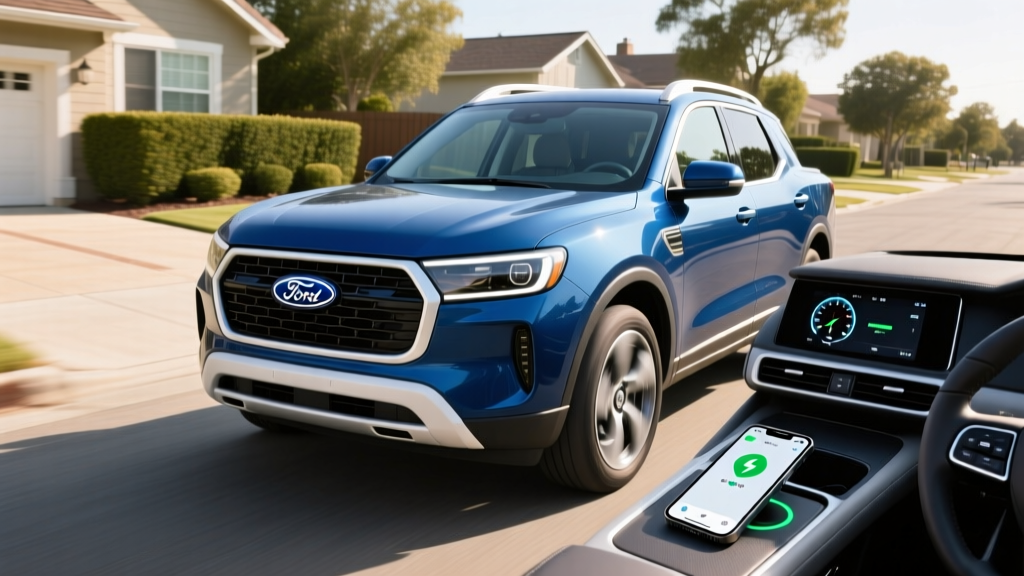
The Ford Maverick Hybrid has carved out a unique position in the compact truck market: genuine utility paired with fuel economy that rivals a midsize sedan. For 2026, Ford continues to refine the Maverick's hybrid powertrain, and buyers are searching for one key data point — the real-world 2026 Ford Maverick Hybrid MPG numbers and how they translate to daily driving and long-term ownership costs.
This guide covers the complete picture: EPA ratings versus real-world results, the hybrid powertrain architecture, pricing across trims, tax credit realities, battery longevity, and how the Maverick Hybrid stacks up against plug-in hybrid trucks and full EVs.
2026 Ford Maverick Hybrid MPG: EPA Ratings and Real-World Results
The 2026 Ford Maverick Hybrid pairs a 2.5-liter Atkinson-cycle four-cylinder engine with an electric motor and a 1.1 kWh lithium-ion battery pack, routing power to the front wheels through an electronic continuously variable transmission (eCVT). This is a conventional hybrid (HEV) — it charges its battery through regenerative braking and the engine. You never plug it in.
| Metric | EPA Rating | Real-World Expectation |
|---|---|---|
| City MPG | 42 MPG | 40–45 MPG (hybrids excel in stop-and-go) |
| Highway MPG | 33 MPG | 28–32 MPG (aero drag hurts at 70+ mph) |
| Combined MPG | 37 MPG | 34–39 MPG depending on driving mix |
| Fuel Tank Capacity | 16.5 gallons | — |
| Total Range | ~610 miles | ~560–640 miles |
HEV vs PHEV: Understanding What the Maverick Hybrid Actually Is
A common source of confusion in the truck market is the difference between a conventional hybrid (HEV) and a plug-in hybrid (PHEV). The Maverick Hybrid is an HEV. Here is what that means for your daily routine:
| Feature | HEV (Maverick Hybrid) | PHEV (e.g., upcoming rivals) | BEV (e.g., Rivian R1T, Ford F-150 Lightning) |
|---|---|---|---|
| Plug in to charge? | No — self-charging | Yes — 120V or 240V | Yes — 240V or DC fast charge |
| Electric-only range | 0 miles (motor assists engine) | 20–50 miles typical | 230–400+ miles |
| Total range | ~610 miles | 400–500 miles combined | 230–400 miles |
| Fuel/energy cost per mile | ~$0.10/mi (at $3.50/gal) | ~$0.04–0.10/mi | ~$0.04–0.06/mi (home charging) |
| Home charging needed? | No | Recommended (Level 2) | Essential (Level 2) |
| Federal tax credit (§30D) | Not eligible | Up to $7,500 (if requirements met) | Up to $7,500 (if requirements met) |
The Maverick Hybrid's biggest advantage over a PHEV or BEV truck is simplicity: no charging infrastructure needed, no range anxiety on long hauls, and a lower purchase price. The trade-off is that you will always burn some gasoline, and you miss out on the instant torque and near-silent operation of electric-only driving.
Powertrain Deep Dive: Engine, Motor, and Combined Output
The 2026 Maverick Hybrid's powertrain is a proven architecture Ford has used across multiple models. Here are the hard numbers:
| Component | Specification |
|---|---|
| Engine | 2.5L Atkinson-cycle inline-4 |
| Engine output | 162 hp / 155 lb-ft torque |
| Electric motor | Permanent-magnet synchronous, integrated in eCVT |
| Motor output | 126 hp / 173 lb-ft torque |
| Combined system output | 191 hp |
| Transmission | eCVT (planetary gearset, not belt-driven) |
| Drivetrain | Front-wheel drive (FWD standard; AWD available) |
| Hybrid battery | 1.1 kWh lithium-ion (not plug-in capable) |
| 0–60 mph | ~8.5 seconds (FWD) |
| Max towing capacity | 2,000 lbs (standard); 4,000 lbs with 4K Tow package (requires EcoBoost AWD) |
| Max payload | 1,500 lbs |
Note on AWD: For 2026, Ford offers the hybrid powertrain with available all-wheel drive, which drops EPA ratings slightly — expect roughly 39 city / 32 highway / 35 combined. The AWD system uses a rear-mounted electric motor rather than a mechanical driveshaft, which preserves cargo space and adds traction without the efficiency penalty of a traditional AWD system.
Pricing, Trims, and Tax Credit Eligibility
The 2026 Maverick Hybrid is positioned as an affordable entry into the truck market, undercutting most midsize and full-size trucks by a significant margin. Here is the current trim and pricing breakdown:
| Trim | Drivetrain | Base MSRP (est.) |
|---|---|---|
| XL Hybrid | FWD | ~$27,995 |
| XLT Hybrid | FWD | ~$29,495 |
| Lariat Hybrid | FWD | ~$33,495 |
| Lobo Hybrid (performance) | AWD | ~$36,995 |
AWD adds approximately $1,500–$2,000 to any trim equipped with the hybrid powertrain.
Battery Longevity, Warranty, and Replacement Cost
Hybrid battery anxiety is one of the most common concerns among first-time hybrid buyers. Here is what the data shows for the Maverick's system:
The Maverick's 1.1 kWh hybrid battery is small compared to a PHEV or BEV pack, which actually works in its favor for longevity. Smaller batteries experience shallower charge/discharge cycles, reducing stress on the cells. Ford's 2.5L hybrid system (shared with the Escape Hybrid and previously the Fusion Hybrid) has accumulated millions of real-world miles across taxi fleets and daily drivers, with widespread reports of batteries lasting 150,000–200,000+ miles without replacement.
If replacement is needed (typically after 10–15 years of use), expect the following cost range:
- Hybrid battery pack replacement: $2,500–$4,000 (parts + labor)
- Individual module replacement (if supported): $500–$1,200
- Refurbished/remanufactured packs: $1,500–$2,500
For context, this is a fraction of a BEV battery replacement ($10,000–$20,000+), and the hybrid battery is far less likely to need replacement within the vehicle's normal lifespan.
Who Should Buy the Maverick Hybrid — And Who Shouldn't
✓ Choose the Maverick Hybrid If:
- You want a real truck bed without paying full-size truck fuel costs
- Your commute is mostly city/suburban (where the hybrid shines at 40+ MPG)
- You lack access to home or workplace charging (apartment, street parking)
- You tow light loads (under 2,000 lbs) or don't tow at all
- You want lower total cost of ownership without the complexity of plug-in charging
- Budget is a priority — starting under $28K is hard to beat
✗ Look Elsewhere If:
- You need serious towing capacity (4,000+ lbs requires EcoBoost with 4K Tow)
- You want electric-only commuting to eliminate fuel costs entirely
- You do mostly highway driving at 75+ mph (the hybrid advantage shrinks)
- You want to qualify for the $7,500 federal tax credit (requires a BEV or PHEV)
- You need a crew cab with full-size rear seat space (Maverick rear seat is compact)
Ownership Costs: 5-Year Fuel Savings vs a Gas Maverick
The Maverick also offers a 2.0L EcoBoost turbocharged gas engine. Here is how the hybrid stacks up over five years of typical ownership (15,000 miles/year, $3.50/gallon average):
| Metric | Hybrid (37 MPG combined) | EcoBoost AWD (26 MPG combined) |
|---|---|---|
| Annual fuel use | ~405 gallons | ~577 gallons |
| Annual fuel cost | ~$1,418 | ~$2,020 |
| 5-year fuel cost | ~$7,090 | ~$10,100 |
| 5-year savings (Hybrid) | ~$3,010 | |
The hybrid's fuel savings typically offset its modest price premium over the EcoBoost within 2–3 years, depending on trim selection and local gas prices. At higher gas prices ($4.00+/gallon), the payback period shortens further.
Frequently Asked Questions
How many MPG does the 2026 Ford Maverick Hybrid actually get?
The EPA rates the FWD Maverick Hybrid at 42 city / 33 highway / 37 combined MPG. In real-world driving, owners regularly report 36–40 MPG in mixed commuting. City-heavy routes push it toward 42–45 MPG thanks to regenerative braking, while sustained highway driving at 75+ mph drops it to 28–32 MPG.
Does the Maverick Hybrid need to be plugged in?
No. The Maverick Hybrid is a conventional HEV. Its small 1.1 kWh battery charges through regenerative braking and the gasoline engine. You fuel it like any other truck — just with fewer stops at the pump.
Is the Maverick Hybrid reliable?
Ford's 2.5L hybrid powertrain is one of the most proven in the industry, with roots in the Fusion Hybrid (introduced 2009) and Escape Hybrid. The system has been widely used in fleet and taxi applications with strong durability records. Ford backs the hybrid components with an 8-year/100,000-mile warranty. The eCVT has no traditional belts or friction clutches, reducing common transmission failure points.
Can I get the Maverick Hybrid with AWD?
Yes. For 2026, Ford offers the hybrid powertrain with available AWD on select trims. AWD uses a rear electric motor rather than a mechanical driveshaft, preserving the flat load floor. Expect a 2–3 MPG drop across the board with AWD equipped.
Does the 2026 Maverick Hybrid qualify for a tax credit?
The Maverick Hybrid does not qualify for the federal §30D clean vehicle credit because it is not a plug-in vehicle. Some states offer minor hybrid incentives or HOV lane access — check the Alternative Fuels Data Center for your state's programs. If tax credits are a priority, you would need to look at a PHEV or BEV truck like the Ford F-150 Lightning or Rivian R1T.
What is the Maverick Hybrid's towing capacity?
The FWD Maverick Hybrid is rated for 2,000 lbs of towing. AWD hybrid models maintain the same 2,000-lb rating. If you need 4,000 lbs of towing, you must step up to the 2.0L EcoBoost engine with the available 4K Tow package — the hybrid powertrain is not offered with that package.
How does the Maverick Hybrid compare to the Hyundai Santa Cruz?
The Hyundai Santa Cruz does not offer a hybrid powertrain as of the 2026 model year. The Maverick Hybrid is currently the only compact truck with a hybrid option, giving it a distinct fuel-economy advantage in this segment. The Santa Cruz offers a more refined ride and standard AWD availability on turbo trims, but its best combined fuel economy (~23 MPG with the turbo engine) trails the Maverick Hybrid by roughly 40%.
Sources: EPA fuel economy data via fueleconomy.gov, Ford Motor Company official specifications, IRS New Clean Vehicle Credit guidelines, Alternative Fuels Data Center.