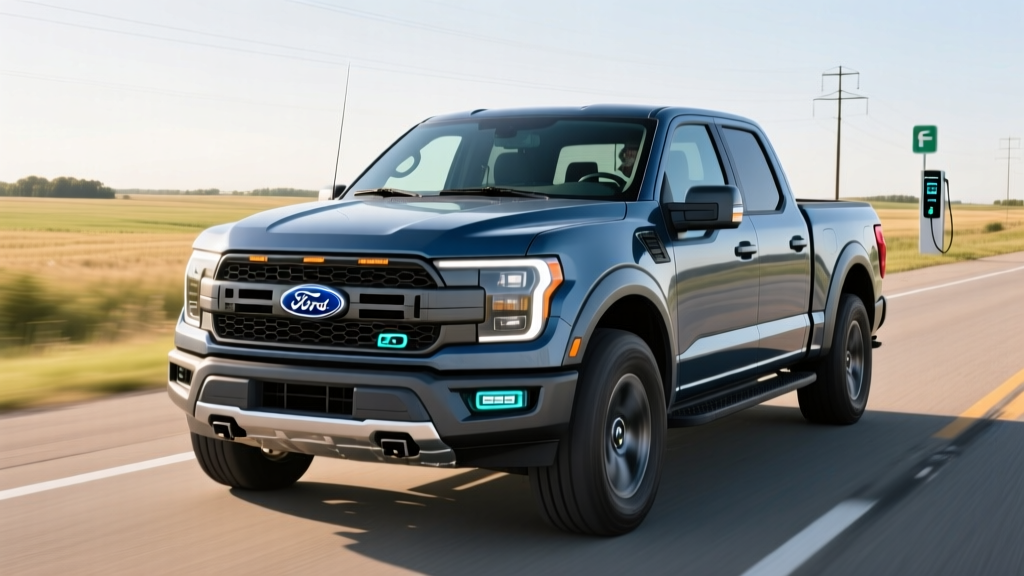
The 2026 Ford F-150 Hybrid — officially the F-150 PowerBoost — occupies a narrow but compelling lane in the full-size truck market. It's neither a plug-in hybrid nor a full battery-electric vehicle like the F-150 Lightning. Instead, it pairs a twin-turbo V6 with a self-charging hybrid system to deliver meaningful fuel savings over the gas-only F-150 without requiring a charger, a plug, or any change in refueling habits. For truck buyers who tow, haul, and cover serious highway miles but still wince at the pump, the PowerBoost is Ford's answer to the efficiency-versus-capability tradeoff.
This guide breaks down the 2026 F-150 Hybrid's real-world fuel economy, powertrain specs, towing limits, pricing, and ownership economics — and explains exactly who should (and shouldn't) consider it over the Lightning EV or the conventional EcoBoost.
HEV vs. PHEV: What the F-150 PowerBoost Actually Is
Before diving into specs, it's critical to understand what the 2026 F-150 Hybrid is not. The PowerBoost is a conventional hybrid (HEV). It cannot be plugged in. It has no electric-only driving range. Its small battery recharges exclusively through regenerative braking and the gasoline engine.
HEV (F-150 PowerBoost) vs. PHEV vs. BEV at a Glance
| Attribute | HEV (PowerBoost) | PHEV (e.g., Pacifica Hybrid) | BEV (F-150 Lightning) |
|---|---|---|---|
| Plugs in? | No | Yes | Yes |
| Electric-only range | None | 20–40 mi typical | 240–320 mi |
| Refuels at gas station | Yes | Yes | No |
| Home charger needed | No | Recommended | Required |
| Federal tax credit (§30D) | No | Up to $7,500* | Up to $7,500* |
*Eligibility depends on MSRP caps, buyer income, battery sourcing, and current-year IRS rules. See IRS §30D guidelines.
If you were hoping the 2026 F-150 Hybrid could drive 20–30 miles on electricity alone before the engine kicks in, that's not what this truck does. Ford does not currently offer a plug-in hybrid F-150. The PowerBoost is a self-charging system designed for incremental MPG gains and low-speed electric assist, not zero-emission commuting.
Powertrain Specs: 3.5L PowerBoost V6 Hybrid
The 2026 F-150 PowerBoost pairs Ford's 3.5-liter twin-turbocharged EcoBoost V6 with a 35 kW (47 hp) electric motor integrated into the 10-speed automatic transmission. A 1.5 kWh lithium-ion battery pack stores energy captured from regenerative braking and engine-generated electricity. That battery is small by EV standards — by design. It's there to smooth stop-start traffic, provide torque fill during acceleration, and enable brief electric assist at low speeds.
| Spec | 2026 F-150 PowerBoost Hybrid |
|---|---|
| Engine | 3.5L twin-turbo V6 + 35 kW electric motor |
| Combined output | 430 hp / 570 lb-ft torque |
| Transmission | 10-speed automatic |
| Drivetrain | RWD or 4WD |
| Battery | 1.5 kWh lithium-ion |
| 0–60 mph | ~5.8 seconds (4WD) |
| Max towing capacity | 7,800 lbs (properly equipped) |
| Max payload | ~1,735 lbs |
| Pro Power Onboard | Standard 2.4 kW (7.2 kW optional) |
The 570 lb-ft of combined torque is the headline figure here. That's more than the 5.0L V8 and competitive with the high-output EcoBoost variants, making the PowerBoost genuinely capable under load. The standard Pro Power Onboard system — essentially a built-in generator — turns the hybrid battery into a 2.4 kW power source for job-site tools, tailgating, or emergency home backup (7.2 kW on higher trims). That feature alone has swayed commercial fleet buyers and contractors who see the hybrid system as a productivity tool, not just an efficiency play.
Fuel Economy: EPA Ratings and Real-World MPG
The 2026 F-150 PowerBoost's EPA-estimated fuel economy lands at 24 MPG combined for the 4WD configuration, with a 25 MPG city and 23 MPG highway split. Rear-wheel-drive models edge slightly higher at 25 MPG combined. For a 7,800-pound-capable, body-on-frame truck, those numbers represent a substantial improvement over the non-hybrid 3.5L EcoBoost (roughly 20–22 MPG combined) and a dramatic one over the 5.0L V8 (18–19 MPG combined).
| Configuration | City | Highway | Combined |
|---|---|---|---|
| F-150 PowerBoost 4WD | 25 MPG | 23 MPG | 24 MPG |
| F-150 PowerBoost RWD | 25 MPG | 24 MPG | 25 MPG |
| F-150 3.5L EcoBoost 4WD | 18 MPG | 23 MPG | 20 MPG |
| F-150 5.0L V8 4WD | 16 MPG | 22 MPG | 18 MPG |
Source: fueleconomy.gov. Verify specific trim ratings before purchase.
Real-World MPG: What to Actually Expect
The EPA sticker is a starting point. In real-world driving, the PowerBoost's hybrid system shines in stop-and-go city traffic, where regenerative braking recaptures energy the gas-only trucks waste as heat. Many owners report 25–27 MPG in suburban and urban driving — exceeding the EPA city estimate. Highway driving is a different story. At sustained 75–80 mph speeds, the hybrid advantage shrinks because there's less braking to recapture energy, and you're hauling 5,300+ pounds of truck against aerodynamic drag. Expect 21–23 MPG on open interstate.
Towing changes the equation entirely. Hook up a 5,000-pound travel trailer and the PowerBoost will return roughly 12–15 MPG depending on terrain and wind — similar to the EcoBoost under load. The hybrid system doesn't magically eliminate the physics of towing weight, though the electric motor's low-end torque does make initial acceleration feel smoother.
Cold-weather impact is moderate compared to a full EV. The battery is small, and the engine runs more frequently in freezing temperatures to maintain cabin heat and battery charge, so expect a 1–2 MPG drop in sub-30°F conditions — nothing like the 20–30% range loss a BEV experiences.
Pricing, Trims, and Tax Credit Eligibility
The PowerBoost hybrid powertrain is available across multiple F-150 trims for 2026, starting with the XLT and extending through the Lariat, King Ranch, and Platinum. Ford positions it as a $2,500–$3,500 upgrade over the standard 3.5L EcoBoost depending on the trim and configuration.
| Trim | Starting MSRP (4WD) | PowerBoost Availability |
|---|---|---|
| XLT | ~$52,000 | Optional |
| Lariat | ~$60,000 | Optional / Standard on select packages |
| King Ranch | ~$68,000 | Optional |
| Platinum | ~$72,000 | Optional |
Pricing is approximate and excludes destination charges. Verify with Ford's build-and-price tool for exact configurations.
Does the F-150 Hybrid Qualify for a Federal Tax Credit?
No. The F-150 PowerBoost is a conventional hybrid (HEV), and the federal §30D Clean Vehicle Credit applies only to plug-in electric vehicles (BEVs and qualifying PHEVs) with sufficient battery capacity and compliant sourcing. The PowerBoost's 1.5 kWh battery falls far short of the minimum threshold, and it cannot be plugged in. There is no federal purchase incentive for this truck.
The all-electric F-150 Lightning is the Ford truck that may qualify for the up-to-$7,500 federal credit, subject to current-year MSRP caps ($80,000 for trucks), buyer income limits ($300,000 joint / $150,000 single), and battery critical-mineral sourcing requirements per IRS §30D rules. The Lightning can also transfer the credit to the dealer at point of sale, effectively reducing the purchase price at the dealership.
Some states offer their own rebates for hybrids, but these are increasingly rare and vary widely by jurisdiction. Check your state's energy or environmental agency for current programs.
Battery Warranty, Reliability, and Replacement Cost
The PowerBoost's hybrid battery is a frequent concern for first-time hybrid truck buyers. Ford covers the hybrid battery and related components under a 8-year / 100,000-mile warranty (extended to 10 years / 150,000 miles in California Air Resources Board states including CA, CO, CT, ME, MA, NJ, NY, OR, RI, VT, and WA). That warranty guarantees the battery will retain sufficient capacity to function as designed — not a specific percentage, but coverage against defects and premature degradation.
F-150 PowerBoost Hybrid Battery Warranty
- Standard coverage: 8 years / 100,000 miles
- CARB-state coverage: 10 years / 150,000 miles
- What's covered: Hybrid battery pack, electric motor, inverter, related control modules
- Out-of-warranty replacement estimate: $3,500–$5,500 (battery pack) plus labor
On reliability, the PowerBoost system has been in the F-150 lineup since the 2021 model year, giving it several years of field data. The 3.5L EcoBoost V6 itself is a proven engine with millions of units on the road across Ford's lineup. The primary early complaints centered on software glitches in the hybrid control system and occasional transmission shift hesitation — issues Ford has addressed through software updates in subsequent model years. The hybrid battery, being small and managed conservatively (never fully charged or fully depleted), is expected to last well beyond 150,000 miles under normal use, consistent with hybrid battery longevity across the industry.
For context, out-of-warranty hybrid battery replacement runs $3,500–$5,500 for the pack itself, with labor adding $500–$1,000. That's a fraction of what a full EV battery replacement costs ($15,000–$25,000), though the likelihood of needing it within the truck's useful life is low based on historical hybrid battery data from Toyota, Ford, and Honda.
PowerBoost vs. Lightning vs. EcoBoost: Which F-150 Fits You?
The F-150 lineup now offers three distinct powertrain philosophies. Choosing among them isn't about which is objectively best — it's about matching the truck to your driving pattern, infrastructure, and budget.
Choose the F-150 PowerBoost Hybrid if:
- You drive 15,000+ miles per year and want to reduce fuel costs without plugging in
- You need full towing capacity (7,800 lbs) and don't want EV range loss while towing
- You work on job sites and value Pro Power Onboard as a built-in generator
- You live in an apartment or lack home charging access
- You want a bridge technology — more efficient than gas, but not ready for full electric
Choose the F-150 Lightning (BEV) if:
- You can install a Level 2 home charger (240V / 30–60 amp circuit)
- Your daily driving is under 200 miles with predictable routes
- You want the lowest per-mile fuel cost (~$0.04–$0.08/mile on home electricity vs. ~$0.18–$0.24/mile on gas)
- You qualify for the §30D tax credit, which can offset $7,500 at point of sale
- You rarely tow heavy loads long distances (towing cuts EV range by 40–50%)
Choose the F-150 EcoBoost (Gas) if:
- Upfront cost is the top priority — the EcoBoost is $2,500–$3,500 cheaper than the PowerBoost
- You drive fewer than 10,000 miles per year (the hybrid fuel savings won't offset the premium)
- You prefer the simplest possible powertrain with no hybrid system complexity
Pros and Cons: 2026 F-150 PowerBoost
Pros
- 24–25 MPG combined — 4–6 MPG better than the V8, 2–4 better than the EcoBoost
- 570 lb-ft torque with smooth low-end electric assist
- No plug, no charger, no behavior change required
- Pro Power Onboard (2.4 kW standard, 7.2 kW available) for job-site and emergency use
- 8-year/100,000-mile hybrid warranty (10/150k in CARB states)
- Full 7,800-lb towing capacity retained
Cons
- No electric-only range — this is not a plug-in hybrid
- No federal tax credit eligibility
- $2,500–$3,500 price premium over the EcoBoost
- Highway MPG advantage is modest (23 MPG at 75 mph)
- Towing fuel economy drops to 12–15 MPG, similar to gas trucks
- Hybrid system adds weight and complexity vs. the base EcoBoost
Frequently Asked Questions
How many MPG does the 2026 Ford F-150 Hybrid get?
The 2026 F-150 PowerBoost is EPA-rated at 25 city / 23 highway / 24 combined MPG with 4WD. Real-world city driving often yields 25–27 MPG thanks to regenerative braking, while sustained highway driving at 75+ mph typically returns 21–23 MPG. Towing a trailer drops economy to 12–15 MPG depending on weight and conditions.
Can the F-150 Hybrid drive on electric power only?
Only at very low speeds for brief distances — think crawling through a parking lot or stop-and-go traffic for a few hundred yards. The 1.5 kWh battery is far too small for meaningful electric-only driving. This is a conventional hybrid, not a plug-in. If you need 20–40 miles of electric-only range, you'd need a PHEV like the Chrysler Pacifica Hybrid or a full BEV like the F-150 Lightning.
Does the 2026 F-150 Hybrid qualify for any tax credit?
No federal tax credit applies to the F-150 PowerBoost. The IRS §30D Clean Vehicle Credit requires plug-in capability and minimum battery capacity that conventional hybrids don't meet. Some states may offer modest hybrid rebates, but these vary by jurisdiction and are increasingly uncommon. The all-electric F-150 Lightning is the Ford truck eligible for federal incentives.
Is the F-150 PowerBoost reliable? What about battery replacement?
The PowerBoost has been in production since 2021 and the underlying 3.5L EcoBoost engine has years of proven service. Ford's hybrid battery warranty covers 8 years / 100,000 miles (10 years / 150,000 in CARB states). Out-of-warranty battery replacement is estimated at $3,500–$5,500, though most hybrid batteries last well beyond 150,000 miles based on industry-wide data.
How does the PowerBoost compare to the F-150 Lightning for daily driving?
If you have home charging, the Lightning delivers dramatically lower per-mile fuel costs (~$0.05/mile vs. ~$0.20/mile), instant torque, and a frunk. But the Lightning costs more upfront, loses 40–50% range when towing, and requires a 240V home charger installation ($500–$2,000). The PowerBoost sacrifices the lowest fuel cost but eliminates range anxiety, towing penalties, and charging infrastructure requirements entirely.
What is the towing capacity of the F-150 Hybrid?
The 2026 F-150 PowerBoost is rated to tow up to 7,800 pounds when properly equipped with the Max Trailer Tow Package. That's slightly less than the maximum available on the high-output EcoBoost (~13,000 lbs) but sufficient for most boat, utility, and mid-size travel trailer applications.
The 2026 Ford F-150 Hybrid won't satisfy buyers looking for electric-only commuting or federal tax credits. But for the large segment of truck owners who need full capability, drive high annual miles, and aren't ready to install a charger or plan charging stops, the PowerBoost delivers a practical 4–6 MPG improvement over gas-only alternatives with zero lifestyle compromise. It's the most fuel-efficient F-150 you can drive without ever plugging in — and for many truck buyers, that's exactly the right tradeoff.