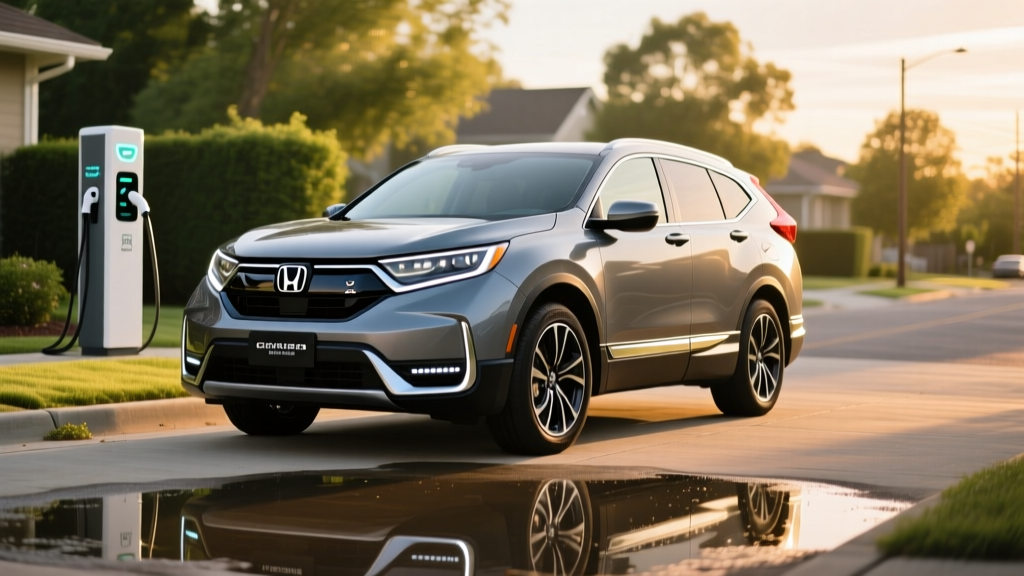
Fuel Tank Capacity: How Many Gallons in the 2026 CR-V Sport Touring Hybrid?
The 2026 Honda CR-V Sport Touring Hybrid carries a 14.0-gallon (53.0-liter) fuel tank. That's the direct answer to the question shoppers are searching, and it's a meaningful number when paired with this SUV's EPA-rated fuel economy. With a combined rating of 40 MPG, that 14.0-gallon tank translates to a theoretical maximum range of approximately 560 miles on a single fill-up — enough to drive from Chicago to Memphis without stopping for gas.
But real-world range depends on how and where you drive. City-heavy commutes actually push the CR-V Hybrid closer to — and sometimes slightly beyond — its EPA city rating, thanks to regenerative braking recapturing energy at every stoplight. Sustained highway cruising at 75+ MPH, steep mountain grades, or cold-weather operation below freezing can trim that range by 10–15%. Expect a realistic mixed-driving range of 480–540 miles before the low-fuel warning illuminates.
| Specification | Value |
|---|---|
| Fuel Tank Capacity | 14.0 gallons (53.0 L) |
| EPA Fuel Economy (City / Hwy / Combined) | 43 / 36 / 40 MPG |
| Theoretical Max Range | ~560 miles |
| Real-World Mixed Range | ~480–540 miles |
| Powertrain | 2.0L 4-cyl + 2 electric motors (HEV) |
| Combined Horsepower | 204 hp |
| Combined Torque | 247 lb-ft |
| Drivetrain | AWD (standard on Sport Touring) |
| 0–60 MPH | ~7.6 seconds |
| Cargo Volume (behind rear seats) | 36.3 cu ft |
| Starting MSRP (Sport Touring Hybrid AWD) | $40,850 |
| Hybrid Battery Warranty | 8 years / 100,000 miles |
Fuel Economy Breakdown: EPA Ratings vs. Real-World MPG
The 2026 CR-V Sport Touring Hybrid is rated by the EPA at 43 MPG city, 36 MPG highway, and 40 MPG combined. These figures apply specifically to the Sport Touring trim with standard all-wheel drive. Front-wheel-drive CR-V Hybrid trims (Sport and Sport-L) eke out slightly higher numbers — 43/36/40 MPG as well for 2026, though prior model years showed a 1–2 MPG advantage for FWD in some trims.
| Trim | Drivetrain | City | Highway | Combined |
|---|---|---|---|---|
| Sport Hybrid | FWD | 43 | 36 | 40 |
| Sport Hybrid | AWD | 43 | 36 | 40 |
| Sport-L Hybrid | AWD | 43 | 36 | 40 |
| Sport Touring Hybrid | AWD | 43 | 36 | 40 |
Real-world MPG reality check: Honda's two-motor hybrid system excels in stop-and-go traffic, where the electric motors handle low-speed propulsion and regenerative braking recovers kinetic energy. Owners consistently report 42–46 MPG in city-dominant driving, sometimes exceeding the EPA city sticker. Highway MPG is a different story. At sustained 70–80 MPH speeds, the 2.0L Atkinson-cycle engine does most of the work directly, and aerodynamic drag takes its toll. Expect 33–36 MPG on the highway, roughly matching or slightly below the EPA highway figure. In sub-freezing temperatures, expect a combined MPG drop of roughly 5–10% due to increased engine runtime for cabin heat and reduced battery efficiency.
For a detailed look at official EPA testing data, see the fueleconomy.gov database.
Hybrid vs. Plug-In Hybrid vs. Full EV: Which CR-V Fits You?
A common source of confusion among CR-V shoppers is the distinction between a conventional hybrid (HEV) and a plug-in hybrid (PHEV). The 2026 CR-V Sport Touring Hybrid is a conventional hybrid (HEV). It cannot be plugged in, has no electric-only driving range to speak of, and generates all its electricity from the gasoline engine and regenerative braking. Honda does not currently offer a plug-in hybrid variant of the CR-V in the US market for the 2026 model year.
| Feature | HEV (CR-V Hybrid) | PHEV (e.g., RAV4 Prime) | BEV (e.g., Ioniq 5) |
|---|---|---|---|
| Plugs in? | No | Yes | Yes |
| Electric-only range | ~1 mile at low speed | 30–42 miles typical | 250–350+ miles |
| Battery size | ~1.1 kWh (small) | 15–20 kWh | 60–100 kWh |
| Gasoline engine? | Yes (primary) | Yes (backup) | No |
| Home charging needed? | No | Recommended (Level 2) | Essential |
| Federal tax credit (§30D) | Not eligible | Up to $7,500 (if eligible) | Up to $7,500 (if eligible) |
| Best for | No home charging, long trips | Short commutes + road trips | Home charging + daily driving |
Choose the CR-V Hybrid (HEV) if: You don't have access to home or workplace charging, you take frequent long road trips, you want maximum simplicity with no plug-in routine, or you live in an apartment or condo without charging infrastructure. The HEV delivers meaningful fuel savings (roughly 40% better than the gas-only CR-V's ~30 MPG combined) without any change to your refueling habits.
Consider a PHEV or full EV if: You have reliable Level 2 home charging, your daily commute is under 35 miles round-trip (PHEV sweet spot), or you want to minimize or eliminate gasoline use. A PHEV like the Toyota RAV4 Prime offers ~42 miles of electric-only range for daily driving and a gas engine for longer trips. A full EV eliminates tailpipe emissions entirely but requires charging planning for road trips exceeding ~250 miles.
Powertrain Deep Dive: How the CR-V Hybrid System Works
The 2026 CR-V Sport Touring Hybrid uses Honda's fourth-generation two-motor hybrid system. Here's how the components break down:
- Engine: 2.0-liter DOHC 4-cylinder running the Atkinson cycle for maximum thermal efficiency, producing approximately 146 hp on its own
- Drive motor: One electric motor that primarily drives the front wheels, contributing up to 181 hp
- Generator motor: A second electric motor that acts as a generator, converting engine output to electricity or starting the engine
- Combined system output: 204 hp and 247 lb-ft of torque
- Battery: Lithium-ion hybrid battery pack (~1.1 kWh usable capacity), positioned under the cargo floor
- AWD system: The Sport Touring trim includes a rear-mounted electric motor that provides torque to the rear axle when needed — there is no mechanical driveshaft connecting the engine to the rear wheels
The system operates in three primary modes: EV Drive (battery powers the drive motor at low speeds for roughly a mile or less), Hybrid Drive (the engine spins the generator motor, which sends electricity to the drive motor — the engine doesn't directly turn the wheels), and Engine Drive (at steady highway speeds, a lockup clutch connects the engine directly to the front wheels for maximum efficiency). The transitions between these modes are nearly imperceptible from the driver's seat.
The 0–60 MPH time of approximately 7.6 seconds is respectable for the compact SUV segment and noticeably quicker than the non-hybrid CR-V's ~8.3-second run. The electric motor's instant torque delivery makes the CR-V Hybrid feel responsive in city driving and merging situations, even if it won't win any drag races.
Pricing, Tax Credits, and Total Cost of Ownership
The 2026 Honda CR-V Sport Touring Hybrid starts at an MSRP of $40,850 (including destination charge). As the top-of-the-line hybrid trim, it comes well-equipped: standard AWD, leather-trimmed seats, a 9-inch touchscreen with wireless Apple CarPlay and Android Auto, a Bose premium audio system, wireless phone charging, heated front seats, a heated steering wheel, and Honda's full Honda Sensing suite of driver-assistance features.
Pros
- 40 MPG combined — roughly 33% better than the gas CR-V AWD
- Standard AWD on Sport Touring with no fuel-economy penalty vs. FWD
- 560+ mile theoretical range from a 14.0-gallon tank
- Quick, smooth hybrid powertrain with 204 hp
- Strong resale value and Honda reliability reputation
- Comprehensive Honda Sensing safety suite standard
Cons
- Not eligible for the federal §30D EV/PHEV tax credit
- Highway MPG drops to low-to-mid 30s at 75+ MPH
- No plug-in option — cannot drive on electric-only for commutes
- Sport Touring trim pushes past $40K before options
- CVT-style operation can drone under hard acceleration
- Cold weather reduces MPG by 5–10%
Federal tax credit status: The conventional CR-V Hybrid does not qualify for the IRS §30D Clean Vehicle Credit. That credit — worth up to $7,500 — applies only to plug-in electric vehicles (PHEVs and BEVs) that meet battery sourcing, MSRP cap, and buyer income requirements per current IRS guidelines. Some states offer their own incentives for hybrid vehicles, though these are less common than EV incentives. Check your state's energy or environmental agency website for current programs.
Five-year fuel cost perspective: At 15,000 miles per year and $3.50/gallon regular unleaded, the CR-V Hybrid at 40 MPG combined would consume approximately 375 gallons annually, costing about $1,313 per year in fuel. Over five years, that's roughly $6,563. A comparable gas-only compact SUV averaging 28 MPG combined would burn about 536 gallons per year ($1,875 annually, or $9,375 over five years). The hybrid saves approximately $2,800 in fuel over five years — a meaningful offset to its higher purchase price.
Battery Warranty, Reliability, and Replacement Costs
Hybrid battery longevity is one of the most common concerns among first-time hybrid buyers. Here's what you need to know about the 2026 CR-V Hybrid's battery:
Hybrid Battery Warranty
Honda covers the CR-V Hybrid's lithium-ion battery pack for 8 years or 100,000 miles (whichever comes first) in most states. In California Air Resources Board (CARB) states — which include California, Colorado, Connecticut, Maine, Maryland, Massachusetts, New Jersey, New York, Oregon, Rhode Island, Vermont, Virginia, and Washington — the warranty extends to 10 years or 150,000 miles. This warranty covers battery capacity loss below a specified threshold and any manufacturing defects.
Real-world reliability data: Honda's hybrid systems have proven durable in long-term use. The two-motor architecture is mechanically simpler than traditional automatic transmissions (no multi-gear planetary sets or torque converters), and the hybrid battery is relatively small (~1.1 kWh), meaning it undergoes shallower charge-discharge cycles than a PHEV or EV battery — a key factor in longevity. Taxi fleets and high-mileage owners of previous-generation Honda hybrids have reported battery packs lasting well beyond 150,000 miles without replacement.
Replacement cost if out of warranty: Should the hybrid battery require replacement after the warranty period, expect a cost in the range of $2,000–$4,000 for the battery pack itself, plus $500–$1,000 in labor. This is significantly less than EV battery replacement ($10,000–$20,000+) because the hybrid battery is much smaller. Third-party refurbishment shops and used battery options are increasingly available for older Honda hybrids at lower cost.
For safety ratings and crash-test performance, check the latest results from IIHS and NHTSA, as the CR-V has historically performed well in both.
Who Should Buy the 2026 CR-V Sport Touring Hybrid?
Decision Framework
Choose the CR-V Sport Touring Hybrid if:
- You want a compact SUV that gets 40 MPG without plugging in
- You lack home or workplace Level 2 charging access
- You regularly take road trips exceeding 300 miles
- You want AWD capability with minimal fuel-economy penalty
- You prioritize proven reliability and strong resale value
- You want a premium trim (leather, Bose, wireless everything) under $42K
Look elsewhere (PHEV or EV) if:
- You have home charging and a sub-35-mile daily commute (a PHEV could eliminate most gas use)
- You want to maximize federal or state tax incentives (HEVs don't qualify for §30D)
- You want to minimize or eliminate gasoline purchases entirely
- You want one-pedal driving or the instant acceleration of a full EV
The 2026 CR-V Sport Touring Hybrid occupies a specific and well-defined niche: it's the right choice for buyers who want meaningful fuel savings and the torque-rich feel of electrified propulsion without altering their refueling routine. The 14.0-gallon tank and 40 MPG combined rating deliver genuine 500+ mile range, the AWD system handles four-season weather, and Honda's hybrid track record inspires confidence for long-term ownership. It's not a bridge to an electric future — it's a practical, efficient solution for today's drivers who aren't ready or able to plug in.
Frequently Asked Questions
How many gallons does the 2026 CR-V Sport Touring Hybrid hold?
The 2026 CR-V Sport Touring Hybrid has a 14.0-gallon (53.0-liter) fuel tank. This is the same tank capacity across all CR-V Hybrid trims for the 2026 model year.
How many MPG does the 2026 CR-V Sport Touring Hybrid get?
The EPA rates it at 43 MPG city, 36 MPG highway, and 40 MPG combined. In real-world driving, city-dominant routes can yield 42–46 MPG, while sustained highway driving at 75+ MPH typically returns 33–36 MPG.
Is the CR-V Hybrid a plug-in hybrid?
No. The 2026 CR-V Hybrid is a conventional hybrid (HEV). It does not plug in, has no meaningful electric-only range, and recharges its small battery through the gasoline engine and regenerative braking. Honda does not offer a plug-in CR-V in the US for 2026.
Does the 2026 CR-V Hybrid qualify for a federal tax credit?
No. The IRS §30D Clean Vehicle Credit applies only to plug-in electric vehicles (PHEVs and BEVs). Conventional hybrids like the CR-V Hybrid are not eligible. Some state-level incentives may apply — check your state's energy agency for details.
How long will the CR-V Hybrid battery last?
Honda warrants the hybrid battery for 8 years/100,000 miles (10 years/150,000 miles in CARB states). Real-world data from previous-generation Honda hybrids suggests the battery can last 150,000+ miles under normal use. Out-of-warranty replacement costs approximately $2,000–$4,000 for the battery pack.
What is the real-world range on a full tank?
With the 14.0-gallon tank and 40 MPG combined, the theoretical maximum is approximately 560 miles. In mixed real-world driving, expect 480–540 miles per tank. Highway-heavy driving and cold weather will reduce range toward the lower end of that estimate.
How does the CR-V Hybrid compare to the gas-only CR-V?
The gas-only 2026 CR-V AWD is rated at approximately 29 MPG combined. The Hybrid's 40 MPG combined represents a roughly 38% improvement. The hybrid also delivers more torque (247 lb-ft vs. 179 lb-ft) and quicker acceleration (7.6 sec vs. ~8.3 sec 0–60), making it both more efficient and more responsive.