Quick Verdict: The Only Plug-In Hybrid Minivan That Still Matters
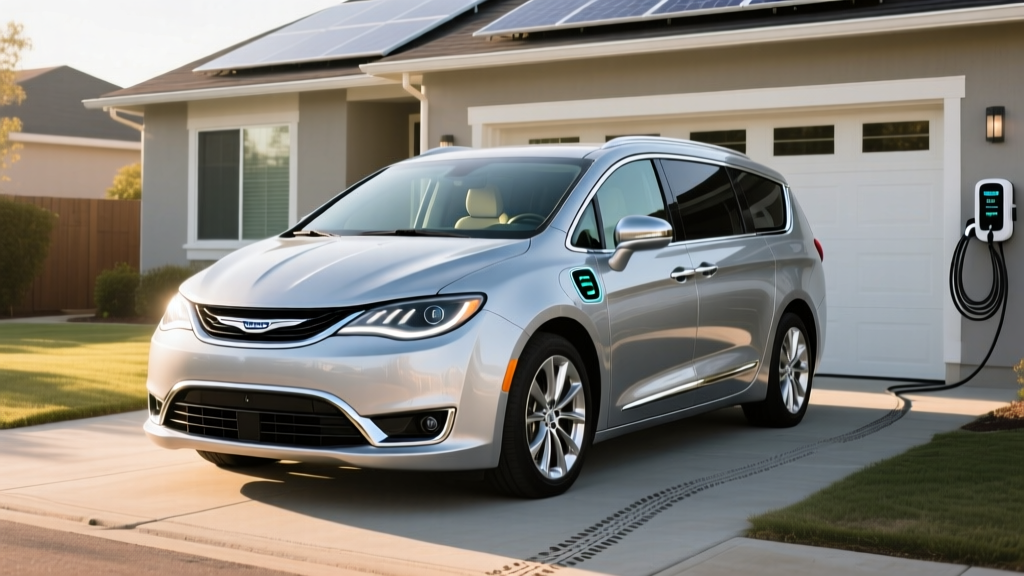
The 2026 Chrysler Pacifica Plug-In Hybrid occupies a segment of one. No other automaker sells a PHEV minivan in the United States, and for families who need three rows, sliding doors, and the ability to do school runs on electricity alone, that monopoly is the whole point. With an EPA-rated 32 miles of electric-only range, 82 MPGe combined, and a total system range exceeding 520 miles, the Pacifica PHEV bridges daily electric commuting and cross-country road trips without compromise.
But the Pacifica PHEV isn't cheap — starting around $51,095 before incentives — and it trades some cargo versatility for the battery pack beneath the floor. Stow 'n Go second-row seating is unavailable on the plug-in variant. If you can charge at home and your daily driving stays under 30 miles, this minivan can operate as a de facto EV most days while keeping a gas engine for weekend hauls.
HEV vs PHEV: Understanding the Two Pacifica Powertrains
Chrysler sells the Pacifica in two electrified flavors, and confusing them is a common buyer mistake. Here is the fundamental difference:
Conventional Hybrid (HEV)
- No plug required. The battery recharges through regenerative braking and the engine.
- Electric assist only. The electric motor helps the gas engine but cannot propel the van alone for meaningful distances.
- EPA combined: ~30 MPG.
- Battery: Small (~1.8 kWh), not externally chargeable.
- Stow 'n Go: Available — second-row seats fold into the floor.
Plug-In Hybrid (PHEV)
- Plug-in charging required to unlock the electric-only range benefit.
- 32 miles electric-only before the gas engine engages.
- EPA combined (hybrid mode): 30 MPG | MPGe: 82.
- Battery: 16 kWh lithium-ion, Level 2 chargeable.
- Stow 'n Go: NOT available on second row (battery occupies under-floor space).
If you cannot charge at home or at work, the PHEV's premium over the HEV is difficult to justify — you'll be carrying 16 kWh of battery weight without using its electric capability. If you can plug in nightly, the PHEV transforms your weekday driving economics entirely.
Fuel Economy and Electric Range: What the EPA Says vs. Reality
The EPA rates the 2026 Pacifica PHEV at 82 MPGe (miles per gallon equivalent) when operating on combined battery and fuel energy, and 30 MPG combined once the battery is depleted and the van runs as a conventional hybrid. Here is the full breakdown:
| Mode | City | Highway | Combined |
|---|---|---|---|
| Electric + Gas (MPGe) | — | — | 82 MPGe |
| Hybrid-only (MPG, battery depleted) | 29 | 30 | 30 |
| Electric-only range | 32 miles (EPA) | ||
| Total combined range | ~520 miles | ||
Real-World Range Expectations
EPA electric range: 32 miles. In mixed suburban driving at moderate temperatures (60–75°F), expect 28–33 miles on a full charge. Highway speeds above 70 mph cut electric range to roughly 22–25 miles. In freezing weather (below 32°F), plan for 20–24 miles of electric range due to cabin heating demands and reduced battery efficiency. The Pacifica PHEV does not include a heat pump — it uses resistive heating, which draws heavily from the battery in cold conditions.
Once the battery depletes, the Pacifica PHEV operates as a conventional hybrid. Real-world hybrid-mode MPG tends to land between 27–31 MPG depending on driving style and terrain, consistent with the EPA's 30 MPG combined estimate. Unlike smaller hybrids, minivans don't benefit as dramatically from city regenerative braking due to their mass (~5,000 lbs curb weight), so city and highway figures are unusually close.
Powertrain and Performance Specs
The Pacifica PHEV pairs a 3.6-liter Pentastar V6 engine with two electric motors integrated into a continuously variable transmission (eVT). The system prioritizes electric propulsion at low speeds and seamlessly blends in the gas engine under heavier loads or once the battery is depleted.
| Specification | Value |
|---|---|
| Engine | 3.6L V6 (Atkinson cycle) |
| Electric motors | 2 integrated (eVT) |
| Combined system horsepower | 260 hp |
| Battery capacity | 16 kWh (lithium-ion) |
| Electric-only range (EPA) | 32 miles |
| Total range | ~520 miles |
| 0–60 mph (est.) | ~7.1 seconds |
| Drivetrain | Front-wheel drive |
| Towing capacity | Not rated for towing (PHEV) |
| Cargo volume (behind 3rd row) | 32.3 cu ft |
| Cargo volume (max, all rows folded) | 140.5 cu ft |
A critical trade-off: the Pacifica PHEV is front-wheel drive only. Chrysler does not offer AWD on the plug-in variant (AWD is available on the gas-only Pacifica). If you need all-wheel drive for snow-belt living, you'll need to look at the conventional Pacifica AWD or a competing three-row SUV PHEV like the Toyota Grand Highlander Hybrid Max — though neither offers the minivan's sliding-door convenience.
Also note: the PHEV is not rated for towing. The battery placement and thermal management constraints mean Chrysler advises against towing with the plug-in model. If you need to pull a trailer, the gas-only Pacifica (rated up to 3,600 lbs) is the correct choice.
Charging: Times, Connectors, and the No-DC-Fast-Charge Limitation
The Pacifica PHEV's 16 kWh battery can be replenished two ways. Understanding the difference between kW (power, or charge speed) and kWh (energy, or battery capacity) is essential here — the Pacifica accepts relatively modest power, so charging is a patience game compared to full EVs.
| Charge Level | Power (kW) | 0–100% Time | Connector |
|---|---|---|---|
| Level 1 (120V household outlet) | ~1.4 kW | ~13 hours | J1772 |
| Level 2 (240V home/public) | ~6.6 kW | ~2 hours | J1772 |
| DC Fast Charge | Not supported | ||
The Pacifica PHEV cannot DC fast charge. This is a deliberate engineering choice common to most PHEVs with smaller batteries. Since the 16 kWh pack is designed for overnight home charging and daily electric commuting, Chrysler did not include DC fast-charge hardware. On a road trip, you'll simply drive in hybrid mode — there's no benefit to stopping at a DC fast charger even if one is available.
For home charging, a Level 2 station at 6.6 kW will refill the battery in roughly two hours. Most PHEV owners plug in overnight using either a Level 2 wallbox or even a standard 120V outlet (Level 1), which adds about 5–6 miles of range per hour of charging — sufficient if you can leave it plugged in for 10+ hours.
Battery and Powertrain Warranty
Chrysler covers the Pacifica PHEV's high-voltage battery with a 10-year / 100,000-mile warranty (in CARB states; 8-year/100,000-mile in other states). This warranty guarantees the battery will retain a minimum capacity threshold — typically 70% of original capacity. The powertrain (engine, eVT, electric motors) is also covered for 5 years / 60,000 miles. The conventional 12V auxiliary battery carries a separate 3-year/36,000-mile warranty.
Battery replacement cost: Out-of-warranty replacement of the 16 kWh pack has historically ranged from $5,500 to $7,500 including labor, though prices vary by dealer and parts availability. Given the 10-year/100k-mile coverage, most original owners will never face this expense. Chrysler's PHEV battery track record since the 2017 model year launch has been generally positive, with fewer widespread degradation complaints than early Nissan Leaf or Chevy Bolt packs.
Pricing, Trims, and Federal Tax Credit Eligibility
The 2026 Chrysler Pacifica Plug-In Hybrid is offered in two primary trims. Pricing reflects the PHEV premium over the conventional hybrid, which runs roughly $8,000–$10,000 higher depending on trim.
| Trim | MSRP (est.) | Key Features |
|---|---|---|
| Pacifica PHEV Select | ~$51,095 | Heated front seats, Uconnect 5 (10.1"), power sliding doors, 32-mi EV range |
| Pacifica PHEV Limited | ~$56,095 | Nappa leather, ventilated front seats, hands-free liftgate, premium audio, 360° camera |
Federal tax credit (§30D): The Pacifica PHEV's eligibility for the federal plug-in vehicle credit is complex and subject to change. Under current IRS rules, the vehicle must meet battery component and critical mineral sourcing requirements, the buyer must fall under income caps ($150,000 single / $300,000 joint modified AGI), and the vehicle MSRP must not exceed $80,000 for vans/SUVs. The Pacifica PHEV's MSRP clears the cap, but battery sourcing compliance varies by model year and production batch.
- MSRP cap: Vehicle must be under $80,000 (vans/SUVs) — Pacifica PHEV qualifies.
- Income cap: Buyer MAGI must be under $150K (single) or $300K (joint).
- Battery sourcing: Critical minerals and battery components must meet phased-in domestic/FEOC thresholds. Verify on fueleconomy.gov for the specific 2026 model year status.
- Point-of-sale transfer: If eligible, the credit (up to $7,500) can be applied as a down-payment reduction at the dealer.
- State incentives: Some states (CA, CO, NY, MA, and others) offer additional rebates for PHEVs — check your state energy office or AFDC state incentive database.
Consult a tax professional before assuming credit eligibility. The IRS maintains the definitive list of qualifying vehicles at irs.gov, and the list updates periodically as automakers adjust supply chains.
Who Should Buy the Pacifica PHEV — and Who Shouldn't
Pros
- Only PHEV minivan on the market — no direct competitor
- 32-mile EV range covers most school runs, errands, and commutes
- 520+ mile total range eliminates road-trip range anxiety
- Level 2 charging in ~2 hours is practical for daily use
- Stow 'n Go third row still folds flat for cargo
- 10-year/100,000-mile battery warranty (CARB states)
- Families can transition to electric daily driving without giving up the minivan form factor
Cons
- Starting near $51K — significant premium over the gas Pacifica
- No Stow 'n Go on second row (captain's chairs only, battery underneath)
- No AWD option — FWD only
- No DC fast charging
- Not rated for towing
- No heat pump — cold-weather EV range drops significantly
- Electric range insufficient for drivers with 40+ mile one-way commutes
PHEV vs. Full EV vs. Gas: Which Pacifica Fits You?
Choose the Pacifica PHEV if: You can charge at home (Level 1 or 2), your daily driving is under 30 miles round-trip, you need a minivan specifically, and you want to reduce fuel costs without committing to a full EV's range limitations on road trips.
Choose the Pacifica HEV (conventional hybrid) if: You cannot charge at home, you need second-row Stow 'n Go flexibility, you want AWD availability, or you want lower upfront cost while still gaining MPG over the gas-only model.
Choose a full EV (e.g., Kia EV9, Tesla Model X) if: You want zero tailpipe emissions, have reliable home and destination charging, don't need minivan-specific features like sliding doors, and are comfortable with DC fast-charging on road trips.
Reliability and Long-Term Ownership
The Pacifica PHEV has been in production since the 2017 model year, giving Chrysler one of the longest-running PHEV minivan track records in the industry. Early model years (2017–2019) saw some recalls related to the high-voltage battery — specifically, a fire-risk recall affecting certain 2017–2018 units where Chrysler recommended parking outdoors and limiting charge to 80%. Those issues were addressed through software updates and battery module replacements under recall.
For the 2026 model year, Chrysler has refined the battery management system and thermal controls. The eVT transmission has proven durable, with no widespread failure reports. The 3.6L Pentastar V6 is one of Stellantis's most proven engines, with millions of units on the road across multiple brands.
According to NHTSA, the Pacifica PHEV carries favorable safety ratings, and the vehicle's structural design accommodates the under-floor battery without compromising crash performance. Routine maintenance costs are lower than the gas-only Pacifica thanks to regenerative braking (less pad wear) and reduced engine operation during electric-mode driving.
Frequently Asked Questions
How many MPG does the 2026 Chrysler Pacifica Plug-In Hybrid get?
The EPA rates the Pacifica PHEV at 82 MPGe combined when factoring in electric operation, and 30 MPG combined (29 city / 30 highway) once the battery is depleted and the van runs in hybrid mode. Real-world hybrid MPG typically falls between 27–31 depending on driving conditions.
How far can the Pacifica PHEV go on electric only?
The EPA rates it at 32 miles of electric-only range. In real-world driving, expect 28–33 miles in mild weather and suburban conditions, 22–25 miles at sustained highway speeds, and 20–24 miles in freezing temperatures. The van transitions seamlessly to hybrid mode once the battery is depleted — you won't be stranded.
Does the Pacifica PHEV qualify for a federal tax credit?
It may, depending on battery sourcing compliance for the 2026 model year, your income level, and MSRP. The van's price falls under the $80,000 van/SUV cap. Check the current qualifying vehicle list on irs.gov and confirm with your dealer and tax professional before purchase.
Is the Pacifica PHEV reliable, and what does battery replacement cost?
The Pacifica PHEV has been in production since 2017 with generally positive reliability outcomes after early recalls were addressed. The battery carries a 10-year/100,000-mile warranty (CARB states). Out-of-warranty replacement costs have historically ranged from $5,500 to $7,500. Most owners will not face this cost within the warranty period.
Can I DC fast charge the Pacifica PHEV?
No. The Pacifica PHEV does not support DC fast charging. It charges via Level 1 (120V, ~13 hours) or Level 2 (240V, ~2 hours) using a J1772 connector. This is standard for PHEVs with smaller battery packs — the design intent is overnight home charging, not highway fast-charging stops.
Why doesn't the PHEV have Stow 'n Go second-row seats?
The 16 kWh battery pack is mounted beneath the second-row floor area, occupying the space that Stow 'n Go compartments would use. The second-row captain's chairs are removable but do not fold into the floor. The third row still features Stow 'n Go folding.
Hybrid vs PHEV vs EV — which is right for my family?
If you need a minivan and can charge at home, the PHEV gives you electric weekdays and gas-engine flexibility for road trips. If you can't charge at home, the conventional Pacifica HEV provides solid MPG without a plug. If you're ready to go fully electric and don't need minivan-specific features, consider a three-row EV SUV like the Kia EV9 (EPA range up to 304 miles) — but you'll sacrifice sliding doors and the lowest step-in height.