The Hybrid Jeep Grand Cherokee 4xe: What You're Actually Buying
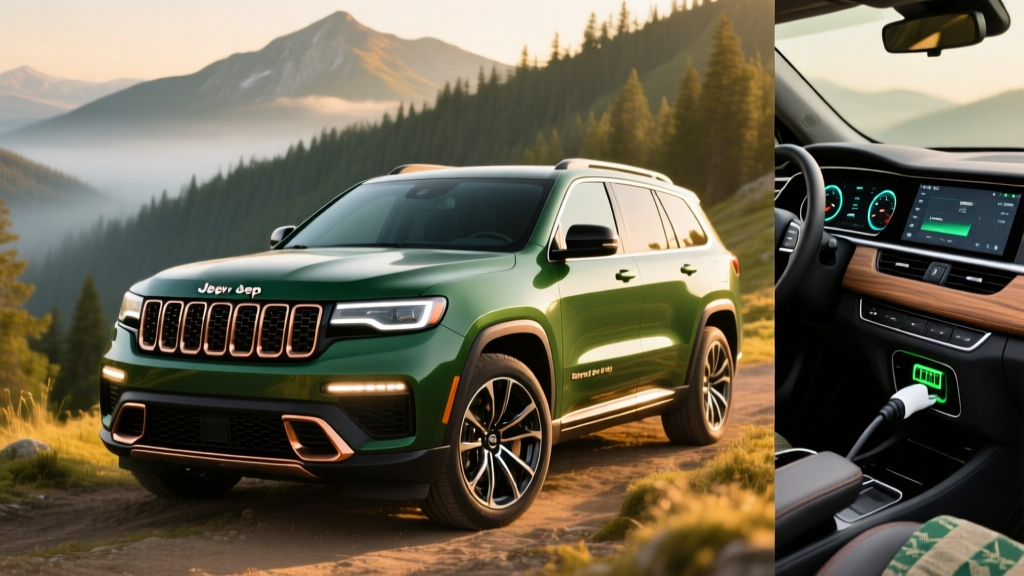
If you've been searching for a hybrid Jeep Grand Cherokee, what you'll find in 2026 is the Grand Cherokee 4xe — a plug-in hybrid (PHEV) that pairs a 2.0-liter turbocharged four-cylinder engine with two electric motors and a 17.3 kWh battery pack. It's not a conventional hybrid you simply fill with gas and forget; it's a vehicle that rewards you with roughly 25 miles of electric-only driving before the gas engine seamlessly takes over.
The 4xe powertrain produces a combined 375 horsepower and 470 lb-ft of torque, routed through an eight-speed automatic transmission and Jeep's 4x4 system. That's more torque than the V6 gas model and enough to move this 5,300-pound SUV with genuine urgency. The 0-60 mph time lands around 6.0 seconds — brisk for a three-row-capable family hauler.
But performance is only half the story. The real question for buyers is whether the 4xe's electrified drivetrain delivers meaningful fuel savings, whether you can actually charge it conveniently, and whether the premium over the gas-only Grand Cherokee makes financial sense. Let's work through the numbers.
HEV vs. PHEV: Why the Grand Cherokee 4xe Requires a Plug
Jeep does not currently offer a conventional hybrid (HEV) Grand Cherokee in the US market. The 4xe badge means plug-in hybrid, and understanding the difference is critical before you buy:
| Feature | Conventional Hybrid (HEV) | Plug-in Hybrid (PHEV) — Grand Cherokee 4xe |
|---|---|---|
| Plug-in charging required? | No — regenerates via braking and engine | Yes — plug in to access full electric range |
| Electric-only driving | Minimal (1-2 mi at low speed) | ~25 miles at full highway speed |
| Battery size | Small (~1-2 kWh) | 17.3 kWh (usable ~14.5 kWh) |
| Fuel savings potential | Moderate (10-20% improvement) | High if daily driving is under electric range |
| Tax credit eligible? | No | Potentially up to $3,750 under §30D |
If you cannot charge at home or at work, the Grand Cherokee 4xe still functions as a heavy, slightly less efficient hybrid once the battery depletes. You'll still benefit from regenerative braking and electric assist at low speeds, but you'll forfeit the biggest advantage — those 25 miles of zero-gas commuting. Charging access is the single most important factor in whether this vehicle makes sense for you.
Fuel Economy and Electric Range: The EPA Numbers and Reality
The EPA rates the 2026 Jeep Grand Cherokee 4xe at 56 MPGe (miles per gallon equivalent) when operating in combined electric-plus-gas mode, and 23 MPG combined once the battery is depleted and the vehicle runs on gasoline alone. Here's the full breakdown:
| Mode | City | Highway | Combined |
|---|---|---|---|
| Charge-sustaining (gas only, battery depleted) | 23 MPG | 24 MPG | 23 MPG |
| Blended (electric + gas, MPGe) | — | — | 56 MPGe |
| Electric-only range | 25 miles (EPA estimated) | ||
| Total range (full tank + full charge) | ~440 miles | ||
Source: fueleconomy.gov
Real-world range reality: The EPA's 25-mile electric-only estimate assumes moderate temperatures and mixed driving. In cold weather (below 30°F), expect that figure to drop to roughly 18-20 miles as the battery's usable capacity shrinks and cabin heating draws power. On warm-weather city commutes under 45 mph, some owners report stretching to 27-28 miles. Highway driving at 70+ mph depletes the battery faster — plan for 20-22 electric miles on faster roads.
Once the battery is depleted, the 23 MPG combined figure is respectable for a 5,300-pound, four-wheel-drive SUV, but it's not dramatically better than the gas-only Grand Cherokee V6, which returns 21 MPG combined. The fuel savings advantage of the 4xe comes almost entirely from those daily electric-only miles. If your commute is 20 miles round-trip and you charge every night, you might burn gasoline only a few times per month.
Charging the Grand Cherokee 4xe: What You Need at Home
The Grand Cherokee 4xe uses a standard J1772 connector for AC charging. It does not support DC fast charging — there is no CCS or NACS port for rapid top-ups. This is typical for PHEVs with smaller battery packs.
| Charging Method | Power | Time (0-100%) | Notes |
|---|---|---|---|
| Level 1 (standard 120V outlet) | ~1.4 kW | ~10-12 hours | Works for overnight charging if daily use is under 25 mi |
| Level 2 (240V home charger) | ~7.2 kW (onboard charger limited) | ~2.5 hours | Recommended for daily use; full charge during workday or overnight |
The onboard charger is rated at approximately 7.2 kW, meaning even if you install a 48-amp Level 2 charger capable of delivering 11.5 kW, the 4xe will only accept 7.2 kW. A 32-amp Level 2 unit (7.7 kW) is the practical sweet spot — it'll fully recharge the pack in about 2.5 hours, which is fast enough to top up during a workday or between errands.
Home installation cost: A Level 2 charger installation typically runs $600-$1,800 depending on whether your electrical panel needs an upgrade. The charger unit itself costs $300-$700 for a quality unit (ChargePoint Home Flex, Emporia Level 2, or similar). If your panel is already 200 amps and the run from panel to garage is short, expect the lower end. Older homes with 100-amp panels may need a $1,500-$3,000 panel upgrade — factor this into your purchase decision.
Unlike a full BEV, the 4xe's small battery means Level 1 charging from a standard household outlet is actually viable for many owners. If you drive under 25 miles daily and plug in overnight, a 120V outlet will replenish enough charge by morning. It's slow, but for a 17.3 kWh pack, it's workable.
Powertrain and Performance: 375 HP With a Turbo Four
The 4xe powertrain combines:
- 2.0L turbocharged inline-four gasoline engine: 270 hp, 295 lb-ft
- Two electric motors integrated into the transmission and front axle
- 17.3 kWh lithium-ion battery pack (NMC chemistry, liquid-cooled)
- Eight-speed automatic transmission with integrated electric motor
- Full-time 4x4 with Jeep's Selec-Terrain traction management
Combined output is 375 horsepower and 470 lb-ft of torque. The torque figure is especially impressive — it exceeds the 5.7L V8 HEMI option and gives the 4xe strong passing power and confident highway merging. The electric motors fill in the low-end torque gap that turbocharged four-cylinders often exhibit, making acceleration feel linear and immediate.
Towing capacity is rated at 6,000 pounds when properly equipped — identical to the V6 gas model and sufficient for most boat trailers, small campers, and utility trailers. Note that towing will significantly reduce your electric-only range; expect roughly 10-12 electric miles when pulling a loaded trailer.
| Specification | 2026 Jeep Grand Cherokee 4xe |
|---|---|
| Combined Horsepower | 375 hp |
| Combined Torque | 470 lb-ft |
| Engine | 2.0L turbo I4 + dual electric motors |
| Battery Capacity | 17.3 kWh (NMC, liquid-cooled) |
| Electric-Only Range | 25 miles (EPA) |
| Total Range | ~440 miles |
| 0-60 mph | ~6.0 seconds |
| Towing Capacity | 6,000 lbs |
| Drivetrain | Full-time 4x4 |
| Transmission | 8-speed automatic |
Pricing, Trims, and Federal Tax Credit Eligibility
The 2026 Jeep Grand Cherokee 4xe starts at approximately $56,095 (including destination) for the base trim and climbs to over $73,000 for a fully loaded Summit Reserve. Here's a trim-level overview:
| Trim | Starting MSRP | Key Features |
|---|---|---|
| 4xe (base) | $56,095 | 10.1" infotainment, wireless CarPlay/Android Auto, 4x4 |
| Trailhawk 4xe | $63,595 | Air suspension, skid plates, all-terrain tires, electronic sway-bar disconnect |
| Overland 4xe | $66,395 | Nappa leather, panoramic sunroof, 19" wheels, hands-free liftgate |
| Summit 4xe | $70,195 | McIntosh 19-speaker audio, front-passenger display, night-vision camera |
| Summit Reserve 4xe | $73,595 | Palermo leather, rear-seat entertainment, head-up display |
Does the Grand Cherokee 4xe Qualify for a Federal Tax Credit?
Under current IRS §30D rules, the Grand Cherokee 4xe may qualify for up to $3,750 in federal tax credits — but eligibility depends on several factors that change frequently:
- MSRP cap: SUVs must have an MSRP under $80,000. All Grand Cherokee 4xe trims currently fall under this cap.
- Buyer income cap: Modified adjusted gross income must not exceed $150,000 (single), $225,000 (head of household), or $300,000 (married filing jointly).
- Battery sourcing: The $3,750 credit requires meeting critical-minerals sourcing requirements. The full $7,500 additionally requires battery-component assembly in North America. As of 2026, the 4xe typically qualifies for $3,750 based on partial sourcing compliance.
- Point-of-sale transfer: You can elect to transfer the credit to the dealer at purchase, reducing your out-of-pocket cost immediately rather than waiting to claim it on your tax return.
Always verify current eligibility on IRS.gov or consult a tax professional before relying on credit amounts. Battery sourcing requirements tighten annually, and specific model eligibility can change mid-year.
Some states offer additional incentives for PHEVs — California, Colorado, and New York have programs that may stack with the federal credit. Check your state's energy office or AFDC state incentive database for current programs.
Battery Longevity, Warranty, and Replacement Cost
Jeep's hybrid battery warranty: The Grand Cherokee 4xe's high-voltage battery is covered for 8 years or 100,000 miles (whichever comes first), with a capacity-retention threshold of 70%. In California Air Resources Board (CARB) states, that warranty extends to 10 years or 150,000 miles. If the battery drops below 70% of original capacity within the warranty period, Jeep will repair or replace it at no cost.
PHEV battery degradation is generally modest. The 4xe's liquid-cooled NMC pack is designed to handle daily cycling, and Jeep's battery management system maintains a buffer — you can't fully drain or fully charge the pack to the cell level, which reduces stress on the chemistry.
Real-world degradation data from earlier 4xe models (2022-2024) suggests most owners retain 90-95% of original electric range after 3 years and 40,000-50,000 miles. This is consistent with PHEV battery performance across the industry, where smaller packs with conservative charge/discharge buffers tend to age well.
Out-of-warranty replacement cost: If the battery requires replacement after warranty expiration, expect a cost between $8,000 and $12,000 including parts and labor. This is a significant figure, though it's worth noting that complete PHEV battery failures are rare — most degradation issues involve individual module replacements at lower cost. The conventional 12V auxiliary battery is a separate, inexpensive maintenance item ($200-$350 replacement).
The gasoline powertrain components carry Jeep's standard 5-year/60,000-mile powertrain warranty, and the vehicle's limited warranty covers 3 years/36,000 miles bumper-to-bumper.
Who Should Buy the Hybrid Jeep Grand Cherokee — And Who Shouldn't
Choose the Grand Cherokee 4xe if:
- Your daily commute is under 25 miles round-trip and you can charge at home
- You want a premium, off-road-capable SUV with genuine towing ability
- You take road trips where charging infrastructure is sparse — the gas engine eliminates range anxiety
- You want 375 hp and 470 lb-ft without stepping to a V8 or full EV
- You value the Trailhawk trim's off-road capability with reduced fuel use on pavement
Choose a full EV (like the Rivian R1S or Tesla Model X) if:
- You have reliable home charging and your daily driving is under 250 miles
- You want zero gasoline expenses and minimal maintenance (no oil changes, fewer moving parts)
- You qualify for the full $7,500 federal credit on an eligible BEV
Choose the gas-only Grand Cherokee (3.6L V6) if:
- You cannot charge at home or at work
- Your budget is under $50,000 and you don't want to stretch for the 4xe premium
- Your annual mileage is low enough that fuel savings won't offset the 4xe's higher purchase price
The financial breakeven point depends heavily on your driving patterns. If you drive 30 miles per day, charge nightly, and pay $3.50/gallon for gas, the 4xe might save you $1,200-$1,800 annually in fuel versus the V6 gas model. Against a $6,000-$8,000 price premium (after tax credits), breakeven arrives in roughly 4-6 years. For high-mileage commuters with home charging, the math works. For weekend-only drivers, the gas model likely makes more financial sense.
Pros and Cons at a Glance
Pros
- 25 miles of electric-only range covers most daily commutes
- 470 lb-ft of torque — strongest acceleration in the Grand Cherokee lineup short of the SRT
- Full 4x4 capability with no compromise on ground clearance or towing
- No range anxiety on road trips — gas engine takes over seamlessly
- Qualifies for up to $3,750 federal tax credit (verify current eligibility)
- 8-year/100,000-mile battery warranty provides long-term peace of mind
Cons
- 23 MPG on gas alone is only marginally better than the V6 gas model
- No DC fast charging — Level 2 at 7.2 kW max limits public charging usefulness
- $6,000-$8,000 price premium over equivalent gas trims
- Electric range drops to ~18-20 miles in cold weather
- Four-cylinder engine note lacks the refinement of the V6 under hard acceleration
- Cargo space slightly reduced due to battery pack placement
Frequently Asked Questions
How many MPG does the hybrid Jeep Grand Cherokee get?
The 2026 Grand Cherokee 4xe returns 23 MPG combined (23 city / 24 highway) when running on gasoline after the battery is depleted. When factoring in electric-only driving, the combined rating is 56 MPGe. In real-world use, owners who charge daily and commute under 25 miles report burning very little gasoline — sometimes only 1-2 tanks per month.
How far can the Grand Cherokee 4xe go on electric power only?
The EPA rates the 4xe at 25 miles of electric-only range. Real-world results vary: expect 18-20 miles in cold weather, 25-28 miles in moderate temperatures on city streets, and roughly 20-22 miles at sustained highway speeds above 70 mph.
Does the Grand Cherokee 4xe qualify for a tax credit?
Under current §30D rules, it may qualify for up to $3,750 depending on battery sourcing compliance, your income, and the vehicle's MSRP. The full $7,500 is generally not available for the 4xe due to partial sourcing compliance. Verify at IRS.gov before purchasing.
Is the hybrid Jeep Grand Cherokee reliable?
Jeep's 4xe system has been in production since 2021 (Wrangler) and 2022 (Grand Cherokee), and the powertrain has proven generally robust. The 8-year/100,000-mile battery warranty covers the highest-risk component. The gasoline engine and transmission are proven designs. Overall reliability ratings from Consumer Reports and J.D. Power for the Grand Cherokee have been average to slightly above average for recent model years — not class-leading, but acceptable. The complexity of a PHEV system does introduce more potential failure points than a simple gas powertrain.
What does it cost to replace the Grand Cherokee 4xe battery?
Out-of-warranty replacement runs approximately $8,000-$12,000. However, complete battery failures are uncommon. Most degradation claims involve individual module replacement at significantly lower cost. The 8-year/100,000-mile warranty (10/150,000 in CARB states) provides substantial coverage.
Can I charge the Grand Cherokee 4xe at a public DC fast charger?
No. The 4xe only supports AC charging via a J1772 connector — Level 1 (120V) or Level 2 (240V). There is no DC fast-charge port. This is standard for PHEVs with smaller battery packs. Public Level 2 chargers at shopping centers, workplaces, and parking garages are compatible and will add roughly 25 miles of range per 2.5 hours of charging.
Hybrid vs PHEV vs EV — which is right for me?
If you can charge at home and your daily driving stays under 25 miles, the Grand Cherokee 4xe PHEV offers an excellent blend of electric commuting and road-trip flexibility. A conventional hybrid (HEV) makes sense if you can't plug in but still want modest fuel savings. A full EV (BEV) is ideal if you have home charging, drive under 250 miles daily, and want the lowest operating costs and zero tailpipe emissions. The 4xe occupies a practical middle ground — especially for buyers who need towing capacity and off-road capability that most EVs can't yet match.