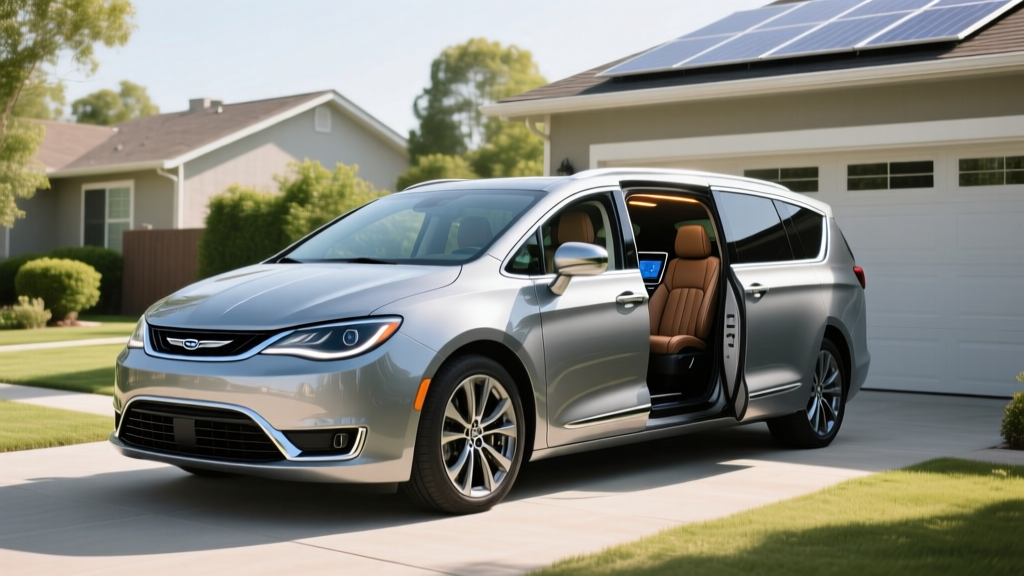
The minivan segment has exactly one plug-in hybrid option, and it's been that way for years. The 2026 Chrysler Pacifica Hybrid remains the sole PHEV minivan on the US market, offering 32 miles of electric-only driving before its gasoline engine kicks in. For families who can charge at home but still need the flexibility for 500-mile road trips without range anxiety, it occupies a unique niche that no full EV or conventional hybrid currently fills.
But the Pacifica Hybrid's position comes with trade-offs: no DC fast charging, all-wheel-drive unavailability, and a price premium over the gas-only Pacifica that demands careful math. Here's every spec, cost, and ownership detail you need before deciding.
2026 Chrysler Pacifica Hybrid: Core PHEV Specifications
| Specification | Value |
|---|---|
| Powertrain Type | Plug-in Hybrid (PHEV) |
| Combined System Horsepower | 260 hp |
| Gas Engine | 3.6L Pentastar V6 (Atkinson cycle) |
| Electric Motors | Dual-motor eCVT (drive + generator) |
| Battery Capacity (Usable) | 16 kWh (liquid-cooled lithium-ion) |
| EPA Electric-Only Range | 32 miles |
| EPA Total Combined Range | 520 miles (electric + gas) |
| EPA MPGe (Electric Mode) | 82 MPGe combined |
| EPA MPG (Gas-Only, Combined) | 30 mpg combined |
| EPA MPG (City / Highway — Gas) | 29 city / 30 highway |
| Level 2 Charge Time (0–100%) | ~2 hours at 7.2 kW (240V) |
| Level 1 Charge Time (0–100%) | ~14 hours at 1.4 kW (120V) |
| DC Fast Charging | Not available |
| Drivetrain | Front-wheel drive only |
| 0–60 mph | ~7.1 seconds |
| Seating Capacity | 7 passengers (Stow 'n Go second row removed for battery) |
| Cargo Volume (Behind 3rd Row) | 32.3 cu ft |
| Base MSRP (Select Trim) | $51,095 |
| Top Trim MSRP (Pinnacle) | $57,395 |
| Battery Warranty | 10 years / 100,000 miles |
| Powertrain Warranty | 5 years / 60,000 miles |
Sources: EPA Fueleconomy.gov, Stellantis/Chrysler Official.
PHEV vs. Conventional Hybrid: What the Pacifica Actually Is
The Chrysler Pacifica Hybrid is a plug-in hybrid electric vehicle (PHEV), not a conventional hybrid (HEV) like the Toyota Sienna. The distinction matters for daily driving and fuel costs:
| Feature | PHEV (Pacifica Hybrid) | HEV (e.g., Toyota Sienna) |
|---|---|---|
| Plug-in Charging | Yes — plug in to add electric range | No — never plugs in |
| Electric-Only Driving | 32 miles at up to ~75 mph | ~1 mile at low speed only |
| Gas-Only MPG | 30 mpg combined | 36 mpg combined |
| Battery Size | 16 kWh | ~1.6 kWh |
| Daily Commute (Under 30 mi) | Mostly electric, near-zero gas use | Hybrid mode, still burns gas |
| Price Premium Over Gas Model | ~$8,000–$10,000 | ~$2,000–$3,000 |
Bottom line: If your daily round-trip commute is under 30 miles and you can charge at home, the Pacifica Hybrid lets you drive almost entirely on electricity during the week while retaining a 520-mile total range for road trips. If you can't plug in regularly, a conventional hybrid like the Sienna delivers better gas-only MPG for less money.
Real-World MPG and Electric Range: What to Actually Expect
EPA Sticker vs. Real World:
- Electric-only range: EPA rates it at 32 miles. In mild weather (60–75°F) with city driving and regenerative braking, owners commonly report 33–36 miles. Highway driving at 70+ mph drops this to roughly 24–27 miles. Cold weather (below 30°F) can reduce electric range to 20–24 miles due to cabin heating demands and reduced battery efficiency.
- Gas-only MPG: EPA says 30 mpg combined. City-heavy driving with gentle acceleration can yield 31–33 mpg. Sustained highway driving at 75+ mph typically returns 27–29 mpg. Cold weather and heavy cargo loads push figures toward 25–27 mpg.
- MPGe (electric mode): 82 MPGe is the EPA combined figure. This is useful for comparing electricity costs to gasoline, but your actual cost per mile depends on your local electricity rate (national average ~$0.17/kWh as of 2025).
The Pacifica Hybrid's eCVT uses a power-split device rather than a traditional transmission, which means smooth, seamless transitions between electric and gas power. In practice, most owners report the engine engagement is nearly imperceptible during normal acceleration from a stop. The V6 is more audible under hard highway merging or when climbing grades with a full load.
Charging the Pacifica Hybrid: Level 1, Level 2, and What You Need at Home
| Charging Level | Voltage / Power | Time (0–100%) | Practical Use |
|---|---|---|---|
| Level 1 (Standard Outlet) | 120V / ~1.4 kW | ~14 hours | Overnight top-up; adds ~4–5 mi/hr |
| Level 2 (Home/Public AC) | 240V / 7.2 kW | ~2 hours | Ideal home setup; full charge overnight or during workday |
| DC Fast Charging | N/A | N/A | Not supported — no CCS or CHAdeMO port |
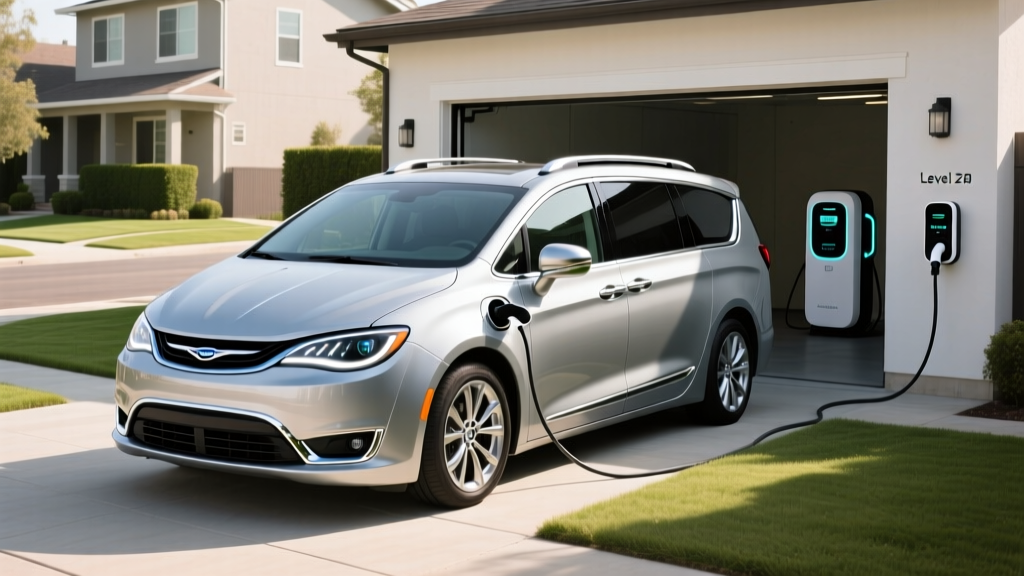
The Pacifica Hybrid uses a standard J1772 connector for AC charging. It does not have a DC fast-charge port — a notable limitation for road trips where a quick 20-minute top-up would be useful. However, since the battery is only 16 kWh, a full Level 2 charge in roughly two hours is practical for most use cases: plug in when you get home, wake up to a full battery every morning.
Home charging setup cost: If you already have a 240V outlet (like a dryer outlet) near your parking spot, a portable Level 2 EVSE (electric vehicle supply equipment) costs $300–$600. A hardwired Level 2 station with professional installation typically runs $800–$2,000 total, depending on whether your electrical panel needs an upgrade. Most Pacifica Hybrid owners find a 32-amp or 40-amp Level 2 charger is more than sufficient.
Pricing, Trims, and Federal Tax Credit Eligibility for 2026
The 2026 Chrysler Pacifica Hybrid is available in two trims:
- Select: Starting at $51,095 MSRP (includes destination)
- Pinnacle: Starting at $57,395 MSRP (premium leather, upgraded infotainment, enhanced safety suite)
§30D Federal Tax Credit — 2026 Rules:
Under current IRS §30D rules, the Pacifica Hybrid may qualify for up to $7,500 in federal tax credits, but eligibility is not guaranteed for every buyer. Requirements include:
- MSRP cap: Vans/minivans must be under $80,000 — both trims qualify.
- Buyer income cap: Modified AGI must not exceed $150,000 (single), $225,000 (head of household), or $300,000 (joint).
- Battery sourcing: Critical minerals and battery components must meet phased-in domestic/free-trade sourcing thresholds. Stellantis has worked to qualify, but verify current-year compliance at purchase.
- Point-of-sale transfer: As of 2024+, eligible buyers can transfer the credit to the dealer for an immediate price reduction at purchase rather than waiting to claim it on their tax return.
Verify before buying: Check the IRS qualified vehicles list and confirm with your dealer and tax professional. State incentives (e.g., California, Colorado, New York) may stack on top.
Even with the full $7,500 credit applied, the Pacifica Hybrid Select drops to roughly $43,595 — still a significant premium over the gas-only Pacifica (starting around $40,000). The fuel savings math depends heavily on your commute distance, electricity rate, and how often you drive in electric mode.
Reliability, Battery Lifespan, and Replacement Costs
Battery Warranty: Chrysler covers the Pacifica Hybrid's 16 kWh lithium-ion battery for 10 years or 100,000 miles (whichever comes first), with a capacity retention threshold of 70%. If the battery degrades below 70% of original capacity within the warranty period, Chrysler will repair or replace it at no cost.
Out-of-warranty replacement cost: Based on current dealer pricing and parts availability, a full battery replacement runs approximately $7,000–$9,500 including labor. This is a significant expense, but real-world data from Pacifica Hybrid owners (the PHEV variant launched for the 2017 model year) suggests the battery holds up well with typical use. Many high-mileage examples have crossed 100,000+ miles with minimal degradation.
The Pacifica Hybrid's powertrain has been in production for nearly a decade, and the eCVT design has no traditional transmission fluid or clutch packs to wear out — reducing one common failure point. The V6 engine is a well-proven design shared across Stellantis vehicles.
Common reliability concerns reported by owners include:
- 12V auxiliary battery drain: Like many PHEVs and EVs, the 12V battery can die if the vehicle sits unplugged for extended periods. Keep it plugged in or use a 12V maintainer if storing.
- Infotainment glitches: Uconnect software has improved but occasional freezes or reboot cycles are reported. Generally resolved with OTA updates or dealer reflashes.
- Stow 'n Go limitation: The Pacifica Hybrid sacrifices second-row Stow 'n Go seating to accommodate the battery pack. Second-row captain's chairs must be physically removed (not folded into the floor) for maximum cargo space. This is a dealbreaker for some minivan buyers.
Pacifica Hybrid vs. Full EV vs. Gas Minivan: Which Fits Your Family?
Choose the 2026 Chrysler Pacifica Hybrid if:
- Your daily driving is under 30 miles round-trip and you can charge at home
- You need minivan space (7 seats, large cargo area) but want to minimize gas use on weekdays
- You take road trips beyond 300 miles and don't want to plan around DC fast chargers
- You want to reduce emissions without committing to a full EV's range limitations
Choose a full EV (e.g., Kia EV9, Tesla Model X) if:
- You have reliable home charging and access to DC fast chargers for road trips
- You want zero tailpipe emissions and the lowest per-mile fuel cost
- You're willing to accept 250–310 miles of range and plan charging stops on long trips
Choose a conventional hybrid minivan (Toyota Sienna) if:
- You can't charge at home (apartment, street parking, no garage outlet)
- You want the best gas-only MPG (36 combined) at the lowest purchase price
- You don't want to manage plug-in charging routines
- All-wheel drive is important (Sienna offers AWD; Pacifica Hybrid does not)
Choose the gas-only Pacifica if:
- You want the lowest upfront price and AWD availability
- You need second-row Stow 'n Go seating for frequent cargo/passenger switching
- Your annual mileage is low enough that fuel savings won't offset the PHEV premium
5-Year Cost of Ownership Snapshot
| Cost Category | Pacifica Hybrid (PHEV) | Toyota Sienna (HEV) | Pacifica Gas (V6) |
|---|---|---|---|
| Purchase Price (after credit) | ~$43,595* | ~$40,000 | ~$38,500 |
| Fuel / Electricity (5 yr) | ~$4,200** | ~$7,500 | ~$10,800 |
| Maintenance (5 yr) | ~$3,800 | ~$3,200 | ~$4,200 |
| Insurance (5 yr avg) | ~$9,500 | ~$8,200 | ~$8,000 |
| Estimated Depreciation | ~$18,000 | ~$15,000 | ~$17,000 |
| Total (approx.) | ~$79,095 | ~$73,900 | ~$78,500 |
*Assumes full $7,500 §30D credit. **Assumes 60% of miles driven on electricity at $0.17/kWh. Actual costs vary significantly by driving pattern, electricity rate, and fuel prices. Insurance estimates are national averages; PHEVs and EVs often carry higher premiums.
The Pacifica Hybrid's fuel savings are real but take years to offset the purchase premium. If you drive mostly in electric mode and your electricity is cheap, the math improves considerably. If you rarely plug in, you're carrying 500+ lbs of dead battery weight and getting worse MPG than the Sienna.
Pros and Cons at a Glance
✓ Pros
- Only PHEV minivan available — no direct competitor
- 32 miles electric covers most daily school/activity runs
- 520-mile total range eliminates road-trip range anxiety
- Smooth, quiet electric driving in city conditions
- Qualifies for up to $7,500 federal tax credit (verify eligibility)
- 10-year / 100,000-mile battery warranty
- Proven powertrain with nearly a decade of real-world data
✗ Cons
- No DC fast charging — road-trip top-ups require Level 2 stops
- Front-wheel drive only — no AWD option (Sienna HEV offers AWD)
- Second-row seats don't fold into floor (battery occupies Stow 'n Go space)
- $51,095 starting price is steep for a minivan
- Gas-only MPG (30 combined) trails Toyota Sienna (36 combined)
- Heavier than gas Pacifica — impacts tire wear and braking distances
- Electric range drops significantly in cold weather
Frequently Asked Questions
How many MPG does the 2026 Chrysler Pacifica Hybrid get?
The EPA rates the Pacifica Hybrid at 30 mpg combined (29 city / 30 highway) when running on gasoline alone. When operating in electric mode, it achieves 82 MPGe combined. In real-world driving, owners report 31–33 mpg in city conditions and 27–29 mpg on the highway in gas-only mode. The key advantage is that many daily trips use zero gasoline if you start with a full charge.
How far can the Pacifica Hybrid go on electric only?
The EPA rates it at 32 miles of electric-only range. In mild weather with city driving, expect 33–36 miles thanks to regenerative braking. Highway driving at 70+ mph drops this to about 24–27 miles. In freezing temperatures, plan for 20–24 miles of electric range due to battery efficiency loss and cabin heating demands.
Does the 2026 Pacifica Hybrid qualify for a tax credit?
Under current IRS §30D rules, the Pacifica Hybrid may qualify for up to $7,500 in federal tax credits. Eligibility depends on your income (AGI caps apply), the vehicle's battery component and critical mineral sourcing, and the MSRP cap for vans ($80,000 — both trims qualify). The credit can be transferred to the dealer at point of sale for an immediate price reduction. Always verify eligibility with your tax professional and the IRS qualified vehicle list before purchasing.
Is the Pacifica Hybrid reliable? What does a battery replacement cost?
The Pacifica Hybrid's powertrain has been in production since 2017, and real-world data shows the 16 kWh battery holds up well over time. Chrysler covers the battery for 10 years / 100,000 miles with a 70% capacity retention guarantee. Out-of-warranty battery replacement costs approximately $7,000–$9,500 including labor. Common non-battery issues include 12V auxiliary battery drain during extended storage and occasional infotainment software glitches.
Can the Pacifica Hybrid DC fast charge?
No. The Pacifica Hybrid only supports AC charging via a J1772 connector — Level 1 (120V, ~14 hours) or Level 2 (240V, ~2 hours). There is no CCS, CHAdeMO, or NACS port. For a 16 kWh battery, Level 2 charging at 7.2 kW is practical for overnight home use, but you cannot quickly top up at a highway DC fast charger.
Should I buy the Pacifica Hybrid or the Toyota Sienna?
If you can charge at home and your daily driving is under 30 miles, the Pacifica Hybrid lets you drive mostly on electricity, saving significantly on fuel. If you can't charge at home, the Toyota Sienna hybrid delivers 36 mpg combined without ever plugging in, costs less upfront, and offers available AWD. The Sienna also retains full second-row Stow 'n Go–style fold-flat seating.
Does the Pacifica Hybrid have all-wheel drive?
No. The Pacifica Hybrid is front-wheel drive only. If AWD is essential for your climate or driving conditions, the gas-only Pacifica offers AWD, and the Toyota Sienna hybrid also offers AWD — but the Pacifica Hybrid does not.
Editorial note: Specifications reflect 2026 model-year data available at time of publication. Federal tax credit rules under §30D are subject to change. Verify current eligibility at IRS.gov and consult a tax professional before purchasing. Real-world range and MPG figures are based on aggregated owner reports and independent testing; individual results will vary based on driving style, climate, terrain, and vehicle load.