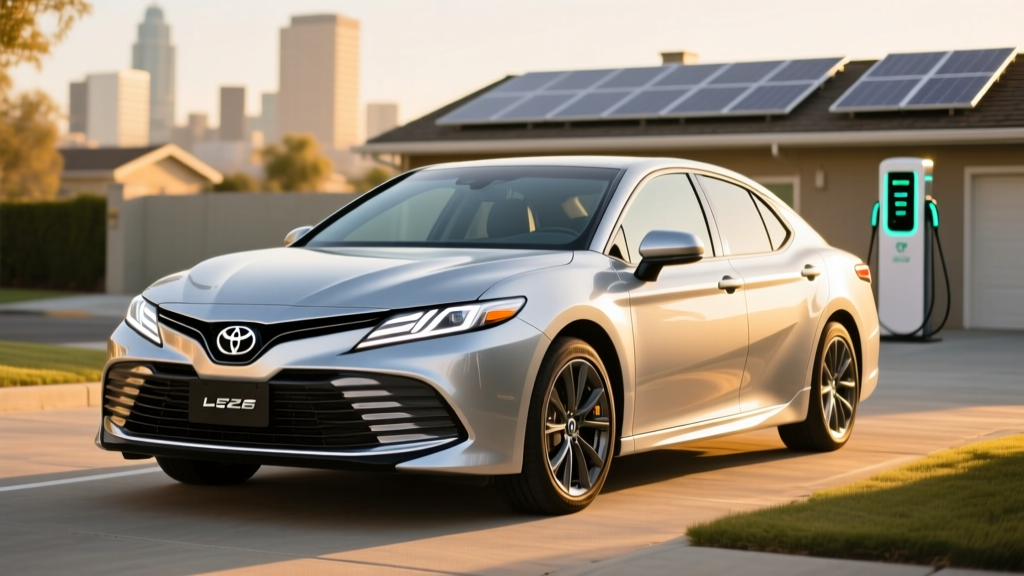
The 2026 Toyota Camry LE Hybrid occupies a rare sweet spot in the midsize sedan market: genuine 50+ MPG efficiency without plug-in complexity, paired with a starting MSRP under $30,000. For buyers weighing their electrification options, the Camry LE Hybrid represents the lowest-friction entry into hybrid ownership — no charging infrastructure required, no range anxiety, and a powertrain backed by one of the industry's longest hybrid battery warranties.
This guide covers everything a prospective buyer needs: exact EPA fuel economy figures, real-world MPG expectations, the hybrid powertrain specs, battery longevity data, pricing across trims, and how the Camry Hybrid stacks up against plug-in hybrids and full battery-electric vehicles (BEVs).
2026 Camry LE Hybrid Powertrain and Specifications
The 2026 Camry is offered exclusively as a hybrid — Toyota discontinued the four-cylinder gas-only Camry after the 2024 model year, making every new Camry a hybrid. The LE trim is the entry point and the most fuel-efficient variant in the lineup.
| Specification | Value |
|---|---|
| Powertrain | 2.5L 4-cyl hybrid (Toyota Hybrid System 5th gen) |
| Combined Horsepower | 225 hp (FWD) / 232 hp (AWD) |
| Engine | 2.5L Dynamic Force inline-4 (184 hp) |
| Electric Motor(s) | Front: 100 kW / Rear (AWD): 30 kW |
| Hybrid Battery | Lithium-ion, ~1.6 kWh (self-charging HEV) |
| Transmission | eCVT (planetary gearset) |
| Drivetrain | FWD standard, AWD available |
| 0–60 mph | ~7.2 seconds (FWD) |
| EPA MPG (FWD) | 53 city / 50 highway / 51 combined |
| EPA MPG (AWD) | 51 city / 49 highway / 50 combined |
| Fuel Tank | 13.2 gallons |
| Total Range | ~673 miles (FWD combined) |
| Base MSRP (LE FWD) | $29,990 (est.) |
| Hybrid Battery Warranty | 10 years / 150,000 miles |
The fifth-generation Toyota Hybrid System (THS) uses a parallel hybrid architecture. The gasoline engine and electric motor(s) can drive the wheels independently or together, managed seamlessly by the eCVT. Unlike a plug-in hybrid (PHEV), the Camry Hybrid's small lithium-ion battery recharges exclusively through regenerative braking and the engine — you never plug it in.
Fuel Economy: EPA Ratings vs. Real-World MPG
The EPA rates the 2026 Camry LE Hybrid FWD at 53 city / 50 highway / 51 combined MPG, according to fueleconomy.gov. The AWD variant drops slightly to 51/49/50 MPG due to the rear motor's added weight and drivetrain losses.
| Trim / Drivetrain | City MPG | Highway MPG | Combined MPG |
|---|---|---|---|
| LE FWD | 53 | 50 | 51 |
| LE AWD | 51 | 49 | 50 |
| SE/XSE FWD | 48 | 47 | 47 |
| SE/XSE AWD | 46 | 45 | 46 |
Hybrid vs. Plug-In Hybrid vs. Full EV: Which Fits You?
The Camry LE Hybrid is a conventional hybrid (HEV). It cannot be plugged in and has no meaningful electric-only driving range beyond low-speed creep. This is a deliberate design choice: maximum efficiency with zero behavioral change from a gas car.
HEV vs. PHEV vs. BEV — Quick Decision Matrix
| Factor | HEV (Camry Hybrid) | PHEV (e.g., Prius Prime) | BEV (e.g., Tesla Model 3) |
|---|---|---|---|
| Plug-in required? | No | Yes (for EV range) | Yes (always) |
| Electric-only range | None (low-speed only) | ~40 miles | 250–360 miles |
| Home charging needed? | No | Recommended (120V OK) | Essential (240V ideal) |
| Federal tax credit (§30D) | Not eligible | Up to $7,500* | Up to $7,500* |
| Upfront cost premium | Low (~$1,500 over gas) | Medium (~$4,000+) | High (~$10,000+) |
| Best for | No charging access, high mileage | Short commute + home charging | Home charging + low fuel cost |
* §30D credit subject to MSRP caps, buyer income limits, and battery sourcing requirements. See IRS guidelines.
Choose the Camry LE Hybrid if: You lack access to home or workplace charging, drive 15,000+ miles per year, want to minimize fuel costs without changing your refueling habits, and prefer the lowest upfront price among electrified options.
Consider a PHEV instead if: Your daily commute is under 40 miles round-trip and you can install a Level 2 home charger. A PHEV like the Prius Prime lets you drive most days on electricity alone while retaining a gas engine for road trips.
Consider a BEV instead if: You have reliable home Level 2 charging, want the lowest per-mile energy cost (~$0.04/mile vs. ~$0.07/mile for the Camry Hybrid), qualify for the full federal tax credit, and are comfortable planning around DC fast charging on road trips.
2026 Camry Hybrid Pricing and Tax Credit Eligibility
The 2026 Camry LE Hybrid starts at an estimated $29,990 MSRP (including destination charge) for the FWD model. Adding AWD costs approximately $1,500. Higher trims (SE, XLE, XSE) range from $32,000 to $38,000+.
Despite the lack of a federal tax credit, the Camry Hybrid's total cost of ownership remains compelling. At 51 MPG combined and $3.40/gallon, annual fuel cost over 15,000 miles is approximately $1,000. A comparable gas-only midsize sedan at 30 MPG would cost roughly $1,700 per year — a $700 annual gap that recoups any hybrid premium within 2–3 years.
Hybrid Battery Longevity, Warranty, and Replacement Cost
Battery lifespan is the single most common concern among first-time hybrid buyers. Here's what the data shows:
Real-world longevity data: Toyota's hybrid battery packs — now using lithium-ion chemistry in the 9th-generation Camry — are engineered for the life of the vehicle. Taxi fleets running Toyota hybrids routinely exceed 300,000 miles on the original battery. The small ~1.6 kWh pack is never fully charged or fully depleted (Toyota's battery management system keeps the state of charge between roughly 40% and 80%), which dramatically reduces degradation compared to a BEV battery that cycles through a wider range.
Replacement cost if out of warranty: A new OEM hybrid battery pack for the Camry Hybrid currently costs between $2,500 and $4,000 installed at a dealership. Refurbished or aftermarket packs are available for $1,500–$2,500. However, individual battery modules can often be replaced for $200–$400 each if only one or two cells fail — a repair most hybrid-specialty shops can perform. Given the 10-year/150,000-mile warranty and the historical failure rate (well under 5% within the warranty period), battery replacement should not be a primary purchase concern.
Reliability, Safety, and Ownership Costs
Toyota's hybrid powertrain is among the most proven in the automotive industry, with over 25 years of continuous production since the original Prius. The Camry nameplate consistently earns top reliability marks from Consumer Reports and J.D. Power.
The eCVT transmission — technically a planetary gearset with no belts, chains, or traditional gears — has fewer wear components than a conventional automatic or CVT. Brake pad life is extended significantly by regenerative braking, with many owners reporting 60,000–80,000 miles on original pads.
Safety: The 2026 Camry comes standard with Toyota Safety Sense 3.0, which includes pre-collision braking with pedestrian detection, lane departure alert with steering assist, full-speed adaptive cruise control, lane tracing assist, and automatic high beams. The Camry has historically earned the IIHS Top Safety Pick+ designation and 5-star NHTSA overall ratings. See NHTSA for official crash-test results when available.
Insurance: The Camry Hybrid typically costs $1,400–$1,800 per year to insure (national average for a clean-record driver), comparable to the gas Camry and below most BEVs. Hybrid-specific repair costs are minimal since body and suspension parts are shared with the broader Camry platform.
Pros
- 51 MPG combined — class-leading for a midsize sedan
- No plug-in charging required
- Low starting MSRP (~$29,990)
- 10-year / 150,000-mile hybrid battery warranty
- Strong resale value and proven reliability
- AWD available across all trims
- Toyota Safety Sense 3.0 standard
Cons
- No federal tax credit (HEV, not PHEV/BEV)
- Small trunk vs. some rivals (~15.1 cu ft)
- AWD drops MPG by 1–2 MPG combined
- No electric-only driving mode
- Higher trims approach PHEV/BEV pricing
- eCVT drone under hard acceleration
Frequently Asked Questions
How many MPG does the 2026 Camry LE Hybrid get?
The FWD Camry LE Hybrid is EPA-rated at 53 city / 50 highway / 51 combined MPG. The AWD version rates at 51/49/50. Real-world city driving often exceeds the EPA city number (55–58 MPG in warm weather), while sustained highway driving at 75+ mph typically returns 44–48 MPG.
Does the 2026 Camry Hybrid need to be plugged in?
No. The Camry Hybrid is a conventional hybrid (HEV), not a plug-in hybrid. Its small lithium-ion battery recharges through regenerative braking and the gasoline engine. You refuel it exactly like a gas car — at any gas station.
How far can the Camry Hybrid drive on electric power alone?
The Camry Hybrid can creep at very low speeds (under ~25 mph) on electric power for roughly one mile or less before the engine engages. It does not have a meaningful electric-only range like a PHEV. For 40+ miles of electric-only driving, consider the Toyota Prius Prime PHEV.
Is the Camry Hybrid battery reliable, and what does replacement cost?
Toyota hybrid batteries have an exceptional reliability record with a failure rate well under 5% within the 10-year/150,000-mile warranty period. Out-of-warranty replacement costs $2,500–$4,000 for a new OEM pack, or $1,500–$2,500 for a refurbished unit. Many owners never need a replacement over the vehicle's lifetime.
Does the 2026 Camry Hybrid qualify for a federal tax credit?
No. The IRS §30D Clean Vehicle Credit applies only to plug-in electric vehicles (PHEVs and BEVs) with a battery capacity of at least 7 kWh. The Camry Hybrid's ~1.6 kWh battery does not meet this threshold. No federal tax credit currently exists for conventional hybrids. Check your state's energy office for possible local incentives.
How does the Camry Hybrid compare to a full EV like the Tesla Model 3?
The Camry Hybrid wins on upfront cost (~$30K vs. ~$39K), zero charging-infrastructure requirements, and unrestricted road-trip flexibility. The Model 3 wins on per-mile energy cost (~$0.04/mile electricity vs. ~$0.07/mile gas), the $7,500 federal tax credit (if eligible), instant torque, and lower maintenance (no oil changes, fewer brake replacements). If you have home Level 2 charging and drive under 300 miles daily, a BEV may save more long-term. If you lack charging access or regularly drive long distances, the Camry Hybrid is the pragmatic choice.
What is the total driving range of the 2026 Camry LE Hybrid?
With a 13.2-gallon fuel tank and a 51-MPG combined rating, the FWD Camry LE Hybrid can travel approximately 673 miles on a single tank under mixed driving conditions. Highway-heavy driving will reduce this to roughly 600–640 miles; city-heavy driving can push it past 700 miles.