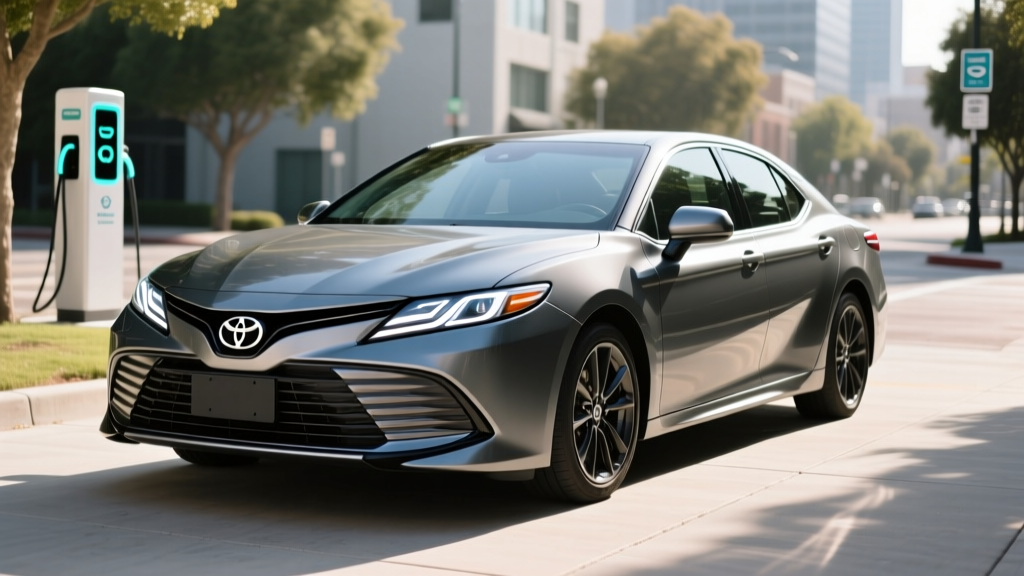
The Toyota Camry has been America's best-selling sedan for years, and for the 2025 model year, Toyota made a decisive move: every Camry is now a hybrid. That carries forward into 2026, meaning Camry hybrids aren't a niche trim anymore — they're the entire lineup. If you're shopping for midsize sedan efficiency without plugging in, this is the default benchmark.
This guide breaks down the 2026 Camry Hybrid's powertrain, real-world MPG versus EPA estimates, pricing across trims, battery longevity, and whether it's the right electrified choice for your driving pattern — or if a PHEV or full EV would serve you better.
HEV vs. PHEV: Where the Camry Hybrid Fits
Before diving into specs, it's worth clarifying what the Camry Hybrid is — and isn't.
Conventional Hybrid (HEV) — Toyota Camry Hybrid
- No plug required. The battery recharges through regenerative braking and the gasoline engine.
- Small battery (~1.6 kWh usable) — assists the engine but cannot drive on electric power alone for meaningful distances.
- No electric-only range to manage. You just fill up with gas and drive.
- No federal EV tax credit eligibility under current IRS §30D rules.
Plug-In Hybrid (PHEV) — Not Offered on Camry
- Larger battery (typically 13–18 kWh) with an electric-only range of 25–45 miles.
- Requires plug-in charging to realize efficiency benefits.
- May qualify for the federal §30D tax credit if battery-sourcing and MSRP caps are met.
- Toyota's closest PHEV offering is the RAV4 Prime, not a sedan.
The Camry Hybrid is a self-charging HEV. If you want plug-in electric range in a Toyota sedan, you'd need to look at a full EV like the bZ4X or wait for future PHEV sedan offerings.
2026 Camry Hybrid Powertrain and Performance Specs
The 2026 Camry Hybrid carries over the fifth-generation Toyota Hybrid System (THS) introduced with the 2025 redesign. All trims use a 2.5-liter four-cylinder engine paired with electric motor-generators and an electronically controlled CVT (eCVT).
| Specification | FWD Trims | AWD Trims |
|---|---|---|
| Engine | 2.5L 4-cyl + 2 motor-generators | 2.5L 4-cyl + 3 motor-generators |
| Combined Horsepower | 225 hp | 232 hp |
| Drivetrain | Front-wheel drive | Electronic AWD (rear motor) |
| Transmission | eCVT | eCVT |
| Hybrid Battery | Lithium-ion, ~1.6 kWh usable | |
| 0–60 mph (est.) | ~7.1 sec | ~6.9 sec |
| Towing Capacity | Not rated for towing | |
The AWD system adds a dedicated rear electric motor (40 hp) that engages automatically for traction — there's no mechanical driveshaft to the rear wheels. This keeps packaging efficient and weight down while providing confident grip in rain and light snow.
Fuel Economy: EPA Ratings and Real-World MPG
Fuel economy is the headline reason buyers choose Camry hybrids. Here's the EPA breakdown by drivetrain, per fueleconomy.gov:
| Drivetrain | City MPG | Highway MPG | Combined MPG |
|---|---|---|---|
| FWD (LE) | 53 | 50 | 51 |
| FWD (SE/XSE/XLE) | 48 | 47 | 47 |
| AWD (all trims) | 51 | 49 | 50 |
The LE trim's lighter weight and lower-resistance tires give it a slight edge. Sport and luxury trims with larger wheels sacrifice 4 MPG combined — still exceptional numbers.
Real-World MPG: What Owners Actually See
Toyota hybrids historically exceed their EPA city estimates in real-world driving. The hybrid system recovers energy during stop-and-go traffic that a gas car wastes as heat. In mixed suburban driving, many owners report 50–55 MPG in the LE and 46–50 MPG in higher trims.
Where real-world numbers dip below EPA:
- Sustained highway driving above 75 mph — aerodynamic drag dominates, and the engine carries more load. Expect 42–46 MPG at 80 mph.
- Cold weather (below 30°F) — the engine runs more often for cabin heat and battery warmup. Expect a 10–15% reduction, landing around 43–46 MPG combined in winter.
- Mountain driving with sustained grades — the engine works harder uphill, though regen recovers energy on descents.
For a 40-mile daily commute with moderate traffic, the Camry Hybrid LE will use roughly 3.2 gallons per week. At $3.40/gallon, that's about $11/week or $570/year in fuel — roughly half what a comparable 28-MPG gas sedan would cost.
2026 Camry Hybrid Pricing by Trim
Toyota prices the Camry Hybrid aggressively, with minimal premiums over the previous gas-only models it replaced.
| Trim | Drivetrain | MSRP (est.) |
|---|---|---|
| LE | FWD | $29,495 |
| LE | AWD | $30,995 |
| SE | FWD | $31,995 |
| SE | AWD | $33,495 |
| XLE | FWD | $34,495 |
| XLE | AWD | $35,995 |
| XSE | FWD | $35,995 |
| XSE | AWD | $37,495 |
Note: Pricing is estimated for the 2026 model year based on 2025 MSRP structures. Confirm exact pricing with Toyota's official configurator at launch. Destination charges (~$1,095) apply.
Tax Credit Eligibility
The Camry Hybrid is a conventional HEV, not a plug-in vehicle. It does not qualify for the federal §30D Clean Vehicle Credit, which requires a minimum 7 kWh battery and plug-in capability. No state-level HOV lane access or EV rebates apply either, as those programs specifically target PHEVs and BEVs.
The trade-off is the lower purchase price. A Camry Hybrid LE at ~$29,500 costs $10,000–$15,000 less than most EVs and PHEVs before credits, and the fuel savings versus a gas sedan pay back quickly.
Hybrid Battery Longevity, Warranty, and Replacement Cost
Battery lifespan is consistently the top concern for hybrid shoppers. Here's what the data shows.
2026 Camry Hybrid Battery Warranty
- Hybrid Battery: 10 years / 150,000 miles (whichever comes first)
- Hybrid System Components: 8 years / 100,000 miles
- Capacity threshold: Toyota warrants the battery against defects and abnormal degradation; there is no published minimum capacity-retention percentage as with EVs
Toyota's hybrid batteries have proven remarkably durable. The Camry Hybrid's small ~1.6 kWh lithium-ion pack operates in a narrow state-of-charge window (roughly 40–80%), which dramatically reduces stress compared to an EV battery that cycles from 10–90%+. Data from fleet operators and long-term owners shows most Toyota hybrid batteries last 150,000–200,000+ miles before needing replacement, with many exceeding the life of the vehicle itself.
Battery Replacement Cost
If the hybrid battery does fail outside warranty:
- New OEM battery: $2,500–$4,000 including labor at a Toyota dealer
- Refurbished/remanufactured battery: $1,500–$2,500
- Individual cell replacement: Some independent hybrid specialists replace only the degraded cells for $800–$1,500
For context, this is a fraction of EV battery replacement costs ($8,000–$20,000+), reflecting the Camry Hybrid's much smaller battery.
Camry Hybrid vs. PHEV vs. Full EV: Which Is Right for You?
The Camry Hybrid is one option in a broader electrified spectrum. Here's a practical decision framework.
Choose the Camry Hybrid (HEV) if:
- You can't charge at home or work (no garage, apartment living, street parking)
- You want maximum simplicity — no plug, no range planning, no charging apps
- Your budget is under $35,000 and you want proven reliability
- You drive 15,000+ miles/year and want low cost-per-mile without infrastructure changes
- You frequently take long road trips and don't want to plan around charging stops
Choose a PHEV (e.g., Toyota RAV4 Prime, Hyundai Tucson PHEV) if:
- You have home Level 2 charging and a commute under 40 miles round-trip
- You want to drive mostly on electricity daily but keep gas for long trips
- You want potential federal tax credit eligibility (up to $7,500, subject to §30D rules)
- You're willing to pay a $5,000–$10,000 premium over an HEV
Choose a Full EV (e.g., Tesla Model 3, Hyundai Ioniq 6) if:
- You have reliable home charging and want the lowest per-mile energy cost
- You want the strongest acceleration and quietest drivetrain
- You qualify for the full §30D credit and your total cost of ownership math works
- You're comfortable planning charging stops on road trips (or rarely take them)
The Camry Hybrid's advantage is universality. It works for every driver regardless of charging access, climate, or trip pattern. The trade-off is that it never drives on electricity alone — you're always burning some gasoline.
Pros and Cons of the 2026 Camry Hybrid
Pros
- Class-leading 51 MPG combined (LE FWD) — among the highest of any non-plug-in sedan
- No charging infrastructure needed — works for apartment dwellers and street parkers
- 225–232 hp provides confident highway merging and passing
- 10-year/150,000-mile hybrid battery warranty
- Available AWD with minimal fuel economy penalty (only 1 MPG combined vs. FWD LE)
- Starting under $30,000 — thousands less than competing PHEVs and EVs
- Toyota Safety Sense 3.0 standard on all trims
- Strong resale value — Toyota hybrids historically depreciate less than gas counterparts
Cons
- No electric-only driving mode — always uses gasoline
- No federal or state EV tax credit eligibility
- eCVT drone under hard acceleration (though improved over prior generations)
- Rear seat and trunk slightly smaller than some rivals due to battery packaging
- No DC fast charging capability (not applicable to HEVs, but limits electrified flexibility)
- Sport trims (SE/XSE) lose 4 MPG to larger wheels and sport tuning
Reliability and Safety Ratings
Toyota's hybrid powertrain is one of the most proven in the automotive industry, with over 25 years of continuous refinement since the original Prius. The Camry Hybrid specifically benefits from:
- No traditional transmission — the eCVT uses a planetary gearset with no clutches, bands, or torque converter to fail
- Reduced brake wear — regenerative braking handles most deceleration, often extending pad life to 80,000–100,000 miles
- Less engine strain — the electric motor assists during high-load moments, reducing wear on the gasoline engine
For safety, the 2025 Camry earned top marks from the IIHS, and the 2026 model carries forward the same structure with Toyota Safety Sense 3.0 standard (automatic emergency braking, lane-keeping assist, adaptive cruise control, and road sign assist). Expect the 2026 to maintain NHTSA 5-star ratings once tested.
Frequently Asked Questions
How many MPG does the 2026 Camry Hybrid get?
The Camry Hybrid LE (FWD) is EPA-rated at 53 city / 50 highway / 51 combined MPG. AWD models achieve 51/49/50. Sport and luxury trims (SE, XLE, XSE) drop to 48/47/47 (FWD) due to larger wheels and additional equipment. In real-world city driving, many owners exceed EPA estimates by 2–4 MPG thanks to regenerative braking.
Can the Camry Hybrid drive on electric power only?
Only at very low speeds (under ~25 mph) for short distances (a few hundred yards), such as creeping through a parking lot. The ~1.6 kWh battery is too small for meaningful electric-only driving. If you want electric-only range, you need a PHEV (30–45 miles electric) or a full EV (250–350+ miles electric).
Does the Camry Hybrid need to be plugged in?
No. The Camry Hybrid is a conventional HEV that charges its battery through regenerative braking and the gasoline engine. You simply fill up at a gas station as you would with any other car. There is no plug, no charging cable, and no charging port.
Is the Camry Hybrid reliable, and what does battery replacement cost?
Toyota's hybrid system is among the most reliable powertrains on the road. The hybrid battery is warranted for 10 years / 150,000 miles, and real-world data shows most last well beyond 150,000 miles. If replacement is needed out of warranty, expect $2,500–$4,000 for a new OEM battery or $1,500–$2,500 for a refurbished unit — far less than EV battery replacement.
Does the 2026 Camry Hybrid qualify for any tax credit?
No. The federal §30D Clean Vehicle Credit requires plug-in capability and a minimum 7 kWh battery. The Camry Hybrid is a self-charging HEV with a ~1.6 kWh battery and no plug. It does not qualify for federal EV credits, state EV rebates, or HOV lane access programs. Its value proposition is a lower purchase price and exceptional fuel economy rather than incentive eligibility.
How does the Camry Hybrid compare to a full EV on cost?
At 51 MPG combined and $3.40/gallon, the Camry Hybrid LE costs roughly $570/year in fuel for 15,000 miles. A comparable EV at 3.5 miles/kWh and $0.16/kWh (national average home charging) would cost about $685/year. The EV saves slightly on energy, but the Camry Hybrid costs $10,000–$15,000 less upfront, has no charging infrastructure requirements, and avoids EV insurance premiums (typically 15–25% higher). Over 5 years, total cost of ownership is often comparable — the Camry Hybrid wins on simplicity, while the EV wins on per-mile energy cost.
Is AWD worth the MPG trade-off?
The AWD Camry Hybrid loses only 1 MPG combined versus the FWD LE (50 vs. 51) while gaining a dedicated rear electric motor for improved traction in rain and snow. For $1,500 extra and a negligible fuel economy penalty, AWD is one of the best value propositions in the lineup — especially in northern climates.
The 2026 Camry Hybrid isn't trying to be an EV. It's a deliberate, pragmatic answer for the millions of drivers who want dramatically better fuel economy without changing how they refuel. At 51 MPG, under $30,000, with a 10-year battery warranty and no plug required, it remains the most accessible path to electrified efficiency in the midsize sedan segment.